
The traditional view of the hybrid cloud as a temporary bridge between legacy systems and the public cloud is officially obsolete. In 2026, a sophisticated hybrid cloud strategy has become the permanent standard for resilient enterprise operations, with the global market projected to reach up to $222.45 billion. You've likely felt the friction of fragmented visibility across disparate environments or the budget-straining impact of rising egress costs. These challenges aren't just IT hurdles; they are signals that your infrastructure requires a more cohesive architectural framework to realize its full potential.
We understand that balancing strict operational control with the limitless scalability of the modern cloud is a delicate act. This guide helps you master that balance by moving beyond simple adoption toward strategic orchestration. You'll learn how to implement a unified management framework that ensures compliance with evolving data privacy regulations across diverse jurisdictions while achieving seamless workload portability. We will outline the transition to a more optimized future where FinOps disciplines turn unpredictable cloud spending into a predictable, strategic asset for your organization.
Key Takeaways
- Understand why a modern hybrid cloud strategy focuses on strategic orchestration rather than just technical migration to solve data sovereignty and latency requirements.
- Identify the critical physical layers and the "connective tissue" required to maintain a resilient and interconnected enterprise architecture.
- Navigate the "data gravity" challenge by balancing high-control on-premises environments with the rapid agility of public cloud services.
- Implement a structured roadmap that prioritizes thorough application inventory and governance guardrails to secure your long-term digital evolution.
- Explore how strategic cloud adoption services transform technical complexity into streamlined business value and predictable operational costs.
The State of Hybrid Cloud in 2026: Why Strategy Precedes Technology
By 2026, the hybrid cloud has transitioned from a technical necessity to a deliberate business mandate. It's no longer just a mix of disparate environments; it's a strategic orchestration where on-premises, private cloud, and public cloud resources function as a single, fluid ecosystem. This dominance is fueled by a global shift toward stricter data sovereignty laws, such as the comprehensive privacy regulations now active in Indiana and Kentucky, and the non-negotiable need for low-latency processing at the edge. Organizations that fail to treat this as a strategic priority often find themselves struggling with fragmented systems that hinder rather than help growth.
Many organizations find themselves in an "unplanned hybrid" state. They've adopted SaaS for one department and public cloud for another, leaving IT to manage a fragmented mess of disconnected systems. This lack of foresight leads to visibility gaps and cost overruns that stifle innovation. Without a clear plan, these businesses suffer from "cloud sprawl" where resources are underutilized yet expenses continue to climb. A hybrid cloud strategy is a comprehensive roadmap that dictates the optimal placement of every workload based on its specific performance requirements, compliance needs, and total cost of ownership.
The Evolution of the Hybrid Model
Early hybrid efforts focused on simple co-existence where on-prem and cloud systems lived side-by-side. Today, the priority is deep integration and interoperability. Modern organizations rely on cloud infrastructure consulting to bridge the gap between legacy hardware and cloud-native services. The focus has shifted from managing siloed dashboards to deploying unified management planes that provide a single source of truth across the entire infrastructure. This evolution marks the transition toward multi-cloud maturity, where the platform, rather than the provider, becomes the primary focus of the IT organization.
Why a "Cloud-First" Approach is Being Replaced by "Cloud-Smart"
The industry has moved past the "cloud-at-all-costs" mentality. Enterprises realize that moving 100% of their workloads to the public cloud isn't just expensive; it's often counterproductive for performance and security. A "cloud-smart" approach recognizes that sensitive data and mission-critical applications often belong on-premises or within a "sovereign cloud" framework to meet regional regulatory demands. This is especially true for entities covered by the Cyber Incident Reporting for Critical Infrastructure Act (CIRCIA), which mandates strict reporting timelines for cyber incidents. By strategically placing data where it's most secure and accessible, businesses gain the control they need without sacrificing the scalability that public cloud providers offer.
Core Pillars of a Resilient Hybrid Cloud Architecture
Building a resilient infrastructure requires more than just a collection of service subscriptions. It demands a structured approach to three distinct physical layers: the public cloud for its elastic scale, the private cloud for dedicated resource control, and legacy on-premises systems that house critical, non-migratable assets. These layers don't operate in a vacuum. They rely on "connective tissue" such as SD-WAN, encrypted VPN tunnels, and high-speed dedicated interconnects to ensure data flows securely and without performance-degrading latency. When these components are properly aligned, they form the foundation of a robust hybrid cloud strategy that scales with your business needs.
To manage this inherent complexity, a unified management layer is essential. This "single pane of glass" provides the comprehensive visibility needed to monitor health, security, and performance across the entire estate. Without this centralized oversight, IT teams remain blind to the very silos they sought to eliminate. Containerization, specifically through Kubernetes, serves as the primary engine for this mobility. It abstracts the application from the underlying hardware, allowing workloads to move between on-premises servers and public instances without requiring extensive code changes or manual reconfiguration.
Public vs. Private: Finding the Right Balance
Determining the right mix of environments is a cornerstone of modern public cloud consulting. While the public cloud offers unmatched agility for DevOps and customer-facing applications, the private cloud provides the cost predictability and security isolation required for sensitive financial or medical records. Deciding where a specific workload lives involves several key considerations, including the frequency of data access, the required proximity to the end-user, and the specific compliance requirements of your industry.
Workload Orchestration and Portability
Workload orchestration ensures that your architecture remains flexible enough to evolve as market conditions change. Avoiding vendor lock-in is critical; a standardized architecture allows you to pivot between providers if service levels drop or costs spike unexpectedly. Conducting a periodic cloud architecture review helps identify portability gaps before they become expensive technical debt. By utilizing Infrastructure as Code (IaC), you can maintain configuration consistency across all environments, ensuring that security policies are enforced regardless of where the workload runs. If you're ready to refine your framework, our team provides ongoing cloud support to help you maintain peak performance and operational continuity.
The Strategic Balancing Act: Performance, Compliance, and Cost
Executing a successful hybrid cloud strategy requires a clear understanding of the friction between operational control and technical agility. While the public cloud offers nearly infinite scalability for bursty workloads, on-premises environments provide the low-latency performance and hardware-level control that mission-critical legacy applications often demand. This isn't a binary choice; it's a spectrum of placement decisions. Moving massive datasets between these environments introduces the challenge of "Data Gravity," where the sheer volume of information makes it expensive and slow to relocate. As highlighted in the Key Considerations For A Hybrid Cloud Strategy, performance and accessibility must remain at the forefront of these architectural decisions to avoid creating bottlenecks that frustrate end-users.
Security in this context operates under a shared responsibility model. You cannot assume that a public provider's security certificates cover your entire ecosystem. While the provider secures the underlying infrastructure, your organization remains responsible for the data, application code, and access layers across every environment. This complexity can quickly lead to cost sprawl if left unmanaged. Engaging in cloud optimization consulting provides the necessary oversight to align resource consumption with actual business value, ensuring that your hybrid environment remains an asset rather than a liability.
Managing Compliance in a Hybrid World
Navigating the fragmented regulatory landscape of 2026 requires a precise approach to data residency. You can leverage a hybrid cloud to maintain sensitive data within specific geographic boundaries to satisfy GDPR, CCPA, or the new state-level laws in Indiana and Kentucky, while still utilizing global public cloud compute power for non-sensitive processing. Automated compliance monitoring tools are no longer optional. They provide the continuous verification needed to prove that your security guardrails are active across both private and public sectors, turning compliance from a manual hurdle into a streamlined, automated process.
The FinOps Approach to Hybrid Costs
One of the most frequent causes of budget overruns is the failure to account for egress fees. Moving data out of the public cloud can incur significant costs that weren't visible during the initial migration phase. To achieve predictable billing, organizations are adopting FinOps to monitor fluctuating usage patterns and right-size their instances in real-time. FinOps is the cultural practice of taking ownership of cloud spend through cross-functional collaboration and financial accountability. By treating cloud costs as a variable operational expense rather than a fixed capital cost, you can maintain the financial flexibility required for long-term modernization.
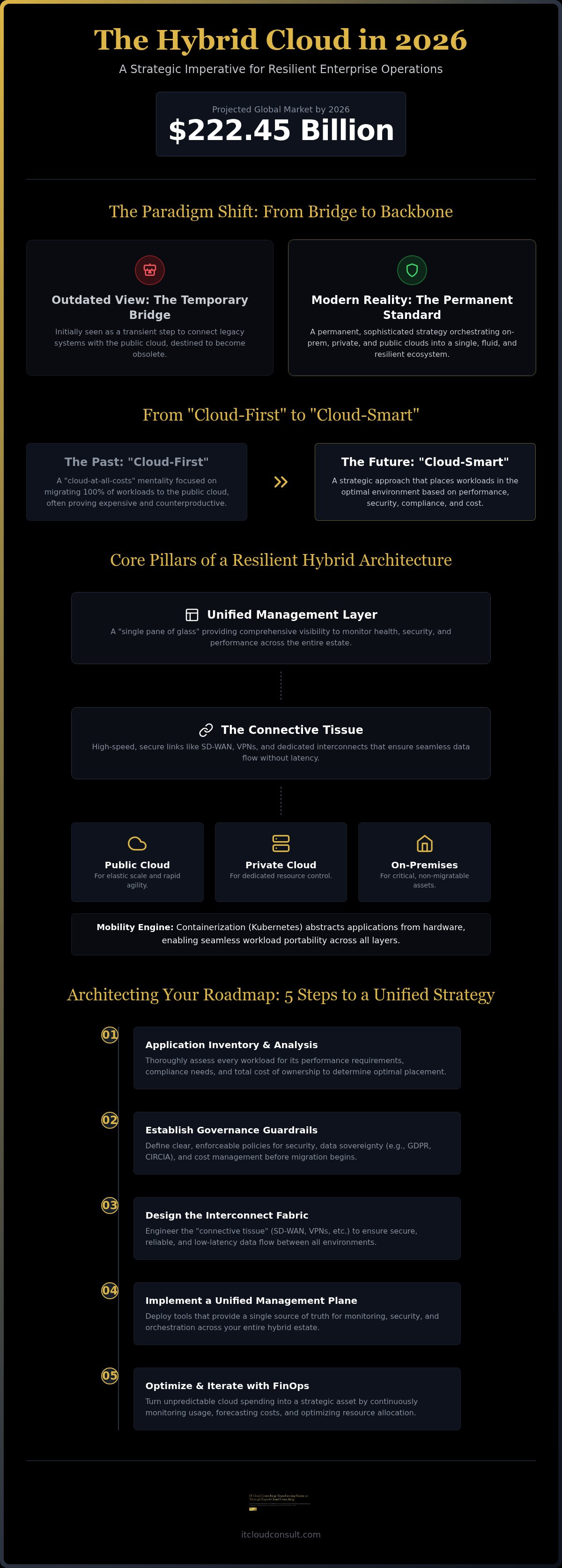
Architecting Your Roadmap: 5 Steps to a Unified Hybrid Strategy
Transitioning from a fragmented infrastructure to a cohesive environment requires a methodical roadmap. Successfully executing a hybrid cloud strategy is less about selecting specific vendors and more about aligning technical capabilities with organizational objectives. This process begins with a clear-eyed assessment of your current state and ends with a unified operational model that treats your entire estate as a single resource pool. By following a structured five-step approach, you can minimize risk while maximizing the transformative potential of your infrastructure.
- Step 1: Inventory and Assessment. Catalog every application, database, and service within your organization. You must identify hidden dependencies and "shadow IT" that could disrupt migration or cause security vulnerabilities later.
- Step 2: Define Governance. Establish security and access guardrails before moving a single workload. This ensures that every component of the hybrid ecosystem adheres to the same compliance standards from day one.
- Step 3: Network Modernization. Align your connectivity layers to ensure low-latency, high-bandwidth communication between on-premises hardware and public cloud instances. This often involves upgrading to SD-WAN or dedicated interconnects.
- Step 4: Pilot Migration. Test your architectural assumptions by moving non-critical workloads first. Use these pilots to refine your deployment scripts and monitoring protocols.
- Step 5: Operational Integration. Merge your disparate IT workflows into a single management stream. This eliminates the need for separate teams to manage cloud and on-prem resources, reducing overhead and improving response times.
The Importance of a Cloud Readiness Assessment
A thorough readiness assessment identifies the technical debt that often lingers in legacy systems. You cannot simply "lift and shift" outdated applications into a hybrid model without addressing underlying performance issues. This stage also highlights skills gaps within your current IT team. If your staff is focused primarily on hardware maintenance, they may require upskilling in orchestration and automated monitoring to manage the new environment effectively. A robust checklist should evaluate application architecture, data sensitivity, and integration requirements to determine if a workload is truly ready for the cloud.
Establishing Governance and Security Guardrails
Consistent security across the hybrid estate depends on a centralized Identity and Access Management (IAM) framework. By implementing global policies that apply to both on-premises and cloud resources, you prevent the security gaps that occur when environments are managed in isolation. For a deeper dive into establishing these frameworks, consult the Cloud Infrastructure Guide for Enterprise Leaders 2026. If your organization is ready to move beyond planning, our team specializes in Strategic Cloud Adoption to ensure your roadmap leads to measurable business results.
Evolution Through Integration: How Strategic Consulting Unlocks Hybrid Potential
Professional advisory services act as the essential catalyst that transforms technical complexity into tangible business value. While the previous sections of this guide established the architectural foundation and the roadmap for execution, the true potential of a hybrid cloud strategy is realized through continuous refinement and strategic alignment. It's not enough to simply exist across multiple environments; organizations must thrive within them. This requires a partner who understands the "big picture" and can navigate the nuances of workload placement and performance tuning. By prioritizing strategic cloud adoption, you ensure that your infrastructure isn't just a static utility but a dynamic engine for long-term growth.
Maintaining the health of such a complex, interconnected ecosystem demands more than occasional oversight. The integration of managed cloud services provides the continuous monitoring and expert intervention required to prevent technical debt from accumulating. IT Cloud Consulting serves as the visionary architect in this journey, bridging the gap between current operational realities and your future digital state. We help you move beyond the "unplanned hybrid" mess toward a state of steady assurance and empowerment.
Moving Beyond the Migration
The most successful enterprises view migration as a beginning, not an end. True evolution requires a commitment to continuous optimization where resources are constantly right-sized and security postures are updated in real-time. This level of maturity allows the hybrid cloud to serve as a springboard for advanced innovations like AI and edge computing. For instance, you can leverage the public cloud's massive scale to train AI models while utilizing your private infrastructure for low-latency inference at the edge. Ongoing technical assistance ensures you stay ahead of rapid shifts in technology and regional regulations, turning potential disruptions into competitive advantages.
Transforming IT from a Cost Center to a Growth Engine
Realizing the full potential of a hybrid model requires a psychological shift among leadership. IT must be viewed as a growth engine rather than a mere cost center. This transition is validated by linking infrastructure performance directly to business KPIs, such as accelerated time-to-market for new features or a measurable reduction in operational downtime. When your systems are agile, your entire organization becomes more responsive to market demands. This is the realization of latent potential that modern technology promised. Partner with the experts at IT Cloud Consulting to architect your future and secure your trajectory in the evolving digital landscape.
Securing Your Competitive Edge through Architectural Sovereignty
The transition from fragmented infrastructure to a unified ecosystem is the defining challenge of the 2026 digital landscape. Success requires moving beyond simple connectivity to embrace a mature hybrid cloud strategy that prioritizes data sovereignty and operational agility. By mastering the balance between private control and public scale, you position your organization to leverage emerging innovations like edge computing and AI without sacrificing compliance or financial predictability. This evolution turns IT from a reactive cost center into a proactive growth engine that directly supports your business objectives.
A resilient architecture is built on a foundation of clear governance and continuous optimization. If you're ready to transform technical complexity into a strategic advantage, our experts provide the roadmap development and infrastructure oversight required to navigate this shift with confidence. Architect your hybrid cloud success with IT Cloud Consulting through our dedicated focus on cloud optimization and managed support for complex environments. The path to modernization is clear, and the potential for innovation has never been greater.
Frequently Asked Questions
What is the difference between hybrid cloud and multi-cloud?
Hybrid cloud refers to the strategic integration of on-premises or private infrastructure with public cloud services to create a single, unified ecosystem. Multi-cloud involves utilizing services from multiple public cloud providers, such as AWS, Azure, or Google Cloud, to avoid vendor lock-in. A sophisticated hybrid cloud strategy often incorporates multi-cloud elements to enhance redundancy and optimize geographic reach for global operations.
Is a hybrid cloud strategy more expensive than a public cloud-only approach?
A hybrid cloud strategy can be more cost-effective for stable, high-volume workloads that don't require the constant elasticity of the public cloud. While the initial capital expenditure for private infrastructure is higher, it eliminates the recurring "rental" costs and unpredictable egress fees associated with moving large datasets out of public environments. Long-term value is achieved by placing each workload in the environment that offers the best price-to-performance ratio.
How does hybrid cloud improve disaster recovery?
Hybrid cloud enhances disaster recovery by providing a flexible failover target in the public cloud for on-premises applications. Organizations can replicate critical data to cloud instances without the expense of maintaining a secondary, idle physical data center. This architecture ensures that mission-critical services remain available during local outages, significantly reducing recovery time objectives and protecting business continuity.
What are the biggest security risks in a hybrid cloud environment?
The most significant risks include misconfigured access controls and the expanded attack surface created by data moving between disparate environments. Maintaining consistent security policies across private and public sectors is technically complex and requires a centralized management layer. Organizations must also navigate the shared responsibility model, ensuring that encryption and identity management are enforced across every point of the infrastructure.
Can I use hybrid cloud with legacy mainframe systems?
You can integrate legacy mainframe systems into a hybrid framework by using modern API layers and middleware to bridge the gap between old and new. This allows you to keep high-security, core processing tasks on stable mainframe hardware while leveraging the public cloud for agile, customer-facing front ends. This integration preserves your existing investments while enabling the modernization of your broader digital estate.
How do I choose between a private cloud and on-premises hardware for my hybrid strategy?
Choose a private cloud when your team requires the self-service, automation, and rapid provisioning capabilities of the cloud but needs to maintain strict hardware isolation for compliance. Standard on-premises hardware is often better for static, high-performance workloads that don't require frequent scaling. Private clouds offer the agility needed for modern DevOps workflows while satisfying regional data residency mandates.
What role does containerization play in a hybrid cloud strategy?
Containerization provides the essential portability that allows workloads to move seamlessly between on-premises servers and public cloud instances without code changes. By utilizing platforms like Kubernetes, your hybrid cloud strategy becomes truly vendor-neutral, preventing lock-in and ensuring operational consistency. Containers abstract the application from the underlying hardware, which simplifies deployment and management across the entire hybrid estate.
How often should we perform a cloud architecture review for our hybrid setup?
You should conduct a cloud architecture review at least every six months to identify emerging technical debt and cost sprawl. More frequent reviews are necessary if you experience significant changes in your regulatory environment or if you're integrating new AI-driven workloads. Regular assessments ensure that your infrastructure remains aligned with your strategic business goals and continues to operate at peak efficiency.


