
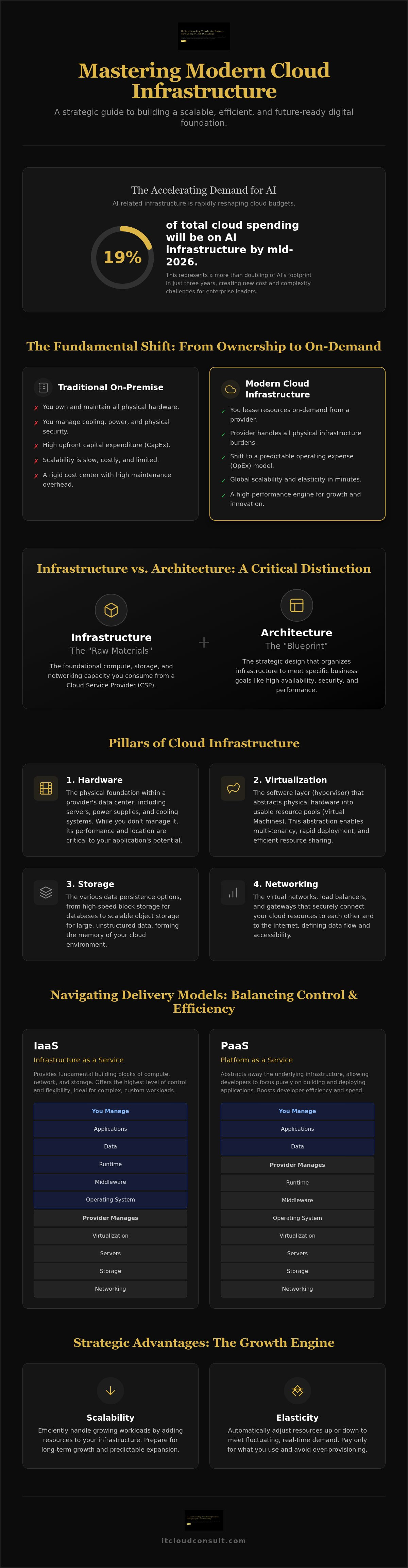
By mid-2026, AI-related infrastructure has surged to account for 19% of total cloud spending, more than doubling its footprint in just three years according to CloudZero research. This rapid acceleration leaves many enterprise leaders navigating a landscape of unpredictable costs and the inherent friction of legacy systems. You likely recognize that your current cloud infrastructure strategy must evolve to do more than just house data; it needs to catalyze innovation while maintaining rigorous financial discipline.
We understand the pressure of managing multi-cloud complexity while attempting to prove the ROI of every dollar spent. This guide empowers you to master the fundamental components of modern architecture, ensuring your technical foundation supports scalable growth rather than hindering it. We'll provide a clear framework for evaluating delivery models like IaaS and PaaS, alongside a breakdown of the four pillars that define a mature, future-ready environment. By the end of this article, you'll have the strategic confidence to align your infrastructure investments with your organization’s long-term modernization goals and realize the latent potential of your digital ecosystem.
Key Takeaways
- Identify the core components of cloud infrastructure and how the shift to on-demand resource leasing provides a foundation for modern enterprise agility.
- Develop a comprehensive cloud infrastructure strategy that aligns your technical roadmap with measurable business ROI and long-term modernization goals.
- Evaluate the critical differences between IaaS and PaaS delivery models to select the framework that best balances operational control with developer efficiency.
- Leverage the strategic advantages of scalability and elasticity to transition your IT operations from a rigid cost center to a high-performance growth engine.
- Recognize how professional strategic advisory bridges the gap between latent technical potential and the realization of complex enterprise objectives.
Defining Cloud Infrastructure: The Foundation of Modern Enterprise
Cloud infrastructure represents the integrated collection of hardware and software components that enable Cloud computing. It encompasses the physical servers, storage units, and networking equipment housed in global data centers, along with the virtualization layers that make these resources accessible via the internet. The fundamental shift here involves moving away from physical ownership toward a model of on-demand resource leasing. In a traditional on-premise environment, you own the hardware, manage the cooling, and handle the power supply. In the cloud, the Cloud Service Provider (CSP) assumes these operational burdens, allowing your organization to focus on high-level outcomes rather than server maintenance.
A robust cloud infrastructure strategy treats these components as a dynamic ecosystem. Instead of static assets, infrastructure becomes a programmable service that scales with your business needs. This transition from a rigid, physical footprint to a fluid, virtualized one is the primary driver of enterprise modernization. By leveraging the CSP’s global data center footprint, businesses can deploy applications closer to their users, reducing latency and improving the overall digital experience without the need for local hardware investments.
The Evolution of IT Infrastructure
The journey from physical hardware silos to virtualized, elastic resource pools has reached a critical juncture. By 2026, the obsolescence of legacy systems has become a significant barrier to entry for emerging technologies. Research indicates that AI-related infrastructure now accounts for 19% of total cloud spending, making specialized hardware more vital than ever. Organizations that remain tethered to traditional data centers often face high maintenance costs and limited scalability. Modern infrastructure maturity is now directly linked to organizational agility; the faster you can provision resources, the faster you can respond to market shifts.
Cloud Infrastructure vs. Cloud Architecture
It's vital to distinguish between infrastructure and architecture to avoid strategic misalignment. Infrastructure refers to the "raw materials," which include the actual compute, storage, and networking capacity you consume. Architecture is the "blueprint" that defines how those materials are organized to meet specific business requirements, such as high availability or security compliance. Understanding this distinction is a cornerstone of effective cloud infrastructure consulting. Leaders who master this vocabulary can bridge the gap between technical potential and actual business results, ensuring that every cloud infrastructure strategy aligns with the broader corporate vision.
The Four Pillars: Essential Components of Cloud Infrastructure
A successful cloud infrastructure strategy requires a granular understanding of the four pillars that support every digital workload. These pillars represent more than just technical categories; they're the levers that leaders pull to drive efficiency and innovation. Hardware forms the base. It consists of the physical servers, power supplies, and cooling systems within a provider's data center. While you don't manage these directly, their performance and regional availability dictate your application's ceiling. Virtualization then sits atop this hardware, acting as the software layer that abstracts physical assets into virtual machines (VMs). This abstraction is what allows for the rapid deployment of cloud-native and multi-cloud applications across disparate environments.
The Role of the Hypervisor
The hypervisor is the engine of virtualization. It enables multi-tenancy by isolating resources so multiple users can share physical hardware securely. In enterprise settings, Type 1 hypervisors are the standard. These run directly on the bare metal, offering superior performance and security compared to Type 2 hypervisors, which require a host operating system. As we move through 2026, the industry is shifting beyond basic VMs toward containerization and serverless abstraction layers. These technologies further decouple software from the underlying hardware. They allow your teams to focus on code rather than server lifecycle management.
Advanced Storage and Data Management
Modern data management demands specialized solutions. Block storage remains the gold standard for high-performance databases and mission-critical applications that require low latency. Conversely, object storage has become the backbone for massive, unstructured data lakes and AI training sets. Recent developments, such as the Google Cloud "Cloud Storage Rapid Family" released in 2026, highlight the need for zonal high-performance storage optimized for AI workloads. Ensuring data durability and high availability across multiple availability zones is no longer optional. It's a strategic necessity. Networking completes this picture by acting as the fabric of routers, switches, and load balancers that ensures global connectivity. It manages the flow of data between your users and your services, regardless of geographic distance. If your current environment feels fragmented, ongoing cloud support can help stabilize these pillars into a cohesive system.
Understanding these components allows you to refine your cloud infrastructure strategy for maximum ROI. By treating compute, storage, and networking as programmable assets, you transform IT from a maintenance burden into a scalable growth engine.
Navigating Delivery Models: IaaS, PaaS, and SaaS Frameworks
The choice of delivery model is perhaps the most influential decision within your cloud infrastructure strategy. These frameworks determine the boundary between your internal management and the provider's responsibility. Infrastructure as a Service (IaaS) offers the highest level of control, providing access to the virtualized stack and operating system. Platform as a Service (PaaS) streamlines development by removing the burden of OS management, allowing your teams to focus entirely on software delivery. Software as a Service (SaaS) represents the final layer of abstraction, where you consume applications without managing any underlying infrastructure. Central to these models is the Shared Responsibility Model. This framework defines who secures which layer of the stack; typically, the provider secures the "cloud," while you remain responsible for the data "in" the cloud.
Choosing the Right Model for Modernization
Selecting the appropriate model depends on your specific modernization goals. Prioritizing IaaS is often the most effective path for legacy "lift-and-shift" migrations. It allows you to move existing workloads with minimal disruption to the code base. Conversely, leveraging PaaS is essential for organizations looking to accelerate cloud-native application development and reduce time-to-market. When weighing these options, public cloud consulting provides the necessary framework to decide between a purely public approach or a hybrid model that keeps sensitive workloads in a private environment.
The Strategic Rise of Multi-Cloud Infrastructure
Modern enterprises are increasingly avoiding vendor lock-in by diversifying their footprint across multiple providers. According to the Flexera 2026 State of the Cloud Report, 73% of organizations have adopted a hybrid cloud strategy, while 14% use a multi-cloud strategy without a private component. This shift is often driven by "geopatriation," where businesses move workloads to regional clouds to comply with data sovereignty regulations like the EU's GDPR or the US CLOUD Act. This diversification increases resilience but introduces significant management challenges.
Maintaining consistent governance across different cloud ecosystems requires a disciplined approach to orchestration. Disparate security protocols and billing structures can quickly lead to inefficiencies. Utilizing a cloud architecture review helps identify these multi-cloud gaps and ensures your infrastructure spend remains aligned with business ROI. By intentionally selecting the right delivery models and providers, you transform your infrastructure into a versatile asset that supports continuous innovation.
Strategic Advantages and the Reality of Cloud Management
Transitioning from rigid legacy hardware to a cloud-native architecture offers immediate strategic advantages, yet it requires a disciplined approach to avoid common pitfalls. Scalability and elasticity allow you to grow resources instantly to meet sudden demand peaks without the lead times of physical procurement. This shift from heavy CapEx investments to a predictable OpEx pay-as-you-go model transforms IT into a flexible financial asset. However, leaders must remain vigilant. For instance, the final IRS regulations (TD 10022) released in 2025 now impact how digital content and cloud transactions are classified for tax purposes, requiring more granular financial oversight than in previous years.
Without a mature cloud infrastructure strategy, organizations often fall into the complexity trap. Unmanaged growth leads to cloud sprawl and budget overruns that erode the very ROI the cloud was meant to provide. This risk is heightened by provider price adjustments, such as the May 2026 Google Cloud price increases for CDN and peering services in North America and Europe. Global reliability is a built-in benefit of the cloud, but it's only realized when your environment is architected for redundancy across multiple availability zones. If you're struggling to balance rapid innovation with these rising costs, our cloud optimization services ensure your environment remains lean and high-performing.
Operational Efficiency and Infrastructure Automation
Consistency is the cornerstone of operational excellence. Automating infrastructure provisioning through Infrastructure as Code (IaC) ensures that every environment is a precise replica of the last, which drastically reduces human error and configuration drift. Continuous monitoring is equally vital; you can't manage what you don't measure. By linking infrastructure performance directly to the digital end-user experience, you ensure that technical metrics like latency and throughput translate into customer satisfaction and business growth.
Security and Compliance in a Perimeter-less Environment
In a cloud environment, the traditional network perimeter has vanished. Identity and Access Management (IAM) has become the new security perimeter, requiring strict least-privileged access controls. Security can't be an afterthought or an add-on; it must be baked into the infrastructure layer from the start. This is especially critical for maintaining compliance with global regulations such as GDPR, HIPAA, and the June 2026 EU Cloud and AI Development Act (CADA). A future-proof cloud infrastructure strategy prioritizes data residency and sovereignty, ensuring that your workloads remain compliant even as international data laws continue to evolve. By integrating these security protocols into your automated deployment pipelines, you create a resilient foundation that supports both agility and trust.
Transitioning to a Modern Infrastructure with IT Cloud Consulting
Realizing the full promise of a cloud infrastructure strategy requires more than technical migration; it demands a bridge between latent technical potential and measurable business results. Professional advisory ensures that your infrastructure doesn't just exist but actively drives innovation. We focus on transforming your digital environment into a high-performance engine through strategic cloud adoption. By aligning your technical roadmap with long-term corporate objectives, we help you transition from legacy constraints to a flexible, future-proof state.
Our approach centers on maximizing the value of every dollar spent. With the global cloud infrastructure market growing at 35% year-over-year as of Q1 2026, the risk of inefficient resource allocation has never been higher. We provide cloud optimization services designed to eliminate waste and refine your existing environments. This process involves more than just cutting costs; it's about reallocating resources to high-impact areas like AI-native architectures and GPU orchestration. Once your environment is optimized, our ongoing cloud support provides the steady assurance required for 24/7 operational excellence and proactive security management.
Building Your Infrastructure Modernization Roadmap
Success begins with a rigorous assessment phase. We identify the legacy bottlenecks that hinder your agility and uncover untapped opportunities within your current stack. Designing a resilient architecture means preparing for the next wave of disruption. Since AI-related infrastructure now accounts for 19% of total cloud spending, your roadmap must prioritize AI-readiness and data sovereignty. Modernization isn't a one-time migration event. It's a continuous journey of optimization that evolves alongside your business and the broader technological landscape.
Partnering for Long-Term Success
A dedicated guide is essential in an era of rapid vendor shifts and complex regulatory changes. While hyperscalers offer proprietary tools, IT Cloud Consulting provides the independent, strategic perspective needed to manage multi-cloud environments without vendor lock-in. We empower your internal teams to stop managing routine maintenance and start focusing on core business growth. This shift in focus is the ultimate goal of a mature cloud infrastructure strategy. Your next step toward a more optimized future is simple. Contact us to schedule a comprehensive infrastructure maturity assessment and begin the transition to a truly modern enterprise.
Architecting Your Path to Enterprise Modernization
Modernizing your digital foundation is no longer a choice; it's the prerequisite for competing in an AI-driven economy. By mastering the four pillars of infrastructure and selecting the delivery models that align with your specific growth targets, you transition IT from a maintenance burden into a scalable engine. A disciplined cloud infrastructure strategy ensures that every resource deployment directly contributes to organizational agility and long-term modernization. This evolution is not just about adopting new technology. It's about building a resilient framework that supports continuous innovation.
Success in this complex landscape requires a partner who understands both the architectural blueprints and the financial realities of the cloud. We provide the strategic advisory necessary for complex enterprise evolution, alongside expert cloud optimization to ensure your FinOps goals are met. With comprehensive managed cloud support, you gain the 24/7 reliability required to focus on your core business objectives without being hindered by technical debt or unpredictable costs. Partner with IT Cloud Consulting to modernize your enterprise infrastructure today. We're ready to help you realize the latent potential of your digital ecosystem and lead your organization into a more optimized future.
Frequently Asked Questions
What is the difference between cloud infrastructure and traditional IT infrastructure?
Cloud infrastructure is defined by on-demand resource leasing and virtualization, whereas traditional IT relies on physical ownership and manual maintenance of hardware. In the cloud, providers manage the physical layer, which allows you to scale resources instantly via software. This shift transforms your IT department from a hardware management center into a strategic service provider for the business.
What are the 4 main components of cloud infrastructure?
The four main components are hardware, virtualization, storage, and networking. These pillars work together to provide the compute power and connectivity required for modern applications. A successful cloud infrastructure strategy integrates these elements into a programmable environment that supports rapid deployment and organizational agility.
Is cloud infrastructure more secure than on-premise servers?
Cloud infrastructure is often more secure because hyperscale providers invest significantly more in physical security and automated threat detection than most individual enterprises can afford. However, security is a shared responsibility. While the provider protects the underlying hardware, your team must secure the data and access points within that environment to maintain compliance with global standards.
How does cloud infrastructure support business scalability?
Cloud infrastructure enables scalability through elasticity, which allows you to provision or decommission resources in real time based on demand. This eliminates the need for over-provisioning hardware for peak periods. For instance, enterprises can handle sudden traffic surges without performance degradation, then scale back to save costs when the demand subsides.
What is the difference between IaaS and cloud infrastructure?
Cloud infrastructure refers to the physical and virtualized resources themselves, while Infrastructure as a Service (IaaS) is the delivery model used to access them. IaaS provides you with direct control over the virtualized stack, including the operating system and middleware. It's essentially the mechanism through which you consume and manage the underlying infrastructure components.
What happens if a cloud provider’s data center goes down?
Service disruptions are mitigated through built-in redundancy and automated failover across multiple availability zones. If one data center experiences an outage, your workloads can automatically shift to another facility within the same region. This geographic distribution is a core advantage of the cloud; it ensures high availability even during localized hardware failures or power disruptions.
How do businesses effectively manage costs within their cloud infrastructure?
Effective cost management requires a disciplined FinOps approach that prioritizes visibility and continuous optimization. Businesses should utilize automated tagging, right-sizing tools, and reserved instances to eliminate waste. With AI-related infrastructure costs rising to 19% of cloud spend in 2026, a proactive cloud infrastructure strategy is necessary to align your technical spend with actual business ROI.
Can an enterprise use multiple cloud infrastructure providers simultaneously?
Yes, most modern enterprises use a multi-cloud strategy to avoid vendor lock-in and increase resilience. According to the Flexera 2026 State of the Cloud Report, 73% of organizations use a hybrid approach, while 14% use a multi-cloud strategy without a private component. This allow you to place specific workloads with the provider that offers the best performance or pricing for that particular task.


