
Cloud infrastructure is no longer a utility to manage; it's a strategic asset to architect for continuous evolution. Many organizations find themselves trapped by unpredictable spending and performance bottlenecks that stall momentum. You likely recognize that simply being "in the cloud" isn't enough when technical debt begins to outweigh your operational agility. Professional cloud infrastructure consulting bridges this gap by aligning your technical environment with your long-term business trajectory, moving beyond mere maintenance to realize latent potential.
This guide explores how to transform legacy complexities into a scalable engine for sustainable growth and innovation. We'll outline a clear roadmap for modernization that reduces operational overhead while ensuring your environment remains secure and compliant with the latest 2026 standards, including mandatory NIST-aligned encryption. By shifting the focus from reactive support to strategic cloud adoption and optimization, you'll establish a high-performance foundation that empowers your enterprise to lead. We will examine the specific frameworks required to achieve a secure, compliant, and truly scalable cloud environment that supports your vision for the future.
Key Takeaways
- Understand how professional cloud infrastructure consulting evolves your technology stack from a basic utility into a powerful engine for strategic innovation.
- Master the core pillars of infrastructure advisory, including readiness assessments that clear the path for seamless, high-availability architecture.
- Navigate the complexities of hybrid cloud models to achieve the ideal balance between public cloud agility and private cloud control.
- Build a sustainable FinOps culture that aligns your engineering and finance teams to eliminate waste and maximize your cloud investment.
- Shift from reactive maintenance to a proactive model that integrates strategic cloud adoption with ongoing, expert managed support.
What is Cloud Infrastructure Consulting in the Modern Enterprise?
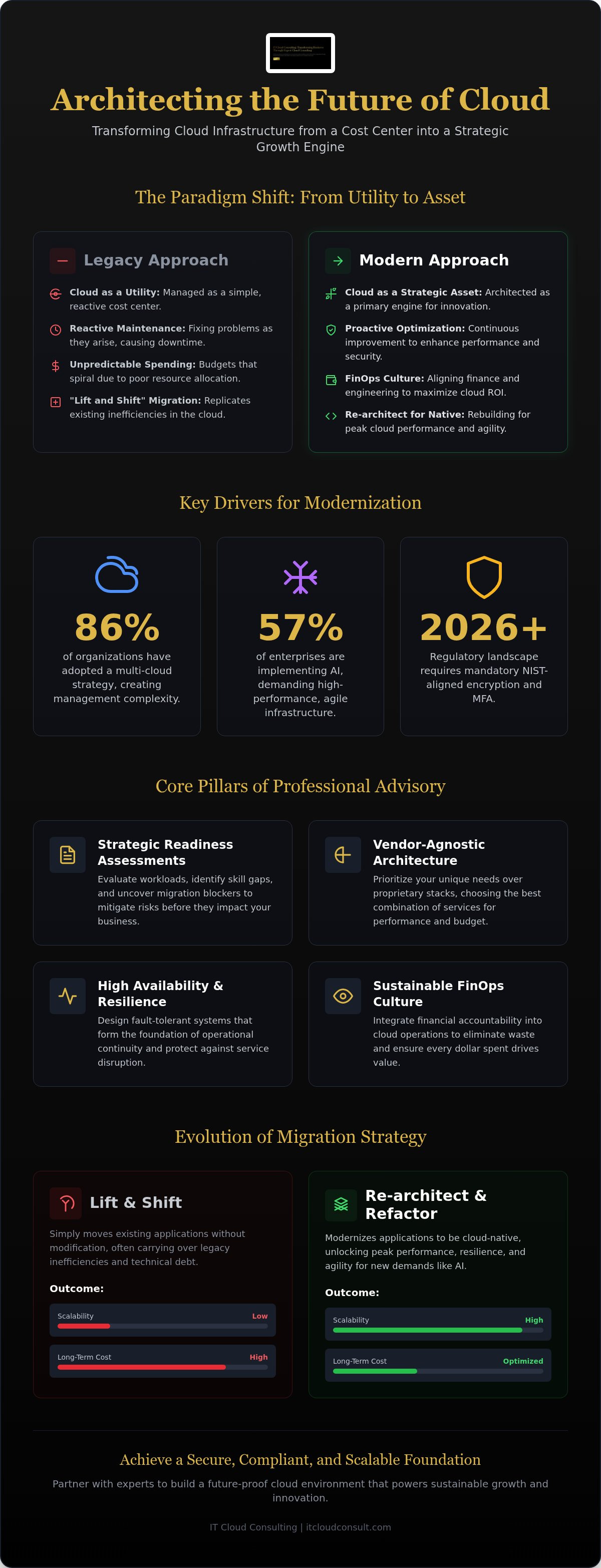
Cloud infrastructure consulting is a professional advisory service that ensures your technological foundation directly supports your organizational objectives. It's no longer enough to simply occupy space in a remote data center. Today, true modernization requires a strategic alignment between technical capabilities and business outcomes. While early cloud initiatives often focused on basic storage, the current environment demands a more integrated approach. As of 2025, 86% of organizations have adopted a multi-cloud strategy; this complexity makes generic hosting solutions obsolete. Modern enterprises require a framework that handles the nuances of cloud computing across diverse providers and deployment models.
We've moved beyond treating the cloud as a mere utility. It's now a primary growth driver. A strategic consultant acts as a visionary architect, identifying where your current architecture limits your potential and designing a path toward a more optimized future. By bridging the gap between legacy limitations and cloud-native potential, cloud infrastructure consulting provides the steady assurance needed to navigate complex migrations and architectural shifts. This partnership transforms infrastructure from a cost center into a scalable engine for innovation.
The Evolution of Infrastructure Strategy
The traditional "Lift and Shift" approach often replicates existing inefficiencies in a new environment. True modernization involves refactoring and re-architecting applications to be cloud-native. This evolution is critical for deploying high-performance workloads like AI and data analytics. Since 57% of enterprises are now implementing AI-driven automation, your infrastructure must be agile enough to support these compute-heavy demands without compromising operational resilience. Professional guidance ensures that these transitions occur without disrupting core services, allowing you to realize the latent potential of your data and workflows.
Key Business Drivers for Seeking Professional Advice
Technical debt remains a primary barrier to agility. Legacy systems often create performance bottlenecks that prevent rapid scaling during periods of high demand. Beyond performance, the regulatory landscape is shifting rapidly. With mandatory NIST-aligned encryption and multi-factor authentication requirements coming into full effect through 2026 and 2027, professional guidance ensures your security guardrails remain robust and compliant. Expert assessments also allow for better resource utilization. This turns unpredictable spending into a controlled, value-driven investment. By addressing these drivers, cloud infrastructure consulting helps organizations reduce operational overhead and maintain a secure, compliant environment that is ready for future expansion.
The Core Pillars of Professional Infrastructure Advisory
Professional infrastructure advisory is built on objective analysis rather than vendor-specific bias. While many providers push proprietary stacks that serve their own interests, effective cloud infrastructure consulting prioritizes the unique requirements of your enterprise. This process begins with identifying migration blockers and evaluating architectural integrity to ensure long-term stability. It's about creating a clear cause-and-effect relationship between technical decisions and business results. By remaining vendor-agnostic, consultants can recommend the specific combinations of services that best fit your performance and budget goals.
Strategic Readiness Assessments
You can't modernize what you don't fully understand. A comprehensive assessment evaluates current workloads for cloud compatibility and business criticality. This step also uncovers internal skill gaps that could impede progress. By identifying these hurdles early, you mitigate risk before the first data packet moves. For a more technical deep-dive into this process, you can read more about our Cloud Architecture Review.
Once readiness is established, the focus shifts to developing a strategic roadmap. This plan must balance the need for speed with rigorous risk mitigation. High availability and fault tolerance aren't just technical metrics; they're the foundation of operational continuity. Comprehensive cloud infrastructure consulting integrates cost-efficiency modeling into this phase to prevent cloud sprawl, where underutilized resources inflate budgets without adding value.
Architecting for Scalability and Security
Modern infrastructure requires Security by Design. This means embedding security guardrails directly into the architectural layer rather than treating them as an afterthought. Architecture must also support elastic scaling to handle unpredictable demand spikes, ensuring performance remains consistent even during peak loads. Whether you need to meet SOC2 or HIPAA standards, your environment should be built to satisfy these compliance requirements automatically. As we move through 2026, the convergence of security and compliance into unified platforms makes this architectural precision more important than ever. This methodical approach ensures that your infrastructure remains a secure, compliant, and resilient asset.
Effective modernization is a steady evolution. It requires a partner who acts as both a visionary architect and a dependable guide. If you're ready to move beyond technical debt, exploring strategic cloud adoption can help you realize your organization's latent potential. Each design choice should serve as a building block for a more optimized and future-ready state.
Navigating Strategic Cloud Models: Public, Private, and Hybrid
Selecting the appropriate deployment model is a pivotal decision in the modernization journey. While the public cloud offers unparalleled agility, certain workloads require the heightened control and data residency of a private environment. In 2026, the hybrid cloud has emerged as the dominant enterprise standard, with 70% of organizations utilizing this model to balance performance with regulatory requirements. Professional cloud infrastructure consulting helps leaders determine which business units benefit most from specific environments, ensuring that technical choices align with operational realities. It's about strategic placement. By leveraging multi-cloud strategies, enterprises avoid the risks of single-vendor dependency while maintaining the flexibility to run workloads where they perform best.
Public Cloud Consulting for Rapid Innovation
The public cloud is the primary engine for speed. By utilizing serverless architectures and cloud-native services, organizations can significantly reduce time-to-market for new applications. This model allows teams to focus on code rather than hardware. To understand how these environments differ, you can compare models in our guide on Public Cloud Consulting. Beyond speed, financial efficiency is a core benefit. Strategic optimization involves more than just turning off unused instances. For example, moving from on-demand pricing to one-year reserved instances can yield discounts of approximately 30% to 31% on major providers like AWS and Microsoft Azure. Expert guidance ensures these cost-saving measures are implemented without sacrificing the elasticity your developers require.
Hybrid and Multi-Cloud Management
Managing a fragmented infrastructure requires a unified approach to governance. With 86% of organizations now pursuing a multi-cloud strategy, the ability to ensure seamless data portability is essential. This complexity is often driven by a need for sovereign cloud solutions, especially as regulations like the EU Data Act and the Cloud and AI Development Act increase the demand for localized data processing. Effective cloud infrastructure consulting centralizes visibility across these diverse platforms. It bridges the gap between legacy on-premise systems and modern cloud environments, creating a cohesive ecosystem. This centralized oversight prevents the security gaps that often occur when different departments manage cloud resources in silos. By establishing a single source of truth for your infrastructure, you maintain the steady assurance needed to scale globally while staying compliant with evolving international standards.
Implementing a Framework for Cloud Optimization and ROI
Success in the cloud isn't just about a successful migration; it's about the relentless pursuit of efficiency after the transition. Many organizations find that their initial excitement fades when they face unpredictable spending and opaque billing cycles. Establishing a FinOps culture aligns your finance and engineering teams, turning cloud consumption into a shared responsibility rather than a technical silo. Through professional cloud infrastructure consulting, you can implement continuous monitoring that identifies underutilized resources before they impact your bottom line. This shift allows you to move from a reactive posture to a proactive strategy that uses predictive analytics to forecast future capacity needs with precision.
The Path to Cloud Cost Optimization
Achieving efficiency requires a methodical framework that prioritizes clarity and action. We recommend a structured three-step approach to regain control over your environment:
- Step 1: Gain granular visibility into billing. Implement professional tagging strategies to ensure every dollar spent is attributed to a specific project or department. Without this data, you can't identify the root cause of cost spikes or resource waste.
- Step 2: Right-size your instances based on performance data. Many enterprises over-provision resources out of a fear of downtime. We analyze actual utilization to ensure you aren't paying for high-compute instances when a standard tier would suffice.
- Step 3: Implement automated shutdown schedules. Non-production environments don't need to run 24/7. Automating the suspension of these systems during off-hours can significantly reduce monthly operational overhead.
Measuring Strategic Impact Beyond Cost
Strategic ROI isn't solely measured in dollars saved; it's also found in the realization of latent potential within your development teams. You should track improvements in deployment frequency and system uptime to gauge the health of your modernized environment. A reduction in Mean Time to Recovery (MTTR) indicates a more resilient architecture that can handle failures with minimal disruption. These technical improvements link directly to the end-user experience. Faster load times and higher reliability translate to better conversion rates and customer satisfaction. By automating infrastructure management, you eliminate the human error that often leads to costly outages and performance bottlenecks.
This methodical approach ensures that your cloud environment remains a scalable engine for growth. By integrating these practices, you transform your infrastructure into a lean, high-performance asset that supports your long-term vision. If you're ready to refine your current environment and eliminate technical debt, explore our cloud optimization services to see how we can maximize your return on investment.
Partnering for Evolution: The IT Cloud Consulting Approach
Modernization is not a one-time event; it's a continuous cycle of refinement and growth. Our approach to cloud infrastructure consulting centers on delivering strategic confidence through every stage of this evolution. We don't just provide a list of technical recommendations. Instead, we act as a partner invested in your long-term trajectory, ensuring your technical foundation remains aligned with your business goals as they shift. By combining the foresight of a visionary architect with the practical proficiency of a dependable guide, we help you transition from legacy limitations to a state of sustained operational excellence. Our national coverage allows us to provide professional assessments and roadmap development for enterprises across the United States, ensuring that every architectural decision serves a broader business purpose.
This collaborative orientation distinguishes our advisory services from vendor-centric models that often prioritize specific product sales over objective technical health. We focus on the cause-and-effect relationship between your infrastructure and your business results. Whether you're resolving the complexities of a multi-cloud environment or preparing for mandatory 2026 compliance standards, we provide the steady assurance required for high-level execution. This partnership turns technical challenges into a scalable engine for innovation.
From Strategic Planning to Managed Support
The most robust roadmap provides little value without the expertise to execute and maintain it. We integrate strategic cloud adoption with ongoing managed support to ensure that your infrastructure remains resilient and high-performing long after the initial migration. This transition allows your internal teams to focus on core innovation while we handle the complexities of optimization and security. For those seeking a deeper look at long-term operational strategies, you can learn about our Managed Cloud Services. This continuity of care prevents the performance degradation that often occurs when environments are left unmanaged. Having a dedicated guide throughout the modernization journey ensures that your systems evolve alongside your business needs.
Taking the Next Step in Your Cloud Journey
Defining a vision for your digital future requires a clear understanding of your current state. Our process begins with a professional infrastructure assessment designed to uncover hidden inefficiencies, security gaps, and technical debt. We then build a customized roadmap tailored to your specific organizational needs, whether you're navigating complex hybrid models or scaling compute-heavy AI workloads. This methodical progression ensures that your cloud environment becomes an "always-on" engine for growth. Initiating this assessment is the first step toward realizing the latent potential of your technology stack. If you're ready to transform your infrastructure into a strategic asset, connect with our consultants to architect your success and begin the journey toward a more efficient, scalable, and secure future.
Architecting Your Digital Future
Modernizing your enterprise requires a shift from viewing technology as a cost center to treating it as a strategic engine for growth. We've explored how a methodical approach to architecture reduces technical debt while ensuring your environment remains resilient. By aligning technical processes with organizational benefits, you create a foundation that is ready for the rapid AI and data analytics deployments of the future. This evolution ensures that your systems don't just function; they excel.
Professional cloud infrastructure consulting provides the clarity needed to navigate complex hybrid models and shifting regulatory standards. It's about more than just a successful migration; it's about the continuous optimization that secures long-term ROI. Whether you're establishing a FinOps culture or seeking a comprehensive roadmap for global scale, the right partnership transforms latent potential into measurable performance.
Ready to evolve your infrastructure? Schedule a Strategic Cloud Infrastructure Consultation today. Our team delivers expert strategic roadmaps, a dedicated focus on cloud optimization, and comprehensive managed support options to ensure your success. Take the next step toward an optimized future with a partner who understands your trajectory and is committed to your long-term development.
Frequently Asked Questions
What exactly does a cloud infrastructure consultant do?
A cloud infrastructure consultant acts as a visionary architect who aligns your technical environment with your long-term business goals. They evaluate your current architecture to identify performance bottlenecks and technical debt, then design a scalable roadmap for modernization. This process ensures that every technical decision serves a specific organizational purpose, moving beyond simple maintenance to drive strategic innovation.
How long does a typical cloud infrastructure consulting engagement take?
The duration of an engagement varies based on the complexity of your existing systems and the scope of the desired transformation. A focused readiness assessment might be completed in a few weeks, while a comprehensive enterprise-wide modernization strategy can span several months. Each phase is methodical and purposeful, designed to build a foundation of trust through clear milestones and comprehensive coverage.
Can cloud consulting help reduce our monthly AWS or Azure bills?
Yes, cloud infrastructure consulting directly targets cost inefficiencies by implementing a structured FinOps framework. Consultants analyze actual utilization data to right-size instances and eliminate underutilized resources that inflate your budget. By leveraging strategic options like reserved instances, which can offer discounts of approximately 30 percent, you transform unpredictable spending into a controlled, value-driven investment.
Is cloud infrastructure consulting only for large enterprises?
Organizations of all sizes benefit from professional advisory, though the specific challenges may differ. While large enterprises often seek to resolve complex technical debt, smaller organizations use consulting to architect a scalable foundation that avoids costly mistakes early on. The goal is to realize the latent potential of your infrastructure, regardless of your current scale or industry.
How do consultants ensure our data remains secure during a migration?
Security is embedded into the architectural layer using a "Security by Design" philosophy rather than being treated as an afterthought. Consultants ensure your environment adheres to mandatory 2026 standards, including NIST-aligned encryption for data at rest and in transit. This steady assurance protects your assets throughout the migration process while maintaining compliance with evolving regulatory requirements.
What is the difference between managed services and cloud consulting?
Cloud consulting focuses on high-level strategic planning, architectural design, and the transition to an optimized future state. Managed services, or ongoing cloud support, involve the day-to-day operational maintenance and monitoring of that environment once it's established. A successful modernization journey often begins with expert cloud infrastructure consulting and transitions into long-term managed excellence.
How do we prepare our internal team for a consulting engagement?
Preparation begins with a clear internal audit of your current workloads and a recognition of existing performance gaps. You should define your primary business objectives and gather documentation on legacy systems to provide the consultant with a "big picture" perspective. This clarity allows the consultant to act as a dependable guide, bridging the gap between your current limitations and your future potential.
Will cloud infrastructure consulting help us move to a multi-cloud strategy?
Professional advisory is critical for managing the complexities of a multi-cloud environment, which is now the strategy for 86 percent of organizations. Consultants help you avoid single-vendor dependency by ensuring seamless data portability and centralizing governance across fragmented platforms. This approach maintains the agility you need while ensuring your entire infrastructure remains a secure and cohesive ecosystem.


