
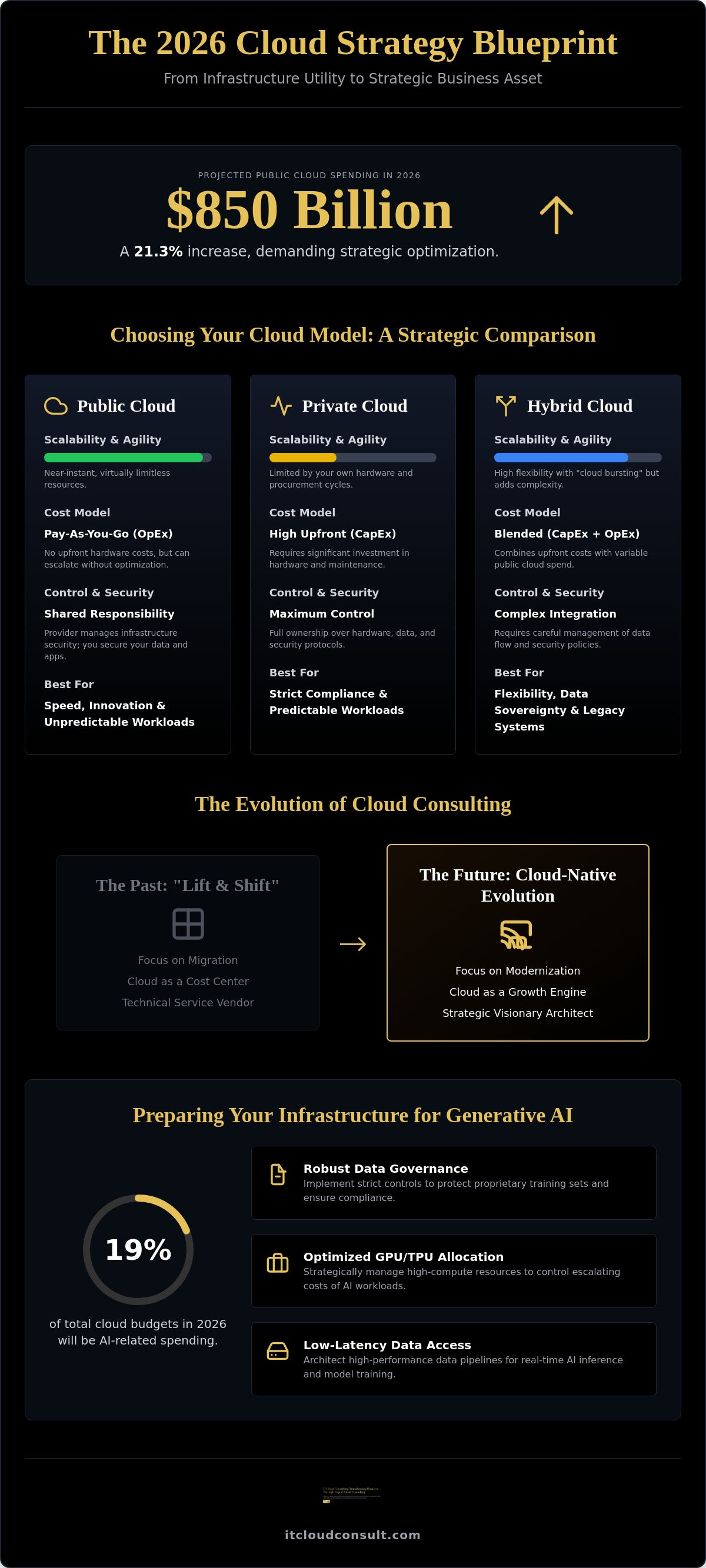
With public cloud end-user spending projected to reach $850 billion in 2026, a staggering 21.3% increase from the previous year, the enterprise landscape has reached a critical tipping point where the right public cloud consulting strategy becomes a survival requirement. You likely recognize the pressure of escalating cloud costs that lack a clear ROI, coupled with the growing complexity of multi-cloud environments that stretch internal IT teams to their limits. It's a common challenge to feel that your infrastructure is currently a utility rather than the strategic asset it was promised to be.
This guide will help you evaluate and select a partner capable of driving operational efficiency and ensuring your systems are fully prepared for the AI-driven demands of 2026. We'll explore how to reduce monthly cloud spend through precise optimization and establish a scalable infrastructure ready for seamless generative AI integration. By comparing strategic approaches to cloud adoption, you'll gain a clear roadmap for an evolution that aligns technical execution with your most ambitious business results. This transition represents more than a simple migration; it's the realization of your organization's latent potential through architecture designed for the future.
Key Takeaways
- Understand how the shift from simple migration to cloud-native evolution has transformed public cloud consulting into a vital strategic partnership for enterprise modernization.
- Analyze the critical trade-offs between public, private, and hybrid models to ensure your deployment architecture supports long-term scalability and operational efficiency.
- Match the unique strengths of AWS, Azure, and Google Cloud to your specific industry needs and existing software ecosystems to maximize your technology investment.
- Identify the core competencies required to select a strategic consultant who acts as a visionary architect rather than a mere service vendor.
- Implement proven optimization frameworks to reduce monthly expenditures and build a robust infrastructure that's fully prepared for generative AI integration.
The Evolution of Public Cloud Consulting in 2026
In 2026, the definition of Cloud computing has expanded far beyond simple storage and compute. It's now the foundational layer for enterprise intelligence. Consequently, public cloud consulting has evolved from a technical service into a strategic partnership. Modern consultants don't just move data. They architect the digital nervous system of the organization. This shift is necessary because the complexity of the current market requires more than just operational uptime; it demands a vision for long-term modernization. A consultant acts as a visionary architect, bridging the gap between raw technical execution and meaningful business results.
The role of the consultant has also become central to navigating the maze of technology sovereignty and compliance. With the 2026 HIPAA Security Rule updates making AES-256 encryption and multi-factor authentication mandatory, compliance is no longer a simple checkbox. It's a fundamental architectural requirement. Strategic public cloud consulting provides the expertise needed to manage these complex issues while maintaining high performance. You need a guide who understands both the technical requirements and the legal implications of your data strategy.
Beyond Migration: Architecting for Innovation
The "lift and shift" era is effectively over. Moving legacy problems to a new environment only creates more expensive legacy problems in the long run. Today's strategy focuses on cloud-native evolution. We look for latent potential in your existing stack to unlock new revenue streams. By reframing the cloud as an engine for growth, consultants help businesses escape the "utility trap" where cloud is seen only as a cost center. Success now depends on high-performance data pipelines and agile frameworks that allow for rapid iteration. A strategic partner identifies where your infrastructure is holding you back and builds a bridge to a more optimized future.
The Impact of Generative AI on Cloud Strategy
Generative AI has rewritten the rules of infrastructure. In 2026, AI-related cloud spending accounts for 19% of total cloud budgets. This surge requires specialized expertise to manage high-compute workloads and high-density data gravity. A consultant's role is to ensure your foundation can scale alongside rapid AI advancements without spiraling costs. They facilitate the transition from experimental novelty to measurable operational efficiency. It's about creating a scalable infrastructure that's ready for the next wave of innovation. This involves:
- Architecting low-latency data access for real-time AI inference.
- Optimizing GPU and TPU resource allocation to control escalating costs.
- Implementing robust data governance to protect proprietary training sets.
Ultimately, the evolution of consulting in this space is about empowerment. It's about giving your internal teams the tools and the roadmap they need to lead your industry. The right partner doesn't just manage your cloud; they help you realize your organization's full potential.
Public vs. Private vs. Hybrid: Comparing Consulting Approaches
The choice between public, private, and hybrid models represents a fundamental strategic decision. It dictates not only your technical capabilities but also the specific expertise your organization requires to succeed. While the public cloud offers unparalleled agility, private and hybrid models provide the control often necessitated by legacy systems or strict regulatory mandates. Evaluating these trade-offs requires a deep understanding of total cost of ownership (TCO). It isn't just about the monthly bill; it's about the long-term cost of maintenance, security, and the "opportunity cost" of slower innovation cycles. Enterprises often seek specialized public cloud consulting to validate their TCO assumptions before committing to a full-scale migration.
Effective public cloud consulting provides the clarity needed to navigate these complex trade-offs. A consultant acts as a bridge, ensuring that your chosen architecture supports both current operational needs and future evolution. They help you determine which model aligns with specific security mandates, such as the upcoming encryption requirements for sensitive data. This strategic alignment ensures that technical processes are directly linked to organizational benefits.
Public Cloud: Agility and Global Scale
Organizations prioritize the public cloud when rapid innovation and global reach are the primary drivers of growth. This model allows you to bypass the heavy capital expenditure of hardware and instead focus on resource elasticity. A consultant's focus here shifts toward pay-as-you-go optimization and leveraging the vast ecosystems of hyperscalers. For instance, the Cloud.gov platform demonstrates how even highly regulated public sector entities utilize public cloud infrastructure to maintain compliance while fostering innovation. By utilizing these shared resources, enterprises can scale workloads instantly to meet global demand without the lag of hardware procurement.
Hybrid and Multi-Cloud: The Complex Enterprise Reality
Most large organizations find themselves in a hybrid or multi-cloud reality. This usually stems from a need to balance the security of on-premise systems with the flexibility of the cloud. Consulting strategies in this space focus on managing disparate environments seamlessly. The goal is to create a unified operational layer that prevents data silos and minimizes architectural complexity.
Avoiding vendor lock-in is a critical component of this approach. By utilizing multi-cloud management services, consultants help you maintain the freedom to move workloads between providers as pricing or performance needs change. This level of strategic planning ensures that your infrastructure remains an asset rather than a constraint. Engaging in Strategic Cloud Adoption ensures your architecture aligns with your specific business goals while maintaining a robust security posture. Whether you're optimizing a single environment or orchestrating a complex multi-cloud strategy, the focus remains on driving measurable business value.
Navigating the Hyperscalers: AWS, Azure, and Google Cloud
Choosing between the major hyperscalers is rarely about finding the "best" cloud; it's about identifying the architectural philosophy that best aligns with your organizational DNA. As of early 2026, AWS, Microsoft Azure, and Google Cloud collectively account for 68% of global enterprise cloud spending. Each platform offers unique strengths that require a disciplined approach to evaluate. Expert public cloud consulting involves more than just technical deployment. It requires a deep understanding of how these ecosystems support your long-term evolution. A Brookings Institution analysis suggests that strategic improvements in adoption often depend on how well an organization balances rapid innovation with complex policy requirements. Consultants bridge the feature gaps between these providers, ensuring that identity management and data governance remain consistent across your entire digital nervous system.
Platform-specific certifications are a non-negotiable requirement for any high-value consulting partner. These credentials ensure that the individuals architecting your environment possess a deep, verified understanding of the provider's latest tools and security protocols. This expertise allows them to translate abstract business goals into precise technical configurations that drive efficiency and reduce waste.
AWS and Azure: The Enterprise Standards
Amazon Web Services (AWS) maintains its position as the market leader with a 30% share, driven by its immense breadth of services and mature developer ecosystem. In 2026, forward-looking enterprises leverage AWS for high-performance computing using the new Graviton 5 processors, which offer superior cost-efficiency for diverse workloads. Conversely, Microsoft Azure, holding 25% of the market, remains the preferred choice for Windows-centric organizations. Its seamless integration with the Microsoft 365 stack and exclusive access to advanced AI models through Azure AI Studio makes it a powerhouse for enterprises already embedded in that ecosystem. A consultant helps you determine which environment offers the highest ROI by analyzing licensing benefits and existing technical debt.
Google Cloud and Specialized Providers
Google Cloud, with a 13% market share, has established itself as the leader in advanced analytics and machine learning. In 2026, its TPU v5p accelerators provide the necessary compute power for training the most complex AI models. Specialized public cloud consulting for GCP often focuses on Vertex AI and data-heavy applications that benefit from Google's unique global networking capabilities. Beyond the "Big Three," we're seeing the rise of specialized clouds tailored for highly regulated sectors like healthcare. Multi-cloud strategies have also become a standard for resilience. Many organizations now utilize a secondary provider specifically for disaster recovery or to maintain leverage against vendor lock-in. This approach ensures your infrastructure remains a flexible asset rather than a rigid constraint.
Evaluating a Public Cloud Consulting Partner: A Strategic Framework
Selecting the right entity for public cloud consulting is a high-stakes decision that determines whether your infrastructure becomes a catalyst for growth or a burden on your balance sheet. A high-value consultant possesses more than just technical certifications; they demonstrate a profound understanding of how architectural decisions influence business agility. The distinction between a mere vendor and a strategic partner lies in their long-term perspective. While a vendor focuses on resolving immediate technical tickets, a strategic partner acts as a visionary architect. They look three to five years ahead to ensure your foundation supports continuous evolution. This partnership is built on absolute transparency, especially regarding managed support fees and the methodology used for ongoing maintenance. You need a dependable guide who bridges the gap between technical execution and business results.
In the same way that a successful long-distance relocation requires the expertise of Southern Elite Van Lines, a seamless cloud transition depends on a partner who can navigate the complexities of the journey while protecting your most valuable assets.
Assessment and Roadmap Development
Every successful modernization journey begins with a comprehensive cloud readiness assessment. This initial phase isn't just a technical audit. It's a strategic evaluation of your organization's latent potential and current technical debt. You should look for consultants who prioritize business outcomes, such as reduced time-to-market or enhanced data accessibility, rather than focusing solely on server uptime. A customized modernization plan is essential. A one-size-fits-all approach ignores the unique complexities of your legacy systems and specific industry compliance needs. The resulting roadmap should provide a clear line of sight from your current state to a more optimized and advanced future.
Post-Migration Support and Optimization
The work doesn't end once the migration is complete. Evaluating a consultant’s approach to ongoing cloud support is critical for long-term success. As global cloud spending is projected to surpass $1 trillion by the end of 2026, FinOps and cost optimization have become non-negotiable competencies. Expert public cloud consulting ensures that your infrastructure remains efficient long after the initial deployment. Your partner should provide continuous monitoring and proactive system health checks to ensure your monthly spend remains aligned with actual value. This proactive orientation transforms cloud management from a reactive cost center into an optimized engine for innovation. It's about having the steady assurance that your environment is always ready for the next wave of technological advancement.
If you're ready to move beyond basic vendor relationships and embrace a partner-led approach, explore our Strategic Cloud Adoption services to start building your roadmap today.
Driving Operational Excellence with IT Cloud Consulting
IT Cloud Consulting operates as a visionary architect for the modern enterprise. We don't just manage services; we empower organizations to realize their full potential. Our approach to public cloud consulting is rooted in the belief that infrastructure should be a driver of innovation rather than a static cost center. By aligning technical roadmaps with high-level business objectives, we ensure every architectural decision serves a strategic purpose. This methodology transforms your digital environment from a utility into a digital nervous system capable of supporting complex AI workloads and global operations. We position ourselves as a dependable guide, providing the steady assurance needed to navigate a rapidly changing technological landscape.
Our commitment to continuous innovation ensures that your organization stays ahead of the curve. We connect technical optimization directly to accelerated business growth, creating a clear cause-and-effect relationship between your cloud spend and your market performance. This long-term partnership focuses on the realization of latent potential, helping you evolve from your current state to a more advanced, future-proofed version of your business.
A Client-Centric Approach to Modernization
We recognize that every organizational structure is unique. Our strategic cloud adoption frameworks are customized to fit your specific goals, whether you're prioritizing rapid scale or strict data sovereignty. We bridge the gap between abstract strategy and technical proficiency, providing expert advice that spans your entire cloud journey. This supportive orientation allows your internal teams to focus on their core competencies while we handle the complexities of the underlying environment. We don't believe in generic solutions. Instead, we build the specific components required to achieve your broad vision of success.
Accelerating Growth Through Cloud Efficiency
Operational excellence is the direct result of technical precision. Our optimization services address the primary pain point of rising costs by identifying inefficiencies and re-architecting for performance. This creates immediate value and prepares your business for the next decade of digital transformation. By focusing on high-performance data pipelines and AI-readiness, we help you transition from a state of complexity to a more optimized and advanced future state. Our ongoing cloud support ensures that your infrastructure remains lean and powerful as new technologies emerge.
Success in the public cloud is not a destination but a continuous evolution. You don't need another vendor; you need a partner invested in your trajectory. This relationship is built on trust, clarity, and a shared vision for growth. Take the next step in your evolution. Consult with a visionary architect at IT Cloud Consulting today to secure your digital future.
Architecting Your Digital Future
The transition toward AI-ready infrastructure and multi-cloud complexity in 2026 requires more than technical maintenance. It demands a visionary approach to modernization. We've explored how identifying the right deployment model and matching hyperscaler strengths to your organizational DNA transforms your infrastructure into a powerful engine for growth. Effective public cloud consulting bridges the gap between raw compute power and measurable business outcomes. It ensures your evolution remains both purposeful and cost-effective through every stage of the journey. This strategic alignment is what separates market leaders from those merely keeping pace with change.
By utilizing our expert Strategic Cloud Adoption frameworks, you can move beyond the limitations of legacy systems to embrace a more agile future. We provide comprehensive Cloud Optimization to ensure maximum ROI and dedicated Ongoing Cloud Support that scales with your ambitions. Partner with IT Cloud Consulting to architect your strategic evolution. Your organization's latent potential is waiting to be realized through a digital foundation built for the next decade of innovation. We're ready to guide you toward a more advanced and optimized state of operational excellence.
Frequently Asked Questions
What is the primary difference between public cloud consulting and managed services?
Public cloud consulting focuses on high-level strategy, architectural design, and the long-term evolution of your infrastructure. It's a transformative process where a visionary architect builds a roadmap for modernization to align with business goals. In contrast, managed services involve the day-to-day operational support and maintenance of an existing environment. While managed services keep the systems running, consulting ensures your infrastructure is actually driving your business forward.
How much does public cloud consulting typically cost for an enterprise migration?
The cost of consulting depends on several factors, including the complexity of your legacy environment, the volume of data being moved, and the level of specialization required for AI-readiness. Enterprise migrations usually involve a multi-phase approach that includes assessment, planning, and execution. Most organizations view these costs as a strategic investment to avoid the much higher expenses associated with failed migrations, security breaches, or inefficient resource allocation.
Can a public cloud consultant help reduce our existing AWS or Azure monthly spend?
Yes, cloud optimization is a core competency that directly addresses escalating costs. By conducting a deep audit of your current environment, a consultant identifies underutilized resources, optimizes instance sizing, and implements automated scaling. This FinOps-driven approach often leads to immediate reductions in monthly spend. It transforms your cloud from a source of financial uncertainty into a lean, efficient engine for growth.
What certifications should I look for in a cloud consulting partner in 2026?
In 2026, you should prioritize partners holding professional-level credentials such as the AWS Certified Solutions Architect (Professional) or the Microsoft Azure Solutions Architect Expert. Given the surge in AI-related cloud spending, certifications in AI and Machine Learning from major providers are also essential. These credentials provide the steady assurance that your consultant possesses the verified expertise required to handle complex, modern architectures.
Is public cloud consulting necessary for a small business, or is it only for large enterprises?
Public cloud consulting is highly beneficial for organizations of all sizes, though the scope of engagement usually differs. Small businesses often use consultants to ensure their initial architecture is scalable and secure from day one, preventing expensive technical debt later. While a large enterprise might require a multi-year modernization roadmap, a small business benefits from a focused strategy that ensures every dollar spent on the cloud delivers maximum ROI.
How long does a typical cloud strategy and roadmap development phase take?
A typical strategy and roadmap phase generally spans four to eight weeks. This timeframe allows for a thorough assessment of your current IT landscape and the identification of your organization's latent potential. The process involves technical audits, stakeholder interviews, and financial modeling. By the end of this period, you'll have a clear, actionable plan that connects technical processes directly to your broader organizational benefits.
What are the biggest risks of migrating to the public cloud without a consultant?
The primary risks include spiraling costs due to poor resource allocation and critical security vulnerabilities arising from misconfigurations. Without an architect's guidance, businesses often fall into the "lift and shift" trap, moving legacy problems into a more expensive environment. This leads to poor performance and an internal skills gap that prevents the team from utilizing cloud-native features. A consultant mitigates these risks by providing a dependable guide for execution.
How does cloud consulting address data sovereignty and industry compliance?
Consultants address these issues by architecting specific controls into your environment, such as selecting appropriate geographic regions and implementing mandatory encryption protocols. With the 2026 HIPAA Security Rule updates requiring AES-256 encryption for data at rest, a consultant ensures your infrastructure is compliant before deadlines pass. They bridge the gap between complex legal mandates and technical execution, maintaining your organization's integrity while fostering innovation through public cloud consulting frameworks.


