
What if your cloud migration wasn't the finish line, but actually the entry point into a cycle of escalating costs and hidden technical debt? As the global cloud market surpasses the $1 trillion mark in late 2026, the distinction between organizations that merely exist in the cloud and those that thrive there comes down to a single factor: the quality of their ongoing cloud support. You've likely already felt the friction of unpredictable monthly invoices or the realization that your internal team is too bogged down by routine maintenance to leverage new, specialized AI-native features.
We recognize that maintaining a high-performance environment shouldn't feel like a constant battle against complexity. This guide provides the strategic clarity you need to master post-migration management and transform your infrastructure into a predictable, zero-downtime asset. We'll examine the necessary shift toward FinOps, the impact of new 2026 data regulations like the California Delete Act, and the specific steps required to align every dollar of cloud spend with your broader business objectives.
Key Takeaways
- Learn how to transition from initial migration success to "Day 2" operational excellence by treating your infrastructure as a dynamic, evolving asset rather than a static utility.
- Identify the essential technical and maintenance components of ongoing cloud support required to maintain a secure, zero-downtime environment in an increasingly complex multi-cloud landscape.
- Evaluate the total cost of ownership for internal teams versus managed services to ensure your organization possesses the specialized expertise needed for 2026's cloud-native features.
- Discover how to use Quarterly Business Reviews as a strategic bridge, transforming technical performance data into actionable roadmaps for continuous modernization.
- Understand how transparent managed support fees provide the financial predictability necessary to align your cloud investment with long-term business value.
Defining Ongoing Cloud Support in the Modern Enterprise
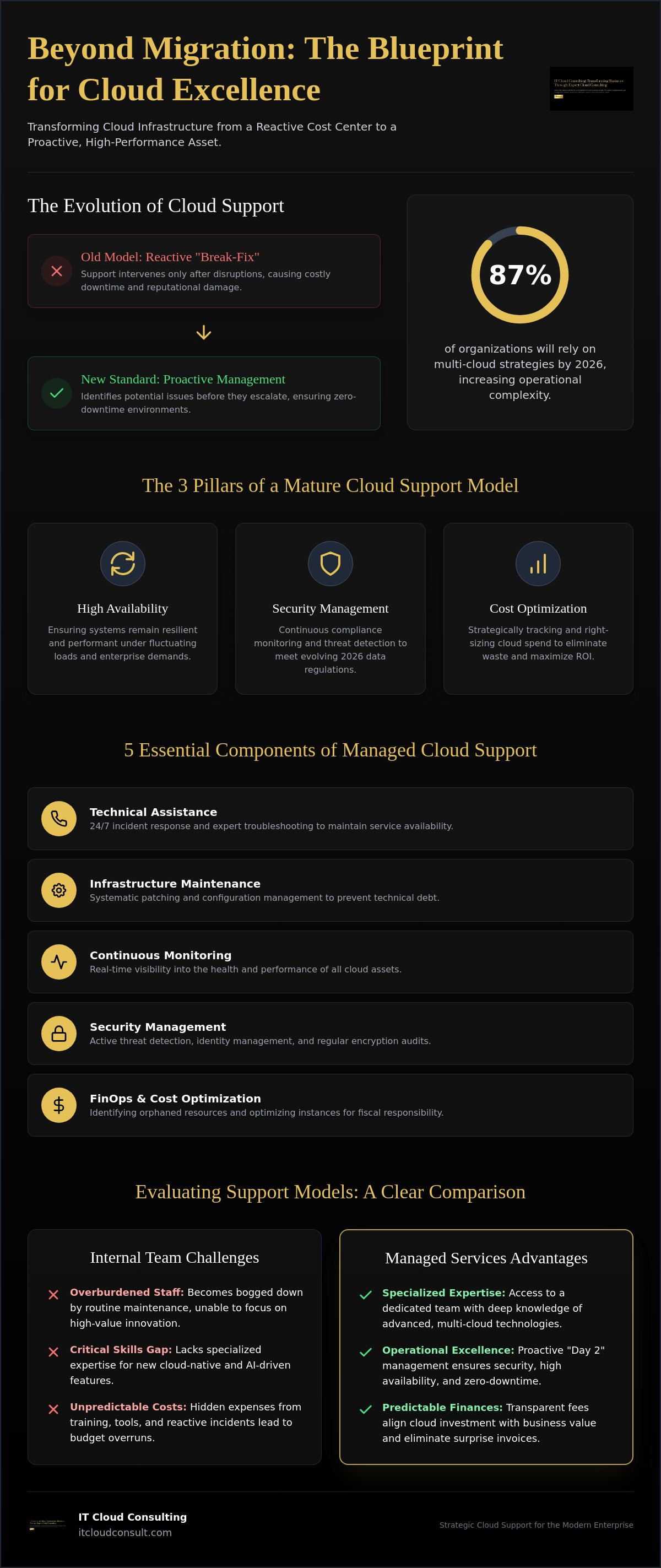
The successful migration of a workload marks the conclusion of a project, but it also signals the birth of a living digital ecosystem. In the 2026 enterprise environment, where multi-cloud strategies are the norm for 87% of organizations, the cloud is never truly "finished." Ongoing cloud support is the disciplined, continuous application of monitoring, maintenance, and optimization protocols that ensure these environments remain aligned with shifting business requirements. It's the bridge between the technical achievement of a migration and the long-term realization of business value.
Many leaders mistakenly focus their resources on "Day 1" migration goals, treating the move as a singular event. However, "Day 2" operational excellence is where the actual return on investment is secured or lost. A static cloud environment is a liability. Without active management, cloud configurations quickly become outdated, leading to security vulnerabilities and significant cost bloat. Effective support functions as a modernization engine, consistently refining the architecture to leverage new cloud-native features and more efficient resource models.
The Evolution from Break-Fix to Proactive Management
Traditional IT models often relied on a reactive "break-fix" approach. In this scenario, support only intervenes after a service disruption impacts end users or halts production. This delay is unacceptable when global markets demand zero-downtime environments. Proactive management shifts the focus toward identifying potential bottlenecks and security gaps before they escalate into critical incidents. By utilizing advanced analytics and continuous monitoring, organizations can maintain business continuity and protect their brand reputation from the fallout of preventable outages.
Core Pillars of a Mature Support Model
A sophisticated approach to managed cloud support services rests on three fundamental pillars that drive enterprise stability and define high-quality ongoing cloud support. First is infrastructure high availability, ensuring that systems remain resilient under fluctuating loads. Second is security posture management, which involves continuous compliance monitoring to meet evolving 2026 regulations. Finally, cost transparency and resource right-sizing are essential. This pillar ensures that cloud spend is not just tracked, but strategically optimized to eliminate waste. When these pillars are managed as part of a unified strategy, the cloud transforms from a complex cost center into a lean, high-performance asset capable of accelerating organizational growth.
Essential Components of Managed Cloud Support Services
A high-performance cloud environment requires more than just a reactive help desk. It demands a sophisticated framework of services that work in harmony to protect and advance the enterprise's digital footprint. Comprehensive ongoing cloud support integrates tactical technical assistance with high-level strategic oversight. This ensures that every layer of the stack, from the underlying infrastructure to the user-facing application, operates at peak efficiency. By viewing support as a modular system, organizations can scale their capabilities to match the complexity of their 2026 multi-cloud architectures. This perspective transforms support from a reactive cost into a driver of operational resilience.
The foundation of this model includes five critical components:
- Technical Assistance: 24/7 incident response and expert troubleshooting to maintain service availability.
- Infrastructure Maintenance: Systematic patching, version updates, and configuration management to prevent technical debt.
- Continuous Monitoring: Real-time visibility into the health and performance of all cloud assets.
- Security Management: Active threat detection, identity and access management (IAM), and regular encryption audits.
- Cost Optimization: Identifying orphaned resources and optimizing reserved instances to ensure fiscal responsibility.
Operational Monitoring and Incident Response
Effective incident response relies on the speed of detection. Automated alerts play a vital role in reducing the Mean Time to Repair (MTTR) by notifying engineers of anomalies before they manifest as outages. It's essential to distinguish between infrastructure monitoring, which tracks hardware and network health, and Application Performance Monitoring (APM), which focuses on the end-user experience. Establishing clear escalation paths ensures that critical failures reach the right specialists immediately, preserving business continuity in high-stakes environments. This methodical approach reduces friction between internal teams and external providers. If you're looking to refine these processes, exploring professional cloud support services can provide the necessary framework for execution.
Strategic Optimization and FinOps
As organizations move toward more mature cloud modernization strategies, the focus shifts to the intersection of finance and operations. Ongoing cloud support isn't just about uptime; it's about tracking cloud spend against tangible business outcomes. By utilizing cloud optimization consulting, enterprises can systematically reduce waste and reallocate capital toward innovation. This involves regular architectural reviews to evaluate new cloud-native features released in 2026, such as specialized AI-driven resource scaling. This strategic alignment ensures that the cloud remains a lean, powerful engine for growth rather than an unmanaged expense.
Evaluating Support Models: In-House vs. Managed Cloud Services
Selecting the right operational model is a pivotal strategic decision that determines whether a cloud environment becomes a catalyst for growth or a source of friction. Many executives face a fundamental choice: build an internal team or partner with an external provider for ongoing cloud support. While direct control over staff is appealing, the total cost of ownership (TCO) for hiring specialized cloud talent has reached new heights in 2026. Beyond base salaries, organizations must account for recruitment cycles, benefits, and the significant expense of continuous training required to keep pace with rapid platform updates. When these costs are aggregated, the financial burden of an in-house team often exceeds the predictable investment of a managed model.
Expertise depth represents another critical point of comparison. Internal teams typically specialize in a single platform, yet 87% of organizations now operate in multi-cloud environments. A managed service provider offers a broader perspective, drawing on cross-platform experience that a single-platform internal team cannot replicate. This breadth allows for more creative problem-solving and faster adoption of emerging cloud-native features. By leveraging IT Cloud Consulting Support, enterprises can bypass the limitations of localized knowledge and access a global standard of operational excellence. Furthermore, if your firm is scaling into new territories, you can learn more about Encor Group to manage the corporate complexities of international growth.
The opportunity cost of internal management is perhaps the most overlooked factor. Every hour your senior engineers spend on routine patching, configuration updates, or orphaned resource cleanup is an hour they aren't spending on high-value innovation. Shifting these "Day 2" tasks to an external partner allows your best minds to focus on core business logic and product development. This strategic reallocation of human capital accelerates time-to-market and ensures that your internal talent is invested in projects that directly drive revenue.
When internal teams are freed from the burden of routine infrastructure maintenance, they can better collaborate with digital partners like Big Drop Inc to build high-performance websites that translate technical efficiency into tangible business growth.
The Internal Talent Gap and Retention Risks
Cloud architect turnover remains a significant risk in the current market. When a key engineer leaves, they often take undocumented system knowledge with them, creating dangerous "knowledge silos." Managed support mitigates this risk by serving as a centralized knowledge repository that remains stable regardless of individual personnel changes. Furthermore, achieving 24/7 coverage internally requires hiring at least three shifts of engineers. A managed model provides this comprehensive availability without the massive overhead of a massive payroll expansion.
Service Level Agreements (SLAs) as a Risk Mitigation Tool
Internal support teams generally operate on a "best effort" basis, which lacks the rigorous accountability required for mission-critical systems. In contrast, ongoing cloud support through a managed provider is governed by contractual SLAs that guarantee specific uptime and response times. These agreements include financial credits if targets aren't met, providing a level of risk mitigation that internal teams simply cannot offer. Using these SLAs allows stakeholders to plan with confidence, knowing that system stability is backed by a formal commitment to performance.
Building a Roadmap for Continuous Cloud Modernization
In the high-stakes environment of 2026, modernization is a continuous journey rather than a static destination. Organizations that treat their cloud environment as a "set and forget" utility often find themselves burdened by legacy configurations and rising costs. Ongoing cloud support provides the structural framework for this constant evolution, facilitating incremental improvements that keep your stack at the edge of innovation. By viewing support as an engine for change, you ensure that your infrastructure remains agile enough to pivot alongside market demands. This requires a persistent strategic cloud adoption mindset that looks far beyond the initial migration phase.
Modernization today is heavily influenced by the integration of AI-driven automation. With AI-related cloud spending reaching 19% of total cloud expenditure in 2026, the ability to incorporate specialized hardware and generative AI features into existing stacks is a competitive necessity. Support teams play the role of visionary architects here. They don't just fix issues; they identify opportunities to refactor workloads for better performance and lower latency. Secure your enterprise's future by exploring how ongoing cloud support transforms routine maintenance into strategic momentum.
Quarterly Strategic Reviews and Performance Tuning
Quarterly Business Reviews (QBRs) serve as the vital bridge between technical telemetry and business strategy. These sessions move beyond simple uptime reports to analyze performance metrics against 2026 industry benchmarks. During these reviews, we identify "low-hanging fruit" for immediate gains, such as rightsizing underutilized EKS clusters or transitioning to more cost-effective storage tiers. This ensures that technical capacity is always aligned with upcoming business initiatives, such as major product launches or seasonal demand spikes. It's about making data-driven decisions that translate technical efficiency into business value.
Implementing Cloud Automation and Self-Healing Systems
A mature support model prioritizes the development of Infrastructure as Code (IaC) to ensure consistency and speed. By codifying the environment, ongoing cloud support teams can implement automated scaling and self-healing protocols that move the organization toward a "NoOps" reality. This transition reduces the risk of human error in maintenance workflows and ensures that recovery happens in seconds, not hours. Automated patching and configuration audits further harden the security posture, allowing your internal developers to focus entirely on building features that drive growth rather than managing the underlying plumbing.
Maximizing Efficiency with IT Cloud Consulting Support
Realizing the full potential of a cloud-native architecture requires a partner that understands the delicate balance between technical stability and strategic agility. IT Cloud Consulting provides a unified model where high-level strategic advisory integrates seamlessly with tactical managed support. This ensures that your infrastructure doesn't just stay online; it evolves. By entrusting the technical heavy lifting to a visionary architect, your internal teams are empowered to focus entirely on product innovation and market expansion. We don't operate as a mere vendor. We act as a dependable guide, ensuring every technical action serves a specific organizational benefit.
Predictability is the cornerstone of a sustainable cloud strategy. Our Managed Cloud Support Fees are designed as a transparent, fixed investment that eliminates the volatility often associated with cloud operations. In an era where cloud end-user spending is forecasted to reach $850 billion in 2026, hidden costs and usage-based support spikes represent a major risk to margins. Having a clear, consistent management cost allows for more accurate long-term budgeting. This fiscal clarity is essential as organizations navigate the complexities of 2026, where AI-related spending and specialized hardware requirements can otherwise lead to significant budget overruns. Our commitment is to ensure that your ongoing cloud support remains a lean, value-driven engine for your business.
A Partnership Built on Strategic Assurance
We move beyond the standard break-fix model to become a deeply invested strategic consultant. Our cause-and-effect approach means that every patch, configuration update, or security audit is linked to a broader business result, such as improved latency for global users or compliance with the latest 2026 regulations. For example, as the California Delete Act's DROP platform becomes mandatory in August 2026, we ensure your data architectures are prepared for the required 45-day deletion cycles. This visionary perspective allows us to provide both the big-picture roadmap and the granular technical execution required to achieve it. You gain the assurance that your cloud environment is not only secure today but resilient against the challenges of tomorrow.
Next Steps: Securing Your Cloud Future
The path toward continuous modernization begins with a clear understanding of your current operational state. We recommend starting with a comprehensive gap analysis to identify where your existing support model might be falling short, whether in cost governance or specialized AI expertise. Once these gaps are identified, our advisory team works with you to define specific 2026 modernization goals that align with your growth trajectory. This structured approach ensures that every step you take is purposeful and high-impact. Don't let technical debt or unmanaged complexity stall your progress. Engage IT Cloud Consulting for Ongoing Support to transform your cloud into a strategic asset that accelerates your organizational evolution.
Securing Your Trajectory Toward Continuous Evolution
The cloud isn't a static utility; it's a living digital ecosystem that requires constant calibration to deliver sustained business value. Achieving operational excellence in 2026 demands a shift from reactive maintenance to a model of continuous modernization. By integrating ongoing cloud support into your strategic framework, you ensure that your infrastructure remains agile, secure, and perfectly aligned with your organizational goals. This disciplined approach transforms technical complexity into a predictable engine for growth, allowing your internal teams to focus on the innovations that define your market position.
Navigating this landscape requires a partner who provides both a visionary perspective and the technical proficiency to execute it. We offer steady assurance through 24/7 proactive monitoring and incident response, combined with strategic roadmapping that anticipates the challenges of tomorrow. Our transparent Managed Cloud Support Fees provide the fiscal predictability you need to invest in the future with confidence. It's time to realize the latent potential of your cloud environment and turn operational stability into a lasting competitive advantage.
Optimize your cloud operations with IT Cloud Consulting and begin your journey toward a more efficient, secure, and scalable future. We're ready to guide your evolution.
Frequently Asked Questions
What is the difference between cloud hosting support and managed cloud support?
Cloud hosting support focuses on the availability of the provider's underlying hardware and network, ensuring the platform itself remains functional. Managed cloud support extends into the client's specific environment, handling application performance, operating system patching, and security configurations. It's the difference between ensuring the "building" has power and ensuring the "office" inside is optimized for your specific business operations.
How much do ongoing cloud support services typically cost?
Costs vary depending on the platform and the level of assistance required. In 2026, AWS Enterprise Support starts at $15,000 per month or a tiered percentage of monthly usage, while Google Cloud's Premium Support follows a similar baseline of $15,000. These fees cover the platform provider's assistance, whereas third-party managed services offer a more tailored layer of strategic oversight and tactical management suited to specific enterprise needs.
Just as organizations seek transparency in cloud costs, they should also explore Professional Accounting and Tax Advisory Fees from Fair View Accounting Services to ensure their broader financial and tax strategies are managed with the same level of professional oversight.
Can managed cloud support help reduce our monthly AWS or Azure bill?
Managed services directly impact cost efficiency by implementing rigorous FinOps principles. Experts identify orphaned resources, such as unattached storage volumes, and optimize reserved instances or savings plans. With Azure Reservations offering savings of up to 72% for specific commitments in 2026, proactive management ensures these discounts are fully leveraged to align every dollar of spend with business value.
How does ongoing support handle cloud security and compliance updates?
Security is handled through continuous posture management rather than periodic audits. Support teams implement real-time threat detection and ensure systems comply with 2026 regulations, such as the expanded CCPA neural data protections. This proactive approach includes managing encryption keys and identity access (IAM) to prevent vulnerabilities from emerging after the initial migration phase is complete.
Do we need external cloud support if we have a small internal IT team?
Small internal teams often lack the capacity for 24/7 monitoring or specialized expertise in every new cloud-native feature. Partnering for ongoing cloud support allows your internal talent to focus on high-value innovation instead of routine patching and maintenance. It provides a stable knowledge repository that protects your organization from the operational risks of staff turnover in a high-demand talent market. This model of delegating specialized tasks is equally effective for international expansion; for example, firms can rely on Vostok Consult for company establishment in the UAE, allowing their small IT team to focus exclusively on cloud performance rather than regional administrative requirements.
What are the typical response times (SLAs) for enterprise cloud support?
Enterprise-grade SLAs provide guaranteed response times based on the severity of the incident. Critical "Priority 1" issues typically require a response within 15 to 30 minutes, while general inquiries or lower-priority requests may have a 4 to 8-hour window. These contracts provide a level of accountability and potential financial recourse that internal "best effort" support models simply cannot match.
How does ongoing support facilitate cloud-native modernization?
Modernization is facilitated through the transition to automated, self-healing architectures. Support teams develop Infrastructure as Code (IaC) and integrate new AI-driven resource scaling features released in 2026. This allows your environment to evolve from a basic migration into a sophisticated, cloud-appropriate stack that fully utilizes advanced services like EKS or serverless functions without increasing manual overhead.
What metrics should we use to measure the success of cloud support?
Success should be measured by a combination of technical performance and financial KPIs. Key metrics include Mean Time to Repair (MTTR), system uptime percentages, and the ratio of automated versus manual incident resolutions. Additionally, tracking the strategic alignment between cloud expenditure and organizational growth provides a clear picture of the support model's long-term impact on business value.


