
The era of "growth at any cost" has officially ended, replaced by a mandate for rigorous fiscal and technical discipline as public cloud spending is forecasted to reach $1.6 trillion by 2028. With recent 2026 price increases for major platforms like Microsoft 365 and Google Cloud networking, the pressure to maintain cloud operational efficiency is no longer a luxury but a strategic necessity. You likely recognize the frustration of unpredictable monthly bills and the friction of manual interventions required to keep your systems afloat. It's a common pain point where technical complexity often obscures the path to actual business value.
We understand that your goal is not just to survive these rising costs, but to evolve your environment into a self-healing, high-performance engine. This guide provides a structured roadmap to help you realize that latent potential. You'll learn how to implement systematic tuning that replaces manual scaling with automated governance and turns vague resource utilization into clear, actionable visibility. We will explore the specific architectural shifts and financial frameworks necessary to align your cloud investment with your long-term organizational trajectory.
Key Takeaways
- Learn why the shift from "cloud-first" to "efficiency-first" is the defining strategy for high-performing organizations in 2026.
- Discover how a 90-day utilization baseline helps you eliminate "zombie" assets and reclaim wasted resources.
- Master the transition to Infrastructure as Code and automated scaling to maintain peak cloud operational efficiency without manual oversight.
- Implement robust governance through precise tagging and automated budget alerts to ensure 100% resource accountability.
- Understand how professional advisory services help you overcome "operational blindness" to uncover hidden technical debt.
Defining Cloud Operational Efficiency: Beyond Simple Cost Management
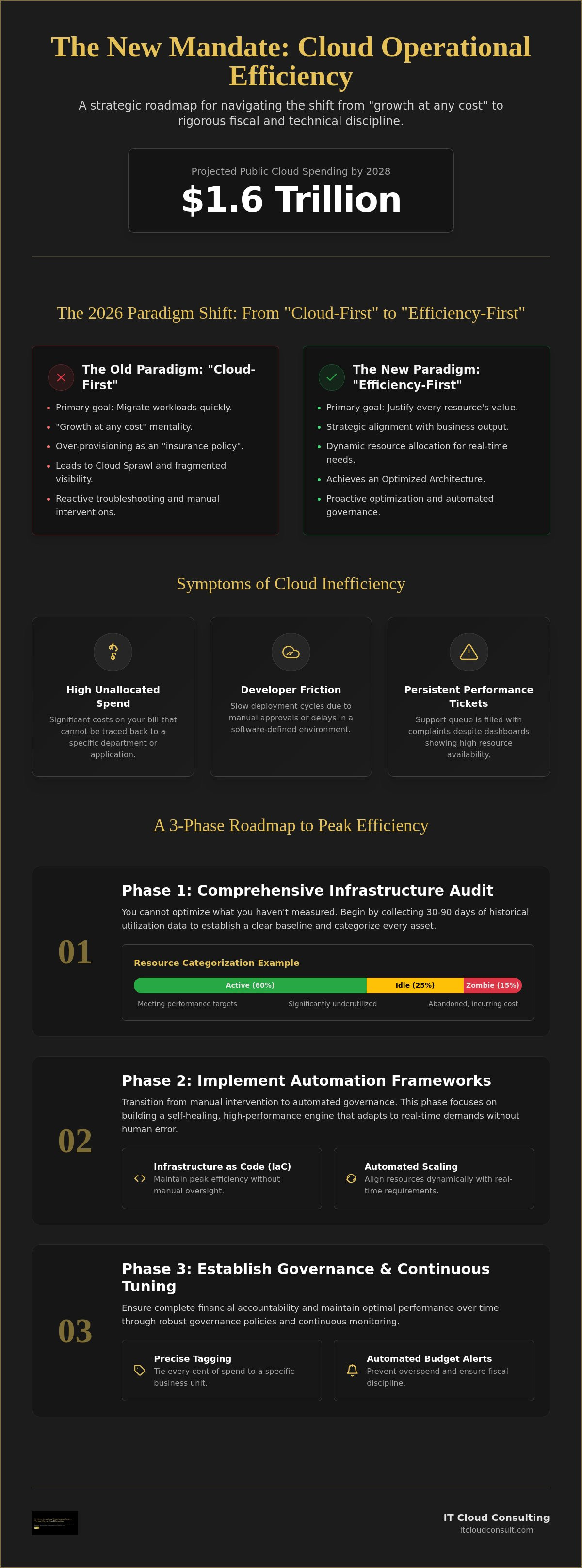
True cloud operational efficiency is measured as the precise ratio of business output to cloud input, encompassing cost, time, and risk. In 2026, the industry has moved decisively past the "cloud-first" era, where the primary objective was simply to migrate workloads to the digital space. We've entered an "efficiency-first" paradigm where every provisioned resource must justify its existence through measurable performance and strategic value. Organizations that fail to make this transition often find themselves trapped in "Cloud Sprawl," a state characterized by redundant services, forgotten instances, and fragmented visibility. This contrasts sharply with an "Optimized Architecture," where resources are dynamically aligned with real-time requirements to ensure no capital is wasted on idle capacity.
This evolution requires a holistic approach that balances three critical pillars. Technical Performance ensures that systems meet user demands without lag; Financial Accountability ties every cent of spend to a specific business unit or project; and Process Automation removes the human error that leads to configuration drift. Effective Cloud management serves as the connective tissue between these pillars, allowing leadership to view the cloud not as an unavoidable utility bill, but as a finely tuned engine for growth.
The 2026 Efficiency Paradigm: Performance vs. Cost
Many leaders mistakenly believe that over-provisioning is a safe insurance policy against downtime, yet this practice creates a ripple effect of inefficiency. Beyond the inflated monthly bill, excess capacity introduces unnecessary complexity into your environment, making security patches and updates harder to manage. In this new landscape, latency and reliability have become primary efficiency metrics. If your system is up but performing sluggishly, you're still losing business value. Operational efficiency is the strategic balance between execution speed and long-term infrastructure sustainability.
Identifying the Symptoms of Cloud Inefficiency
Recognizing the need for cloud operational efficiency often begins with identifying subtle points of friction within your daily operations. Common symptoms include:
- High Unallocated Spend: Your billing dashboard shows significant costs that cannot be traced back to a specific department or revenue-generating application.
- Developer Friction: Engineering teams face slow deployment cycles because they're waiting for manual approvals or hardware-style provisioning in a software-defined world.
- Persistent Performance Tickets: Your support queue is filled with performance-related complaints despite your dashboard showing high resource availability, indicating a mismatch between allocation and actual workload needs.
Addressing these symptoms requires a shift from reactive troubleshooting to proactive optimization. By establishing a baseline of your current state, you can begin the process of reclaiming lost potential and redirecting those resources toward innovation.
Phase 1: Conducting a Comprehensive Cloud Infrastructure Audit
Establishing a baseline is the first mandatory step toward achieving peak cloud operational efficiency. You cannot optimize what you haven't accurately measured, so your audit must begin by collecting at least 30 to 90 days of historical utilization data. This window provides a statistically significant view of your environment, accounting for weekly cycles and end of month processing spikes. During this phase, you should categorize every resource into three distinct buckets: Active, Idle, and Zombie. Active assets are those meeting performance targets; Idle assets are running but significantly underutilized; and Zombie assets are abandoned resources, such as old test environments or unattached storage volumes, that continue to incur costs without providing value.
Beyond technical categorization, this audit must evaluate how your current architecture aligns with your broader strategic cloud adoption goals. A Brookings Institution analysis emphasizes that while the cloud offers immense agility and potential cost savings, these benefits are only realized when infrastructure is rigorously managed. By mapping your cloud spend directly to specific business units or products, you can identify low-ROI areas where the cost of infrastructure outweighs the business value generated. For organizations looking to accelerate this process, a professional cloud assessment can provide the external perspective needed to spot these inefficiencies quickly.
Resource Utilization and Rightsizing Assessments
Effective rightsizing requires looking deep into CPU, Memory, and IOPS metrics to identify exactly where your instances are over-provisioned. You'll need to decide between vertical rightsizing, which involves changing the instance size or type, and horizontal rightsizing, where you adjust the number of active instances. Don't overlook orphaned resources; unattached block storage and unused elastic IP addresses are silent budget killers that often survive even after the parent instance is terminated. Addressing these technical gaps is a foundational requirement for any long-term cloud operational efficiency initiative.
Security and Compliance Gap Analysis
Inefficiency isn't always found in a line item on a bill; it's often hidden in your security posture. Misconfigured storage buckets or unnecessarily open ports require additional monitoring and remediation effort, wasting valuable engineering hours. You should evaluate your current encryption and identity management protocols to ensure they aren't creating bottlenecks that slow down your team. A strong security posture isn't just about protection. It directly impacts your operational uptime and reliability by preventing the types of configuration errors that lead to system-wide failures.
Phase 2: Implementing Automation and Orchestration Frameworks
Once you've established a baseline through a comprehensive audit, the focus shifts from observation to execution. Automation serves as the bridge between identifying inefficiencies and permanently eliminating them. By transitioning from manual configurations to automated workflows, you remove the human error that frequently leads to resource leakage and performance bottlenecks. This phase is about building a self-sustaining ecosystem where your infrastructure adapts to business needs in real time, ensuring that your cloud operational efficiency scales alongside your organizational growth without requiring a proportional increase in headcount.
A mature automation strategy also extends to your standard operating procedures (SOPs). Patch management, backups, and routine security scans shouldn't rely on manual triggers; they should be codified and scheduled to run autonomously. This approach doesn't just save time. It creates a predictable operational rhythm that reduces the risk of downtime and ensures that your environment remains in a "known good" state at all times. When you automate these foundational tasks, your engineering talent is freed to focus on high-value innovation, such as when you explore AI applications that can further enhance operational decision-making and business logic.
Infrastructure as Code (IaC) for Repeatable Efficiency
Consistency is the enemy of waste. Whether you utilize Terraform for its provider-agnostic flexibility, AWS CloudFormation for deep integration, or Azure Bicep for streamlined syntax, Infrastructure as Code (IaC) is the primary tool for maintaining environment consistency. IaC acts as the immutable blueprint for an efficient environment, ensuring that every deployment matches your optimized baseline exactly. By defining your infrastructure through code, you virtually eliminate "configuration drift," a common phenomenon where manual changes over time create a messy, inefficient environment that's difficult to secure or scale. This programmatic approach allows you to version-control your entire data center, making every architectural change transparent and reversible.
Serverless and Managed Services vs. Legacy VMs
The most efficient resource is the one that doesn't exist when it's not being used. Leveraging serverless architectures like AWS Lambda, Azure Functions, or Google Cloud Functions allows you to move away from the "always-on" legacy VM model toward a pure "pay-per-execution" system. This shift significantly lowers your Total Cost of Ownership (TCO) by offloading the management of the underlying server, operating system, and runtime to the provider. While containers and Kubernetes remain vital for complex, long-running microservices, pure serverless is often the superior choice for event-driven workloads. By matching the right compute model to the specific task, you ensure that you're never paying for idle CPU cycles, which is a cornerstone of long-term cloud operational efficiency.
In complex enterprise environments, Kagool specializes in optimizing these managed services for SAP and Microsoft workloads to ensure peak performance and cost-efficiency.
Phase 3: Establishing Governance and Continuous Performance Tuning
Governance is the essential mechanism that transforms cloud operational efficiency from a temporary project into a permanent organizational discipline. It provides the structural integrity needed to sustain the technical optimizations implemented in previous phases. Without a rigorous governance framework, even the most finely tuned environments will eventually succumb to resource fragmentation and cost escalation. This phase focuses on creating a culture of accountability where every stakeholder understands the financial and operational impact of their architectural choices.
To achieve this, you must implement a structured, multi-step governance protocol:
- Step 1: Define Tagging Policies. Establish a mandatory tagging schema that ensures 100% resource accountability. Every asset should be linked to a specific department, project, and owner to eliminate "unallocated" spend.
- Step 2: Set Budget Alerts and Kill Switches. Configure automated triggers that notify teams at 50%, 75%, and 100% of their monthly budget. For non-production environments, implement "kill switches" that automatically terminate resources that exceed defined limits or violate compliance rules.
- Step 3: Deploy an Observability Stack. Move beyond basic logging to a system that prioritizes real-time metrics and distributed tracing. This provides the granular visibility needed to understand how different services interact and where waste occurs.
- Step 4: Conduct Monthly Architecture Reviews. Cloud providers release hundreds of new features and instance types annually. Regular reviews allow you to swap aging infrastructure for newer, more efficient services as they become available.
Building a Cloud Center of Excellence (CCoE)
A Cloud Center of Excellence (CCoE) serves as the strategic heart of your governance model. This cross-functional group brings together Finance, IT, and Business Leadership to align cloud spending with organizational goals. The CCoE's primary role is to establish "guardrails" rather than acting as a traditional "gatekeeper" that slows down development. By focusing on KPIs such as unit cost per transaction, the CCoE helps the business understand if cloud costs are scaling linearly with revenue. This shift in perspective ensures that the cloud remains a high-performance engine for growth rather than a ballooning overhead expense.
Observability: Beyond Basic Monitoring
Modern observability is about understanding the internal state of your systems based on the data they produce. In complex microservices environments, basic monitoring is insufficient because it only tells you if a system is up or down. True observability utilizes tracing and metrics to identify the root cause of performance bottlenecks. Leveraging AI-driven insights allows your team to predict these issues before they impact the end-user experience. Integrating these insights into your CI/CD pipeline enables "Shift-Left" efficiency, where resource-heavy code is identified and optimized before it ever reaches production. To ensure your governance model is built for long-term success, consider partnering with an expert for ongoing cloud support to maintain peak performance.
Future-Proofing Efficiency with Strategic Cloud Optimization Consulting
Internal engineering teams often operate under a state of "operational blindness," where the daily demands of maintaining system uptime obscure the broader opportunities for architectural improvement. When your staff is focused on immediate ticket resolution and firefighting, systemic inefficiencies become part of the background noise. This is where the value of a professional third-party audit becomes clear. An external perspective identifies hidden technical debt and resource leakage that internal teams may have overlooked simply because those configurations have existed for years. By partnering with a consultant, you gain a visionary architect who can bridge the gap between technical execution and high-level business strategy.
The realization of your cloud's latent potential requires a shift from reactive maintenance to proactive, strategic innovation. This transition ensures that your cloud operational efficiency doesn't just peak after a single project but remains a core component of your organizational DNA. We focus on the cause and effect of every architectural choice, ensuring that technical processes are directly linked to your long-term growth. This methodical approach transforms your infrastructure from a necessary expense into a flexible asset that can adapt to the shifting market conditions of 2026 and beyond.
The Role of Managed Cloud Support in Sustained Success
Efficiency gains can erode quickly without continuous monitoring and performance tuning. Our Ongoing Cloud Support services ensure that the optimizations you implement today continue to deliver value as your workloads evolve. One of the greatest advantages of this partnership is the ability to access specialized expertise for niche cloud technologies without the burden of hiring full-time, high-cost specialists. We've seen through various client engagements that strategic tuning doesn't just lower costs; it accelerates growth by improving system responsiveness and developer velocity. It's a steady assurance that your environment is always running at its peak capability.
Next Steps: Your Roadmap to an Optimized 2026
Your journey toward a more efficient future begins with a clear, logical progression. Start by prioritizing "quick wins" identified in your audit, such as terminating zombie assets or rightsizing over-provisioned instances. These actions provide immediate impact with minimal effort, building the momentum needed for larger projects. Following these initial gains, you should develop a long-term modernization roadmap for legacy applications that may require refactoring to take full advantage of serverless or containerized environments. To kickstart this evolution, requesting a professional Cloud Optimization assessment is the most effective way to gain a comprehensive understanding of your current state and the path forward. It's time to stop managing your cloud and start mastering it.
Transforming Your Infrastructure into a Strategic Asset
The path to 2026 requires a departure from reactive management in favor of a disciplined, architectural approach. By establishing a rigorous 90-day baseline and adopting Infrastructure as Code, your organization can eliminate the "zombie" assets that currently drain your budget. Implementing a Cloud Center of Excellence ensures that these gains aren't temporary but become a permanent part of your operational DNA. Achieving true cloud operational efficiency is an evolution that aligns technical performance with tangible business value, turning your cloud environment from a cost center into a high-performance engine.
We provide the authoritative advisory required for such a complex enterprise transformation. Our proven methodology for strategic cloud adoption bridges the gap between your current state and a future where your infrastructure drives innovation rather than overhead. If you're ready to secure expert guidance in cloud infrastructure consulting, the next step is a targeted review of your systems. It's time to realize the latent potential hidden within your architecture through systematic tuning and professional oversight.
Optimize your cloud environment with a professional assessment from IT Cloud Consulting.
The future of your digital environment is bright when it's built on a foundation of precision and strategic intent. We look forward to partnering with you on this journey toward modernization and sustained success.
Frequently Asked Questions
What is the difference between cloud cost optimization and cloud operational efficiency?
Cloud cost optimization focuses primarily on reducing the monthly bill through financial tactics like reserved instances. In contrast, cloud operational efficiency is a broader architectural discipline that measures the ratio of business value produced against the resources consumed. It encompasses technical performance, staff productivity, and risk mitigation. Efficiency ensures that every dollar spent directly contributes to a high-performance engine rather than just paying for idle capacity.
How can automation specifically improve our cloud ROI?
Automation improves ROI by eliminating the manual intervention typically required for provisioning and scaling. By using Infrastructure as Code and auto-scaling groups, your team spends less time on repetitive maintenance and more time on high-value innovation. This shift reduces the cost of human error, which is a leading cause of downtime and security vulnerabilities. Ultimately, automation ensures your infrastructure costs align perfectly with real-time user demand.
Is serverless always more efficient than traditional virtual machines?
Serverless isn't a universal solution for every workload. While it excels at event-driven tasks by eliminating idle resource costs, traditional virtual machines or containers are often more cost-effective for steady-state, high-throughput applications. The decision depends on your specific execution patterns. A strategic assessment helps determine where serverless provides a TCO advantage and where legacy models remain the more efficient choice for sustained performance.
What are the most common hidden costs in a typical cloud bill?
Hidden costs frequently manifest as data egress fees, unattached block storage volumes, and forgotten snapshots. These "zombie" assets continue to incur charges long after the primary instances have been terminated. Other common culprits include idle load balancers and over-provisioned elastic IP addresses. Identifying these requires a granular audit of your billing dashboard to ensure that every line item is linked to an active, value-generating resource.
How often should our organization conduct a cloud architecture review?
Your organization should conduct tactical architecture reviews monthly to adapt to new cloud feature releases and pricing changes. Major strategic reviews are best performed quarterly to ensure your infrastructure remains aligned with evolving business goals. This consistent rhythm prevents "configuration drift" and allows you to swap aging instance types for newer, more efficient models as they become available on the market.
What is a Cloud Center of Excellence (CCoE) and do we need one?
A Cloud Center of Excellence (CCoE) is a cross-functional team that brings together Finance, IT, and Business Leadership to govern cloud usage. You need one if your organization has multiple departments utilizing cloud resources independently. The CCoE establishes the guardrails that prevent fragmented "cloud sprawl" while ensuring that technical decisions support the broader corporate strategy. It acts as the visionary architect for your long-term digital evolution.
Can we improve efficiency without migrating our entire infrastructure?
You can significantly improve cloud operational efficiency without a full-scale migration. Focus on optimizing your existing cloud footprint through rightsizing and automating your current manual workflows. Even in hybrid environments, implementing better tagging policies and observability tools provides immediate visibility into wasted spend. These incremental improvements create a more sustainable foundation that supports future modernization efforts without the disruption of a total infrastructure overhaul.
How do we measure the success of our cloud efficiency initiatives?
Success is measured through specific KPIs like unit cost per transaction and the percentage of automated deployments. You should also track the reduction in unallocated spend and the time saved on manual remediation tasks. When these metrics show a clear alignment between infrastructure costs and business growth, your efficiency initiatives are working. These data points prove that your cloud has transitioned from a simple utility into a strategic performance engine.


