
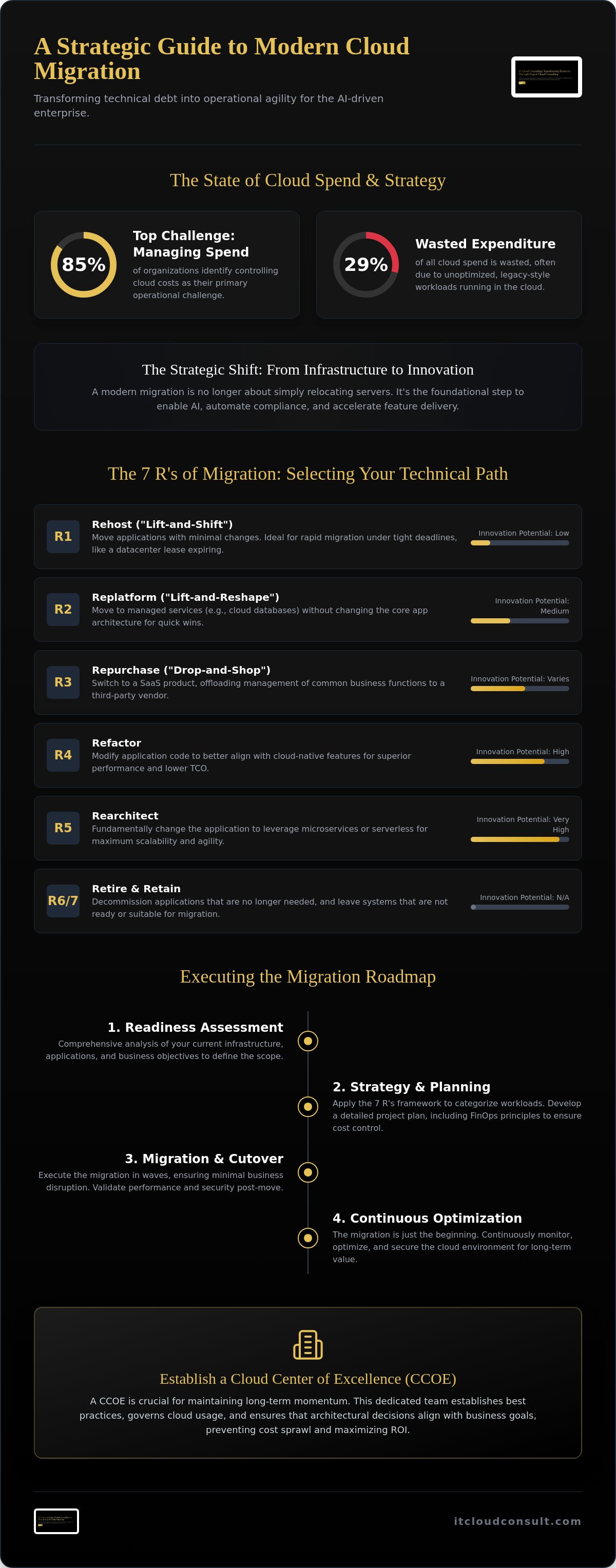
85% of organizations now identify managing cloud spend as their primary challenge, yet wasted expenditure has climbed to 29% for the first time in five years. It's understandable why many IT leaders approach modernization with caution. You likely recognize that the transition is necessary, but the fear of unexpected costs and the complexity of legacy system integration can create a sense of paralysis. A successful cloud migration strategy requires more than just moving data; it demands a visionary architecture that transforms technical debt into operational agility.
We're here to help you move past the uncertainty of service downtime and internal expertise gaps. This article provides a professional framework designed to align your infrastructure with your most ambitious growth targets. You'll gain a clear, phased roadmap that ensures predictable cloud expenditure and minimal business disruption. We'll examine how to categorize your workloads using the standard 7 Rs framework and establish a Cloud Center of Excellence to maintain long term momentum.
Key Takeaways
- Understand why a modern cloud migration strategy focuses on enabling AI and data innovation rather than simple server relocation.
- Learn to apply the industry-standard "7 Rs" framework to determine the most efficient technical path for every application in your portfolio.
- Identify how to align your technical architecture with core business drivers like operational agility and enhanced security.
- Discover the essential steps of a successful roadmap, from conducting a comprehensive readiness assessment to managing a seamless cutover.
- Explore why the migration finish line is the starting point for continuous cloud optimization and ongoing managed support.
Defining the Strategic Value of Cloud Migration in 2026
In the current fiscal year, the justification for moving to the cloud has matured beyond the simple desire to exit a physical data center. While early transitions focused on virtualizing hardware, a modern cloud migration strategy serves as the primary engine for enterprise evolution. By July 2026, the industry has reached a tipping point where 81% of organizations are actively utilizing generative AI, a feat nearly impossible to sustain on rigid, on-premise hardware. Traditional lift-and-shift methods, while fast, are no longer the default choice for forward-thinking leaders who recognize that mere relocation does not equal modernization.
Legacy systems are increasingly becoming strategic liabilities rather than assets. Stagnant infrastructure often lacks the granular data governance required by the January 2026 updates to the CCPA and the California Delete Act. Transitioning to cloud computing environments allows for the automation of these complex compliance requirements. Success in this new era is measured by business growth KPIs, such as accelerated feature release cycles or improved data liquidity, rather than the outdated metric of simple server uptime.
The Shift from Infrastructure to Innovation
Addressing the #1 Migration Fear: Cost Sprawl
Financial unpredictability remains a significant hurdle, as Flexera reports that managing cloud spend is the top challenge for 85% of organizations in 2026. Wasted cloud spend has climbed to 29%, largely driven by the surge in unoptimized AI workloads. A proactive cloud migration strategy mitigates this risk by integrating FinOps principles directly into the initial roadmap. This ensures that every architectural decision is linked to long-term operational efficiency. By establishing a dedicated Cloud Center of Excellence (CCOE) during the planning phase, your organization can maintain predictable expenditure while scaling resources to meet real-time demand.
The 7 Rs of Migration: Selecting Your Technical Path
Selecting the correct technical path is the most critical decision in your cloud migration strategy. The industry standard 7 Rs framework provides a logical structure to categorize workloads based on their business value and technical complexity. By July 2026, this framework remains the foundational methodology for visionary architects who seek to balance immediate operational needs with long term scalability. Each path represents a different level of investment and potential for innovation.
Rehosting, often called "lift-and-shift," involves moving applications to the cloud with minimal changes. This is the fastest route when facing urgent deadlines, such as data center lease expirations or hardware refresh cycles. Tools like AWS Application Migration Service (MGN) or Azure Migrate facilitate these transitions by maintaining the application's existing state. While efficient, rehosting doesn't capitalize on cloud-native features like auto-scaling or managed databases, which can lead to higher long term costs if left unoptimized.
Replatforming and Refactoring offer a strategic middle ground. Replatforming allows you to move to a managed service, such as a cloud-hosted database, without changing the application's core architecture. Refactoring involves modifying the code to better align with cloud environments. This often results in superior performance and lower operational overhead. For organizations looking to modernize their delivery, Repurchasing involves moving to a SaaS model, effectively offloading the management of common business functions to specialized vendors.
Modernization vs. Simple Relocation
Choosing between these paths requires a deep understanding of cloud migration readiness. Modernization through Rearchitecting or Rebuilding is reserved for core business assets that drive competitive advantage. These approaches allow you to leverage microservices and serverless computing. While the initial investment is higher, the realized potential in scalability and innovation is unmatched. If you're unsure which path fits your specific infrastructure, seeking expert Strategic Cloud Adoption guidance can clarify the roadmap ahead.
The Strategic Choice to Retain or Retire
A visionary architect knows that not every workload belongs in the cloud. Retiring redundant applications can reduce your attack surface and technical debt immediately. Retaining applications on-premise is a valid strategic choice for legacy systems that have strict compliance requirements or are nearing their end-of-life. Conducting a thorough gap analysis ensures that your resources are focused on high-impact transitions. This methodical approach prevents the migration of "waste" and ensures that your cloud environment remains lean, secure, and focused on future growth.
Aligning Migration Strategies with Core Business Drivers
A successful cloud migration strategy does not exist in a vacuum; it's a direct response to specific organizational pressures and long term goals. While the technical paths described in the previous section provide the "how," your core business drivers define the "why." Whether your primary objective is to achieve unprecedented agility, reduce operational overhead, or fortify security, every architectural decision must map back to these intended outcomes. In 2026, this alignment is the difference between a high-performing digital ecosystem and a costly, fragmented infrastructure.
Regulatory compliance has become a dominant driver for modernization. With the January 1, 2026, updates to the CCPA requiring comprehensive privacy risk assessments for automated decision-making, many legacy systems simply cannot provide the necessary transparency. Additionally, the April 22, 2026, COPPA compliance deadline for new retention and disclosure requirements has made stagnant on-premise hardware a significant liability. Transitioning to a managed cloud environment allows for the implementation of automated governance guardrails that ensure continuous compliance without manual intervention.
Risk mitigation for mission-critical systems requires a sophisticated understanding of your organization's risk profile. While some smaller workloads might benefit from a rapid transition, core legacy assets often demand a more methodical approach to maintain data integrity. Establishing clear success metrics early ensures that the migration delivers tangible business value, such as a reduction in technical debt or a measurable increase in system resilience.
Agility and Innovation Drivers
Operational Continuity and Risk Management
Choosing between a "Big Bang" cutover and a phased migration is a strategic calculation of your risk tolerance. A phased approach allows for the validation of security protocols and data integrity at each stage, minimizing the potential for business disruption. Before the first workload moves, you must establish robust governance guardrails. This proactive stance ensures that your new cloud environment is secure from day one, providing a stable platform for the next phase of your enterprise evolution.
Executing the Roadmap: From Readiness to Cutover
Transforming a high-level vision into a functioning environment requires a methodical, five-step execution framework. This transition is where the cloud migration strategy moves from abstract architecture to tangible operational reality. The process begins with a comprehensive Cloud Readiness Assessment. This phase evaluates your technology, but it also scrutinizes your people and processes. According to Flexera’s March 2026 report, 71% of organizations now utilize a central Cloud Center of Excellence (CCOE); establishing this body is a critical prerequisite for handling the complexities of modern scale.
The Importance of the Discovery Phase
Portfolio Discovery is the second essential step. You must create a detailed inventory of every application, database, and server in your environment. Automated discovery tools are indispensable here, as they map complex application dependencies that are often invisible to manual audits. Failing to identify these connections is a primary cause of "broken" migrations where interdependent services lose connectivity. During this phase, you should identify "low-hanging fruit," such as non-critical dev/test environments. Migrating these first provides early wins that build organizational confidence and allow your team to refine their workflows before moving mission-critical assets.
Once discovery is complete, you move to Strategy Selection, assigning one of the 7 Rs to every workload as discussed previously. This leads directly into the Pilot Migration. By testing your framework with low-risk applications, you can validate your security protocols and connectivity in a live cloud setting without risking production stability. If your organization lacks the internal bandwidth to manage this granular assessment, engaging with experts in Strategic Cloud Adoption can ensure your roadmap is built on a foundation of technical precision.
Testing and Validation Protocols
The final stage is Full-Scale Execution and Cutover. This methodical move to production relies on clearly defined cutover criteria to minimize business disruption. You must establish "go/no-go" checkpoints based on data synchronization status and latency benchmarks. Post-migration validation is equally vital; you must ensure that performance in the new environment matches or exceeds your previous on-premise metrics. Finally, the cutover is only successful if your team is prepared for the new operational reality. Training staff on cloud-native management tools ensures that the agility gained during migration is not lost to a lack of expertise. This comprehensive approach turns a complex transition into a predictable, value-driven evolution.
Beyond the Move: Continuous Optimization and Strategic Support
The moment of cutover is often celebrated as the finale, but a truly professional cloud migration strategy recognizes that the successful move is merely the beginning of a larger evolution. Reaching the cloud is a technical achievement; staying there efficiently is a strategic one. As organizations integrate more generative AI workloads into their operations, the complexity of resource management increases. Without a structured approach to "Day 2" operations, the agility gained during the move can be quickly offset by new forms of technical debt and unmanaged expenditure. This phase is where your architectural vision is refined into long term operational excellence.
Post-Migration Cost and Performance Tuning
Effective optimization starts with aggressive rightsizing. During the initial migration phase, it's standard practice to over-allocate resources to mitigate performance risks. However, leaving these "safety" settings untouched is a primary driver of the 29% wasted cloud spend currently reported across the industry in 2026. You must transition from a traditional "provisioned" mindset to a dynamic "consumption" mindset. Utilizing automation to scale resources in real-time ensures that your infrastructure matches your actual demand cycles without manual intervention. Regular architecture reviews are equally vital for maintaining a competitive edge. Cloud providers frequently release new instance types or storage tiers, such as the AWS EBS gp3 or Azure Premium SSD v2 options, which offer superior price-to-performance ratios. Incorporating these updates ensures your architecture doesn't become a legacy system within the cloud itself.
Partnering for Long-Term Cloud Success
Sustaining peak performance requires more than just reactive troubleshooting. It demands a visionary architect who can anticipate regulatory shifts and technological breakthroughs before they impact your bottom line. Whether you're adapting to the latest CCPA privacy risk assessment requirements or scaling for global expansion, having a dependable guide is essential for navigating the complexities of modern infrastructure. Ongoing Cloud Support provides the safety net needed to experiment with new services while maintaining a secure, compliant environment. IT Cloud Consulting specializes in this long term alignment, ensuring that your technical roadmap always supports your broader business objectives. We don't just help you move; we help you evolve into a more resilient, forward-looking enterprise.
Discover how our Strategic Cloud Adoption services can transform your business and provide the foundation for your next stage of growth.
Mastering the Evolution of Your Digital Infrastructure
Executing a sophisticated cloud migration strategy is the most impactful step you can take toward securing long term operational agility. By moving beyond simple relocation and embracing a framework of continuous optimization, you transform IT from a cost center into a catalyst for innovation. This article has outlined how the 7 Rs framework and a dedicated Cloud Center of Excellence mitigate risks while maximizing the ROI of your digital evolution. Success in 2026 requires this blend of technical precision and strategic foresight.
As you move from planning to execution, partnering with a seasoned expert provides the strategic confidence necessary for success. We offer expert advisory for national enterprise transformations and proven roadmap development to prevent cost sprawl. Our team remains invested in your trajectory through comprehensive managed support for Day 2 operations. Schedule a Strategic Cloud Readiness Assessment with IT Cloud Consulting to unlock the latent potential of your infrastructure. The future of your enterprise is waiting for a visionary foundation. We look forward to helping you build it.
Frequently Asked Questions
What are the 7 Rs of cloud migration?
The 7 Rs include Rehost, Replatform, Repurchase, Refactor, Rearchitect, Retain, and Retire. This comprehensive framework classifies every workload based on its technical complexity and business value. While Rehosting offers the fastest path for urgent exits, Rearchitecting provides the highest potential for long term innovation and scalability. Selecting the appropriate "R" for each application ensures your resources are focused where they deliver the most significant organizational impact.
How do I choose the right cloud migration strategy for my business?
Aligning your technical path with core business drivers like agility, cost, or security is essential. Start by identifying the primary "why" behind your move. If your goal is rapid market entry, a Rehosting or Replatforming approach might be suitable. Strategic Cloud Adoption involves balancing these immediate needs with future growth potential. A visionary architect ensures that every decision supports the organization's broader corporate vision and long term scalability.
What is the most common mistake in cloud migration planning?
Treating migration as a purely technical event rather than a strategic business evolution is a frequent pitfall. Many organizations fail to conduct a thorough readiness assessment or ignore the "Day 2" operational requirements. This oversight often leads to cost sprawl and technical debt. Without a dedicated Cloud Center of Excellence to manage governance and optimization, the promised benefits of the cloud environment can remain largely unrealized.
How long does a typical enterprise cloud migration take?
A comprehensive enterprise migration typically spans six to twenty-four months, depending on the portfolio's complexity. Smaller, low-risk pilots can be completed in weeks, providing early validation of the framework. Larger, mission-critical systems requiring Rearchitecting naturally take longer. Establishing a phased roadmap allows for continuous progress while minimizing business disruption, ensuring that each stage of the transition adds measurable value to the organization's digital ecosystem.
Is rehosting (lift-and-shift) always the cheapest migration option?
Rehosting is often the cheapest option in terms of initial migration effort, but it can become the most expensive over time. Because it doesn't utilize cloud-native features like auto-scaling, you may end up paying for idle resources. A successful cloud migration strategy prioritizes long term Cloud Optimization to eliminate this waste. Sometimes, a slightly higher initial investment in Replatforming yields much greater cost efficiency by utilizing managed services from the start.
What is a cloud readiness assessment and why do I need one?
A cloud readiness assessment is a comprehensive evaluation of your people, processes, and technology. It identifies potential gaps in internal expertise and technical dependencies before the migration begins. You need this assessment to prevent "broken" migrations and unexpected downtime. By understanding your current state, you can build a more predictable roadmap that aligns with your security requirements and ensures a seamless transition to a modernized environment.
How do I manage security risks during a cloud migration?
Managing security requires a zero-trust approach and the establishment of governance guardrails before any data moves. You must ensure that encryption, identity management, and compliance protocols are integrated into the migration framework. Automated monitoring tools help maintain visibility across hybrid environments. This proactive stance protects your data integrity during the transition and ensures your new cloud infrastructure meets all regulatory standards, such as CCPA, from day one.
Can I migrate legacy systems to the cloud without rewriting code?
Yes, Rehosting and Replatforming allow you to move legacy systems with minimal to no code changes. These strategies are ideal for applications that are stable but need to exit aging on-premise hardware quickly. While this approach provides a faster exit, it may limit your ability to leverage advanced cloud-native features like serverless computing. Choosing these paths should be a deliberate decision based on the application's remaining life cycle and business importance.


