
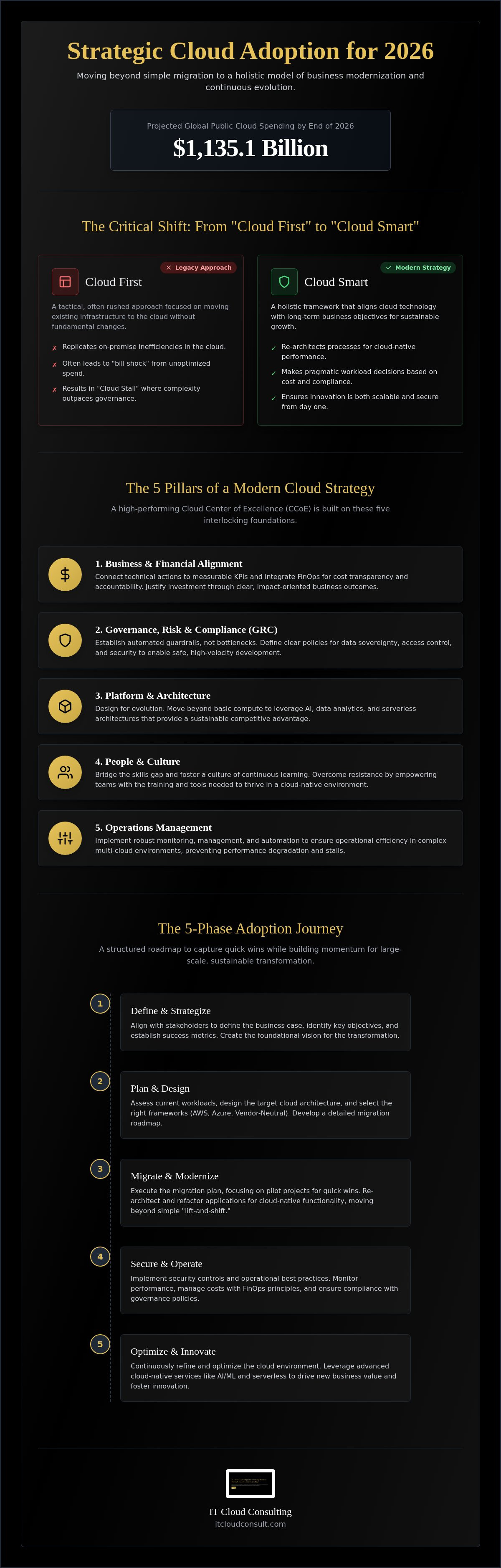
Most cloud migrations fail not because the technology is flawed, but because the strategy treats the cloud as a destination rather than a continuous evolution. As global public cloud spending is projected to reach $1,135.1 billion by the end of 2026, the stakes for strategic cloud adoption have never been higher for the modern enterprise. You likely recognize the immense potential for agility; however, you're probably also grappling with the reality of bill shock, cultural resistance, and the complexity of managing multi-cloud architectures.
It's a common challenge to feel as though your infrastructure is scaling faster than your team's ability to govern it. We're here to bridge that gap. This comprehensive guide provides the roadmap you need to move from a "cloud first" mindset to a "cloud smart" reality. You'll master the phases and frameworks necessary to secure your environment, optimize your costs, and reduce time-to-market. We will break down the transition from legacy systems to a high-performance, cloud-native future, ensuring your organization achieves the operational efficiency required to lead in a competitive market.
Key Takeaways
- Learn why strategic cloud adoption in 2026 demands a shift from legacy "lift-and-shift" tactics to a holistic model of business modernization.
- Identify the five foundational pillars necessary to establish a high-performing Cloud Center of Excellence within your organization.
- Compare the advantages of provider-specific frameworks like AWS and Azure against vendor-neutral approaches to find your ideal strategic fit.
- Master a structured five-phase roadmap designed to capture immediate quick wins while building momentum for large-scale transformation.
- Discover how strategic advisory and ongoing support can help your enterprise navigate complex multi-cloud environments and reduce time-to-market.
What is Strategic Cloud Adoption in 2026?
Strategic cloud adoption is far more than a technical migration; it's a comprehensive framework that aligns an organization's digital infrastructure with its long-term commercial objectives. In 2026, the era of simple "lift-and-shift" is over. Modern leaders recognize that merely replicating on-premise inefficiencies in a virtual environment doesn't drive value. Instead, they focus on transforming their core business models to leverage the full elasticity and innovation potential of cloud computing. This evolution moves beyond basic storage and compute, prioritizing the integration of AI, real-time data analytics, and serverless architectures to foster enterprise-wide agility. Without strategic intent, technical implementation often becomes a series of expensive, disconnected projects that fail to move the needle on market share or operational efficiency. By architecting for evolution from day one, you ensure that your technology stack remains an asset rather than a liability.
The Distinction Between Migration and Strategic Adoption
Migration is a tactical event focused on moving data or virtual machines from point A to point B. It often targets short-term cost savings that may never materialize if the underlying architecture remains rigid. In contrast, strategic cloud adoption involves re-architecting business processes to thrive in a distributed environment. While a "Cloud-First" mentality was once the standard, 2026 demands a "Cloud-Smart" approach. This means making pragmatic decisions about where workloads live based on performance, compliance, and cost, rather than following a dogmatic mandate to move everything at once. This shift ensures that every cloud investment directly contributes to a sustainable competitive advantage and long-term resilience.
Why Ad-hoc Adoption Fails in the Modern Enterprise
Ad-hoc adoption frequently leads to the "Shadow IT" trap, where departments provision their own resources without central oversight. This creates massive security and compliance gaps that are difficult to close after the fact. Siloed operations also result in uncoordinated cloud spend, leading to the "bill shock" that plagues many unguided enterprises. Cloud Stall is the systemic deceleration of modernization efforts occurring when technical complexity outpaces an organization's governance, cultural readiness, and cost management frameworks. By establishing strategic guardrails early, you prevent these fractures and ensure that innovation remains both scalable and secure.
The 5 Pillars of a Modern Cloud Adoption Strategy
Establishing a Cloud Center of Excellence (CCoE) is the definitive step in moving from experimental cloud use to a mature, enterprise-wide standard. This governing body ensures that the five pillars of modernization don't exist in isolation but rather reinforce one another to drive sustainable growth. When these perspectives interlock, technical capabilities naturally align with the organization's maturity level. This transition also marks a fundamental shift in financial philosophy. Moving from a Capex model, where hardware is a sunk cost, to an Opex model allows for a more responsive and consumption-based financial strategy. This shift is a cornerstone of strategic cloud adoption, enabling your business to pivot resources toward innovation rather than just maintenance.
Business and Financial Alignment
A successful cloud journey begins with a business case that justifies the investment through clear, impact-oriented outcomes. You must connect technical actions to measurable KPIs, such as revenue growth or a significant reduction in time-to-market for new products. Integrating FinOps into the core of your strategy provides the cost transparency needed to manage a variable spending model. This financial discipline ensures that cloud usage is always optimized and that every department remains accountable for their consumption. By treating cloud costs as a strategic lever rather than an IT overhead, you unlock the ability to fund further modernization through realized efficiencies.
Governance, Risk, and Compliance (GRC)
Governance should never be a bottleneck for innovation. Instead, it should act as a set of automated guardrails that protect the organization while allowing developers to move at speed. This is especially critical in highly regulated industries where compliance is non-negotiable. Utilizing a secure cloud adoption framework helps you define clear boundaries for data sovereignty and access control. In 2026, the Shared Responsibility Model has become more complex due to multi-cloud environments, requiring a unified approach to risk management that spans all providers.
People and Organizational Change
Modernization is as much a cultural shift as it is a technical one. The "Skills Gap" remains a primary pain point, and overcoming it requires a structured approach to upskilling your existing workforce. You must transition your IT department from a "Gatekeeper" role, which focuses on control and restriction, to an "Enabler" role that focuses on providing the tools and platforms teams need to succeed. Executive sponsorship is the catalyst for this change. Without a clear mandate from the top, internal inertia can stall even the most well-designed technical roadmaps. If you need assistance navigating these organizational shifts, expert strategic cloud adoption guidance can provide the necessary external perspective to drive change.
Evaluating Cloud Adoption Frameworks: AWS vs. Azure vs. Vendor-Neutral
Selecting the right framework is a pivotal decision that dictates the trajectory of your modernization journey. While hyperscalers offer robust blueprints, relying solely on a single provider's methodology can inadvertently limit your future flexibility. With 87% of organizations now employing a multi-cloud strategy (Quantumrun, May 2026), the need for a balanced, interoperable approach has become critical. IT Cloud Consulting specializes in synthesizing these disparate frameworks into a cohesive, client-specific roadmap that prioritizes long-term resilience over vendor convenience. This synthesis ensures that your strategic cloud adoption journey isn't just about moving workloads, but about building a foundation for continuous evolution.
Microsoft Azure CAF: Strengths and Limitations
The Microsoft Azure Cloud Adoption Framework (CAF) is exceptionally strong for enterprises already committed to the Microsoft ecosystem. It provides deeply granular guidance on the "Govern" and "Manage" methodologies, making it ideal for organizations prioritizing strict administrative control and seamless integration with existing enterprise agreements. However, its efficacy often wanes when dealing with non-Windows legacy workloads or complex Linux-based environments. For these hybrid scenarios, a more adaptable strategy is necessary to prevent operational friction and ensure that your cloud environment doesn't become a siloed extension of your old data center.
AWS CAF: Best Practices for Rapid Scaling
AWS remains a leader in cloud infrastructure with a 30% market share as of early 2026 (Quantumrun, May 2026). Their CAF is designed for speed, focusing heavily on the "Envisioning" and "Aligning" phases to catalyze rapid innovation. It's the preferred choice for organizations looking to iterate quickly and adopt cloud-native services like serverless and advanced AI. The challenge lies in the complexity it introduces for enterprises with significant on-premise footprints. In these cases, the AWS innovation-first philosophy can sometimes clash with the need for steady-state stability, requiring a careful balancing act to maintain service levels during the transition.
The Case for a Vendor-Neutral Strategic Roadmap
A vendor-neutral roadmap offers the most protection against vendor lock-in. By focusing on architectural abstraction and service portability, you ensure that your business remains agile enough to shift workloads as market conditions or pricing models change. Managing multi-cloud complexity requires a unified strategy that bridges the gaps between proprietary frameworks. Strategic cloud adoption in this context means leveraging professional advisory services to provide the objective expertise needed to integrate best-of-breed solutions. This approach allows you to harness the unique strengths of different providers while maintaining a single, secure, and scalable governance model across your entire digital estate.
Building Your Roadmap: The 5-Phase Adoption Journey
Phase 1 & 2: Assessment and Strategic Planning
Success begins with a clear-eyed understanding of your starting point. Conducting a thorough cloud readiness assessment allows you to evaluate your current infrastructure, team skills, and operational maturity. During this phase, you must define your "North Star" metrics, such as a 30% reduction in provisioning time or a specific improvement in application uptime, to ensure every technical decision aligns with business value. The discovery process for legacy systems involves a forensic analysis of interdependencies and resource utilization to uncover hidden complexities before they impact the migration timeline. This planning phase prevents the "Cloud Stall" mentioned earlier by setting realistic expectations and clear governance guardrails from the outset.
Phase 3 & 4: Landing Zone Setup and Migration
Before moving production workloads, you must architect a secure landing zone. This foundation serves as the "digital real estate" where your applications will live, incorporating the security, networking, and identity management policies defined in your GRC pillar. When it comes to the migration itself, you must choose the appropriate strategy for each workload using the "6 Rs" framework: Re-host, Re-platform, Re-factor, Re-purchase, Retire, or Retain. Executing a pilot migration with a non-critical but representative application is essential to validate your landing zone design and migration tooling. This step provides the practical data needed to refine your approach before scaling to the rest of the enterprise estate.
Phase 5: Continuous Optimization and Evolution
The journey doesn't end when the last server is migrated. Transitioning from "Day 1" operations to "Day 2" optimization is where the true value of the cloud is realized. This phase focuses on implementing automated scaling, performance tuning, and continuous cost governance through FinOps practices. Leveraging managed services and strategic cloud adoption expertise allows your internal teams to move away from routine maintenance and toward high-value innovation. If you're ready to move beyond simple migration and start architecting for long-term growth, partner with IT Cloud Consulting to build a roadmap that scales with your ambition.
Accelerating Transformation with IT Cloud Consulting
Modernization is complex. In an era where the global cloud computing market is expected to surpass $1 trillion by the end of 2026, the path to strategic cloud adoption requires more than just technical proficiency; it demands a partner who understands the intricate dance between infrastructure and business value. IT Cloud Consulting serves as your dependable guide, bridging the gap between high-level vision and technical execution. We don't just provide a service; we offer a strategic partnership designed to reduce the risks of migration while accelerating your return on investment. By navigating the nuances of multi-cloud ecosystems on your behalf, we empower your leadership team to move forward with a strategic cloud adoption plan that is both ambitious and achievable.
The "Visionary Architect" Approach
Ensuring Long-Term Success with Managed Services
The realization of your cloud vision doesn't end with a successful migration. Ongoing Cloud Support is essential to prevent the performance decay and cost creep that often follow initial adoption. Our managed services provide continuous monitoring and Cloud Optimization, ensuring your environment remains lean and high-performing as your workloads scale. In the 2026 landscape, staying ahead of regulatory changes is non-negotiable. We integrate proactive security management that aligns with the latest standards, such as the FedRAMP "Consolidated Rules for 2026" finalized on June 25, 2026. This methodical oversight provides the steady assurance you need to innovate without compromising your compliance posture.
As you look toward the future of your enterprise, don't let technical complexity stall your progress. Our team is ready to help you architect a future defined by efficiency and scalability. Schedule your strategic cloud adoption assessment with IT Cloud Consulting and take the first step toward a fully optimized, cloud-native organization.
Mastering Your Enterprise Evolution
Transitioning to the cloud is no longer a choice of "if" but a matter of "how effectively." We've explored how a successful strategic cloud adoption journey requires more than technical migration; it demands a holistic alignment of business goals, governance, and organizational culture. By moving through a structured five-phase journey and selecting frameworks that prioritize flexibility, you position your organization to harness the full potential of modernization while avoiding the common pitfalls of cloud stall and bill shock.
Realizing this vision requires a partner who provides more than just tools. IT Cloud Consulting offers professional assessment and optimization of your existing infrastructure, alongside strategic planning and roadmap development tailored to your specific organizational needs. With our continuous monitoring and management services, you can maintain long-term system health and security while your internal teams focus on driving innovation. The path to becoming a cloud-native leader is clear, and the right guidance ensures that every technical action delivers a measurable business result.
The opportunity to lead your industry through digital transformation is within your reach. Architect your future with a customized Strategic Cloud Adoption Roadmap today. Your organization's potential is ready to be realized, and we are here to ensure your journey is successful and sustainable.
Frequently Asked Questions
What is the difference between cloud migration and strategic cloud adoption?
Cloud migration is a tactical project focused on moving data or virtual machines from one location to another. Adoption is a holistic business transformation that involves re-architecting processes to leverage the cloud's full potential. This distinction ensures your technology stack drives long-term competitive advantage rather than just replicating on-premise inefficiencies in a virtual environment.
How long does a typical strategic cloud adoption roadmap take to implement?
A typical strategic cloud adoption roadmap spans six to eighteen months depending on the complexity of your legacy estate. The initial assessment and planning phases usually take two to three months, while actual workload migration occurs in structured waves. It's an iterative journey where early quick wins build the momentum needed for larger, more complex modernization initiatives.
What are the most common reasons cloud adoption strategies fail?
Most strategies fail because organizations prioritize technical speed over cultural change and governance. When teams lack executive alignment or a clear business case, they often experience "bill shock" and security vulnerabilities. Without a centralized framework, modernization efforts frequently stall as technical complexity outpaces the organization's ability to manage its new cloud environment.
Do we need a multi-cloud strategy for a successful transformation?
While not strictly mandatory, 87% of organizations now use a multi-cloud approach to avoid vendor lock-in and enhance resilience (Quantumrun, May 2026). This strategy allows you to choose best-of-breed services from different providers for specific needs, like AI or high-performance computing. It ensures your business remains agile and isn't tied to a single provider's pricing or service limitations.
How does strategic cloud adoption impact our existing IT security posture?
Strategic cloud adoption strengthens your security posture by replacing fragmented legacy controls with a unified, automated governance framework. By shifting to a zero-trust model and utilizing secure landing zones, you reduce the risk of human error and configuration gaps. This approach ensures security is a foundational component of your architecture rather than a layer added after the fact.
How can we measure the ROI of our cloud modernization efforts?
You can measure ROI by tracking metrics such as total cost of ownership (TCO) reduction, improved application uptime, and decreased time-to-market for new features. It's also vital to evaluate indirect benefits like increased developer productivity and the ability to scale resources instantly. These data points provide a clear link between technical modernization and overall organizational growth.
What is a Cloud Center of Excellence (CCoE) and do we need one?
A Cloud Center of Excellence (CCoE) is a cross-functional team that establishes the standards and best practices for your cloud journey. You need one to ensure that different departments don't operate in silos, which can lead to security gaps and uncoordinated spending. This body acts as a visionary guide, aligning technical implementation with your broader business strategy.
Can strategic cloud adoption help reduce our monthly AWS or Azure spend?
Yes, focusing on optimization can significantly lower your monthly cloud bills by eliminating waste and rightsizing resources. By implementing FinOps practices, you gain the cost transparency needed to pay only for the compute and storage you actually consume. This disciplined approach prevents the "bill shock" that often occurs when cloud environments are left unmanaged and unoptimized.


