
A cloud migration without a strategic blueprint isn't an evolution; it's an expensive gamble with your operational stability. Most enterprise leaders recognize that the cloud is the primary engine for long-term modernization, yet the persistent fear of hidden costs and internal skill gaps often stalls progress. You understand that the transition is inevitable, but the uncertainty of potential downtime remains a significant hurdle in your strategic planning. It's a complex challenge to align technical requirements with business objectives while ensuring your team is prepared for the shift to cloud-native environments.
This article provides a comprehensive cloud readiness assessment designed to replace that uncertainty with a clear, authoritative roadmap. By evaluating your organization’s technical and operational preparedness through a strategic lens, you can mitigate risks and realize the latent potential within your infrastructure. We'll walk through a detailed checklist that bridges the gap between current limitations and a more optimized future state, giving you the confidence to lead a successful transition that delivers measurable value.
Key Takeaways
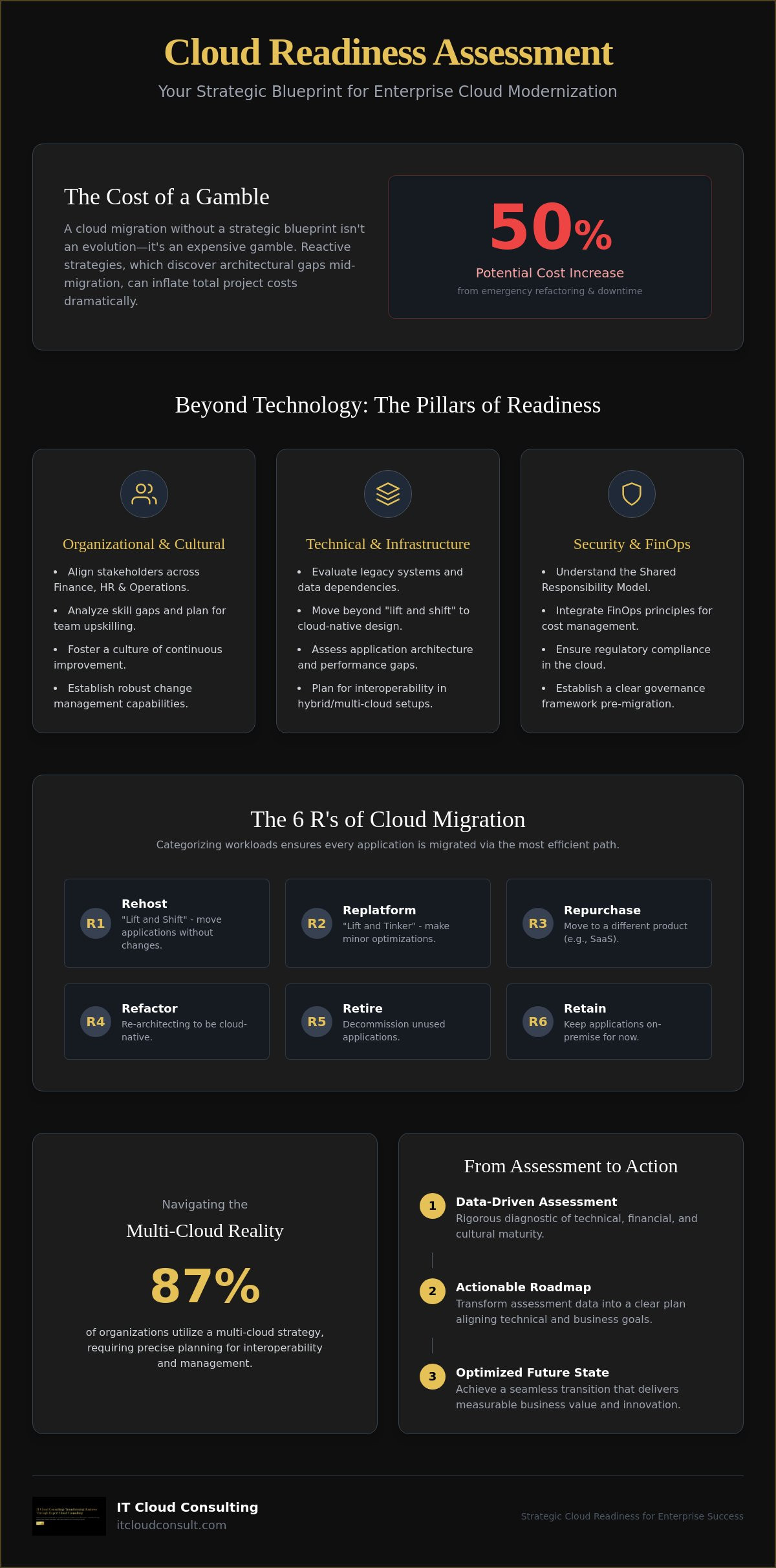
- A comprehensive cloud readiness assessment serves as a strategic blueprint that identifies performance gaps early, preventing the 50% cost increase often triggered by reactive migration strategies.
- Cultural alignment across Finance, HR, and Operations is essential for long-term success, as organizational readiness is frequently the primary factor in determining the speed of cloud adoption.
- Categorizing workloads through the "6 Rs" framework ensures that every application is migrated using the most efficient path, whether it requires simple rehosting or a complete architectural refactor.
- Maintaining compliance and financial health depends on a deep understanding of the Shared Responsibility Model and the integration of FinOps principles into your operational framework.
- Transforming assessment data into an actionable roadmap aligns your technical infrastructure with overarching business objectives, facilitating a seamless transition toward a more optimized future state.
The Strategic Necessity of a Cloud Readiness Assessment in 2026
A cloud readiness assessment is not merely a technical scan of your server environment; it's a rigorous diagnostic of your organization’s technical, financial, and cultural maturity. As we move through 2026, the complexity of enterprise ecosystems has outpaced the utility of simple migrations. This assessment serves as the foundational phase of strategic cloud adoption, ensuring that your infrastructure isn't just moved, but evolved. Organizations that bypass this deep-dive often encounter architectural friction mid-migration. Industry data suggests that discovering these gaps during the execution phase can increase total project costs by as much as 50% due to emergency refactoring and operational downtime.
Modern standards have moved beyond the "lift and shift" mentality of previous years. Today, the focus is on cloud-native evolution, where applications are optimized to leverage elastic scaling and serverless architectures from day one. By evaluating your readiness early, you transition from a reactive posture to a proactive strategy that treats the cloud as a catalyst for business transformation rather than just a different data center.
Why "Good Enough" is No Longer Enough
The 2026 landscape is defined by intricate multi-cloud and hybrid environments. With 87% of organizations now utilizing a multi-cloud strategy, managing the interoperability between providers like AWS, Azure, and Google Cloud requires a level of precision that basic audits can't provide. A formal cloud readiness assessment prevents "cloud stall," a common phenomenon where migrations grind to a halt because of unforeseen data gravity or legacy dependencies. Unlike a vendor-led audit, which often focuses on licensing and consumption, a strategic consulting assessment evaluates how different cloud migration strategies align with your long-term business goals.
The ROI of Proactive Assessment
Identifying technical debt before it becomes a migration blocker is the most effective way to protect your budget. A proactive assessment quantifies the cost of maintaining legacy systems versus the gain of modernization, providing a clear financial justification for every move. This transparency isn't just for IT; it's a tool for aligning stakeholders across the business. When Finance, Operations, and Engineering agree on the roadmap, the result is a faster time-to-market for new features and a significant reduction in the risks associated with large-scale change. You aren't just checking boxes; you're building a sustainable engine for growth.
Organizational and Cultural Readiness: The Human Element
Technology is rarely the primary barrier to modernization. In reality, cultural misalignment stands as the leading cause of failed cloud initiatives. A robust cloud readiness assessment must therefore look beyond the server room to evaluate the "Cloud IQ" of the entire organization. This involves assessing whether leadership views the cloud as a strategic asset or merely a tactical expense. Success requires active participation from stakeholders in Finance, HR, and Operations, each of whom must adapt their traditional processes to support a more fluid, cloud-centric environment. As noted in studies regarding Organizational and Cultural Readiness, the synergy between people, governance, and technology is what ultimately scales innovation and ensures long-term viability.
Establishing a baseline for change management capabilities is essential. You need to determine if your enterprise possesses the resilience to handle the shifts in workflow that accompany cloud adoption. This isn't just about technical training; it's about fostering a mindset that embraces continuous improvement and cross-departmental collaboration.
Skill Gap Analysis and Upskilling
The shift from managing physical hardware to orchestrating virtualized services requires a fundamental change in expertise. A critical component of your readiness checklist is a gap analysis between your current system administrators and the cloud architects required for future-state operations. You must determine if your internal teams have the bandwidth to execute a comprehensive cloud migration strategy or if external expertise is necessary to bridge the gap. Establishing a Cloud Center of Excellence (CCoE) provides a centralized hub for best practices, ensuring that your evolution is consistent and governed by a unified vision.
Cultural Alignment and Stakeholder Buy-In
Cloud adoption thrives on the principles of agility and DevOps. If your organization remains trapped in siloed thinking, where development and operations teams rarely communicate, the benefits of the cloud will likely remain out of reach. A successful cloud readiness assessment establishes clear business KPIs that go beyond technical uptime, focusing instead on agility and market responsiveness. Breaking down these silos requires a concerted effort from leadership to incentivize collaboration. If you find that internal resistance is stalling your progress, seeking strategic cloud adoption guidance can help align your human capital with your technical ambitions, turning potential friction into a shared roadmap for success.
Technical and Infrastructure Evaluation: A Modern Checklist
A successful cloud readiness assessment demands a granular inventory of your existing infrastructure. You can't modernize what you haven't mapped. This phase involves documenting every physical server, network dependency, and data center interconnection to identify potential bottlenecks before they manifest as migration failures. We categorize applications using the "6 Rs" framework; Rehost, Replatform, Refactor, Rearchitect, Retire, or Retain; to determine the most efficient path toward evolution. While rehosting offers a fast path to the cloud, refactoring often delivers the long-term optimization and scalability required for a truly competitive enterprise.
Data gravity remains a critical architectural consideration. As your datasets grow, the complexity and cost of moving them increase exponentially. Your assessment must evaluate egress costs and the potential for latency issues that could disrupt real-time operations. Legacy systems, often the backbone of mission-critical workflows, require a deep compatibility check to ensure they can integrate with modern, cloud-native services without creating new technical debt.
Application Portfolio Discovery
Discovery isn't just about listing software. It's about mapping the invisible threads that connect your workflows. A thorough cloud readiness assessment identifies application dependencies to prevent broken processes during the transition. By targeting "low-hanging fruit" such as non-critical development environments for early migration, you create quick wins that build organizational momentum. Simultaneously, evaluating the technical debt of legacy software allows you to prioritize which systems require a complete architectural overhaul.
Data and AI Readiness
In 2026, AI-related cloud spending has reached 19% of total technology budgets, making AI-readiness a mandatory component of your technical evaluation. You must assess whether your current data quality and pipelines can support AI/ML integration. Real-time data processing demands high network bandwidth and ultra-low latency, which may require upgrading your connectivity before migration begins. Balancing storage costs against performance requirements ensures your data architecture remains lean while supporting the high-compute needs of modern innovation.
Security, Compliance, and FinOps Readiness
Security is the non-negotiable pillar of any digital evolution. In a cloud environment, you don't just inherit security; you co-author it. A comprehensive cloud readiness assessment must map your current compliance requirements, such as GDPR, HIPAA, and SOC2, to their cloud-native equivalents. This ensures that your governance framework remains uninterrupted during the transition. Central to this is the Shared Responsibility Model. You must evaluate your organization’s ability to uphold its end of the bargain, specifically regarding identity and access management (IAM) maturity. If your current IAM protocols are fragmented, they'll become vulnerabilities the moment they're exposed to the public cloud's scale.
The transition also demands a fundamental shift in how you view technology spending. Without a robust FinOps framework established during the assessment phase, many enterprises fall victim to "Cloud Bill Shock." This phenomenon occurs when elastic resources are provisioned without the governance required to manage them. Establishing these financial guardrails early isn't just about saving money; it's about ensuring your cloud investment remains a sustainable engine for growth.
The Security Posture Audit
A security audit in 2026 requires more than a simple checklist. You must review encryption standards to meet the latest requirements, such as the 2026 HIPAA Security Rule updates that make AES-256 for data at rest and TLS 1.2 or higher for data in transit mandatory. Furthermore, for organizations operating across borders, the assessment must address the US CLOUD Act's implications on data sovereignty. Your disaster recovery and business continuity plans need to be re-architected for a cloud context, ensuring that your security tools are ready to operate in virtualized, high-velocity environments.
Financial Governance and FinOps
Financial readiness involves moving from traditional CapEx accounting to a dynamic OpEx model. In 2026, 78% of FinOps teams report directly to the CTO or CIO, reflecting a shift toward managing technology value rather than just costs. Your readiness checklist must include a cost-allocation tagging strategy and real-time tracking capabilities. This is particularly vital as 98% of FinOps teams now manage AI-related costs and 90% manage SaaS spending. Adhering to the IRS final regulations (T.D. 10022) released on January 10, 2025, regarding cloud transactions will ensure your financial reporting remains compliant as you modernize. Engaging in professional cloud optimization ensures your security architecture remains as lean as it is resilient.
Executing Your Cloud Roadmap with IT Cloud Consulting
A completed cloud readiness assessment provides the raw data, but the true challenge lies in translating those insights into a coherent execution plan. IT Cloud Consulting serves as your strategic partner, transforming diagnostic findings into a prioritized roadmap for Strategic Cloud Adoption. We bridge the gap between your existing legacy constraints and a future state defined by agility and operational excellence. Our approach ensures that every technical decision aligns with your overarching business objectives, preventing the fragmentation that often plagues unguided migrations.
We don't just identify gaps; we build the bridge. By positioning ourselves as the visionary architect of your transition, we provide the technical proficiency required to execute complex shifts without disrupting your core operations. This strategic alignment turns a high-level vision of success into a structured, manageable reality.
From Assessment to Action
Execution begins with intelligence. We prioritize migration waves based on immediate business impact and technical feasibility, ensuring that your transition generates value from the first day. Our consultants provide expert advice throughout the journey, helping you navigate the complexities of multi-cloud architectures and data gravity. This isn't a one-size-fits-all process. We deliver customized modernization solutions that address your specific technical debt while preparing your teams for a cloud-native environment. You gain a partner that possesses both the big-picture perspective and the granular expertise needed for precision execution.
Continuous Support and Optimization
Successful evolution doesn't end with the final migration wave. The initial assessment is merely the first step in a long-term partnership focused on sustained performance. Through our Ongoing Cloud Support, we maintain your system health and ensure your environment evolves alongside your business needs. We also provide targeted Cloud Optimization to refine your resource consumption, keeping your costs lean and your performance high. We invite you to a professional advisory session to kickstart your journey and turn your modernization goals into a reality. Request Your Cloud Readiness Assessment Strategy and begin your enterprise evolution today.
Architecting Your Path to Modernization
A successful transition to the cloud requires more than just technical migration; it demands a fundamental evolution of your organizational strategy. By conducting a comprehensive cloud readiness assessment, you effectively eliminate the ambiguity that leads to operational downtime and spiraling costs. You've seen that the human element is just as critical as the infrastructure, and that aligning your team’s culture with agile methodologies is the key to sustaining long-term growth. When technical precision meets financial governance through a robust FinOps framework, your organization moves from a state of reactive maintenance to one of proactive innovation.
The roadmap to your future state is within reach. IT Cloud Consulting provides the professional advisory needed for complex enterprise modernization. With deep expertise in multi-cloud and hybrid infrastructure and a proven track record in cloud cost optimization, we ensure your journey is both efficient and resilient. Don't leave your evolution to chance. Secure Your Strategic Cloud Adoption Roadmap and take the first step toward realizing your organization's latent potential. The future of your enterprise is waiting, and we're ready to guide you there with steady assurance.
Frequently Asked Questions
What is a cloud readiness assessment?
A cloud readiness assessment is a strategic diagnostic process that evaluates an organization’s technical, operational, and organizational maturity before a migration. It serves as a blueprint for modernizing infrastructure by identifying dependencies, skill gaps, and financial requirements. Rather than a simple inventory, it provides a comprehensive roadmap that aligns your IT capabilities with long-term business objectives, ensuring the transition is both predictable and scalable.
How long does a typical cloud readiness assessment take for an enterprise?
A typical assessment for a mid-to-large enterprise generally spans between four and twelve weeks depending on the complexity of the environment. This timeline allows for thorough application discovery, stakeholder interviews, and data analysis. Smaller organizations with centralized infrastructure might complete the process in as little as three weeks, while global enterprises with extensive legacy systems may require several months to ensure every dependency is accurately mapped.
Can we perform a cloud readiness assessment internally?
While internal teams can conduct a preliminary review, a professional cloud readiness assessment often requires the objectivity and specialized methodology of a strategic consultant. Internal assessments frequently miss hidden technical debt or cultural resistance due to departmental silos. Engaging an external partner provides access to advanced diagnostic tools and a broader industry perspective, which is essential for identifying the performance gaps that internal teams might overlook.
What are the most common gaps found during a cloud assessment?
The most frequent gaps identified include high levels of technical debt in legacy applications, a lack of cloud-native skills among current staff, and insufficient financial governance. Many organizations also discover that their existing security protocols don't translate directly to a shared responsibility model. Identifying these discrepancies early allows you to address them before they manifest as costly migration delays or operational failures during the execution phase.
How much does a professional cloud readiness assessment cost?
What is the difference between a technical audit and a readiness assessment?
A technical audit is a backward-looking inventory of existing hardware and software, whereas a readiness assessment is a forward-looking strategic evaluation. The audit tells you what you have; the assessment tells you how to evolve. It bridges the gap between current limitations and an optimized future state by analyzing organizational culture, financial readiness, and technical compatibility with cloud-native services like AI and elastic scaling.
What happens if our organization is found "not ready" for the cloud?
Being found "not ready" is not a failure but a strategic opportunity to remediate gaps before committing capital to a migration. This result provides a clear list of prerequisites, such as upskilling staff, refactoring mission-critical applications, or updating security frameworks. Addressing these foundational issues first ensures that when you do proceed, your organization is positioned to realize the full benefits of modernization without the risk of operational stall.
How often should a cloud readiness assessment be updated?
An assessment should be updated annually or whenever a significant change occurs in your technical or business landscape. As cloud providers release new services and regulatory requirements evolve; such as the 2026 HIPAA Security Rule updates; your readiness posture can shift. Regular updates ensure that your strategic roadmap remains aligned with current market standards and that your infrastructure is continuously optimized for performance and compliance.


