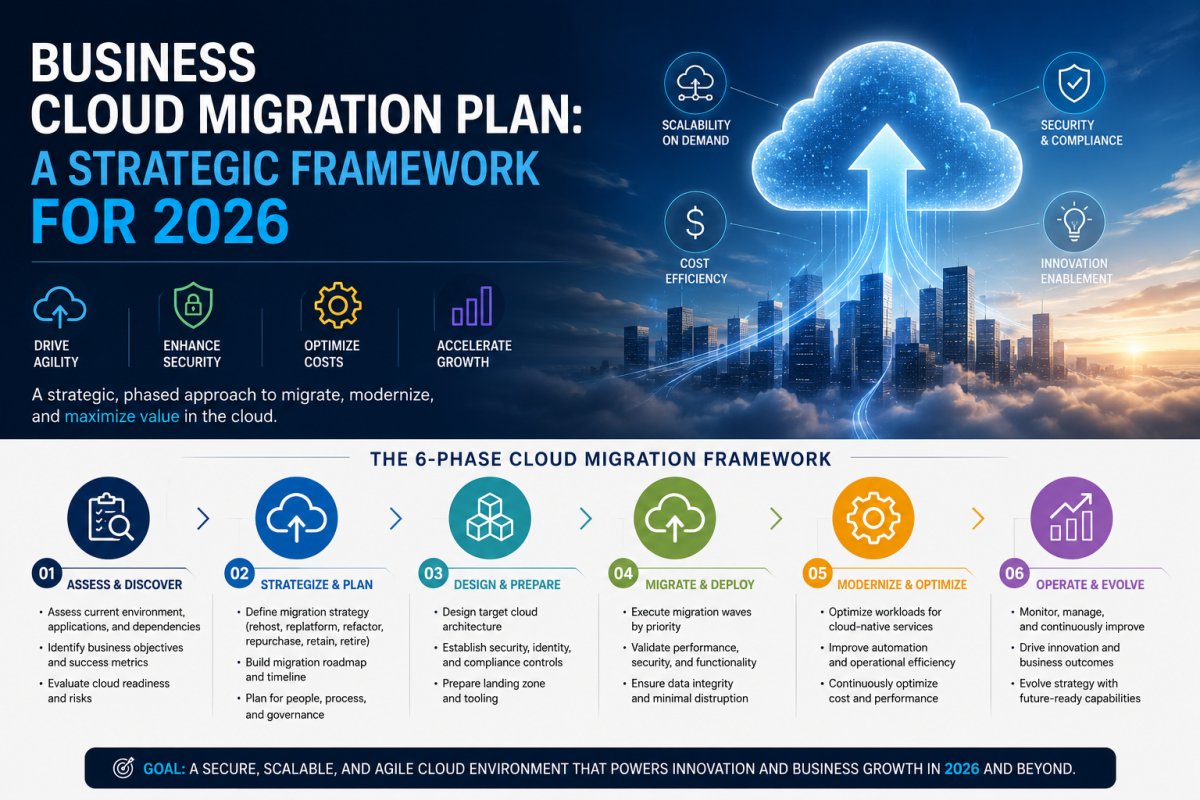
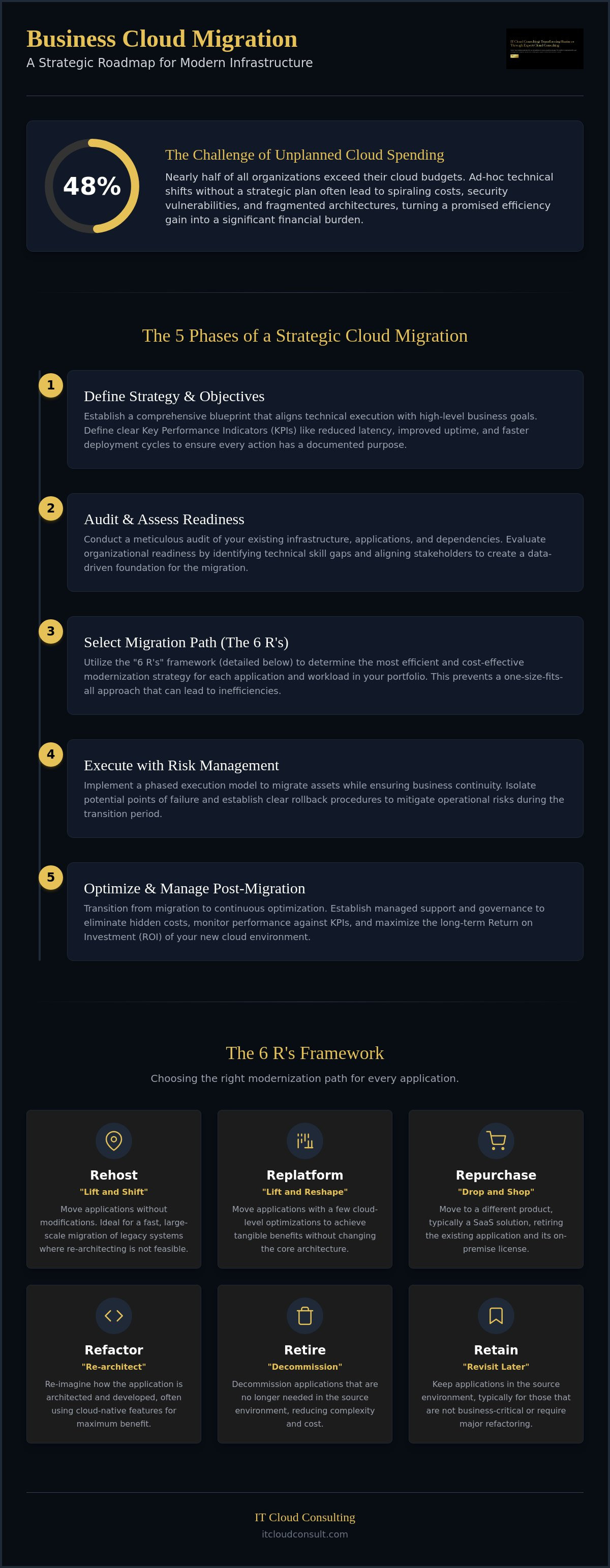
Nearly 48% of organizations exceed their cloud budgets due to inadequate foresight, turning a supposed efficiency gain into a significant financial burden. You likely understand that a transition is necessary to maintain a competitive edge, yet the complexity of integrating legacy systems and the persistent fear of data loss can stall even the most ambitious initiatives. Developing a robust business cloud migration plan is no longer just a technical requirement; it's a foundational move to secure your organization's future and realize its latent potential within an increasingly digital economy.
This article provides the professional roadmap you need to modernize your infrastructure with steady assurance and strategic precision. We'll explore a framework that balances immediate operational needs with long-term scalability, ensuring your migration results in predictable spending rather than spiraling costs. By the end of this guide, you'll have a clear understanding of the 7 R’s of migration, the impact of 2026 regulatory shifts, and the specific steps required to transform your enterprise into a highly optimized, cloud-first organization that is ready for the future.
Key Takeaways
- Understand how a strategic, blueprint-led approach to infrastructure transition outperforms ad-hoc technical shifts in the 2026 landscape.
- Identify organizational readiness and technical skill gaps through a comprehensive audit of your existing on-premise assets.
- Leverage the "6 R" framework to determine the most efficient modernization path for every application within your business cloud migration plan.
- Mitigate operational risks and ensure business continuity by implementing a phased execution model that isolates potential points of failure.
- Establish a foundation for continuous cloud optimization and managed support to eliminate hidden costs and maximize long-term ROI.
Defining the Strategic Business Cloud Migration Plan
A business cloud migration plan is a comprehensive blueprint designed to move digital assets, services, and databases into a cloud computing environment. As we move into 2026, the era of "lifting and shifting" without a broader vision has passed. Ad-hoc technical shifts often lead to fragmented architectures, security vulnerabilities, and unforeseen costs. Instead, a strategic approach treats migration as an organizational evolution. It requires a visionary architect who can bridge the gap between technical execution and high-level business objectives, ensuring every move serves a specific, documented purpose. This architect acts as both a designer of systems and a dependable guide for the entire enterprise.
This planning process serves as the foundation for long-term operational efficiency. By mapping out every dependency and legacy integration before the first byte of data moves, you prevent the friction that typically stalls enterprise projects. A well-constructed plan doesn't just address the technical mechanics of the transition; it justifies the move by connecting technical actions to the realization of latent organizational potential. For leaders who want to ensure their business's legal structure is equally prepared for the future, jm.legal provides the expertise needed to secure corporate legacies and transitions.
The Business Value of a Structured Roadmap
Successful transitions depend on connecting technical migration milestones to tangible growth targets. When you align migration stages with revenue-generating activities, the IT department transforms from a cost center into a strategic partner that drives value. A structured roadmap also provides the governance necessary to eliminate "shadow IT," where individual departments procure unvetted services independently. By centralizing oversight, you maintain security and compliance while fostering transparency across the entire enterprise. This methodology ensures that every stakeholder understands their role in the transition. A cloud migration plan is a strategic investment in modernization.
This investment is particularly critical for enterprises looking to expand their global footprint. For companies facilitating trade or investment between the US and Israel, the Israel Cross Border Law Firm provides the legal framework necessary to ensure cross-border business operations remain compliant and efficient.
Core Objectives: Beyond Simple Data Transfer
Modernization isn't just about moving data; it's about unlocking new capabilities. Your plan must define clear Key Performance Indicators (KPIs), such as reduced application latency, improved system uptime, or significantly faster deployment cycles. Scalability and agility should be your primary drivers, allowing your business to pivot as market conditions shift or customer demands evolve. This alignment ensures that your immediate technical efforts support broader Strategic Cloud Adoption goals, creating a stable foundation for long-term innovation and efficiency. Focusing on these outcomes prevents the migration from becoming a mere infrastructure swap.
Phase 1: Infrastructure Audit and Organizational Readiness
Successful modernization begins with a clinical evaluation of your existing environment. You need data. A robust business cloud migration plan isn't built on assumptions; it's constructed on insights derived from a meticulous infrastructure audit. This phase requires you to catalog every piece of hardware and software, but the inventory is only the surface. You're looking for the hidden connections that keep your business running. Identifying legacy systems that require specialized migration strategies early prevents costly delays during the execution phase. It’s about understanding the current state to envision the future potential.
Technology is only half the equation. You must also evaluate your organizational culture and identify technical skill gaps. Does your team understand cloud-native operations, or do they require upskilling? This assessment sets the foundation for a professional cloud readiness assessment, providing the clarity needed to proceed with confidence. By addressing both technical and human elements, you ensure the organization is prepared for the evolution ahead.
The Technical Audit: Mapping Your Current State
Preventing service interruptions requires documenting complex application dependencies. If you move one database without its connected application, the resulting latency can cripple operations. You must also account for data sovereignty. Entities handling sensitive records must ensure their storage locations comply with evolving privacy standards. Aligning your strategy with established frameworks like the NIST Cloud Computing Reference Architecture provides a standardized baseline for these evaluations. This framework helps you assess network bandwidth and latency constraints before they become bottlenecks in your transition.
Stakeholder Alignment and Resource Allocation
Securing executive buy-in isn't just about getting a signature; it's about demonstrating value. A clear cost-benefit analysis shows how the business cloud migration plan supports the bottom line. You must define roles early, ensuring everyone from the CTO to the security analyst knows their responsibilities. A "cause and effect" analysis is essential here. If you move workload X, how does it affect business unit Y? This level of foresight prevents friction and ensures resource allocation matches the project's complexity. If you're unsure where to start your inventory, consulting with a strategic partner can help illuminate the path forward and ensure no critical dependency is overlooked.
Selecting the Right Migration Path: The 6 R Framework
Once the audit is complete, the next phase of your business cloud migration plan involves determining the specific fate of every workload. This isn't a uniform process. It requires a nuanced understanding of the "6 Rs" framework: Rehost, Replatform, Refactor, Retire, Retain, and Repurchase. Each path offers a different balance of speed, cost, and long-term capability. A visionary architect doesn't just look for the easiest move; they look for the path that aligns with your ultimate cloud optimization goals. Choosing the wrong path can lead to technical debt or missed opportunities for innovation.
Selecting the right path is a strategic exercise in resource management. By categorizing applications based on their business value and technical complexity, you can create a prioritized execution list. Using a formal methodology, such as the VA Cloud Migration Framework, provides the structural integrity needed to justify these decisions to stakeholders. This methodical approach transforms a daunting technical hurdle into a series of logical, manageable steps toward modernization. It ensures that every action serves the broader goal of organizational evolution.
When to Rehost vs. When to Refactor
Rehosting, or "lift and shift," involves moving applications to the cloud with minimal changes. It's often the fastest route for "low-hanging fruit," such as non-critical web servers or development environments. However, while rehosting provides a quick win, it often fails to leverage the true power of the cloud. In contrast, refactoring involves rewriting parts of the application to take advantage of cloud-native features like auto-scaling and serverless computing. Refactoring is often the key to unlocking latent cloud potential. While it requires a higher initial investment, the long-term ROI is significantly greater due to improved efficiency and lower operational costs.
Retiring and Retaining: Pruning the Portfolio
Not every system belongs in the cloud. A sophisticated business cloud migration plan identifies redundant legacy systems that should be retired to reduce overall complexity and eliminate maintenance costs for software no longer in use. Similarly, some workloads might be retained on-premise due to strict regulatory requirements or specific security constraints that the public cloud cannot yet satisfy. These decisions are central to your cloud migration strategy for legacy systems; they ensure you aren't migrating problems or unnecessary costs. By pruning your portfolio, you focus your resources on the assets that will truly drive your organization's future growth.
Execution and Risk Management: Ensuring Business Continuity
The cutover phase is the moment when strategic foresight meets technical reality. For many leaders, the primary concern remains the potential for operational downtime that could disrupt the customer experience. A superior business cloud migration plan addresses this objection through a disciplined, phased execution model. Instead of a single "big bang" migration, you should move workloads in logical waves. This approach allows you to isolate risks and refine your processes based on real-world feedback from early stages, transforming a high-stakes event into a series of controlled, predictable transitions.
Every migration wave requires a rigorous failback strategy. If a workload fails to meet performance benchmarks or encounters unforeseen integration issues, your team must have the ability to revert to the original environment instantly. This safety net isn't a sign of doubt; it's a hallmark of professional risk management. It ensures that your organization remains functional regardless of technical hurdles, maintaining the trust of your stakeholders throughout the evolution. By preparing for the unexpected, you protect the momentum of your modernization efforts.
Data Security and Compliance During Transition
Maintaining security during a hybrid state is a complex challenge that requires steady assurance. While data is in transit or split between environments, you must manage identity and access with absolute precision to prevent unauthorized entry. Implementing robust encryption for data at rest and in motion is a non-negotiable requirement to meet national compliance standards. Continuous monitoring is essential during this period to catch anomalies before they escalate into breaches. By focusing on these security pillars, you protect your digital assets while realizing the potential of your business cloud migration plan.
Testing and Validation Protocols
Success is only confirmed through rigorous validation. User Acceptance Testing (UAT) in the new cloud environment ensures that applications function as intended for the end-user without introducing new friction. You must also perform performance benchmarking against pre-migration baselines to verify that the transition has delivered the expected results. This "cause and effect" analysis confirms that the migration resulted in the promised improvements in speed, agility, or cost-efficiency. If you want to ensure your execution is handled with this level of strategic precision, consider partnering with experts for Strategic Cloud Adoption to guide your journey.
Post-Migration: Transitioning to Optimization and Managed Support
The successful execution of your business cloud migration plan marks a significant milestone, yet it doesn't represent the final destination. In the 2026 landscape, the most resilient organizations understand that migration is merely the catalyst for a permanent state of modernization. The focus now shifts from the logistics of movement to the discipline of Day 2 operations. This transition requires a fundamental change in mindset; you're no longer managing a static data center, but a dynamic, living ecosystem. Integrating FinOps practices into your daily routine is essential to eliminate the hidden costs and resource waste that often follow a rapid transition. This proactive financial oversight ensures your cloud environment remains a driver of profit rather than a drain on capital.
Continuous monitoring is the heartbeat of this new phase. You must maintain total visibility into system health and security to catch anomalies before they impact the user experience. By establishing a culture of ongoing assessment, you protect the integrity of your digital assets while positioning your enterprise to capitalize on emerging technologies like AI-driven analytics. A visionary architect knows that the work of evolution is never truly finished; it simply matures into a more sophisticated rhythm of refinement and growth.
Cloud Optimization: Maximizing Your ROI
True efficiency is born from a commitment to Cloud Optimization. This involves a rigorous process of rightsizing resources to ensure you aren't paying for idle capacity that serves no business purpose. You can transform your financial trajectory by utilizing reserved instances and savings plans, which offer deep discounts in exchange for a commitment to specific usage levels. This creates the predictable spending model that stakeholders demand. Regularly reviewing your cloud architecture allows you to identify performance gaps and apply the latest best practices, ensuring your infrastructure remains as lean and agile as the day you migrated.
The Role of Ongoing Managed Services
Relying on Managed Cloud Support is the key to securing long-term success and technical excellence. Professional advisory services provide the strategic depth needed to ensure your environment evolves alongside your business objectives, rather than becoming a legacy system in its own right. Proactive maintenance acts as a shield, preventing security vulnerabilities from maturing into active threats. This partnership allows your internal teams to step away from routine maintenance and focus on high-level innovation. By establishing a steady rhythm of expert-led updates, you ensure your organization remains at the forefront of its industry, fully realizing the latent potential of your cloud investment.
Executing Your Vision for Infrastructure Excellence
Modernizing your enterprise infrastructure is a transformative journey that extends far beyond the initial data transfer. By establishing a robust business cloud migration plan, you move from reactive technical maintenance to a state of strategic evolution. This framework ensures that every decision, from the initial infrastructure audit to the selection of a specific migration path, serves your broader organizational goals. You've seen how a phased execution model mitigates risk while FinOps integration secures your long-term ROI.
At IT Cloud Consulting, we provide the authoritative guidance required for enterprise-scale modernization. Our team has a proven track record in cloud optimization and cost reduction, ensuring your systems remain efficient long after the cutover. We invite you to partner with IT Cloud Consulting to architect your strategic cloud transformation and benefit from comprehensive managed support for long-term system health.
The future of your organization is built on the stability of your digital foundation. With the right roadmap and a dependable guide, you can confidently navigate the complexities of 2026 and unlock the full potential of your cloud environment.
Common Questions Regarding Cloud Migration
How long does a typical business cloud migration plan take to execute?
Execution timelines vary significantly based on the volume of workloads and the complexity of your legacy environment. A small migration involving fewer than 100 servers might take three to six months; however, enterprise-scale transformations often span 12 to 24 months. Developing a meticulous business cloud migration plan helps you identify dependencies early, which prevents the technical friction that typically causes project delays and extended timelines.
What are the biggest risks involved in a cloud migration?
The primary risks include operational downtime, data loss, and unforeseen cost overruns post-migration. Poorly mapped application dependencies can cause service interruptions during the cutover phase if critical connections are severed. Additionally, failing to implement robust encryption or identity management during the hybrid state can expose sensitive data. These risks are mitigated through a phased execution model and the establishment of rigorous failback protocols for every wave.
Can we move our legacy systems to the cloud without rewriting them?
Yes, you can move legacy systems using the "Rehost" or "Replatform" strategies within the 6 R framework. Rehosting, or "lift and shift," moves applications to the cloud exactly as they are with minimal changes. While this is the fastest route, it may not immediately leverage cloud-native efficiencies. Replatforming involves making minor adjustments to the underlying infrastructure without changing the core code, offering a balance between speed and optimization.
How do we estimate the costs of a cloud migration plan?
Estimating costs requires a detailed inventory of current on-premise hardware and a projection of expected cloud consumption rates. You must account for migration labor, cloud provider fees, and often-overlooked data egress costs. Professional assessments utilize FinOps principles to project long-term ROI, ensuring your business cloud migration plan includes a sustainable budget that avoids the common pitfall of post-migration spending spikes due to unoptimized resources.
Is a hybrid cloud approach better than a full public cloud migration?
The superior approach depends entirely on your specific security, compliance, and performance requirements. A hybrid model is often better for organizations with strict data sovereignty needs or those with significant investments in on-premise hardware that isn't ready for retirement. Conversely, a full public migration offers maximum agility and scalability, allowing you to shed the burden of physical hardware maintenance and focus entirely on innovation.
What is the difference between a migration plan and a cloud adoption strategy?
A cloud adoption strategy is a high-level vision that aligns cloud technology with your broader organizational goals and long-term potential. In contrast, a migration plan is the tactical blueprint for executing that vision. The strategy defines the "why" and the "where," while the plan outlines the specific "how" and "when," detailing every technical step, timeline, and resource allocation required for a successful transition.
How do we ensure data security during the migration process?
Ensuring security requires a multi-layered approach centered on encryption and identity management. You must encrypt data both at rest and while in transit between your local environment and the cloud. Implementing continuous monitoring and strict access controls during the transition prevents unauthorized entry during the vulnerable hybrid state. Adhering to standardized reference architectures provides a professional baseline for maintaining compliance throughout the entire data transfer process.
What roles do we need on our internal cloud migration team?
A successful team requires a mix of strategic leadership and technical proficiency. Key roles include a Cloud Architect to design the environment, a Project Manager to oversee the roadmap, and Security Specialists to ensure data integrity. You also need Migration Engineers for technical execution and a FinOps Lead to manage the budget. Partnering with a strategic consultant can help fill specialized skill gaps and provide the authoritative guidance needed for execution.


