

A cloud budget sets a spending target; a forecast estimates what your organization is likely to spend. Cloud cost forecasting starts with billing history, then accounts for planned changes in usage, workloads, and optimization. The result is a working estimate that should evolve as actual spending shows where assumptions need refining.
Cloud bills can change as traffic grows, services change, or optimization plans take effect. A forecast based only on past spending can therefore miss what is ahead. A useful model connects business and technical changes to expected costs, giving finance and engineering teams a shared basis for planning.
This article explains how to use historical billing data as a baseline, account for upcoming changes and optimization, and compare forecasts with actual costs over time. It also shows how regular variance reviews make forecasting a practical part of cloud cost management, helping teams make informed decisions as usage evolves.
Key Takeaways
- Use FinOps maturity benchmarks to set realistic forecast-accuracy goals and guide progress over time.
- Preserve forecast versions and review variances regularly to identify where assumptions need adjustment.
- Normalize billing history and separate unusual spikes from ongoing usage patterns before projecting future spend.
- Model planned workload changes and optimization opportunities explicitly so their expected impact is visible.
- Use spending ranges and clear ownership to make forecasts a practical part of ongoing cloud cost management.
What Is Cloud Cost Forecasting?
A cloud budget sets a spending target, while a forecast estimates likely spend from observed data. Cloud cost forecasting turns billing patterns and operational assumptions into estimates teams can compare with actual results.
Forecast Accuracy and FinOps Maturity
Forecast accuracy describes how closely predicted cloud spending matches actual spending, while FinOps maturity reflects how consistently teams improve those predictions. This matters because finance and technology teams need a shared view of expected costs to plan budgets and evaluate decisions. The FinOps Foundation states that accurate financial forecasting depends on robust input data from an organization’s other FinOps capabilities.
Benchmarks show how expectations change as forecasting practices mature. The forecasting KPI maturity scale sets Level 0 top-line forecast spend variance at greater than 20% and Level 4 variance below 5%. A separate maturity matrix lists targets of 20% for Crawl, 10% for Walk, and 5% for Run. These figures are useful reference points, not interchangeable labels for every organization.
Other maturity benchmarks describe expected variance differently. At Crawl, forecasts may vary by ±20-25%; at Walk, the target is ±15%; at Run, mature teams aim for ±10-12%. Advanced FinOps practitioners have reported variance of about 5%, compared with about 20% among less advanced practitioners. Compare results using one consistent measure and maturity framework, rather than mixing benchmarks.
Historical Data for Accurate Forecasts
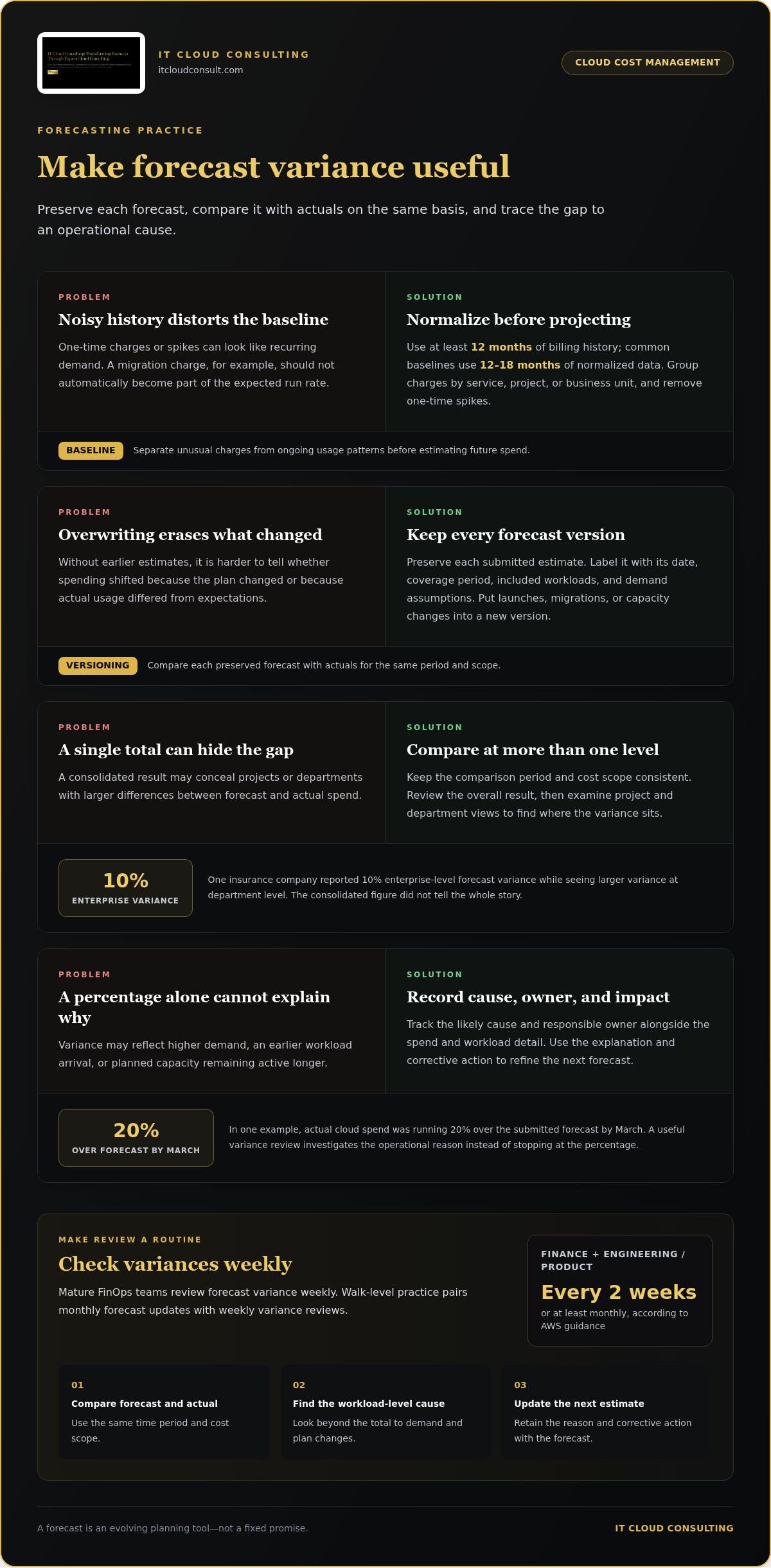
Historical billing data provides the baseline for estimating future cloud spend, while its quality shapes forecast accuracy. A cloud cost forecast should use at least 12 months of history and remove one-time cost spikes. Common baselines use 12-18 months of normalized billing data, which can reveal recurring patterns without treating an unusual charge as ongoing demand.
Prepare the data by grouping charges by service, project, or business unit and normalizing it across cloud providers. These steps make comparisons meaningful when billing categories or usage patterns differ. Forecasts also depend on the amount of historical data available and which data teams select. For example, a one-time migration charge should not automatically be treated as part of the expected recurring run rate.
Accurate forecasts help teams set realistic budgets, spot emerging variances, and make spending decisions with clearer expectations. Forecast each project separately before combining estimates, so growth in one workload does not conceal a smaller project’s decline. Review the assumptions behind each estimate and revise them when actual usage differs. A forecast is most useful as an evolving planning tool, not a fixed promise.
Forecast versioning and weekly variance reviews
Keep each forecast version with its assumptions, then compare it with actual spending. Regular variance analysis helps finance and engineering teams identify changes in demand or workload plans.
Forecast-to-Actual Variance Analysis
Forecast-to-actual variance analysis compares predicted spending with actual charges for the same period and scope. A single total can hide which workloads or teams drove the difference. Preserve each submitted forecast, then record actuals against that version. Mature FinOps teams review forecast variance weekly, while Walk-level practice pairs monthly forecast updates with weekly variance reviews.
Versioning records how expectations changed. Label each forecast with its date, coverage period, included workloads, and demand assumptions. When engineering schedules a launch, migration, or capacity change, capture it in a new version instead of overwriting the prior estimate. This comparison shows whether spending changed because the plan changed or because actual usage diverged from expectations.
Use a consistent comparison period and cost scope. For example, compare a submitted monthly forecast with actual monthly spend, then examine project and department views. One insurance company reported enterprise-level forecast variance of 10% while seeing larger variance at department level. That difference illustrates why a consolidated result can conceal teams that need closer analysis.
Variance Causes and Forecasting KPIs
Variance causes are operational or financial changes that explain the gap between forecast and actual spending. Identifying them helps teams adjust assumptions appropriately for a traffic increase, delayed workload, or change in service usage. Track each variance alongside its likely cause, owner, and effect on the next forecast.
Use percentage variance as a KPI, but retain the underlying spend and workload detail. In one example, actual cloud spend was running 20% over the submitted forecast by March. A useful review would identify whether demand exceeded assumptions, workloads arrived earlier, or planned capacity remained active longer. Record the explanation and the corrective action, so the next forecast reflects the operational reality.
Set a repeatable weekly review for finance and engineering. According to AWS guidance, finance and engineering or product teams should meet every two weeks, or at least monthly, to share knowledge and review cost variances and forecasts. A weekly variance check can complement those discussions by flagging material changes sooner. Teams whose analysis points to usage inefficiencies can explore cloud cost optimization support as a way to connect spending signals with workload decisions.
Forecasting from historical billing data and future changes
Historical spending provides a baseline, but trends alone cannot account for workloads that have not launched. Reliable cloud cost forecasting combines billing and usage patterns with planned changes.
Historical Billing Data and Trends
Trend-based forecasting uses past bills and cloud usage to estimate how spending may continue. It matters because recurring patterns can support planning, while a simple trend may miss new demand. A forecast should use at least 12 months of historical data and remove one-time cost spikes. Common baselines use 12-18 months of normalized billing, helping teams compare spending consistently.
Trend methods work best when existing workloads remain relevant to the forecast period. AWS guidance describes them as useful for looking 6 to 12 months ahead, but less certain beyond one year. For example, a trend model could project compute spend growing 8% month-over-month for six months. Treat that projection as an assumption to revisit, not as a complete picture of future demand.
Data and Metrics for Cost Forecasts
Useful forecasting data links billing amounts to service categories, usage, projects, and time periods. A total bill alone offers limited insight into spending drivers. Normalize data across cloud providers, review historical usage, and identify one-time charges before calculating trends. Both the available history and the data selected affect the resulting forecast.
Compare recent spending with earlier periods and track the usage measures that explain it. One estimate described in the research uses average spending from the current and past two months for each service category, then compares that average with the same period a year earlier. These views help distinguish a persistent trend from a short-lived billing change.
Forecasting New Workloads and Projects
For a new workload, estimate expected demand separately from existing projects. Historical bills cannot reveal the cost of work that has not yet entered the cloud. Base the estimate on planned services, usage assumptions, and rollout timing, then combine it with existing project forecasts. Separate estimates make it easier to understand what is driving forecast changes.
Include known changes, such as a new service, traffic growth, or a scheduled migration. A sample migration plan schedules 10% of compute per week, from a December 1 start to a January 26 target completion. This kind of timeline makes gradual changes visible in the forecast. Adjust the model as the schedule or expected usage changes.
Machine Learning and Historical Usage
Machine learning can analyze historical billing and usage data to identify patterns that inform predictions. Its usefulness depends on whether the input data represents the workloads and demand being forecast. Teams still need to account for new services and planned changes, since historical patterns cannot describe workloads that do not yet exist.
Use model outputs alongside clear assumptions about service usage, timing, and expected demand. Trend-based forecasts have shown variance ranging from 20% to 70% in a video-streaming example, where the method missed workloads that had not yet entered the cloud. That example illustrates why historical patterns need operational context. Compare predictions with actual spending and adjust the model as usage evolves.
Including optimization changes in forecast models
A forecast that excludes planned optimization can overstate expected spending, while one that assumes incomplete changes have already happened can understate it. Separate rate changes from usage changes, and show when each is expected to affect cloud spending.
Rate optimization changes the price paid for a given level of cloud usage. Commitment-based discounts are one example, but they require teams to predict compute consumption over the next one to three years. Include expected commitment coverage and timing in the model, then compare that scenario with the current rate assumption. This makes the financial effect visible without treating a planned discount as an immediate change.
Usage optimization changes the resources a workload consumes. Examples include rightsizing an oversized resource or removing capacity a service no longer needs. At the Walk maturity level, forecasts include rate optimization and commitment-based discounts. At the Run maturity level, models also include usage optimization opportunities, linking engineering decisions to expected spending.
Keep the baseline separate from each proposed optimization scenario. For every change, record the affected workload, expected start, implementation stage, and assumption behind the projected impact. If a migration rolls out gradually, reduce forecast usage progressively rather than showing the full reduction before it happens. This allocation helps finance and engineering teams understand which changes drive the revised estimate.
Automation can apply consistent assumptions across recurring forecast updates. For example, a model can incorporate approved rate adjustments and scheduled usage changes when those inputs are available. But automation does not replace operational context: an optimization may be delayed, apply only to selected workloads, or change how resources are used. Keep the underlying assumption visible so reviewers can distinguish modeled effects from realized savings.
At the Run maturity level, teams track and update forecasts against discount-adjusted, amortized cloud usage. This view connects commitment costs with the usage receiving their benefit, offering a more useful picture than comparing a discount alone with an unadjusted baseline. Review actual usage against the modeled scenario, then adjust the forecast if an optimization is completed, delayed, or produces a different workload pattern.
Build scenarios that account for both rate and usage levers. A rate scenario can model commitment-based discounts; a usage scenario can reflect planned resource changes. Combining them clarifies the expected effect of optimization while preserving enough detail to identify assumptions that need revision. As decisions move from proposal to implementation, update the model to reflect their current status rather than carrying forward an outdated plan.
Cloud cost management
A forecast becomes useful when finance and engineering connect its estimates to decisions, owners, and cloud usage. Cost management translates expected spending into visibility, then prompts action on the drivers behind changes. A forecast should support planning and operational reviews, not sit apart as a finance-only spreadsheet.
Start by assigning each forecast line to a business unit, project, or workload. Aggregated totals can conceal local pressure: one example shows a business unit running 15% over budget while another runs 10% under. The combined result may look acceptable, even though one team needs to review its demand or assumptions. Clear allocation helps leaders see where spending originates and who can respond.
Set alerts around meaningful budget thresholds, then connect each alert to an owner and review action. Cloud budget alerts may be set at 50%, 80%, and 100% of budget, alongside a forecasted-to-breach alert. The last alert can signal a likely overrun before actual charges reach the limit. Finance can then distinguish a planned increase from a workload change that needs attention.
Use ranges instead of presenting a single fixed estimate as certain. The range should reflect known demand drivers, such as traffic, planned launches, and resource changes. Compare each new estimate with actual usage and explain material differences by team or service. This gives decision-makers context rather than treating every variance as evidence that the entire forecast failed.
Scope also matters. Native cloud-provider forecasts generally cover one provider at a time, so organizations using multiple providers need a consolidated view for cross-platform planning. Normalize billing categories and align periods before combining estimates. Account for calendar effects too: a 31-day month is 11% longer than a 28-day month, which can influence usage-based spending comparisons.
Cost management also links forecasts to sustained improvement. McKinsey reports that 67% of companies cannot accurately forecast cloud spending, underscoring the need to connect data, ownership, and review practices. Refresh assumptions as usage patterns shift, and compare planned optimization with realized changes. A forecast that tracks decisions as well as charges can guide resource allocation without obscuring operational needs.
For a focused management approach, start with a product line or business unit, define its spending drivers, and make ownership visible. Then expand the same review structure across other teams. If forecast gaps point to opportunities to improve resource use, discuss cloud cost optimization as part of your ongoing cost-management approach.
IT Cloud Consulting: Strategic Cloud Adoption
IT Cloud Consulting helps organizations align cloud decisions with business priorities through Strategic Cloud Adoption. When forecasts reveal uncertainty around planned workloads, changing demand, or optimization opportunities, strategic guidance can connect financial assumptions with the cloud roadmap. Cloud Optimization can address resource-use opportunities identified during forecast reviews, while Ongoing Cloud Support helps manage cloud environments as needs evolve.
This is a natural next step when teams need to turn forecast insights into informed adoption or optimization decisions. Connecting expected spending with workload requirements and organizational goals can strengthen planning over time.
Contact IT Cloud Consulting to discuss your cloud planning needs, or visit itcloudconsult.com.
Turn Forecast Insight Into Forward Momentum
A forecast creates the most value when it informs decisions before plans become commitments. Make it part of how teams evaluate product priorities, capacity choices, and the timing of cloud initiatives. With this discipline, cloud cost forecasting becomes more than a finance exercise: it helps leaders connect investment decisions with operational goals and adapt as those goals evolve.
The next step is to align cloud planning with the organization’s wider direction. IT Cloud Consulting offers Strategic Cloud Adoption to support that alignment, Cloud Optimization to address opportunities in cloud use, and Ongoing Cloud Support as needs change. These services connect planning with the decisions and improvements that follow.
Build a cloud strategy that supports your organization’s next stage of growth. Contact IT Cloud Consulting to discuss your cloud priorities and move forward with clarity.
Frequently Asked Questions
What is forecasting for FinOps?
FinOps forecasting estimates future cloud spending to support shared decisions across finance, engineering, and business teams. It connects technical plans with financial expectations so teams can assess how workload choices affect budgets. For example, a product team planning a service expansion can share expected usage with finance, allowing both groups to evaluate the spending implications before approving the plan.
What is cloud cost forecasting and how does it work?
Cloud cost forecasting estimates future cloud spending using billing patterns and assumptions about upcoming activity. Teams can estimate costs by project or service, then combine them for broader planning. For a new product feature, they might model expected traffic and resource requirements separately, making it easier to see how the feature could affect the organization’s overall spending outlook.
How accurate are cloud cost forecasts, and what affects accuracy?
Accuracy depends on input data quality, workload stability, and how well assumptions reflect operational plans. A mature service with consistent demand is generally easier to predict than a newly launched workload. Scope matters too: a company-wide result can mask differences between departments. Reviewing results at both consolidated and team levels helps reveal where estimates need refinement.
How should companies account for discounts, reserved instances, savings plans, and committed-use discounts?
Represent each commitment in the model according to expected usage, coverage, timing, and workload allocation. Account for the discount in the periods and services where it applies, and compare modeled consumption with actual use. This helps teams assess whether a commitment aligns with demand. If workloads or consumption change, update the allocation assumptions instead of carrying forward an outdated estimate.
What are common cloud cost forecasting mistakes and risks?
Common risks include treating a one-time charge as recurring, overlooking planned workload changes, and assuming an optimization has already reduced usage. A consolidated total can also obscure an overrun within a department. For instance, one team may exceed its estimate while lower spending elsewhere offsets the difference in the organization-wide view. Keep project assumptions visible to identify these issues.
How can businesses monitor forecast-versus-actual cloud spending and update forecasts?
Compare actual charges with the matching forecast version, period, and organizational scope. Record the difference, its likely cause, and the owner responsible for responding. Distinguish changes in usage from revised project schedules or billing adjustments. When a launch date shifts, preserve the previous estimate and create a new version that reflects the updated timing and expected activity.
What cloud cost forecasting best practices help prevent budget overruns?
Assign owners to major spending areas, connect estimates to workload plans, and use alerts to prompt timely review. Thresholds can be set at 50%, 80%, and 100% of budget, with an additional alert for a forecasted breach. When an alert appears, the responsible team can assess demand, resource allocation, and planned changes, then revise assumptions or take action before spending exceeds expectations.


