
With global IT spending projected to exceed $6 trillion in 2026, the pressure to deliver measurable returns on every digital investment has reached a critical peak. You've likely realized that simply maintaining your current infrastructure is no longer a viable path forward. Many leaders are currently struggling with the weight of rising technical debt and the limitations of inflexible legacy systems that hinder innovation. When your time-to-market for new features slows down, your competitive advantage erodes. Developing a resilient IT modernization strategy is the only way to transform these constraints into a foundation for sustainable growth.
We understand that the transition to a cloud-native future can feel daunting, especially when faced with unpredictable costs and complex security requirements. This article provides a clear, ROI-focused roadmap to help you navigate this evolution with confidence. You'll discover how to achieve operational efficiency and predictable scaling while ensuring your technology remains perfectly aligned with your broader business goals. We'll break down the essential components of a modern architecture, from intentional hybrid cloud design to the latest AI governance frameworks, to ensure your organization is prepared for the challenges of 2026 and beyond.
Key Takeaways
- Grasp the evolution from basic cloud migration to a cloud-native framework that empowers your organization to overcome legacy constraints and technical debt.
- Develop a resilient IT modernization strategy by integrating technical execution with high-level business goals to ensure predictable scaling and operational efficiency.
- Master the "6 Rs" of migration and identify why refactoring serves as the gold standard for high-performance modernization efforts in the 2026 landscape.
- Learn to execute a structured roadmap that transitions your infrastructure from initial assessment to a permanent state of continuous optimization and innovation.
Defining IT Modernization in the 2026 Cloud-Native Era
In 2026, IT modernization represents far more than a routine hardware refresh or a software patch. It is the strategic transition from rigid legacy systems to agile, cloud-native architectures designed for a world of instant scalability. While previous decades focused on simply maintaining uptime, modern enterprises now view their infrastructure as a competitive differentiator. This shift is essential. With global IT spending now exceeding $6 trillion, organizations must ensure their investments yield measurable performance gains rather than merely sustaining existing limitations.
We have moved past the "Cloud First" era, where organizations prioritized moving any workload to the cloud regardless of its structure. Today, the primary organizational driver is being "Cloud-Native." This distinction matters. A cloud-native approach ensures that applications are built specifically for distributed environments, allowing for the microservices and containerization necessary to move at the pace of modern business. Without a cohesive IT modernization strategy, these advanced capabilities remain out of reach, locked behind the barriers of outdated code and monolithic structures.
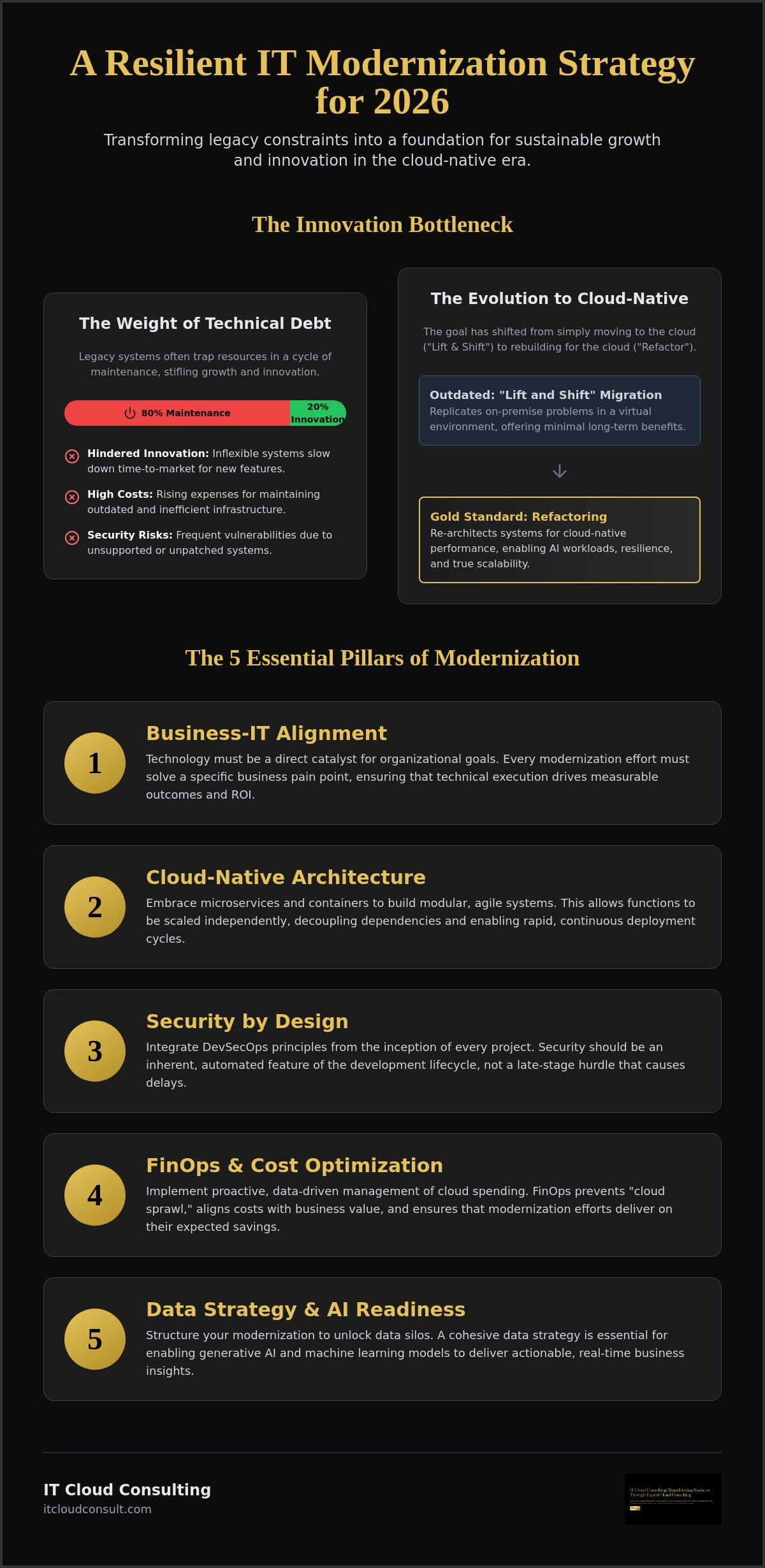
Technical debt acts as the silent killer of enterprise innovation. It is the accumulated cost of choosing easy, short-term fixes over long-term architectural health. When your team spends 80% of their time on maintenance and only 20% on new features, your growth has stalled. A robust IT modernization strategy serves as the engine room for broader Digital transformation, providing the technical agility required to pivot when market conditions change or new opportunities emerge.
The Evolution of IT Modernization Goals
Modern goals have evolved from simple "lift and shift" migrations to sophisticated refactoring. Organizations no longer want to replicate their on-premise problems in a virtual environment. Instead, they seek to re-architect systems to support massive AI and machine learning workloads. This evolution drives a sustainable strategic cloud adoption, where every technical decision directly supports a specific business outcome and long-term scalability.
Identifying the Need for Modernization
Several key indicators suggest your infrastructure has reached a breaking point. These include high maintenance costs, frequent security vulnerabilities, and deployment cycles that take weeks rather than hours. The cost of inaction is high. In a market where competitors release updates daily, a slow legacy system is a liability that prevents you from realizing your full potential. Ultimately, modernization is a continuous state of architectural evolution that ensures your technology never becomes a bottleneck for your vision.
As part of this architectural evolution, businesses are also digitizing their physical touchpoints; for example, you can discover byNow - Bezpieczna platforma wymiany dokumentów i wysyłki dokumentów to replace traditional registered mail with a secure, digital-first delivery system.
The 5 Essential Pillars of an IT Modernization Strategy
A successful IT modernization strategy requires more than technical upgrades; it demands a holistic framework that harmonizes disparate organizational needs. In 2026, the margin for error has vanished. Leaders must balance the relentless drive for speed and innovation with rigid security requirements and fiscal responsibility. This balance is achieved through five foundational pillars that transform infrastructure from a cost center into a strategic asset.
- Business-IT Alignment: Technology must serve as a direct catalyst for organizational outcomes. If a modernization effort doesn't solve a specific business pain point, it lacks a true purpose.
- Cloud-Native Architecture: Utilizing microservices and containers allows for the modularity needed to scale functions independently, ensuring the system remains agile.
- Security by Design: Integrating DevSecOps from the inception of every project ensures that security is an inherent feature rather than a late-stage hurdle.
- FinOps and Cost Optimization: Proactive management of the cloud bill is essential to prevent the "cloud sprawl" that often erodes expected savings.
- Data Strategy and AI Readiness: Modernization must unlock the data silos that prevent generative AI from delivering actionable, real-time insights.
Architecting for Scalability and Resilience
Transitioning from monolithic legacy applications to microservices is a fundamental step in decoupling dependencies. This modular approach allows your teams to update individual components without risking systemic failure, significantly improving your time-to-market. By leveraging serverless computing, organizations can further reduce operational overhead, paying only for the exact resources consumed during execution. In 2026, many leaders are adopting AI-driven infrastructure management to automate routine scaling and maintenance tasks, further enhancing resilience. For complex enterprise needs, an intentionally architected hybrid cloud strategy provides the flexibility to keep sensitive data secure while utilizing public cloud scalability for fluctuating workloads.
The Financial Pillar: FinOps and ROI
Modernization efforts must deliver a clear return on investment to remain sustainable over the long term. This is where FinOps becomes critical. By integrating cloud optimization early in the strategy phase, businesses can achieve a state of predictable cloud spend. Identifying "quick wins," such as retiring underutilized instances or rightsizing existing workloads, creates immediate savings that can fund more complex refactoring projects. This self-sustaining cycle ensures that your IT modernization strategy remains financially viable while continuously delivering value to the organization. Professional guidance during this phase helps bridge the gap between technical execution and fiscal accountability.
Legacy vs. Cloud-Native: Choosing Your Modernization Path
Selecting the correct execution pathway is the most critical decision within an IT modernization strategy. While the allure of a rapid transition is strong, leaders must evaluate whether a quick move solves underlying architectural issues or merely relocates them. The industry standard for this evaluation remains the "6 Rs" framework, which provides a structured methodology for assessing every application in your portfolio.
- Rehost (Lift-and-Shift): Moving applications to the cloud without modification. This is the fastest route but often fails to reduce technical debt or optimize costs.
- Replatform: Making minor adjustments to take advantage of cloud features, such as moving a database to a managed service, without changing the core architecture.
- Refactor: Re-architecting and recoding the application to be cloud-native. This delivers the highest ROI and performance but requires the most significant initial investment.
- Retire: Identifying and decommissioning applications that no longer provide business value.
- Retain: Keeping critical legacy systems in their current environment when the cost or risk of migration outweighs the benefits.
- Replace: Discarding a custom legacy application in favor of a modern SaaS solution.
In 2026, the risks of simple rehosting have become more apparent as egress costs and resource inefficiencies mount. Organizations that prioritize a balanced approach often find that a mix of refactoring for core systems and replatforming for secondary tools yields the best results. This allows you to maintain legacy stability where necessary while aggressively pursuing modern capabilities for customer-facing services.
The Refactoring Revolution
Refactoring has emerged as the gold standard for modernization efforts because it fundamentally changes how an application consumes resources. By breaking down a monolithic codebase into microservices, you enable independent scaling and faster deployment cycles. This transition significantly lowers long-term operational costs by eliminating the waste associated with over-provisioned legacy servers. By aligning application architecture with cloud-native principles, refactoring maximizes the value of cloud modernization services and ensures long-term operational sustainability.
Modernizing Legacy Databases
Legacy databases often represent the final hurdle in a comprehensive IT modernization strategy. Moving from on-premise relational databases to cloud-managed data stores reduces the administrative burden on your team while enhancing data integrity. This shift is essential for enabling real-time business intelligence and supporting AI workloads that require high-velocity data access. During this process, we focus on ensuring that security protocols remain robust, preventing vulnerabilities that can occur when data is in transit between environments. Modernized data structures don't just store information; they turn it into a dynamic asset for decision-making.
For industrial firms, this transformation often involves modernizing core product data systems; check out PLM-Sme FZC to discover how PLM solutions can be optimized for a cloud-native future.
Executing the Roadmap: From Assessment to Continuous Optimization
Execution is the bridge where strategic intent meets operational reality. Developing a comprehensive IT modernization strategy is only the first step; the true value lies in a disciplined, multi-phase rollout that minimizes disruption while maximizing performance. In 2026, successful execution isn't a "big bang" event. It's a series of iterative cycles designed to transition your organization from legacy constraints to a state of permanent agility.
- Phase 1: Discovery and Assessment: We begin by mapping your current infrastructure and identifying the technical debt that hinders your progress.
- Phase 2: Strategy and Planning: This phase focuses on developing the business case and a prioritized roadmap for your high-value assets.
- Phase 3: Execution and Migration: We move into the iterative rollout of modernized systems, ensuring each step delivers measurable benefits.
- Phase 4: Governance and Security: Establishing robust guardrails ensures your new environment remains compliant with 2026 standards, such as the NIST AI Risk Management Framework.
- Phase 5: Continuous Optimization: This final, ongoing stage involves the constant refinement of cloud resources to prevent cost sprawl and performance degradation.
The Discovery and Assessment Phase
You can't modernize what you don't fully understand. During discovery, we inventory your legacy assets and map critical dependencies that could cause service interruptions if ignored. A cloud readiness assessment identifies potential roadblocks, such as incompatible middleware or security gaps in aging codebases. We define clear KPIs at this stage, focusing on metrics like deployment frequency and mean time to recovery. These benchmarks allow us to measure the success of the modernization effort with objective precision, ensuring the project remains aligned with your original vision.
Achieving Continuous Operational Excellence
The conclusion of a migration is actually the beginning of your most productive phase. Implementing cloud operational efficiency practices ensures that your new environment doesn't just work, but thrives. Automation plays a central role here, handling routine maintenance and scaling tasks that previously drained your team's time. We believe that post-migration optimization is where the real ROI is realized. By constantly rightsizing resources and adjusting configurations based on real-time demand, you maintain a lean, high-performance architecture. If you're ready to move beyond basic migration and embrace a state of constant innovation, our team provides the Cloud Optimization expertise needed to secure your long-term success.
Partnering for Success: How IT Cloud Consulting Drives Modernization
Modernization is a continuous journey that demands both high-level strategic vision and meticulous technical precision. It isn't enough to simply change your infrastructure; you must change how your entire organization interacts with technology. At IT Cloud Consulting, we specialize in bridging the gap between rigid legacy constraints and the agile future of cloud-native potential. We understand that your business has unique requirements that a standard checklist cannot address. Our approach focuses on evolution, turning latent potential into realized performance through a customized IT modernization strategy that prioritizes your specific goals.
Generic templates often lead to generic results that fail to solve deep-seated architectural issues. We believe in a "cause and effect" structure where technical processes are directly linked to organizational benefits. This ensures that every dollar spent on modernization contributes to your overall operational efficiency and market responsiveness. By positioning ourselves as a strategic partner rather than a mere vendor, we provide the steady assurance and technical proficiency required to navigate the complexities of 2026 and beyond, often collaborating with specialists like PS WebSolution to deliver advanced process automation for enterprise systems.
Strategic Guidance and Roadmap Development
We believe that a successful roadmap must be as unique as the organization it serves. Our process begins with professional Strategic Cloud Adoption guidance, ensuring that your IT modernization strategy aligns perfectly with your long-term business growth. We eliminate the guesswork that often stalls cloud initiatives by conducting an exhaustive expert assessment of your current state. This allows us to architect a path forward that respects your organizational structure while introducing the modern capabilities required to stay competitive. We help you identify which applications are ready for refactoring and which should be replaced, ensuring your resources are allocated where they will have the most significant impact, often recommending specialized partners like Wanas Apps for businesses needing tailored Zoho customization and training.
Ongoing Management and Support
A modernized environment is only valuable if it remains secure, operational, and efficient over the long term. This is where Ongoing Cloud Support becomes a critical component of your success. In a cloud-native world, the pace of change is relentless, and continuous monitoring is the only way to maintain peak performance while mitigating emerging security risks. We provide the expert oversight required to manage these complex systems, allowing your internal teams to focus on core business initiatives rather than infrastructure maintenance. Our Cloud Optimization services ensure that your resources are always rightsized, preventing the cost sprawl that can derail even the best-planned projects. Ready to evolve? Contact IT Cloud Consulting for a strategic assessment to begin your journey toward architectural excellence.
Realizing the Full Potential of Your Digital Infrastructure
Transitioning from legacy constraints to a cloud-native framework is a strategic necessity for long-term resilience. A successful IT modernization strategy requires a balance of business alignment, cloud-native architecture, and proactive cost management. By prioritizing refactoring and continuous optimization, you transform your infrastructure from a maintenance burden into a high-performance engine for innovation.
We're here to guide you through every phase of this evolution. Our team delivers comprehensive strategic cloud adoption roadmaps and expert cloud optimization consulting to ensure your transition is both smooth and financially sound. With ongoing managed cloud support, we help you maintain sustained efficiency and security in an ever-changing landscape. The realization of your latent potential is within reach; the right architectural foundation is the first step toward that future.
Begin Your Modernization Journey with a Strategic Assessment
The path to a cloud-native future is clear. With a structured roadmap and a dependable partner, your organization will achieve the agility required to thrive in 2026 and beyond.
Frequently Asked Questions
What is the primary goal of an IT modernization strategy?
The primary goal of an IT modernization strategy is to align your technological infrastructure with your long-term business objectives. By transitioning from rigid legacy systems to agile, cloud-native architectures, you eliminate technical debt and improve operational efficiency. This alignment allows your organization to respond rapidly to market changes while maintaining a secure and scalable foundation for future growth and innovation.
How much does IT modernization typically cost for an enterprise?
Costs vary significantly based on the scope of the project, the volume of legacy code, and the chosen migration pathway. While initial investments in refactoring are higher than simple rehosting, they typically yield greater long-term savings through reduced maintenance and optimized resource consumption. We recommend a professional assessment to identify "quick wins" that can help fund more complex modernization efforts over time.
How long does a full IT modernization process take?
A comprehensive modernization journey is rarely a single event and often spans several months to a few years depending on organizational complexity. Most enterprises follow an iterative roadmap, starting with a 30 to 90-day discovery and assessment phase followed by staggered migration waves. This phased approach ensures that critical systems remain operational while new capabilities are integrated into the environment without causing major disruptions.
What are the biggest risks associated with IT modernization?
The most significant risks include data loss during migration, unforeseen dependencies between legacy applications, and cost overruns due to cloud sprawl. Without a structured strategy, organizations might also face cultural resistance or skills gaps within their internal teams. Professional guidance and a robust governance framework are essential to mitigate these risks and ensure a secure transition that respects your existing operational requirements.
How do I choose between refactoring and rehosting my applications?
Choose refactoring when an application is critical to your competitive advantage and requires high scalability or frequent updates. Rehosting, or "lift-and-shift," is more appropriate for low-priority applications that simply need to be moved off aging hardware quickly. Refactoring delivers the highest ROI in 2026 by fully utilizing cloud-native features like microservices and auto-scaling to drive better performance and lower costs.
What is the role of AI in IT modernization strategy for 2026?
In 2026, AI acts as both a driver and a tool for a successful IT modernization strategy. Organizations are re-architecting systems to support massive AI and machine learning workloads, ensuring data is accessible and high-quality. Simultaneously, AI-driven automation is used to manage infrastructure, optimize cloud costs, and monitor security in real-time, making the modernized environment more resilient and much easier to maintain. To discover how to unify complex data for these advanced workloads, visit Syntes AI.
Can we modernize our IT infrastructure without moving everything to the public cloud?
Yes, many organizations adopt an intentionally architected hybrid cloud strategy. This approach allows you to keep sensitive data or highly specialized workloads on-premise or in private clouds while leveraging the public cloud for its scalability and innovation. Modernization is about architectural evolution and agility, not necessarily the physical location of every server. It's about ensuring your systems are flexible enough to meet future demands.
How does IT modernization improve cybersecurity?
Modernization improves security by replacing aging, vulnerable systems with architectures that incorporate "Security by Design" and DevSecOps principles. Cloud-native environments offer automated patching, advanced identity management, and real-time threat detection that legacy systems often lack. By reducing your attack surface and technical debt, you significantly enhance your overall security posture and ensure compliance with the latest data privacy regulations.


