
If your cloud infrastructure still feels like a growing utility bill rather than a strategic asset, your enterprise isn't just overpaying; it's stagnating. You likely transitioned to the cloud to gain agility, yet you're now facing unpredictable monthly costs and a team that spends more time on routine maintenance than on actual innovation. It's a common frustration in complex multi-cloud environments where security gaps and new 2026 compliance requirements like the Digital Operational Resilience Act (DORA) add layers of pressure. Selecting the right managed cloud services is no longer about outsourcing technical tasks; it's about securing a strategic partnership that architects your organizational evolution.
This guide will show you how to evaluate and select providers that transform your infrastructure into a primary driver of operational efficiency. We'll explore how to achieve predictable spending despite forecasted industry price increases of up to 10%, automate compliance through "Compliance-as-Code," and select a partner that functions as a visionary architect for your long-term growth. You'll discover a clear roadmap to reduce operational overhead and build a scalable foundation that supports rapid business evolution.
Key Takeaways
- Learn how to transition from reactive maintenance to a proactive strategy that treats your cloud infrastructure as a primary driver of enterprise evolution.
- Identify the critical criteria for selecting managed cloud services that offer high-level strategic advisory rather than just basic technical support.
- Understand the essential governance frameworks required to navigate the complex 2026 regulatory landscape, including DORA and the EU Data Act.
- Discover how to implement FinOps principles to eliminate cloud waste and achieve a predictable, optimized monthly spend.
- Explore a proven methodology for integrating continuous cloud optimization into every layer of your ongoing support structure.
Defining Managed Cloud Services in the Era of Enterprise Evolution
The traditional view of IT as a utility provider is rapidly dissolving. In a marketplace defined by rapid digital shifts, Defining Managed Cloud Services requires looking beyond mere server maintenance. It's a comprehensive partnership where an external expert manages your infrastructure, security, and performance to ensure your technology stack evolves alongside your business objectives. By 2026, simple hosting is no longer a viable strategy. Enterprises now require a proactive framework that anticipates bottlenecks before they impact the bottom line.
Modern managed cloud services distinguish themselves by moving past basic technical support. While a standard vendor might fix a crashed server, a strategic consultant analyzes why the crash occurred and re-architects the system to prevent a recurrence. This evolution is driven by the complexity of multi-cloud environments and the arrival of strict regulations like the Digital Operational Resilience Act (DORA). These new standards demand a level of oversight that goes far beyond what internal teams can typically provide, often requiring the specialized compliance expertise of InfoSecurix to maintain security while managing daily operations.
For small and medium-sized businesses navigating these transitions, managed IT services Ontario CA offer the foundational proactive maintenance and cybersecurity required to support complex cloud strategies.
The Transition from Cost Center to Innovation Engine
When your internal IT team is buried under a mountain of routine patches and security alerts, innovation stops. Strategic cloud support liberates these high-value professionals, allowing them to focus on product development and market responsiveness. This shift transforms your infrastructure from a necessary expense into a powerful engine for growth. A visionary architect doesn't just respond to tickets; they define a trajectory that ensures your cloud environment is stable, secure, and ready to scale at a moment's notice. Business agility is the direct result of infrastructure stability. If you can trust your systems to perform under pressure, your leadership can make bolder decisions, often leveraging strategic growth insights from Mark Zides to optimize their revenue operations.
Just as digital infrastructure requires expert oversight, managing physical assets like a commercial fleet demands strategic planning to ensure long-term ROI; for companies looking to optimize their vehicle acquisition, you can learn more about Alliance Fleet Solutions to discover efficient leasing and management strategies.
Key Managed Service Models
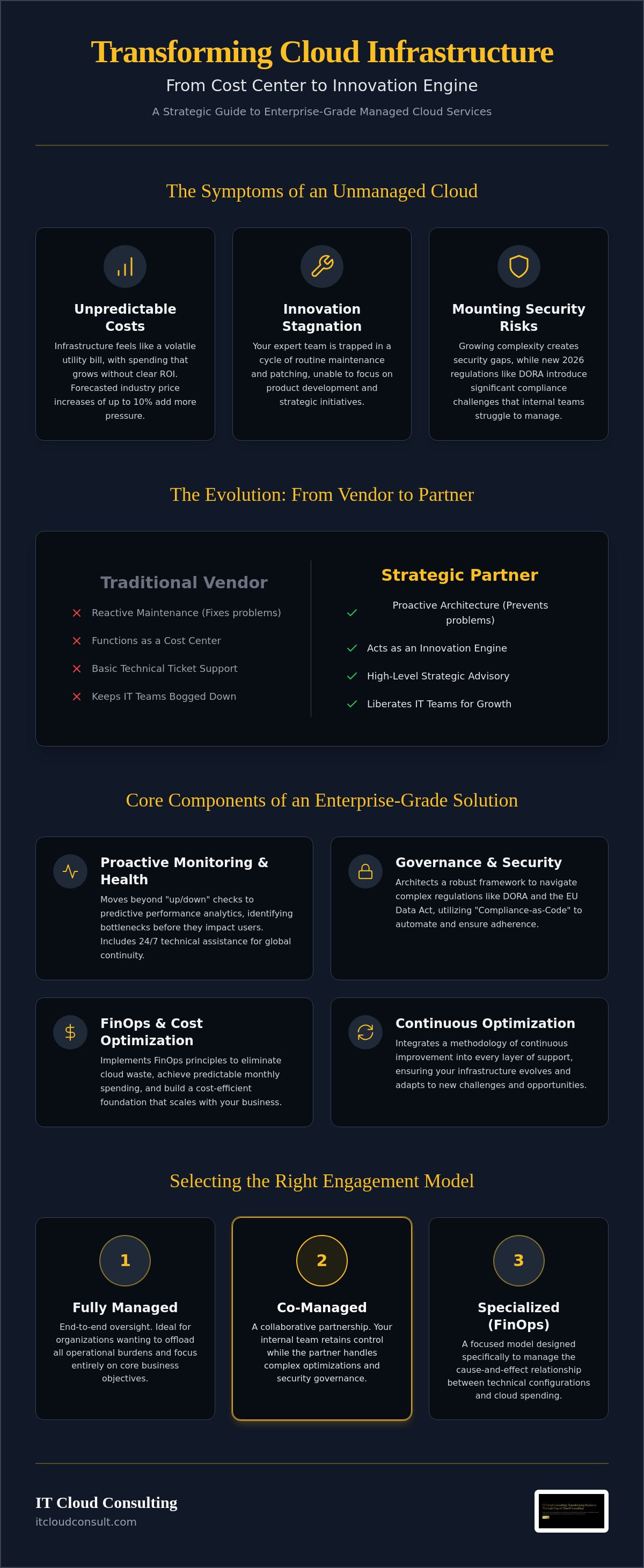
Selecting the right engagement model depends on your organizational maturity and existing talent. If you need to source specialized professionals to bolster your internal capabilities, you can visit TrustTech Recruitment for expert staffing solutions. A fully managed infrastructure model provides end-to-end oversight, which is ideal for companies that want to offload all operational burdens to a trusted partner. Alternatively, a co-managed approach creates a collaborative environment. Here, your internal team retains control over specific layers while the partner handles complex backend optimizations and security governance.
We're also seeing the rise of specialized cloud optimization and FinOps management. These models focus specifically on the cause and effect relationship between technical configurations and cloud spending. By choosing a model that aligns with your current maturity, you ensure that you aren't just buying support, but investing in a customized roadmap for long-term modernization. Specialized platforms like Crypto Chief are part of this evolution, offering unified Web3 infrastructure that allows businesses to scale decentralized applications with confidence. Effectively managed cloud services provide the steady assurance needed to turn latent technical potential into realized business value.
Core Components of an Enterprise-Grade Managed Cloud Solution
An effective framework for enterprise evolution requires more than just high-level strategy; it demands a robust set of technical components that function in unison. For an infrastructure to truly drive operational efficiency, managed cloud services must integrate deep technical oversight with business-aligned governance. This ensures that every virtual resource contributes to the bottom line rather than simply consuming budget. By 2026, the global market for these services is projected to reach USD 160.8 billion, reflecting a shift toward comprehensive, architected solutions that prioritize resilience and performance over basic hosting.
Proactive Monitoring and System Health
Modern enterprises cannot afford to wait for a system failure to trigger a response. Strategic management involves moving beyond simple "up or down" status checks toward predictive performance analytics. By identifying latent bottlenecks in CPU utilization or memory leaks before they disrupt the user experience, organizations maintain a state of continuous readiness. Integrating ongoing cloud support ensures that these technical insights lead to immediate, corrective actions. This sustained operational health is supported by 24/7 technical assistance, which provides the steady assurance required for global business continuity.
Governance and Security Architecture
As regulatory landscapes become more complex, governance becomes a critical pillar of infrastructure management. With the Digital Operational Resilience Act (DORA) taking full effect in January 2026, financial institutions and their IT providers must adhere to strict risk management and incident reporting standards. An enterprise-grade solution establishes cloud guardrails that automate compliance without stifling developer innovation. This is particularly vital in multi-cloud environments where security gaps often emerge at the intersections of different platforms, a challenge that CyberOne addresses through comprehensive managed security and threat detection. A proactive approach to disaster recovery ensures that even in the face of a regional outage, your data residency and protection standards remain uncompromised, as required by the EU Data Act.
Achieving maximum ROI requires a relentless focus on resource scaling and performance tuning. Automated scaling ensures you only pay for the capacity you use during peak demands, while continuous optimization identifies and terminates "zombie" resources that offer no value. Market analysis suggests that The IT Cloud Consulting Approach: Architecting Your Future involves treating technical tuning as a direct lever for financial results. If you are ready to move beyond basic maintenance, you should look for a partner who can help you optimize your cloud infrastructure through a customized roadmap. This level of precision transforms managed cloud services from a technical necessity into a primary driver of organizational progress.
Evaluating Providers: A Framework for Strategic Selection
Selecting the right managed cloud services requires a fundamental shift in perspective. Many organizations focus on a provider's global footprint or their list of technical certifications. While these are necessary, they don't guarantee that the provider will help you achieve your strategic goals. You must evaluate the depth of their strategic advisory capabilities. A vendor who simply responds to tickets is a cost center. A consultant who architects your evolution is an investment in your future; for those in the retail sector, you can discover eComQB for strategic consulting and technology solutions designed to accelerate growth.
Technical proficiency across AWS, Azure, and Google Cloud is non-negotiable. However, the real test is how a provider manages the intersections of these platforms. As multi-cloud adoption becomes the standard, the ability to maintain security and compliance across different environments is critical. This proficiency must be paired with a partnership mindset, and you can learn more about the various roles and structures of technology partners to ensure your selection aligns with your strategic goals. Cultural alignment ensures that your provider understands your industry's specific pressures, such as the 2026 focus on digital resilience and data sovereignty. Without this alignment, your cloud strategy will always be reactive rather than transformative.
Service Level Agreements (SLAs) often act as a safety net, but they shouldn't be the only measure of success. Analyze SLAs through a business-impact lens. Instead of focusing solely on uptime percentages, look for commitments that address application performance and recovery time objectives (RTOs). This approach ensures that technical metrics are directly connected to organizational outcomes. If a critical application is slow, it impacts revenue regardless of whether the underlying server is technically "up."
The Architecture of Partnership
A seasoned expert guide doesn't just manage your current state; they prepare you for what's next. When evaluating providers, ask about their methodology for long-term roadmap development. They should be able to demonstrate how they balance automated monitoring with expert human oversight. Automation provides the speed required for modern operations, but expert human judgment is what navigates the complexities of enterprise-scale migration and optimization. Your provider should be deeply invested in your trajectory, acting as a visionary architect for your infrastructure.
This focus on expert human oversight is also critical when managing personal milestones. Just as you seek a visionary for your cloud infrastructure, you can learn more about Medicare Mentors to find a trusted partner for navigating the complexities of retirement health planning.
Transparency in Support and Pricing
Trust is built through clarity. Managed cloud support fees must be structured logically, reflecting the complexity of the environment and the level of strategic input required. Avoid "black box" management styles that obscure technical inefficiencies. Demand transparent reporting and schedule regular strategic reviews. These meetings should focus on how your managed cloud services are evolving to meet new business challenges. This transparency ensures that every dollar spent—whether on digital infrastructure or physical business essentials sourced through theceocreative.com—is a purposeful investment in your organization's long-term modernization.
Maximizing ROI Through Managed Cloud Optimization
Financial accountability in the cloud is no longer a luxury; it's a prerequisite for enterprise survival. Many organizations find that their cloud bills spiral out of control because they treat the cloud as a static data center rather than a dynamic ecosystem. True managed cloud services bridge the gap between technical performance and fiscal responsibility by implementing FinOps principles at every layer of the infrastructure. This approach ensures that every dollar spent on compute, storage, or networking is directly tied to a measurable business outcome. For small business owners, this financial discipline is further supported by Skyplex Management, which provides specialized bookkeeping and accounting services to ensure total fiscal clarity. When technical tuning is aligned with financial objectives, the cloud stops being an expense and starts being a strategic advantage.
Eliminating Hidden Costs
Waste is the primary enemy of cloud ROI. Continuous monitoring allows for the identification of underutilized resources that frequently go unnoticed in complex environments. By implementing right-sizing strategies and managing reserved instances effectively, businesses can significantly reduce their monthly spend without sacrificing performance. This proactive management prevents the sticker shock often associated with AWS or Azure. Cloud optimization is the relentless pursuit of efficiency. By eliminating these hidden costs, you liberate capital that can be reinvested into higher-value initiatives like artificial intelligence; you can also discover Ellicash to manage international transactions and global investments with your optimized budget.
Modernizing Legacy Environments
The journey toward modernization often begins with a "lift and shift" approach, but staying in that state creates significant technical debt. To realize the full potential of the cloud, enterprises must transition toward cloud-native architectures that utilize microservices and serverless computing. A strategic cloud adoption framework ensures that this transition is methodical and purposeful rather than chaotic. This evolution prevents the accumulation of legacy baggage that slows down innovation and increases operational complexity. Your managed service partner should provide the visionary guidance needed to navigate this shift, ensuring your infrastructure is ready for the demands of 2026.
Leveraging automation is critical for scaling your operations without a corresponding increase in overhead. Automation handles the repetitive tasks of resource provisioning and configuration management, allowing your team to focus on the big picture strategy. This integration of optimization into ongoing management is what separates a mere vendor from a strategic consultant. If you're ready to transform your infrastructure into a high-performance engine, you can start your cloud optimization journey with a customized assessment today. This level of precision is essential for any organization committed to long-term digital transformation and sustainable growth.
The IT Cloud Consulting Approach: Architecting Your Future
At IT Cloud Consulting, we believe that infrastructure is the foundation of your enterprise's future. Our methodology is built on a clear sequence: strategic planning followed by relentless execution. We don't view managed cloud services as a static product, but as a dynamic partnership designed to realize your organization's latent potential. By aligning technical processes with your specific business trajectory, we transform your cloud environment into a high-performance engine that supports rapid evolution and market leadership; to ensure your leadership team is equipped to navigate this growth, you can visit michelboutinstudio for innovative executive consulting services.
A customized roadmap is the cornerstone of our engagement. We recognize that a mid-sized organization has different scaling requirements and compliance pressures than a global enterprise; to ensure your organizational goals are supported by your technical stack, you can discover Carter Strategies for expert guidance on business strategy. Therefore, we integrate Cloud Optimization into every layer of our Ongoing Cloud Support. This ensures that as your business grows, your infrastructure remains lean, efficient, and fully optimized. This cause and effect relationship between technical precision and business result is what allows our clients to maintain a competitive edge in an increasingly complex 2026 digital landscape.
Visionary Strategy Meets Technical Proficiency
We prioritize the "big picture" before deploying a single technical solution. Understanding your long-term goals allows us to architect a system that isn't just stable today, but resilient enough for tomorrow. Our advisory services focus on driving operational efficiency by identifying the most effective paths for Strategic Cloud Adoption. We help you move beyond the limitations of legacy thinking to embrace a future-state architecture that is secure by design. To begin this transition, we offer a comprehensive cloud readiness assessment that evaluates your current maturity and identifies the most impactful opportunities for modernization.
Continuous Support for Continuous Growth
Our commitment to your success extends far beyond the initial implementation. We function as a dependable guide, providing the steady assurance needed to navigate the complexities of multi-cloud management and evolving regulations. The impact of our proactive technical assistance is reflected in your growth velocity. When your internal teams aren't bogged down by routine maintenance, they're free to innovate and respond to new market opportunities with confidence. To see how these operational gains can be paired with a comprehensive marketing strategy, you can find out more about the growth solutions offered by Fireheart Digital. We don't just manage your cloud; we architect your evolution.
The path to a more optimized and advanced future state begins with a single strategic decision. If you're ready to transition from reactive maintenance to proactive growth, our team is prepared to guide your journey. You can Contact IT Cloud Consulting for a strategic roadmap session to discover how our tailored approach can empower your organization to reach its full potential.
Architecting Your Enterprise Evolution in 2026
Your cloud infrastructure shouldn't be a source of technical debt; it's the foundation upon which your organization's future is built. We've explored how a strategic approach to managed cloud services moves you beyond basic maintenance toward a model of continuous, purposeful evolution. By prioritizing predictive analytics and rigorous FinOps governance, you transform unpredictable costs into a transparent, high-performance engine for growth. The transition from a simple vendor relationship to a visionary partnership allows your internal teams to focus on the innovation that defines your market position.
Success in the complex 2026 landscape requires more than just technical proficiency. It demands a partner that provides expert strategic advisory for multi-cloud environments and a proven track record in cloud cost optimization. Our comprehensive 24/7 managed support frameworks ensure your systems remain resilient against both operational disruptions and regulatory shifts. You have the opportunity to realize your enterprise's full latent potential through a roadmap designed for long-term stability. Take the first step toward modernization and secure your strategic cloud roadmap with IT Cloud Consulting. The path to a more efficient and advanced future is within your reach.
Frequently Asked Questions
What exactly are managed cloud services?
Managed cloud services involve the comprehensive oversight of your cloud infrastructure, security, and performance by a strategic partner. This relationship extends beyond basic technical support to include roadmap development and continuous optimization. By entrusting these complexities to experts, your organization can focus on high-level innovation while ensuring your systems remain stable and resilient against the evolving technical demands of 2026.
How do managed cloud services differ from standard cloud hosting?
Standard cloud hosting provides the raw infrastructure, such as virtual servers or storage, but leaves the configuration and maintenance to you. In contrast, managed cloud services provide a layer of professional expertise that actively monitors and tunes that environment. A managed provider acts as a visionary architect, ensuring your infrastructure is not just functional but optimized to meet specific business outcomes and efficiency goals.
Can managed cloud services help reduce my monthly AWS or Azure bill?
Yes, a primary benefit of these services is the implementation of FinOps principles to eliminate cloud waste. Providers identify underutilized resources and manage reserved instances to align your technical spend with actual usage. This proactive approach prevents the common "sticker shock" associated with hyperscale platforms, turning your cloud budget into a predictable and optimized investment that directly supports business growth.
What should be included in a managed cloud service level agreement (SLA)?
A robust SLA should move beyond simple uptime percentages to include specific performance metrics and Recovery Time Objectives (RTOs). It must define clear response times for technical assistance and outline the provider's responsibility for security patching and compliance monitoring. By focusing on business impact lens metrics, you ensure the agreement protects your operational continuity rather than just providing a technical safety net.
Is my business too small for managed cloud services?
Organizations of all sizes benefit from strategic cloud management because technical complexity isn't limited to large enterprises. Small and mid-sized businesses often face the same security threats and regulatory requirements as global firms but with fewer internal resources. For entrepreneurs looking to establish a solid foundation from day one, it's helpful to explore פתיחת חברה ברשם החברות alongside their infrastructure planning. Customized managed cloud services ensure that you receive the specific level of support required to scale your infrastructure without incurring the overhead of a full in-house IT department.
How does a managed service provider handle cloud security and compliance?
Providers establish automated cloud guardrails that embed regulatory controls directly into your infrastructure. This approach is essential for navigating the 2026 regulatory landscape, including the Digital Operational Resilience Act (DORA) and updated NIST frameworks. Continuous monitoring and proactive threat hunting ensure your data remains protected across multi-cloud environments, allowing you to maintain compliance without slowing down your internal development cycles.
What is the typical cost structure for managed cloud support fees?
Support fees are typically structured around the complexity of your environment and the level of strategic advisory required. Common models include per-user or per-resource pricing, while some providers utilize a flat monthly fee for ongoing management. You should look for a transparent structure that includes regular strategic reviews to ensure the cost of the service remains aligned with the value and efficiency gains it provides.
How do I transition from in-house management to a managed cloud service provider?
The transition begins with a comprehensive cloud readiness assessment to map your current infrastructure and identify immediate optimization opportunities. A strategic consultant then develops a customized roadmap for a phased migration of management responsibilities. This methodical approach ensures zero operational downtime while empowering your internal teams to shift their focus from routine maintenance to strategic projects that drive your organization's long-term evolution.


