
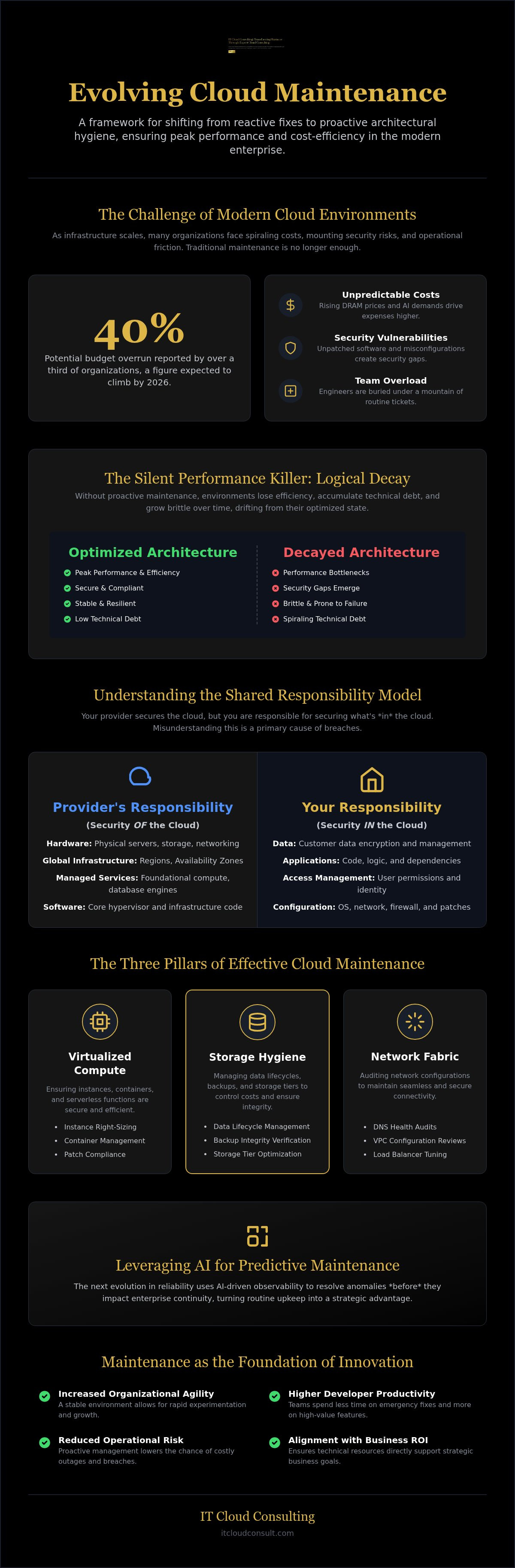
Over a third of organizations currently report exceeding their cloud budgets by as much as 40%, a figure that continues to climb as server DRAM prices and AI infrastructure demands drive provider costs higher in 2026. For many enterprises, the promise of scalability has been eclipsed by the reality of unpatched security vulnerabilities and teams buried under a mountain of routine tickets. This friction suggests that traditional maintenance is no longer sufficient for modern scale. To maintain a competitive edge, forward-thinking leaders are shifting toward sophisticated cloud reliability engineering services that prioritize architectural evolution over simple survival.
You likely feel the strain of unpredictable monthly bills and the constant pressure to secure every logical layer of your environment. It's a common frustration to see technical debt accumulate while your team's potential remains locked behind manual, repetitive processes. This guide promises to help you evolve your maintenance from a reactive struggle into a proactive strategy that ensures peak performance and cost-efficiency. We will provide a clear framework for enterprise continuity, showing you exactly how to align technical tasks with measurable business ROI and long-term operational stability.
While this guide focuses on cloud systems, maintaining a high-performing physical workspace is also vital for business continuity; to discover integrated facilities management, visit The CFS Group.
Key Takeaways
- Learn to transition from reactive troubleshooting to architectural hygiene by managing the logical and virtual components of your cloud environment.
- Clarify the Shared Responsibility Model to understand exactly where your provider's obligations end and your internal maintenance duties begin.
- Implement a holistic framework that utilizes cloud reliability engineering services to balance security protocols, performance optimization, and financial health.
- Explore how AI-driven observability tools facilitate predictive maintenance, allowing your team to resolve anomalies before they impact enterprise continuity.
- Discover how to align routine technical support with high-level business strategy to lower operational risk and realize the latent potential of your infrastructure.
Redefining Cloud Infrastructure Maintenance for the Modern Enterprise
Cloud infrastructure maintenance in 2026 has evolved far beyond the traditional scope of physical hardware repair or occasional instance reboots. In a virtualized world, maintenance is the proactive management of logical, virtual, and architectural components that define your operational environment. We view this as "architectural hygiene," a continuous process of refining the digital structures that support your business applications. This shift is critical because, while your provider manages the physical data center, you remain responsible for the integrity of everything built within it. Modern enterprises recognize that stability isn't a static state but a result of deliberate, ongoing effort.
Neglecting these layers leads to "Logical Decay." It's a silent performance killer. This phenomenon occurs when unmaintained environments lose efficiency, accumulate technical debt, and become increasingly brittle over time. Without consistent oversight, a once-optimized environment begins to drift from its intended state, resulting in performance bottlenecks and security gaps. Establishing a robust maintenance framework is a non-negotiable prerequisite for strategic cloud adoption. It ensures that the transition to modern infrastructure isn't just a migration, but a long-term evolution. Many organizations now apply Site Reliability Engineering principles to automate these tasks, ensuring that their systems remain resilient under pressure. Professional cloud reliability engineering services provide the technical depth required to manage this complexity, turning routine upkeep into a strategic advantage.
The Core Components of the Cloud Stack
Effective maintenance targets the three primary layers of the modern cloud fabric to prevent systemic failure. First, virtualized compute requires constant oversight of instances, containers, and serverless functions to ensure right-sizing and patch compliance. Second, storage hygiene involves managing data lifecycles, verifying backup integrity, and optimizing storage tiers to control costs. Finally, the network fabric demands regular audits of DNS health, VPC configurations, and load balancer settings to maintain seamless connectivity. By addressing these areas, cloud reliability engineering services ensure that every component of the stack operates at peak efficiency.
Why Maintenance is the Foundation of Innovation
A stable, well-maintained environment is the primary driver of organizational agility. When the underlying infrastructure is reliable, engineering teams spend less time on emergency fixes and more time on high-value feature development. System health directly correlates with developer productivity; a clean environment reduces the friction that often slows down deployment cycles. By treating maintenance as a strategic priority, businesses create the breathing room necessary for experimentation and growth. Maintenance is the continuous alignment of resources with business intent.
The Shared Responsibility Model: Debunking the Provider Myth
A common misconception among enterprise leaders is the belief that moving to a major cloud provider offloads the entirety of the maintenance burden. It's a dangerous assumption that often leads to operational gaps. While providers like AWS, Azure, and Google Cloud offer world-class resilience, they operate under a Shared Responsibility Model that draws a clear line between their duties and yours. They are responsible for the security and maintenance of the cloud, but you remain responsible for everything you build and store in the cloud. Ignoring this distinction is a primary cause of configuration drift and security breaches.
Think of the provider as the architect and manager of a high-security apartment complex. They maintain the structural integrity, the utilities, and the perimeter gates. However, they don't lock your individual front door or monitor who you give your keys to. Just as maintaining the value of a physical property might involve specialists like Cabinet refinishing Denver for interior restoration, you must take ownership of your cloud's internal environment. If you leave your digital windows open through unpatched software or misconfigured permissions, the provider's perimeter security cannot protect you. Utilizing professional cloud reliability engineering services helps bridge this gap, ensuring that your internal "apartment" remains as secure and efficient as the building itself. Without this active oversight, your environment becomes a liability regardless of the provider's underlying strength.
What Your Cloud Provider Manages
What Your Organization Must Maintain
Your team is responsible for the logical layers that sit atop the provider's foundation. This includes the guest operating systems, which require regular patching and security hardening to prevent exploitation. You must also manage application configurations to ensure settings haven't drifted from established best practices over time. Identity and Access Management (IAM) is another critical area; you must conduct regular audits of permissions to ensure only authorized users have access to sensitive resources. Establishing a framework for ongoing cloud support is the most effective way to manage these recurring requirements. By aligning your internal tasks with professional cloud reliability engineering services, you can ensure that technical maintenance always supports your broader business objectives. If you're looking to strengthen your operational foundation, consider how strategic cloud management can transform your maintenance routine from a burden into a competitive asset.
The Three Pillars of Effective Infrastructure Maintenance
To realize the full potential of a cloud environment, maintenance must be viewed through a holistic framework rather than a narrow technical lens. It's no longer sufficient to treat upkeep as a simple patching schedule. Instead, sophisticated cloud reliability engineering services approach maintenance as a proactive architectural review that balances security, performance, and financial health. This multidimensional strategy ensures that your infrastructure remains resilient and cost-effective as it scales. By establishing these three pillars, organizations provide the necessary foundation for managed cloud services to deliver maximum business value.
Pillar 1: Security and Compliance Hygiene
Security maintenance is a continuous cycle of identification and remediation. It begins with automated vulnerability scanning and a disciplined patch management strategy that addresses threats before they're exploited. Beyond technical patches, teams must monitor for compliance drift to ensure that every resource consistently meets SOC2 or GDPR standards. A critical but often overlooked task is certificate management. Failing to track and renew SSL certificates is a common cause of preventable outages that can halt enterprise operations in seconds. Maintaining these logical safeguards is essential for protecting the integrity of your data and the trust of your users.
Pillar 2: Performance and Reliability Optimization
Infrastructure that isn't regularly tuned will inevitably suffer from performance degradation. Effective maintenance involves right-sizing instances based on actual telemetry data to ensure you aren't over-provisioning or starving critical workloads. This pillar also includes deep-level tasks like database indexing and query optimization, which prevent latency from creeping into the user experience. To verify system resilience, cloud reliability engineering services implement regular stress testing and disaster recovery drills. These exercises prove that your recovery protocols actually work under pressure, transforming theoretical reliability into a documented operational reality.
Pillar 3: Financial Hygiene (FinOps as Maintenance)
Financial health is a direct indicator of architectural health. Given that over a third of organizations report exceeding their cloud budgets by 20% to 40%, cost management must be treated as a core maintenance function. This involves identifying and terminating "zombie" resources, such as idle instances or orphaned disks that continue to accrue charges without providing value. Maintenance teams must also conduct regular reviews of Reserved Instance (RI) and Savings Plan coverage to capitalize on provider discounts. Unoptimized spend is a symptom of neglected maintenance. By treating cloud spend as a technical metric, you ensure that your infrastructure remains lean and aligned with your organizational ROI.
Leveraging AI and Automation for Predictive Maintenance in 2026
The year 2026 marks a definitive departure from the era of scheduled maintenance windows. With major providers investing over $710 billion in AI data centers, the sheer scale of modern infrastructure has outpaced the capacity for manual oversight. Maintenance has evolved into a predictive discipline. It utilizes AI-driven observability to identify subtle anomalies before they escalate into outages. By shifting from reactive troubleshooting to autonomous management, organizations ensure enterprise continuity without the constant threat of downtime. Professional cloud reliability engineering services are now the primary mechanism for implementing these sophisticated, self-healing architectures.
The Role of AI in Cloud Observability
Traditional monitoring relied on static thresholds that often triggered false positives or missed complex, cascading failures. Modern AI-assisted observability moves beyond simple alerts to multi-variant anomaly detection. It analyzes thousands of concurrent metrics to spot patterns that indicate impending hardware failure or software degradation. When an issue occurs, AI-assisted root cause analysis (RCA) dramatically reduces the Mean Time to Repair by pinpointing the exact source of friction in seconds. Predictive scaling also allows the infrastructure to prepare for demand spikes before they happen, ensuring performance remains consistent without human intervention.
While AI manages the health of your digital infrastructure, similar logic can be applied to the health of the personnel operating it. For team members working demanding 12-hour shifts, Blue Collar Fit provides a platform to explore AI Fitness Coach and maintain physical wellness through automated, personalized guidance.
Infrastructure as Code (IaC) and Configuration Drift
Consistency is the cornerstone of reliability. Utilizing Infrastructure as Code (IaC) tools like Terraform allows teams to enforce a desired state across the entire environment. This approach mitigates the risk of configuration drift, where manual changes or emergency fixes bypass the established roadmap. Automated drift detection tools now provide real-time visibility into these deviations, allowing for immediate remediation. We advocate for an Immutable Infrastructure approach, where components are replaced rather than patched. This ensures that every resource is a clean, verified instance of the master configuration.
The realization of a self-healing architecture is no longer a visionary concept; it's an operational necessity. By integrating these automated workflows, your team can focus on high-level innovation rather than routine upkeep. If you're ready to modernize your approach, our ongoing cloud support provides the expertise needed to deploy these advanced predictive frameworks effectively. Turning maintenance into an automated asset is the most reliable way to lower operational risk and maximize your cloud investment.
Building a Resilient Maintenance Roadmap with IT Cloud Consulting
Transitioning from reactive fire-fighting to strategic optimization requires more than just technical tools; it demands a fundamental shift in how your organization perceives infrastructure. IT Cloud Consulting acts as your visionary architect, managing the inherent complexity of modern environments while ensuring your cloud stack remains a driver of enterprise continuity. We bridge the critical gap between routine technical tasks and high-level business strategy, transforming maintenance from a cost center into an engine for growth. By leveraging our cloud reliability engineering services, you gain a partner dedicated to realizing the latent potential within your architecture.
The current volatility in the 2026 market, characterized by a 15-25% increase in server costs and rising provider fees, makes efficiency a survival requirement. Our approach moves your team away from manual, repetitive tickets and toward a model of continuous architectural evolution. We don't just patch systems; we optimize them to ensure that technical performance directly supports your organizational ROI. This alignment lowers operational risk and provides the steady assurance needed to navigate a rapidly shifting digital landscape. When you align your maintenance framework with business intent, you turn a technical necessity into a competitive advantage.
Our Approach to Continuous Cloud Excellence
Our methodology begins with a strategic assessment of your existing maintenance gaps and hidden risks. We identify the specific areas where logical decay or unoptimized spend may be compromising your stability. Following this, we implement robust automated monitoring and FinOps guardrails to prevent the budget overruns that plague over a third of modern organizations. Through Ongoing Cloud Support, we provide continuous advisory services, ensuring that your infrastructure evolves alongside your business needs rather than becoming a legacy burden. This proactive stance ensures that your environment remains secure, performant, and financially lean.
The Path to Modernization
A resilient maintenance roadmap delivers three primary outcomes: significantly reduced operational risk, predictable monthly costs, and enhanced organizational agility. When your infrastructure is managed with precision, your developers are free to focus on innovation rather than remediation. This is the ultimate goal of Cloud Optimization-creating a lean, high-performing environment that responds effortlessly to market demands. By integrating cloud reliability engineering services into your core operations, you build a foundation that is both stable and scalable.
It's time to empower your organization to stop simply maintaining and start truly evolving. Enterprise continuity in 2026 depends on your ability to anticipate change rather than just reacting to it. We invite you to consult with our experts to develop a tailored maintenance roadmap that secures your digital future. Let's move beyond the status quo and unlock the full potential of your cloud investment together.
Securing the Future of Your Cloud Infrastructure
The transition from reactive patching to a proactive, architectural strategy is essential in the complex environment of 2026. By mastering the shared responsibility model and aligning your technical tasks with the pillars of security, performance, and financial hygiene, you can transform routine upkeep into a strategic engine. Implementing professional cloud reliability engineering services ensures that your environment doesn't just survive but thrives through predictive automation and self-healing systems.
As an expert advisor in cloud modernization, IT Cloud Consulting provides the national coverage required for enterprise-scale support. We focus on delivering strategic ROI and operational efficiency, connecting technical execution with your broader business vision. Partner with IT Cloud Consulting for a strategic approach to cloud excellence to realize the full potential of your digital evolution. It's time to build a foundation that supports your highest ambitions.
Frequently Asked Questions
What is the difference between cloud management and cloud maintenance?
Cloud management involves high-level governance and the orchestration of resources to meet business goals, while cloud maintenance focuses on the granular technical health of your virtualized components. Maintenance ensures that guest operating systems are patched and configurations remain aligned with established best practices. It's the "architectural hygiene" required to prevent the logical decay of your environment over time.
Does cloud maintenance require system downtime in 2026?
Modern cloud maintenance rarely requires system downtime in 2026 due to the prevalence of blue-green deployments and rolling update strategies. These methodologies allow for the seamless replacement of infrastructure components without interrupting the user experience. By utilizing self-healing architectures, organizations maintain enterprise continuity while performing essential updates in the background without affecting availability.
How often should an enterprise conduct a cloud infrastructure audit?
Enterprises should conduct a comprehensive cloud infrastructure audit at least once per quarter, though continuous automated monitoring is the preferred standard for modern scale. Regular deep-dives identify security gaps and performance bottlenecks that automated tools might overlook during daily operations. This frequency ensures your environment evolves in lockstep with your business requirements and evolving compliance standards.
Can cloud maintenance help reduce my monthly AWS or Azure bill?
Effective cloud maintenance directly reduces monthly provider bills by identifying and terminating underutilized or "zombie" resources. This process, often a core component of professional cloud reliability engineering services, ensures that you only pay for the resources that provide active value. Regular right-sizing of instances prevents the over-provisioning that typically leads to significant budget overruns.
Is automated patching safe for mission-critical enterprise applications?
Automated patching is safe for mission-critical applications when it's integrated into a rigorous CI/CD pipeline that includes automated testing. This approach ensures that patches are verified in a staging environment before they are deployed to production. Automation reduces the human error often associated with manual patching cycles, significantly lowering your overall operational risk profile.
What are the risks of neglecting cloud infrastructure maintenance?
Neglecting maintenance leads to increased security vulnerabilities, performance degradation, and unpredictable operational costs. Without active oversight, environments become brittle and prone to "logical decay," making them difficult to scale or modernize. These risks can eventually compromise enterprise continuity and damage your organization's reputation through preventable outages or data breaches.
How does Infrastructure as Code (IaC) simplify the maintenance process?
Infrastructure as Code (IaC) simplifies maintenance by allowing teams to define and enforce a "desired state" through software. Tools like Terraform ensure that every component remains consistent across the environment, effectively eliminating the risk of manual configuration drift. This programmatic approach makes the maintenance process repeatable, auditable, and significantly faster to execute at enterprise scale.
What role does a Managed Service Provider (MSP) play in maintenance?
A strategic partner provides the specialized expertise required to manage the complexity of modern cloud reliability engineering services. They act as a visionary architect, bridging the gap between routine technical tasks and high-level business goals. By providing Ongoing Cloud Support, they ensure your infrastructure remains optimized, secure, and ready for future innovation while your internal team focuses on core development.


