
Is your cloud infrastructure a launchpad for innovation, or is it a silent anchor dragging down your quarterly margins? Many enterprises discover too late that a rapid migration often moves legacy problems to a more expensive environment. You've likely felt the frustration of unpredictable monthly bills, the anxiety of performance bottlenecks during scaling, or the fear of falling behind on updated standards like ISO/IEC 27001:2022. It's a common challenge when the cloud market exceeds $600 billion, yet many organizations still struggle to align their technical stack with their business velocity.
By conducting a rigorous cloud architecture review, you can transform these operational pains into a clear roadmap for modernization. This article provides a strategic framework to help you eliminate technical debt, validate your security posture, and significantly reduce overhead through cloud optimization. We will walk through a comprehensive checklist designed to evaluate your current environment and unlock its latent potential for long-term, strategic cloud adoption.
Key Takeaways
- Analyze the impact of Architecturally Significant Decisions (ASDs) to ensure your infrastructure facilitates long-term scalability rather than accumulating technical debt.
- Master a comprehensive cloud architecture review framework to validate your security posture and eliminate unnecessary operational overhead.
- Evaluate the advantages of external strategic consulting in overcoming "expert blindness" and providing an objective lens for infrastructure remediation.
- Develop a prioritized modernization roadmap that balances immediate "quick wins" with the deep strategic shifts required for sustainable cloud optimization.
Understanding the Cloud Architecture Review: Beyond the Technical Audit
A modern cloud computing environment is a complex ecosystem where a single misconfiguration can ripple through an entire organization. A cloud architecture review isn't a mere technical audit or a narrow security check. Instead, it serves as a holistic assessment of your infrastructure’s performance, cost-efficiency, and risk profile. While a standard security audit focuses primarily on compliance and vulnerabilities, a strategic review evaluates how well your technical framework supports your business velocity. This process moves beyond "is it secure?" to ask "is it optimal for our long-term growth?"
At the heart of a successful cloud architecture review lie Architecturally Significant Decisions (ASDs). These are the high-stakes choices regarding data partitioning, service integration, and infrastructure orchestration that are notoriously expensive to change once they're implemented. If left unexamined, these decisions can lock an enterprise into rigid, inefficient patterns. By identifying and validating these choices, organizations can adopt an "evolutionary architecture." This methodology ensures your system supports guided, incremental change, allowing your business to maintain a competitive edge as the technological landscape shifts through 2026.
The High Cost of Technical Debt in 2026
Outdated patterns create "cloud sprawl," where unmanaged resources bleed capital and complicate governance. Architectural inertia often follows, slowing down software deployment cycles and stifling the release of new features. Technical debt is the compounded interest of poor architectural choices. When teams prioritize immediate speed over sustainable structure, they build a deficit that eventually requires a total system overhaul. A strategic review identifies these leaks before they become catastrophic financial burdens that halt your modernization journey.
When to Initiate a Review: Critical Business Triggers
Identifying the right moment for a review can prevent millions in wasted spend. You should initiate a review following a post-migration stabilization phase to ensure your "lift and shift" didn't inherit legacy inefficiencies. It's also vital when preparing for rapid scaling or entry into new markets, where performance bottlenecks can ruin a user's first impression. Finally, if you notice significant shifts in monthly consumption costs without a corresponding increase in user growth, your architecture is likely misaligned. These triggers signal the need for professional cloud optimization to restore operational equilibrium and realize the latent potential of your infrastructure.
The 6 Pillars of a High-Performing Cloud Environment
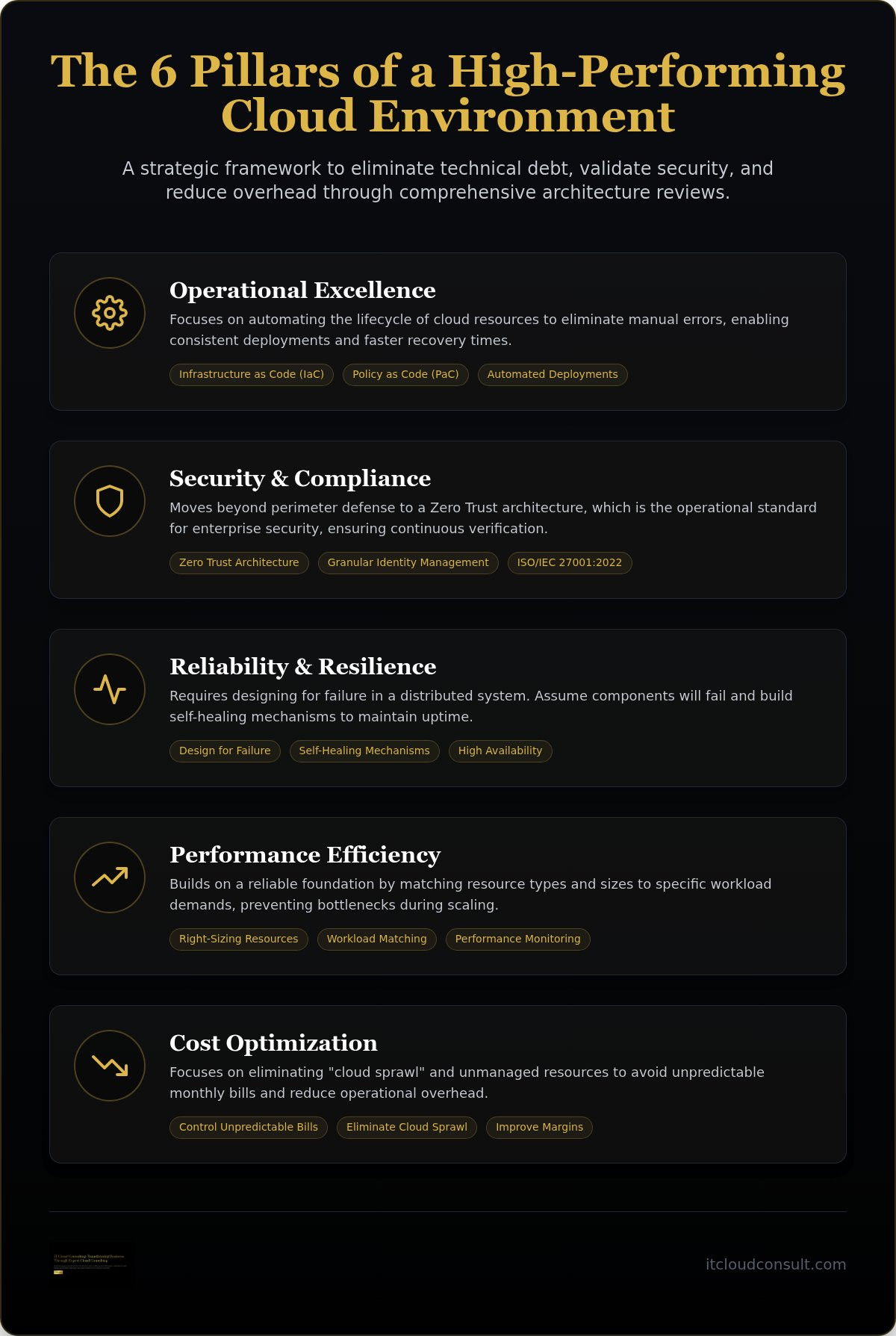
A rigorous cloud architecture review evaluates your infrastructure against a platform-agnostic framework to ensure long-term viability. While native provider tools are useful, an enterprise perspective requires a balanced assessment across six critical pillars. This approach ensures that your technical execution aligns with your strategic vision, regardless of whether you're utilizing AWS, Azure, or a hybrid environment. Utilizing a comprehensive cloud technical checklist during the review process helps identify gaps in security and data governance that platform-specific tools might overlook.
Operational excellence focuses on automating the lifecycle of cloud resources to eliminate manual errors. By implementing Infrastructure as Code (IaC) and Policy as Code (PaC), organizations can achieve consistent deployments and faster recovery times. Simultaneously, security and compliance have evolved from simple "perimeter defense" to a Zero Trust architecture. In 2026, Zero Trust is the operational standard for enterprise security, necessitating a shift toward granular identity management and continuous verification. Partnering with experts for ongoing cloud support ensures these pillars remain robust as your organization evolves.
Reliability and resilience require designing for failure in a distributed system. You must assume that components will eventually fail and build self-healing mechanisms to maintain uptime. Performance efficiency then builds on this foundation by matching resource types to specific workload demands. This isn't just
Internal vs. External Reviews: Choosing Your Strategic Path
Determining who executes your cloud architecture review is a critical decision that impacts the validity of your findings and the trajectory of your remediation. While internal teams possess unparalleled context regarding legacy systems, they often fall victim to "Expert Blindness." This phenomenon occurs when long-standing IT departments become habituated to existing workarounds, overlooking systemic inefficiencies that an outside observer would immediately identify. Additionally, pulling senior architects away from high-value product development to conduct an exhaustive review creates a significant opportunity cost that can stall your innovation pipeline for weeks or even months.
Leveraging public cloud consulting provides an objective lens that internal assessments naturally lack. External partners bring cross-industry insights and a platform-agnostic perspective, ensuring that your architecture isn't just "functional" but truly optimized for performance and cost. Many organizations find that a hybrid approach yields the highest ROI. In this model, internal teams handle the initial data gathering while external consultants perform the high-level analysis and strategic planning. Utilizing frameworks like the National Checklist Program from NIST ensures these external reviews adhere to rigorous, standardized security configurations that meet modern enterprise requirements.
The Limitations of Native Cloud Provider Tools
Native tools like AWS Trusted Advisor or Azure Advisor offer immediate convenience, yet they provide an incomplete picture of your ecosystem. These services typically focus on platform-specific optimizations that may not align with a multi-cloud or hybrid strategy. There is also an inherent conflict of interest when a provider suggests additional services to solve performance issues that might actually stem from poor architectural design. A strategic cloud architecture review requires third-party tools and human expertise to provide visibility across platforms, ensuring your remediation plan isn't biased toward a single vendor's ecosystem or pricing model.
Evaluating External Consulting Partners
When selecting a partner, look beyond technical certifications. The most effective consultants possess a business-first mindset and emphasize strategic cloud adoption over mere technical fixes. Your chosen partner should deliver a prioritized roadmap rather than a generic list of errors. This roadmap must connect technical remediation to specific business outcomes, such as reduced operational overhead or increased deployment frequency. Prioritize partners who demonstrate multi-cloud expertise and a proven ability to bridge the gap between complex infrastructure and organizational goals.
The Enterprise Cloud Architecture Review Checklist
A cloud architecture review is more than a list of technical questions; it's a strategic diagnostic tool for executive leadership. This checklist focuses on high-impact areas that define your organization's agility and risk profile. By examining these components, you move beyond basic maintenance toward a state of continuous evolution. Every item on this list directly influences your bottom line and your ability to scale without friction.
- Inventory Audit: You must validate that every active resource has a clear business owner and a documented purpose. Orphaned resources are more than just cost leaks; they're unmonitored security risks that can act as entry points for lateral movement within your network.
- Security Perimeter Check: Evaluate IAM roles against the Principle of Least Privilege (PoLP) and verify encryption protocols for data at rest and in transit. As Zero Trust becomes the operational standard in 2026, your review should ensure that identity, not the network location, is the primary security boundary.
- Scalability Stress Test: Review your auto-scaling triggers and database sharding strategies. If your infrastructure lags during peak demand, you're losing revenue and damaging brand trust. A review identifies these bottlenecks before they impact the end-user experience.
- Cost-to-Value Mapping: Compare your resource spend against specific business unit outputs. If a high-performance compute cluster supports a low-margin legacy application, it's a clear candidate for rightsizing or refactoring.
- Disaster Recovery Validation: Testing your Recovery Time Objectives (RTO) and Recovery Point Objectives (RPO) is non-negotiable. In a modern distributed system, you don't just test the backup; you test the entire restoration workflow to ensure business continuity.
Operational Readiness and Automation
Modernization requires a shift away from manual intervention. Your review should confirm that Infrastructure as Code (IaC) is utilized for all environment deployments, ensuring consistency and auditability. Monitoring and alerting systems must be tuned to prevent alert fatigue, which often leads teams to ignore critical warnings. Additionally, validate your CI/CD pipelines to ensure security vulnerabilities are caught during the build phase rather than in production.
Data Integrity and Governance
As global regulations evolve, data residency becomes a primary architectural concern. You must assess the lifecycle management of your data backups and archives to ensure compliance with standards like ISO/IEC 27001:2022. This includes verifying that data access strictly follows the Principle of Least Privilege. Ensuring your data governance is robust protects your organization from the legal and financial fallout of non-compliance.
If you're ready to transform your infrastructure into a strategic asset, our experts can guide you through a comprehensive Cloud Optimization journey to eliminate technical debt and accelerate your business velocity.
From Review to Remediation: Modernizing Your Infrastructure
A cloud architecture review provides the diagnostic data necessary for evolution, but its true power is realized only through a structured remediation plan. Data without action is merely overhead. To move from insight to implementation, you must categorize findings based on their impact and the effort required for execution. This disciplined approach ensures that your technical teams remain focused on high-value tasks that directly correlate with organizational goals and long-term business velocity.
Effective remediation utilizes a prioritization matrix that separates "Quick Wins" from "Strategic Shifts." Quick wins, such as rightsizing idle instances or optimizing storage tiers, provide immediate relief to your monthly cloud spend. Strategic shifts, however, require more significant investment, such as refactoring monolithic applications into microservices or adopting serverless frameworks. Securing executive buy-in for these deeper changes requires translating technical needs into ROI. You can demonstrate, for instance, how moving from on-demand pricing to a one-year commitment can result in discounts of up to 72% on AWS and Azure, or how reducing data egress fees, which typically range from $0.09 to $0.12 per GB, directly improves your margins.
Once the initial remediation is complete, maintaining these high standards becomes the next challenge. Utilizing managed cloud services allows your internal teams to focus on core product innovation while experts handle the continuous tuning required for peak efficiency. This partnership ensures that your infrastructure doesn't slowly revert to an inefficient state as your workload demands change.
Bridging the Gap Between Insight and Action
Modernization is a journey, not a single event. Developing a phased roadmap allows you to implement changes incrementally, ensuring that current operations remain stable during the transition. Each phase should have a clear owner and a measurable success metric to maintain accountability across the organization. It's also vital to close the loop by re-reviewing your infrastructure every six months to address any new technical debt that has emerged as your system evolves.
Partnering for Long-Term Cloud Evolution
IT Cloud Consulting acts as your strategic guide, transforming the findings of your cloud architecture review into a functional, optimized reality. We specialize in preventing the recurrence of technical debt through ongoing cloud infrastructure consulting tailored to your specific scale and industry. Our focus remains on your long-term evolution, ensuring your cloud environment is always a competitive asset rather than a financial burden.
Schedule a professional Cloud Architecture Review with IT Cloud Consulting to begin your journey toward a more efficient, secure, and scalable future.
Realizing the Potential of Your Cloud Evolution
Modernizing an enterprise infrastructure requires shifting from a reactive mindset to a proactive, strategic posture. By conducting a comprehensive cloud architecture review, you move beyond mere technical survival and begin to leverage your environment as a true engine for growth. We've explored how aligning Architecturally Significant Decisions with the six pillars of high performance creates a resilient foundation. This process isn't just about identifying errors; it's about building a prioritized roadmap that transforms technical debt into business velocity.
Maintaining this standard across a complex organization requires a partner with a modernization-focused methodology. IT Cloud Consulting provides expert strategic guidance and national US enterprise support to help you navigate the transition from current constraints to an optimized future state. We're committed to helping you bridge the gap between technical complexity and strategic success. The path to modernization is clear, and your potential for innovation is within reach.
Optimize your infrastructure with a professional Cloud Architecture Review
Frequently Asked Questions
How long does a typical cloud architecture review take?
A standard enterprise-scale cloud architecture review typically spans two to four weeks. The exact duration depends on the complexity of your environment and the number of workloads under assessment. Initial data gathering usually takes one week; this is followed by a week of deep-dive analysis and a final week for strategic roadmap development. This methodical timeframe ensures a comprehensive evaluation without rushing the critical discovery phase.
What is the difference between a cloud security audit and an architecture review?
A cloud security audit focuses narrowly on compliance and identifying specific vulnerabilities within your perimeter. In contrast, a cloud architecture review is a holistic assessment that evaluates performance, cost-efficiency, and business velocity. While security is a core pillar, the review determines if your technical framework supports your long-term evolution. It's not just about ticking compliance boxes; it's about realizing the latent potential of your infrastructure.
Will a cloud architecture review cause downtime for our applications?
No, a professional architecture review is an observational process that doesn't cause downtime for your applications. Consultants utilize read-only access to configurations and metadata to identify hidden patterns and bottlenecks. Remediation steps identified during the process are planned separately and executed during standard maintenance windows. This ensures your business operations remain entirely undisturbed throughout the modernization journey while we build your path forward.
Can we perform a review ourselves using native tools like AWS Well-Architected Tool?
You can utilize native tools like the AWS Well-Architected Tool for basic assessments, but these often lack the objective lens required for enterprise transformation. Native tools are frequently biased toward a single provider's ecosystem and may overlook cross-platform inefficiencies. An external review provides a platform-agnostic perspective that accounts for hybrid complexities. It's a way to avoid the expert blindness often found in internal IT departments that have grown accustomed to legacy workarounds.
How often should an enterprise conduct a formal architecture review?
Enterprises should conduct a formal cloud architecture review at least once a year to keep pace with rapid technological shifts. Additional reviews are necessary following major organizational triggers, such as post-migration stabilization or preparation for rapid scaling. Regular assessments prevent the accumulation of technical debt and ensure your infrastructure remains aligned with your strategic growth objectives. This cadence allows for steady evolution in a volatile market.
What are the most common findings in a cloud architecture review?
Common findings often include zombie resources that no longer serve a business purpose and over-provisioned instances that lead to significant waste. Reviews also frequently uncover misaligned IAM roles that violate the Principle of Least Privilege and inefficient data egress patterns. Identifying these leaks is the first step toward cloud optimization. This allows you to reallocate capital toward innovation and modernization rather than maintaining idle or inefficient infrastructure.
How much can we expect to save on our cloud bill after a review and remediation?
Enterprises often realize cost reductions of up to 55% on specific services by moving to commitment models identified during a review. According to industry data from 2026, committing to a three-year term can result in significant discounts on platforms like Google Cloud. A thorough review identifies these specific opportunities, ensuring your spending is directly linked to business value. It's a process that transforms your cloud bill into a controlled investment.


