
Why do most IT leaders find that their enterprise cloud transformation initiatives stall just as they should be delivering the most value? You've likely experienced the frustration of skyrocketing costs and legacy bottlenecks that refuse to budge, despite significant investment. It's a common challenge where the promise of agility is often overshadowed by security anxiety and operational complexity. You aren't alone in seeking a path that transforms the cloud from a costly storage solution into a high-performance engine for growth.
We've designed this comprehensive guide to help you architect a modernization strategy that secures a clear return on investment and ensures long-term scalability. You'll learn how to transition from fragmented migrations to a cohesive framework that reduces operational overhead and unlocks the latent potential of your organizational data. We'll walk through a methodical roadmap for 2026, covering critical readiness assessments, optimization tactics, and the infrastructure requirements needed to support advanced AI and big data initiatives.
Key Takeaways
- Adopt a cloud-native framework rather than a simple "lift-and-shift" approach to ensure your infrastructure is truly modernized for future scalability.
- Prioritize a comprehensive architectural review to identify legacy bottlenecks and secure early wins that demonstrate immediate value to stakeholders.
- Accelerate innovation by transitioning monolithic systems to microservices and integrating automated CI/CD pipelines into your operational workflow.
- Establish a Cloud Center of Excellence (CCoE) to maintain centralized governance and rigorous security standards throughout your enterprise cloud transformation.
- Partner with a strategic consultant to navigate the complexities of execution, ensuring your modernization roadmap leads to reduced overhead and optimized performance.
Defining the Enterprise Cloud Transformation Framework
Enterprise cloud transformation is more than a technical upgrade; it represents the end-to-end modernization of an organization's IT infrastructure and its underlying operational culture. While many businesses view the cloud as a destination, successful leaders recognize it as an operating model that demands a total shift in mindset. Enterprise cloud transformation is the fundamental redesign of an organization's digital DNA, integrating modern cloud computing capabilities to drive continuous business agility and breakthrough innovation.
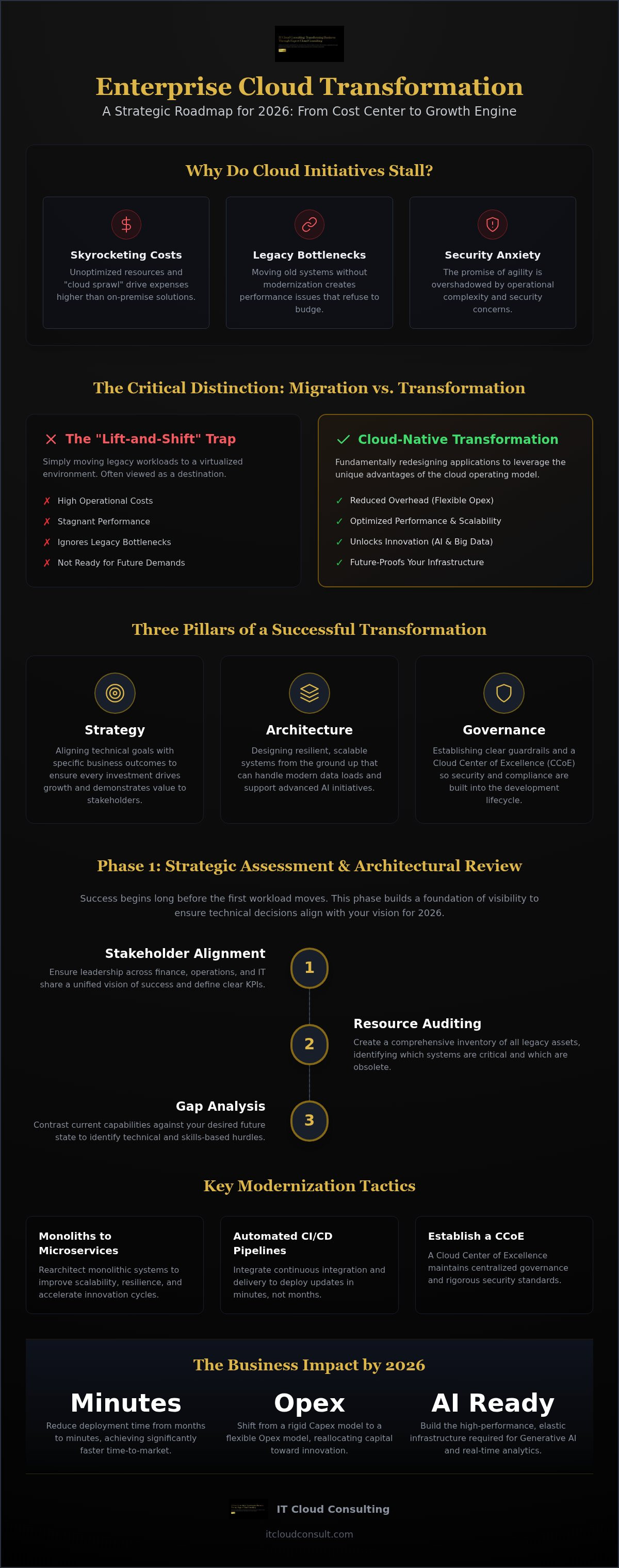
To achieve this state, organizations must move beyond the "Lift-and-Shift" mentality. Simply moving legacy workloads into a virtualized environment often results in high costs and stagnant performance. A true "Cloud-Native" transformation involves rebuilding applications to leverage the unique advantages of the cloud, such as auto-scaling and serverless computing. This evolution rests on three pillars of success:
- Strategy: Aligning technical goals with specific business outcomes to ensure every dollar spent drives growth.
- Architecture: Designing resilient, scalable systems from the ground up that can handle modern data loads.
- Governance: Establishing clear guardrails so security and compliance are built into the development lifecycle.
The Business Case for Transformation in 2026
By 2026, cloud maturity won't be an optional advantage; it will be the primary indicator of market competitiveness. Organizations that prioritize deep transformation gain the ability to deploy updates in minutes rather than months, creating a significantly faster time-to-market. This speed is essential for supporting emerging technologies like Generative AI and real-time analytics, which require high-performance, elastic infrastructure to function effectively. Financially, this shift moves the organization from a rigid Capex model to a flexible Opex model. This allows the C-suite to reallocate capital toward innovation rather than maintaining aging hardware.
Transformation vs. Migration: Why the Distinction Matters
Confusing migration with transformation often leads to "cloud sprawl," where unoptimized resources drive costs higher than on-premise alternatives. Effective strategic cloud adoption ensures that every workload is evaluated for its long-term value. Instead of just moving data, teams should focus on Refactoring or Rearchitecting legacy systems. Refactoring involves minor code changes to better suit the cloud environment, while Rearchitecting involves a complete overhaul to adopt microservices. These strategies prevent the bottlenecks that common migration paths often ignore, ensuring the infrastructure remains ready for future demands.
Phase 1: Strategic Assessment and Architectural Review
Success in enterprise cloud transformation begins long before the first workload moves. Jumping straight into execution without a clear understanding of your current state often leads to fragmented results and wasted capital. Leading analysts at Gartner emphasize that your cloud journey is essentially a Business Transformation, requiring a deep look at how technology serves your commercial goals. This phase is about building a foundation of visibility through a rigorous cloud architecture review to ensure your technical decisions align with your vision for 2026.
We recommend a three-step process to secure this alignment:
- Step 1: Stakeholder Alignment. Ensure that leadership across finance, operations, and IT share a unified vision of success.
- Step 2: Resource Auditing. Create a comprehensive inventory of all legacy assets, identifying which systems are critical and which are obsolete.
- Step 3: Gap Analysis. Contrast your current capabilities against your desired future state to identify the technical and skills-based hurdles you'll need to overcome.
During this inventory process, focus on identifying "low-hanging fruit." These are non-critical applications that are easy to move and provide immediate wins. These early successes build momentum and prove the value of the transformation to skeptical stakeholders. To measure this progress, establish clear Key Performance Indicators (KPIs) such as deployment frequency, cost per transaction, and mean time to recovery (MTTR). If you're looking for a partner to help define these metrics, a professional consultation can provide the clarity you need.
Conducting a Cloud Readiness Assessment
A thorough assessment examines three distinct areas of your business. Technical readiness involves mapping application dependencies and determining data portability to avoid broken connections during migration. Organizational readiness evaluates whether your team possesses the necessary cloud-native skill sets or if a cultural shift is required to adopt DevOps practices. Finally, security readiness ensures that your current compliance requirements are mapped to modern, cloud-native tools. Don't overlook the cultural aspect; a team that isn't ready for the cloud can be a bigger bottleneck than any legacy database.
Building the Modernization Roadmap
Your roadmap should prioritize a phased approach to minimize business disruption. It's not about doing everything at once; it's about doing the right things in the right order. Integrating a resilient IT modernization strategy into your broader plan ensures that your cloud transition isn't just a relocation but a genuine upgrade. This roadmap must also include a realistic budget that accounts for both the initial implementation costs and the ongoing optimization required to maintain peak efficiency as your needs evolve.
Phase 2: Application Modernization and Data Optimization
Once your strategic foundation is set, the focus shifts to the structural evolution of your digital assets. This phase of enterprise cloud transformation is where the actual modernization occurs, moving your organization away from rigid, monolithic architectures toward flexible microservices and containers. This decoupling allows individual components of your system to scale independently, ensuring that a surge in one area doesn't compromise the stability of the entire platform. It's a fundamental shift that replaces legacy constraints with architectural freedom.
To accelerate this transition, you must integrate DevOps practices and robust CI/CD pipelines into your daily operations. These automated workflows ensure that code changes are tested, validated, and deployed with minimal human intervention, which drastically reduces the risk of manual error. Data modernization follows a parallel path. By migrating from siloed legacy databases to unified cloud data lakes, you unlock the ability to perform real-time analytics and support advanced AI initiatives. Leveraging serverless computing further refines this environment by removing the burden of infrastructure management, allowing your engineers to focus on high-value innovation rather than routine maintenance.
The 6 Rs of Cloud Transformation
Navigating an enterprise cloud transformation requires a nuanced approach to every workload. We utilize the "6 Rs" framework to determine the most efficient path for each application:
- Rehost: Moving applications to the cloud without changes (Lift-and-Shift).
- Replatform: Making minor adjustments to take advantage of cloud features without changing core architecture.
- Refactor: Optimizing code to better suit a cloud-native environment.
- Rearchitect: Redesigning the application's architecture to fully utilize microservices and serverless capabilities.
- Retire: Decommissioning applications that no longer provide business value.
- Retain: Keeping legacy systems on-premise when migration isn't currently viable.
While Rehosting is the fastest route, Rearchitecting consistently offers the highest long-term ROI for enterprise-scale workloads. For instance, refactoring a legacy customer portal to use serverless functions can significantly reduce costs compared to simply replatforming it on a virtual machine.
Optimizing for Operational Efficiency
Achieving cloud operational efficiency requires a commitment to automation from day one. By implementing auto-scaling and right-sizing protocols, you ensure that your infrastructure automatically adjusts to demand, preventing costly over-provisioning. This proactive approach doesn't just save money; it's a strategic method for reducing the technical debt that often accumulates in legacy environments. Modernization ensures your systems are as lean as they are powerful, providing a scalable foundation for the next decade of growth.
Phase 3: Governance, Security, and Compliance Guardrails
As your enterprise cloud transformation matures, the focus must shift from technical deployment to long-term sustainability. Establishing a Cloud Center of Excellence (CCoE) is the most effective way to provide this centralized oversight. This cross-functional team acts as a governing body, ensuring that every cloud initiative aligns with organizational standards while providing the necessary guardrails to prevent shadow IT. A well-structured CCoE transforms governance from a restrictive bottleneck into an empowering framework that supports distributed innovation.
Effective Identity and Access Management (IAM) is the cornerstone of this phase, especially in a multi-cloud enterprise environment where permissions can quickly become fragmented. Consistency is key; you must ensure that security policies are uniform across all providers to prevent vulnerabilities. Within this context, understanding the Shared Responsibility Model is essential. This model dictates that while the cloud provider is responsible for the security of the physical infrastructure, the enterprise is solely accountable for the security of the data, applications, and configurations residing within that infrastructure.
To maintain rigorous standards like HIPAA, GDPR, or SOC2, organizations must move away from manual checks toward automated compliance monitoring. These tools provide real-time visibility into your security posture, automatically flagging deviations from established protocols. This proactive approach ensures that your modernized environment remains audit-ready at all times without burdening your engineering teams with administrative overhead.
Financial Governance and FinOps
Managing cloud spend requires a transition from reactive billing to proactive financial management. By implementing real-time visibility through granular tagging and resource allocation, you can identify waste before it impacts your bottom line. Engaging with cloud optimization consulting is a strategic way to prevent budget overruns, as it provides the expertise needed to right-size environments and leverage committed-use discounts effectively. This financial discipline ensures your enterprise cloud transformation remains a driver of profitability rather than a drain on resources.
Securing the Transformed Infrastructure
Securing a modernized perimeter requires a move toward Zero Trust security architecture, where no user or device is trusted by default. This philosophy assumes that threats can originate from anywhere, necessitating continuous verification for every access request. Utilizing Cloud Security Posture Management (CSPM) tools allows you to maintain this high level of vigilance by identifying misconfigurations across your entire cloud footprint. Continuous security audits are no longer periodic events; they're an integrated part of your dynamic operational rhythm. To ensure your defenses are robust enough for 2026, reach out to our strategic consultants for a comprehensive security review.
Executing Your Transformation with IT Cloud Consulting
A successful enterprise cloud transformation requires more than just technical proficiency; it demands a partner who understands the intricate intersection of technology and business strategy. We position ourselves as the architect and guide throughout your journey, ensuring that every architectural decision serves a broader organizational purpose. Our proprietary approach to strategic planning moves beyond the standard checklists, focusing instead on the realization of your company's latent potential through customized implementation support.
The transition to a cloud-native model is a significant evolution that requires steady assurance. By integrating managed cloud services into your long-term roadmap, you ensure that your infrastructure remains stable and secure as market demands shift. We don't just help you reach the cloud; we provide the ongoing managed support necessary to maintain operational continuity and high performance in a 2026 business environment.
Your journey begins with a clear understanding of your current state. Scheduling an Enterprise Cloud Readiness Assessment is the critical first step toward building a risk-mitigated roadmap. This assessment provides the visibility needed to architect a solution that reduces overhead while supporting the high-scale data initiatives your business requires for future growth. It's the foundation upon which your entire enterprise cloud transformation is built.
Tailored Solutions for Complex Environments
Enterprise environments are rarely simple. Whether you're managing hybrid configurations or navigating the complexities of a multi-cloud strategy, our expert advisory services provide the clarity needed to succeed. We develop customized roadmaps that align specifically with your industry's compliance requirements, ensuring that security is never sacrificed for speed. Our focus remains on technical excellence that directly translates into business innovation and faster time-to-market.
Continuous Support and Optimization
The transformation doesn't end at "Go-Live." In fact, the post-migration phase is where the most significant gains in efficiency are often realized. We provide ongoing monitoring and performance tuning as a standard part of our engagement, ensuring your environment is always right-sized for your current needs. This methodical approach to optimization prevents cost creep and ensures your infrastructure remains a competitive asset. Partner with IT Cloud Consulting for Your Strategic Transformation to secure a future-ready foundation built on expertise and trust.
Architecting Your Path to Modernization
Realizing the full potential of enterprise cloud transformation requires a shift from viewing the cloud as a simple utility to treating it as a strategic engine for growth. Throughout this roadmap, we've explored how a methodical approach, from initial architectural reviews to the implementation of automated governance, ensures that your infrastructure is both resilient and scalable for 2026. By prioritizing operational efficiency and application modernization, your organization can shed the weight of legacy technical debt and embrace the agility required for today's competitive landscape.
IT Cloud Consulting provides the authoritative strategic guidance and national US coverage needed to navigate these complexities with confidence. We focus on expert cloud optimization to ensure your investment delivers a measurable enterprise ROI, positioning your business for long-term success and continuous evolution. Our team acts as a dedicated partner, ensuring your technical strategy remains aligned with your broader commercial objectives.
The first step toward this optimized future is gaining a clear view of your current environment. Request Your Enterprise Cloud Readiness Assessment today to begin your journey with a partner committed to your vision. We're ready to help you unlock the possibilities of true innovation and lead your organization into a more advanced future.
Frequently Asked Questions
What is the difference between cloud migration and cloud transformation?
Cloud migration refers to the process of moving existing applications and data to the cloud with minimal changes to their underlying code, often called "lift and shift." In contrast, enterprise cloud transformation involves a fundamental redesign of your IT infrastructure, applications, and organizational culture to fully leverage cloud-native capabilities. While migration focuses on relocation, transformation focuses on long-term evolution and business agility.
How long does a typical enterprise cloud transformation take?
A typical journey can span anywhere from 12 to 36 months, depending on the scale of your legacy debt and the complexity of your application portfolio. It's an iterative process rather than a single event. Initial phases often focus on achieving quick wins within the first six months, while deeper architectural refactoring occurs over subsequent years to ensure stability and alignment with strategic goals.
How do we measure the ROI of our cloud transformation initiative?
ROI is measured through a combination of hard cost savings and qualitative performance gains. You should track specific metrics such as reduced infrastructure overhead, faster deployment cycles, and lower mean time to recovery (MTTR). By comparing these post-transformation figures against your legacy baseline, you can quantify the financial impact of modernized workflows and the resulting increase in market competitiveness.
What are the biggest risks associated with enterprise cloud transformation?
The primary risks associated with enterprise cloud transformation include unmanaged cost sprawl, security misconfigurations, and organizational resistance to new DevOps workflows. Without a clear roadmap, enterprises often over-provision resources, leading to higher-than-expected cloud bills. Additionally, failing to update security protocols for a multi-cloud environment can create vulnerabilities that legacy perimeters aren't equipped to handle.
Do we need to move everything to the cloud at once?
You don't need to move everything at once; a phased approach is often the most strategic path forward. This allows your team to prioritize critical workloads while managing risk and learning from early deployments. By utilizing a hybrid model, you can maintain legacy systems on-premise while gradually transitioning high-value assets to a modernized environment that supports your future growth.
How does cloud transformation impact our existing security protocols?
Transformation requires a shift from traditional perimeter-based security to a Zero Trust architecture where every access request is verified by default. Your existing protocols must evolve to accommodate the Shared Responsibility Model, where you manage the security of your data while the provider secures the infrastructure. This change often necessitates the adoption of automated compliance monitoring and identity-centric access controls.
What role does artificial intelligence play in cloud transformation?
Artificial intelligence serves as a major driver for modernization, as cloud environments provide the elastic compute power required for AI training and deployment. Simultaneously, AI can be integrated into the transformation process itself to automate resource optimization and security threat detection. This creates a feedback loop where a modernized infrastructure directly supports more advanced big data and AI initiatives.
How can we control costs during a multi-year transformation project?
Controlling costs requires the implementation of a FinOps framework and real-time visibility tools. By utilizing granular tagging and automated right-sizing, you can identify and eliminate waste before it impacts your budget. Regular optimization reviews help ensure that your spending remains aligned with actual usage, preventing the financial drift that often occurs in complex, multi-year enterprise environments. To better understand the investment required for specialized support from firms like HRIS Audit, you can discover more about Strategic Advisory and Consulting Fees and how they fit into your transformation budget.


