
With the average cost of a data breach in multi-cloud environments reaching $5.05 million in 2026, the margin for error in your digital infrastructure has effectively vanished. You likely recognize the mounting pressure of managing unauthorized resource spawning and the sheer complexity of shadow IT across fragmented platforms. It's clear that traditional, manual oversight cannot keep pace with the velocity of modern cloud-native growth. A rigorous cloud security audit is no longer just a periodic checkmark for your compliance department; it's a strategic necessity for organizational resilience and evolution.
We understand that the transition from reactive firefighting to proactive resilience requires a fundamental shift in perspective. This guide will empower you to master a systematic process for evaluating your environment, allowing you to mitigate sophisticated threats while ensuring continuous compliance with current standards like NIST CSF 2.0 and SOC 2. We will examine a repeatable framework that transforms your audit from a static report into a catalyst for modernization. By following this structured approach, you'll gain a clear path toward minimizing risk and aligning your technical operations with high-level business objectives.
Key Takeaways
- Recognize the fundamental shift from static inspections to dynamic evaluations required for ephemeral 2026 cloud environments.
- Master the four core pillars of a comprehensive cloud security audit, centering your strategy on identity-centric perimeters and data lifecycle tracking.
- Evaluate the strategic advantages of combining internal continuous monitoring with third-party validation to maximize both security and stakeholder confidence.
- Follow a structured, step-by-step framework to align your environment with mandatory standards such as ISO 27001:2022 and NIST CSF 2.0.
- Leverage audit insights as a catalyst for cloud optimization to eliminate redundant resources and enhance overall organizational ROI.
Understanding the Cloud Security Audit in a Modern Threat Landscape
A modern cloud security audit is a rigorous, systematic evaluation of an organization's digital infrastructure, internal policies, and technical configurations. It serves as the primary mechanism for validating that your defensive posture aligns with both your risk appetite and global standards. While foundational concepts of cloud computing security remain relevant, the execution of an audit in 2026 has evolved significantly from the static inspections of the past decade.
Traditional on-premise audits once focused on physical perimeters and long-lived servers. In contrast, today's cloud environments are dynamic and often ephemeral; resources are spawned and decommissioned in minutes via automated scripts. This volatility necessitates an audit approach that can track "shadow IT" and unauthorized resource creation in real-time. Without this visibility, your organization remains vulnerable to identity drifts and misconfigurations that account for the vast majority of cloud failures. Every audit must be rooted in the Shared Responsibility Model. You must clearly delineate what the provider secures versus what your team is responsible for protecting; any ambiguity here creates a direct path for exploitation.
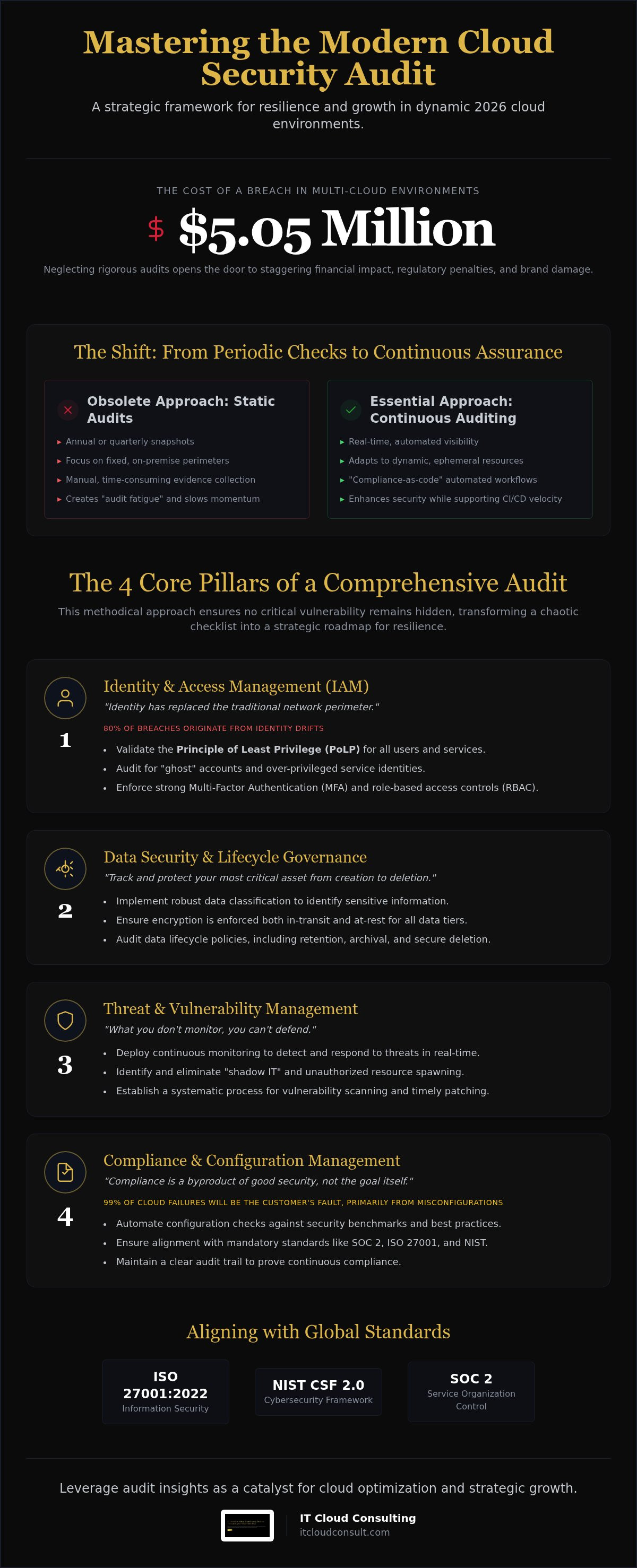
The cost of neglecting this process is staggering. Beyond the immediate financial impact of a data breach, which averaged $5.05 million in 2026 for multi-cloud setups, organizations face severe regulatory penalties and irreparable brand damage. Gaps in your audit trail are directly linked to 15% of all successful cloud attacks, proving that what you don't monitor, you can't defend. By positioning the audit as a prerequisite for Strategic Cloud Adoption, you transform it from a reactive chore into a strategic asset.
The Shift from Periodic to Continuous Auditing
Annual or quarterly audits have become obsolete in the era of rapid CI/CD deployments. When code is pushed to production multiple times a day, a snapshot taken six months ago offers zero assurance of current safety. Continuous auditing utilizes automation to provide real-time visibility into your security posture. This transition doesn't just improve safety. It actively reduces "audit fatigue" by replacing manual evidence collection with automated, "compliance-as-code" workflows that support your IT team's momentum rather than hindering it.
Compliance vs. Security: Why You Need Both
It's a common mistake to assume that passing a SOC 2 or HIPAA assessment means your data is safe. Compliance focuses on meeting a baseline of established rules, whereas security focuses on mitigating actual risk. A security-first cloud security audit ensures that your defenses are robust enough to stop a breach, which naturally makes meeting regulatory requirements a byproduct of good hygiene. The Security-Compliance Gap represents the dangerous space between meeting regulatory checklists and actually defending against live, evolving threats.
The 4 Core Pillars of a Comprehensive Cloud Security Assessment
A successful cloud security audit requires a structured methodology to navigate the complexity of modern, distributed systems. By categorizing your evaluation into four distinct pillars, you ensure that no critical vulnerability remains hidden in the architectural shadows. This methodical approach transforms a chaotic checklist into a strategic roadmap for resilience. It allows leadership to see exactly where technical debt is creating security risks and where infrastructure optimization can drive better business outcomes.
These pillars represent the foundational areas where most cloud failures occur. Gartner predicts that 99% of cloud security failures through 2026 will be the customer's fault, primarily due to misconfigurations and poor identity management. To avoid becoming part of this statistic, your audit must rigorously examine the following domains.
Identity and Access Management (IAM) Deep Dive
Identity has officially replaced the traditional network perimeter. In 2026, 80% of organizations are expected to face data breaches originating from identity drifts. Your audit must validate the Principle of Least Privilege (PoLP) across every user, group, and machine identity. We often find "ghost" accounts from former employees or over-privileged service identities that were created for temporary tasks but never revoked. Evaluating Multi-Factor Authentication (MFA) coverage is also mandatory; you must identify accounts that bypass MFA via legacy protocols or API keys, as these represent the path of least resistance for attackers.
Data Governance and AI Workload Security
Data Security Posture Management (DSPM) is essential for tracking sensitive information through its entire lifecycle. As organizations rapidly integrate AI, the audit must expand to include the data pipelines feeding these models. Ensuring that training data is sanitized and that AI workloads don't inadvertently expose proprietary secrets is a new but critical requirement. Adhering to NIST security and privacy controls provides a rigorous benchmark for these evaluations. Your audit should also verify encryption at rest and in transit, while confirming that data residency remains compliant with regional laws in multi-cloud setups.
Beyond data and identity, the audit must scrutinize network configurations to eliminate open ports and insecure default settings. Finally, governance frameworks must align these technical findings with your broader organizational strategy. Identifying these gaps is the first step toward a more resilient future. Our team helps organizations move from assessment to action through Strategic Cloud Adoption, ensuring your infrastructure is both secure and scalable from the start.
Evaluating Your Approach: Internal Readiness vs. Third-Party Expertise
Deciding whether to deploy internal resources or engage external specialists for a cloud security audit is a pivotal leadership decision that dictates the depth and objectivity of your findings. While internal teams possess an intimate understanding of your specific workflows, they can sometimes suffer from operational familiarity that obscures subtle risks. Conversely, external experts provide the "outside-in" perspective required to validate your defenses against the most sophisticated modern threats. Achieving a holistic defense-in-depth strategy requires you to balance these two approaches, utilizing internal reviews for continuous hygiene and external assessments for strategic validation.
Before committing to an expensive external engagement, you must analyze your organization's "audit readiness." This involves ensuring that all documentation is current, asset inventories are complete, and baseline security controls are already functioning. Engaging a consultant when your internal house isn't in order leads to wasted billable hours and surface-level results. A mature organization uses internal checks to prepare the ground, allowing external specialists to focus on high-level architectural flaws and strategic alignment rather than basic housekeeping.
When to Conduct an Internal Audit
Internal audits should be viewed as a continuous operational pulse rather than a static event. By integrating security checks directly into your DevSecOps pipeline, you can flag configuration drifts in real-time before they reach production. We recommend training your internal teams to recognize common cloud misconfigurations, such as overly permissive storage buckets or unencrypted databases, as part of their daily routine. This proactive stance empowers your IT department to maintain a secure baseline, reducing the "audit fatigue" often associated with major compliance cycles and ensuring your environment remains resilient between formal reviews.
The Strategic Value of External Cloud Security Consultants
External consultants offer more than just a second pair of eyes; they provide deep expertise in rapidly changing regulatory landscapes like GDPR or CCPA. Their familiarity with FedRAMP security assessment standards and other global frameworks ensures that your organization remains compliant with the highest benchmarks of digital trust. These specialists bring knowledge from across diverse industries, identifying patterns of vulnerability that an internal team might miss. Beyond technical validation, an external report carries significant weight with board members and stakeholders. You can leverage these unbiased findings to justify critical infrastructure investments and secure the necessary budget for strategic cloud adoption, moving your business toward a more optimized and resilient future state.
Step-by-Step: How to Execute an Effective Cloud Security Audit
Executing a rigorous cloud security audit requires a methodical transition from high-level oversight to granular technical validation. It's a strategic process that ensures your infrastructure doesn't just meet compliance checkboxes but actively resists modern exploitation. By following a structured five-step approach, you transform raw data into actionable intelligence that drives organizational evolution. This systematic evaluation allows you to identify latent risks before they manifest as costly breaches, ensuring your cloud environment remains a stable foundation for growth.
Phase 1: Preparation and Scoping
You can't secure what you can't see. Comprehensive asset discovery is the non-negotiable first step in defining your audit scope. You must inventory every instance, storage bucket, and identity across your multi-cloud environment to eliminate the risk of shadow IT. Once identified, define the "criticality" of these workloads. A public-facing production database requires a different level of scrutiny than a legacy development environment. This phase also necessitates the alignment of key stakeholders from IT, Legal, and Finance. Their involvement ensures the audit objectives support broader business goals and regulatory requirements from the outset.
Phase 2: Execution and Analysis
This phase involves selecting a robust framework, such as NIST CSF 2.0, CIS Benchmarks, or ISO 27001:2022, to serve as your security baseline. Once the framework is established, utilize Cloud Security Posture Management (CSPM) tools to automate the heavy lifting of data collection. However, automation is only the beginning. Your team must conduct a manual review to provide contextual analysis of the findings. This step is vital to validate results and eliminate false positives that often drain valuable engineering resources. By benchmarking your current state against industry standards, you gain a clear, objective view of your security maturity and technical debt.
Phase 3: Remediation and Closing the Loop
The true value of an audit lies in the remediation of discovered vulnerabilities. Categorize identified risks into "Immediate Action," "Scheduled Task," and "Monitor." This prioritization ensures that your most critical gaps are addressed first, maximizing the impact of your security spend. These findings should create a continuous feedback loop, directly informing your cloud infrastructure consulting efforts to prevent the same misconfigurations from recurring. Finally, perform a re-audit to verify that gaps are truly closed. If you're ready to move beyond the initial assessment and start building a more resilient environment, our team provides the Ongoing Cloud Support necessary to maintain a secure and optimized posture.
Beyond Compliance: Transforming Audit Findings into Strategic Growth
Transforming a cloud security audit from a technical hurdle into a growth engine requires a fundamental shift in executive mindset. Rather than viewing the resulting report as a list of failures, visionary leaders treat these findings as a blueprint for technical excellence and operational maturity. When you align your security posture with high-level business objectives, you move beyond simple risk mitigation and begin to realize the latent potential of your digital infrastructure. This evolution ensures that security is no longer a bottleneck but a foundational component of your competitive advantage.
A rigorous audit frequently identifies where technical debt is creating both security vulnerabilities and financial waste. By linking audit remediation to cloud optimization consulting, your organization can recover significant portions of its cloud spend while simultaneously hardening its defenses. This dual-purpose approach ensures that every dollar invested in security also contributes to a more efficient, high-performance environment. Positioning your security maturity as a business enabler builds profound customer trust, often accelerating sales cycles by providing the transparent assurance that modern stakeholders demand.
Optimizing Performance Through Security
The audit process often shines a light on underutilized or misconfigured resources that drain your budget without providing value. Tightening your security controls often leads to a cleaner, more logical architecture. For instance, removing unused service identities and decommissioning "zombie" instances reduces your attack surface while lowering monthly infrastructure costs. By automating compliance guardrails, you reduce the operational overhead on your engineering teams. This allows them to focus on innovation rather than manual remediation, creating a culture of "Security by Design" that permeates the entire enterprise.
Developing Your Long-Term Cloud Security Roadmap
True resilience isn't achieved through a single event; it requires moving from an "audit-to-audit" mentality toward a state of continuous enterprise cloud transformation. This long-term roadmap involves investing in managed services for ongoing oversight, ensuring that your environment evolves alongside emerging threats. Establishing this level of continuous monitoring provides the peace of mind required to scale your operations with confidence. If you're ready to turn your security requirements into a strategic asset, Contact IT Cloud Consulting for a professional Cloud Security Audit and begin your journey toward a more secure and optimized future.
Architecting a Resilient Future Through Strategic Oversight
The path to enterprise resilience in 2026 requires more than a defensive mindset; it demands a proactive commitment to architectural excellence. By identifying the technical gaps within your infrastructure, you've taken the first step toward transforming security from a cost center into a strategic business enabler. A modern cloud security audit provides the clarity needed to eliminate redundant resources and align your digital operations with the rigorous requirements of global standards. This evolution ensures your organization remains agile in a landscape where complexity is the only constant.
Our team at IT Cloud Consulting serves as your dependable guide, providing the strategic advisory required for complex multi-cloud environments. We specialize in the expert assessment and optimization of existing infrastructure, ensuring your systems are both secure and cost-efficient. Through our continuous monitoring via Managed Cloud Support, you gain the steady assurance that your defenses are evolving alongside your business. Secure your future with a comprehensive Cloud Security Audit from IT Cloud Consulting. Your journey toward a more optimized and resilient future starts here.
Frequently Asked Questions
How often should our organization conduct a cloud security audit?
Organizations should move toward continuous monitoring, but a formal cloud security audit should occur at least annually. Major infrastructure changes, such as migrating new workloads or integrating AI pipelines, also trigger the need for an immediate assessment. Given that 15% of cloud attacks are linked to failed audit trails, maintaining a regular cadence is essential for identifying vulnerabilities before they're exploited.
What are the most common cloud security misconfigurations found during audits?
Overly permissive Identity and Access Management (IAM) roles and unencrypted storage buckets are the most frequent findings. We also commonly see "ghost" identities and shadow IT resources that haven't been properly inventoried. Since Gartner predicts that 99% of cloud failures will be the customer's fault through 2026, these configuration errors represent the most significant risk to your data integrity.
Can we use automated tools to replace a manual cloud security audit?
Automated tools are excellent for identifying configuration drifts at scale, but they can't replace the strategic depth of a manual review. A manual cloud security audit provides the contextual analysis required to understand how different vulnerabilities interact across your specific architecture. While automation handles the "what," human expertise is necessary to determine the "why" and prioritize remediation based on business impact.
How long does a typical enterprise-level cloud security audit take to complete?
A typical enterprise assessment generally spans four to twelve weeks depending on the complexity of your multi-cloud environment. This timeline includes the initial scoping, data collection through automated tools, and the subsequent manual analysis of findings. Organizations with well-documented assets and established hygiene practices often see shorter timelines, while fragmented environments with significant shadow IT require more extensive investigation.
What is the difference between a cloud security audit and a penetration test?
An audit is a comprehensive evaluation of your configurations, policies, and compliance against a set framework like NIST or SOC 2. In contrast, a penetration test is a targeted, active simulation of an attack designed to find exploitable weaknesses. Think of the audit as a thorough building inspection, while the penetration test is a controlled attempt to actually break through the front door.
How do we handle audit findings for third-party SaaS applications?
Managing third-party SaaS security involves a rigorous review of the provider's SOC 2 Type 2 reports and an understanding of the Shared Responsibility Model. You must verify that the provider's controls align with your internal standards and that your team is managing the access and data layers correctly. It's vital to ensure that SaaS integrations don't create unmonitored pathways into your core cloud infrastructure.
What are the essential compliance frameworks for cloud security in 2026?
The primary benchmarks are NIST Cybersecurity Framework (CSF) 2.0 and ISO/IEC 27001:2022, which includes mandatory updates for AI and cloud-native security. PCI DSS v4.0.1 is also the mandatory standard for any organization handling payment data. These frameworks provide the structured governance required to manage supply chain risks and complex identity-centric security models that define modern digital trust.
How much does a professional cloud security audit cost for a mid-sized company?
The investment for a professional assessment varies significantly based on the number of cloud providers, the volume of assets, and the specific compliance frameworks required. Costs scale with the complexity of your data pipelines and the depth of manual analysis needed to verify security controls. Focusing on high-quality assessments early prevents the much higher costs associated with data breaches and regulatory fines.


