
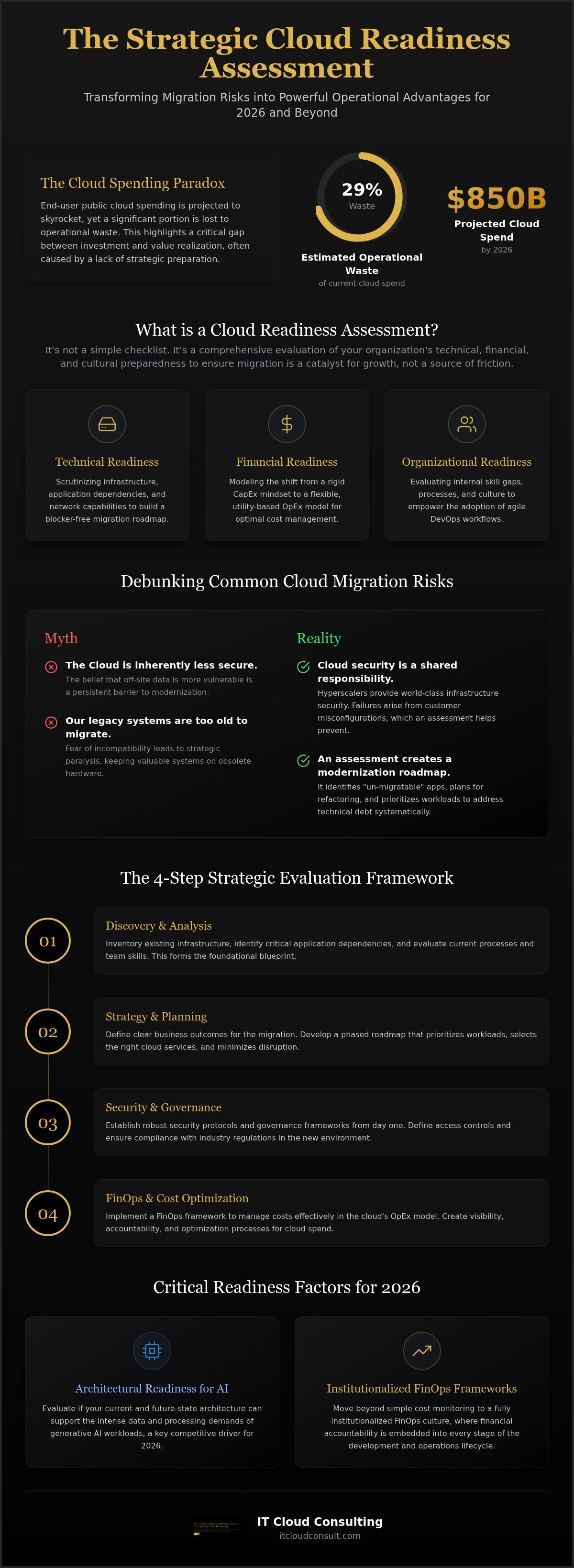
With end-user public cloud spending projected to reach $850 billion in 2026, nearly 29% of that investment is currently estimated as operational waste. This fiscal leak often stems from a fundamental misunderstanding of what a cloud readiness assessment actually entails. It's not a mere pre-flight checklist; it is a diagnostic evolution of your organizational DNA. Many leaders worry that their legacy systems aren't compatible or that they lack the internal expertise to evaluate the move safely, leading to a state of strategic paralysis.
You're right to be cautious, as the complexity of modern hybrid environments makes a simple transition increasingly risky. This article reveals why most migrations stall and how a strategic readiness assessment transforms these perceived risks into powerful operational advantages. We'll provide a clear roadmap for modernization that reduces security vulnerabilities and ensures your IT infrastructure finally aligns with your long-term business goals. You'll learn to move beyond the fear of project failure and start viewing cloud adoption as a controlled, value-driven evolution of your enterprise.
Key Takeaways
- Define the specific parameters of a successful cloud readiness assessment to ensure your transition is rooted in both technical and financial precision.
- Uncover the reality behind common migration myths to replace executive uncertainty with a clear, data-driven roadmap for evolution.
- Execute a logical 4-step evaluation process that directly connects infrastructure modernization to tangible, long-term business outcomes.
- Adapt your strategy for the 2026 landscape by evaluating your architectural readiness for generative AI workloads and institutionalized FinOps frameworks.
- Leverage strategic cloud adoption to transform legacy limitations into scalable, cost-efficient operational advantages that drive future growth.
What is a Cloud Readiness Assessment and Why Does It Matter?
A cloud readiness assessment serves as the foundational blueprint for organizational evolution. It isn't just a technical scan or a simple inventory of servers. Instead, it's a comprehensive evaluation of technical, financial, and organizational preparedness. By analyzing your current state capabilities against future state requirements, your business can move from a reactive posture to a proactive strategy. This process is the essential first step in strategic cloud adoption, ensuring that the transition remains a catalyst for growth rather than a source of friction.
The shift toward cloud computing represents a fundamental departure from traditional IT management. In a legacy environment, resources are static and capital-intensive; in a cloud-native model, they're dynamic and utility-based. This transition creates a clear cause and effect evolution. When you modernize your thinking, you unlock the ability to scale instantly. However, skipping the diagnostic phase often results in "cloud stall." This occurs when unforeseen technical debt or misaligned cost structures halt progress, leading to significant budget overruns and eroded stakeholder trust. Organizations that bypass this diagnostic stage often find themselves trapped in a cycle of expensive remediation. This lack of foresight doesn't just increase costs; it creates security vulnerabilities that can compromise the entire enterprise.
The Diagnostic Deep-Dive: Infrastructure and Applications
A thorough assessment begins by scrutinizing existing infrastructure. We evaluate legacy hardware constraints and network latency requirements to determine if your current environment can support real-time data flows. The discovery process identifies critical application dependencies, highlighting services that might be "un-migratable" without significant refactoring. In 2026, application compatibility is defined by the ability of a service to leverage microservices and containerization without compromising security or performance. Identifying these hurdles early allows us to build a roadmap that addresses technical debt before it becomes a migration blocker.
The Cultural Pivot: Assessing People and Processes
Technology is only half the equation. We must evaluate internal skill gaps to ensure your team can manage complex cloud governance and security protocols. This shift requires the finance department to move from a rigid CapEx mindset to a flexible OpEx model, where costs are managed through usage rather than fixed investments. True modernization happens when people and processes evolve in tandem with the technology stack. If your staff remains tethered to manual provisioning methods, the automation benefits of the cloud will remain out of reach. We address process readiness by planning the move from slow, siloed release cycles to agile DevOps workflows, empowering your organization to realize the full potential of cloud-native innovation.
Myth vs. Reality: Debunking Common Cloud Migration Risks
Executives often view the cloud through a lens of apprehension, treating migration as a leap into the unknown. This hesitation usually stems from common misconceptions that equate change with inherent danger. However, staying on-premise in 2026 often presents a higher risk of technical obsolescence and security failure. A comprehensive cloud readiness assessment serves as the strategic tool that transforms these uncertainties into controlled, manageable variables. By replacing fear with data, your organization can move forward with the confidence of a visionary architect rather than the caution of a reluctant traveler.
Myth: The Cloud is Inherently Less Secure
The belief that off-site data is more vulnerable remains a persistent barrier to modernization. In reality, hyperscale providers invest billions into physical and perimeter security that far exceeds what most private enterprises can maintain. Security failures in the cloud are rarely the fault of the provider; instead, they typically arise from customer misconfigurations. Understanding the Shared Responsibility Model is essential. While the provider secures the "cloud," the enterprise is responsible for security "in" the cloud. Conducting a regular cloud security audit ensures that your governance and identity management are robust. To prepare your team for this transition, utilizing a cloud security assessment checklist helps mitigate risks before the first workload moves.
Myth: Lift and Shift is the Fastest Path to ROI
Speed is often prioritized over strategy, leading many to believe that "lifting and shifting" legacy applications is the most efficient route. This approach frequently backfires. With self-estimated cloud waste rising to 29% of total spend in 2026, moving an inefficient legacy system to the cloud simply creates an "inefficiently expensive" environment. True value is realized through refactoring and rightsizing. During the cloud readiness assessment, we identify which applications require architectural changes to leverage cloud-native features like auto-scaling and serverless compute. Engaging in cloud optimization consulting early in the process prevents the "bill shock" that occurs when organizations fail to account for the shift from fixed hardware to consumption-based pricing. If you're ready to move beyond these myths, exploring our Strategic Cloud Adoption services can provide the clarity needed for a successful transition.
The 4-Step Framework for a Strategic Readiness Evaluation
Executing a successful migration requires more than just technical proficiency; it demands a methodical approach that aligns every digital asset with your overarching business vision. A cloud readiness assessment provides the structured logic needed to navigate this complexity. By following a purposeful four-phase framework, your organization can transform a high-stakes transition into a series of predictable, value-driven milestones. This process ensures that data gathering directly informs roadmap success, creating a clear cause and effect relationship between initial discovery and final optimization.
Phase 1: Discovery and Objective Alignment
Establishing clear, business-driven KPIs is the first step toward modernization. We don't just move for the sake of technology; we move to achieve measurable outcomes like enhanced speed to market, increased scalability, or reduced operational friction. During this phase, we employ automated discovery tools to inventory every digital asset across the enterprise. This rigorous approach uncovers "shadow IT" and hidden dependencies that often escape manual audits. Discovery is the systematic elimination of architectural blind spots that otherwise derail migration timelines.
Phase 2: Gap Analysis and Modernization Roadmap
Once the inventory is complete, we conduct a rigorous gap analysis to compare your current state with the desired future state architecture. This phase involves applying the "6 Rs" of migration to every application: Rehosting, Replatforming, Refactoring, Retiring, Retaining, or Repurchasing. We then develop a prioritized timeline that balances immediate wins with complex legacy moves. By addressing "low-hanging fruit" early, your team builds the momentum and internal confidence required to tackle deep refactoring projects that yield the highest long-term ROI.
Phase 3: Resilience and Security Validation
The third phase shifts the focus toward risk mitigation and enterprise resilience. We validate security protocols and compliance requirements against the rigorous standards of the 2026 landscape. A critical component of this stage is cloud disaster recovery planning, which ensures that your modernized infrastructure is as resilient as it is agile. Incorporating these safeguards during the cloud readiness assessment prevents costly security gaps and ensures that your business remains operational regardless of external disruptions.
Phase 4: Governance and Execution Planning
The final phase involves finalizing the execution strategy and establishing a sustainable governance model. We define the roles, responsibilities, and automated policies required to manage the new environment effectively. This isn't just a technical hand-off; it's the creation of an operational framework that supports ongoing innovation. By formalizing governance early, you ensure that your cloud environment remains optimized, secure, and fully aligned with your long-term business goals as the organization continues to evolve.
Critical 2026 Readiness Factors: AI and FinOps
By 2026, the definition of a successful cloud readiness assessment has expanded far beyond basic storage and compute requirements. As hyperscale providers invest over $630 billion in AI infrastructure this year, the focus has shifted toward high-performance computing and complex data orchestration. Organizations must recognize that enterprise cloud transformation now mandates a specific type of architectural maturity tailored for generative AI and machine learning. Failing to account for these variables during the planning phase doesn't just stall migration; it renders your digital foundation obsolete before it's even completed. A visionary approach treats these technologies as integrated components of a modern ecosystem rather than isolated add-ons.
Preparing for AI and Machine Learning Workloads
AI-driven initiatives demand a level of data quality and accessibility that legacy systems often can't provide. Your assessment must evaluate whether your data pipelines are robust enough to feed sophisticated models without creating performance bottlenecks. High-performance computing (HPC) in the cloud requires specialized GPU availability and low-latency interconnects that differ significantly from standard virtual machine deployments. Because AI workloads can trigger unpredictable spikes in resource demand, your readiness strategy must include dynamic scalability protocols. This ensures your infrastructure evolves in real-time to meet the intense processing needs of 2026's most advanced applications. Identifying these requirements early prevents the architectural friction that occurs when legacy structures attempt to support modern, data-heavy intelligence tools.
Establishing a FinOps Readiness Framework
Financial governance is no longer an afterthought; it's a foundational pillar of modern cloud management. With 98% of FinOps practitioners now managing AI spend, the ability to track and attribute costs in real-time is vital for fiscal health. A strategic cloud readiness assessment identifies the necessary governance guardrails before the first workload moves, preventing the 29% waste common in unoptimized environments. Assessing your organization’s ability to implement unit economics and real-time cost visibility is essential for maintaining long-term ROI. Utilizing managed cloud services can provide the continuous monitoring required to maintain these standards as your footprint grows. This proactive oversight ensures that your cloud environment remains a profit center rather than an unchecked expense. If you're ready to align your financial strategy with your technological goals, our Strategic Cloud Adoption services offer the roadmap needed for a secure and cost-efficient transition.
Executing Your Cloud Journey with IT Cloud Consulting
IT Cloud Consulting serves as the visionary architect for your digital evolution. We don't just provide technical tools; we provide the strategic foresight required to bridge the gap between legacy constraints and future potential. A cloud readiness assessment is the diagnostic engine that powers this transformation. It allows us to identify technical debt early, ensuring your migration isn't just a change of scenery but a fundamental upgrade in capability. Our role is to act as your dependable guide, turning the complex transition into a structured, predictable path toward modernization.
From Strategic Roadmap to Execution
Our roadmapping process connects specific technical actions to broader organizational benefits. This cause and effect structure ensures that every server moved and every application refactored contributes directly to a higher ROI and improved agility. We prioritize performance and cost-efficiency from day one. By engaging in cloud infrastructure consulting, your business gains access to a methodical execution strategy that minimizes downtime and maintains operational continuity. Seasoned expertise is the only reliable way to navigate complex migration risks, transforming potential pitfalls into controlled milestones that build stakeholder confidence.
Ongoing Partnership for Continuous Evolution
Success in the cloud is not a fixed destination; it's a state of continuous optimization. Our ongoing cloud support ensures your systems remain healthy and efficient long after the initial migration is complete. We structure our managed support fees to reflect a commitment to long-term system health, focusing on proactive monitoring rather than reactive repairs. This partnership allows your internal team to focus on core innovation while we manage the complexities of governance and performance tuning. By leveraging a detailed cloud readiness assessment, we create a baseline for success that informs every subsequent phase of our partnership.
We invite you to begin this journey with a strategic consultation to evaluate your current environment. This low-friction first step provides the clarity needed to understand your organization's latent potential and the specific steps required to realize it. Let us help you move beyond legacy limitations and into a more optimized, advanced future state. Your path to enterprise-grade cloud maturity starts with a single, data-driven conversation about where your business is going next.
Architecting Your Future with Strategic Confidence
Modernization is no longer a choice but a requirement for remaining competitive. We've explored how a cloud readiness assessment serves as the vital bridge between your current legacy constraints and the high-performance potential of 2026 technology. By dismantling common migration myths and addressing the specific architectural demands of generative AI and FinOps, your organization can move from a state of uncertainty to a position of strategic strength.
IT Cloud Consulting provides expert roadmap development for complex legacy transitions, ensuring every technical move maximizes your long-term ROI through strategic optimization. With our comprehensive national coverage for enterprise modernization, you gain a dependable guide committed to your long-term success. It's time to stop viewing migration as a risk and start seeing it as a controlled evolution toward peak efficiency.
Your digital transformation is within reach. Schedule Your Strategic Cloud Readiness Consultation today and let's transform your organization's latent potential into a sustainable operational advantage.
Frequently Asked Questions
What are the most common cloud migration risks for enterprises in 2026?
Primary risks include security misconfigurations and unmanaged AI infrastructure costs. Organizations often struggle with the Shared Responsibility Model, which leads to vulnerabilities. A comprehensive cloud readiness assessment identifies these gaps early. This proactive approach prevents the 29% average cloud waste seen in 2026 by aligning technical capabilities with modern FinOps governance before the migration begins.
How long does a typical cloud readiness assessment take to complete?
A standard evaluation typically spans four to twelve weeks. The exact timeline depends on the complexity of your legacy environment and the availability of existing documentation. Large enterprises with extensive "shadow IT" may require more time for automated discovery. This period is a necessary investment to ensure the resulting roadmap is accurate, actionable, and aligned with your long-term modernization goals.
Can we perform a cloud readiness assessment internally without outside consultants?
While internal teams can conduct preliminary reviews, they often lack the specialized diagnostic tools and objective perspective required for a full-scale transition. External consultants act as visionary architects who identify hidden technical debt that internal staff might overlook. Partnering with experts ensures your cloud readiness assessment adheres to 2026 industry standards; this reduces the likelihood of project stall and unforeseen budget inflation.
What is the difference between a cloud readiness assessment and a cloud security audit?
A readiness assessment evaluates your holistic preparedness, including technical, financial, and cultural factors. In contrast, a security audit focuses strictly on compliance and protective controls within the cloud environment. While an assessment determines if you should move, an audit ensures that your destination is secure. Both are essential components of a resilient enterprise strategy, but they serve different diagnostic purposes.
How does a readiness assessment help in reducing cloud bill overruns?
The assessment identifies "inefficiently expensive" legacy systems before they move. By applying rightsizing principles and establishing FinOps guardrails during the planning phase, you prevent consumption-based costs from spiraling out of control. This methodical evaluation ensures that every migrated workload is optimized for performance. This direct alignment leads to a higher ROI and predictable monthly cloud expenditures as your organization continues to scale.
What technical inventory data is required for a successful assessment?
Successful discovery requires detailed server specifications, network latency requirements, and application dependency maps. You must also inventory data volumes and storage types to plan for AI-driven workloads. Using automated tools is the most reliable way to gather this data without missing hidden services. This comprehensive dataset forms the foundation of a modernization roadmap that remains stable throughout the entire execution phase.
How do we assess if our legacy applications are compatible with cloud-native environments?
Compatibility is determined through a rigorous "6 Rs" analysis of your application architecture. We evaluate whether services can be easily containerized or if they require deep refactoring to function in a cloud-native environment. This process identifies which applications will thrive with minor adjustments and which legacy systems need a complete architectural overhaul to meet 2026 performance and security standards.
What happens if the assessment reveals that our organization is not yet ready for the cloud?
A "not ready" result isn't a failure; it's a strategic diagnostic that prevents a costly migration collapse. The assessment provides a clear remediation plan to address specific gaps in security, skill sets, or infrastructure. Following this roadmap allows your organization to evolve systematically. You'll move to the cloud from a position of strength rather than rushing into a high-risk environment.


