
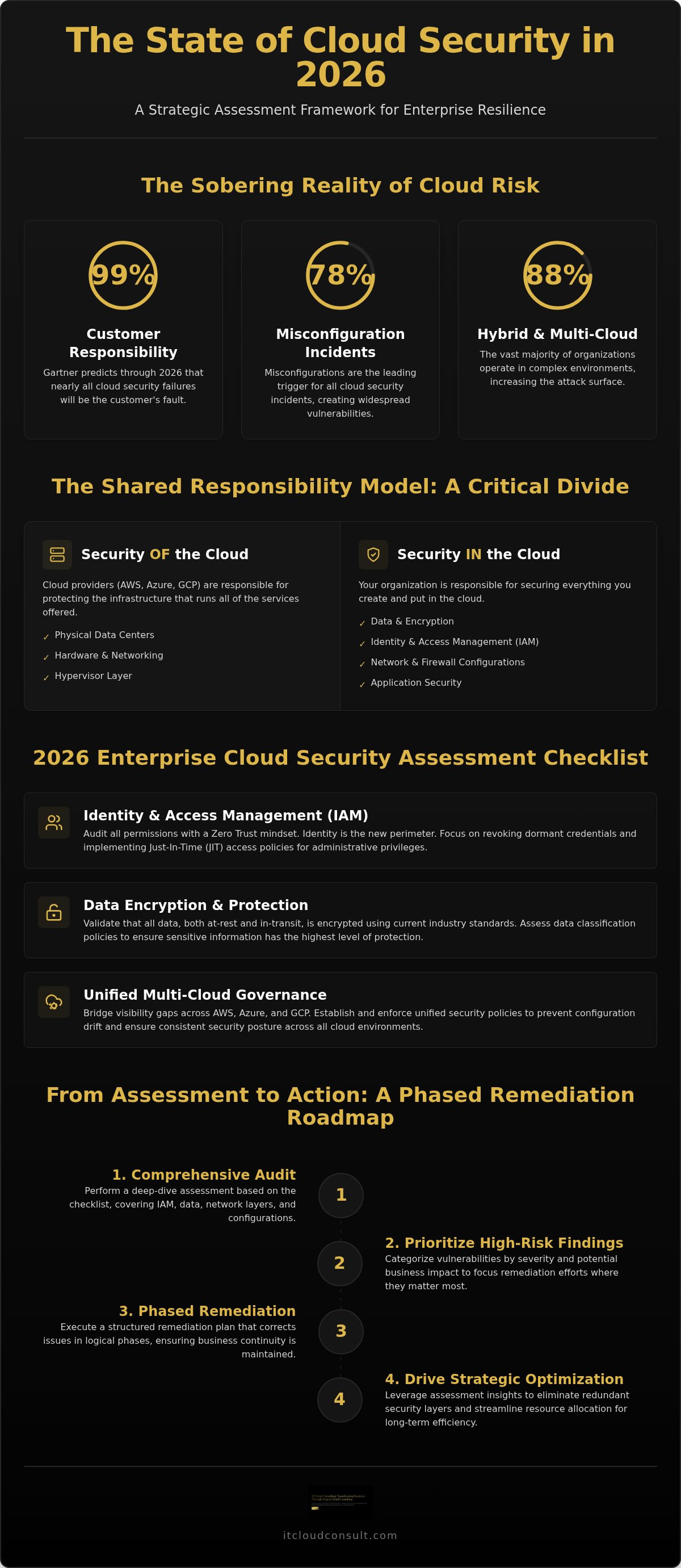
Did you know that through 2026, Gartner predicts 99% of cloud security failures will be the customer's fault? It's a sobering reality for enterprise leaders managing the 88% of organizations now operating in hybrid or multi-cloud environments. As misconfigurations continue to trigger 78% of all cloud incidents, your defense strategy requires more than just reactive patching. To move from vulnerability to resilience, you need a professional-grade cloud security assessment checklist that aligns your technical architecture with the latest 2026 global standards.
We understand that keeping pace with evolving mandates like NIST 2.0 and the enforcement of the EU's Digital Operational Resilience Act (DORA) feels like chasing a moving target. It's difficult to maintain a clear view of your risk posture when identity has become the new perimeter and AI-driven threats are rising. This guide provides a comprehensive framework to validate your current security state and identify latent potential for optimization. You'll gain a structured roadmap for remediation that transforms your cloud from a source of anxiety into a secure, high-performance business asset.
Key Takeaways
- Understand your specific obligations within the shared responsibility model to ensure your organization effectively manages security configurations in the cloud.
- Deploy a professional-grade cloud security assessment checklist to audit identity management and data encryption against the latest 2026 enterprise standards.
- Bridge visibility gaps inherent in multi-cloud architectures by establishing unified policy enforcement across AWS, Azure, and GCP environments.
- Execute a phased remediation roadmap that prioritizes high-risk findings while maintaining the operational continuity your business requires.
- Leverage assessment insights to drive strategic cloud optimization, turning security compliance into a catalyst for modernization and efficiency.
The Strategic Necessity of a Cloud Security Assessment in 2026
A cloud security assessment is far more than a routine technical audit. It represents a comprehensive evaluation of an organization's digital infrastructure, encompassing the policies, technical controls, and operational workflows that define its resilience. As we move through 2026, the complexity of cloud computing security has reached a point where legacy, perimeter-based defenses are no longer sufficient. Relying on a basic cloud security assessment checklist without a strategic lens often leads to a false sense of security. True resilience requires an architectural review that identifies how disparate systems interact and where hidden vulnerabilities reside.
The "Shared Responsibility Model" remains the cornerstone of this process, yet it's also where most enterprises falter. While providers like AWS or Azure secure the underlying physical infrastructure, the burden of securing data, identities, and configurations rests entirely with the customer. Statistics show that through 2026, the vast majority of security failures will stem from customer misconfigurations rather than provider errors. A professional assessment bridges this gap by validating that your internal controls are as robust as the platform hosting them. This alignment is critical for maintaining market trust and ensuring that your organization remains operational in a volatile threat environment.
Evolving Threats: Why 2026 Requires a New Framework
Legacy security frameworks often fail to account for the sophisticated, AI-driven attack vectors prevalent in 2026. These automated threats can exploit minute configuration errors in seconds, making manual or outdated checklists obsolete. We've seen a decisive shift toward Zero Trust Architecture, where "never trust, always verify" isn't just a slogan but a technical requirement. The cost of failing to adapt isn't merely the risk of data loss. It's the potential for total operational paralysis. When systems go down due to a breach, the recovery time and reputational damage can be insurmountable for organizations that haven't modernized their assessment frameworks.
The Business Value of Strategic Security
Investing in a high-level assessment does more than just mitigate risk. It accelerates your journey toward Strategic Cloud Adoption. When security is baked into the architecture, teams can innovate faster without the constant fear of introducing new vulnerabilities. This proactive approach also drives Cloud Optimization by eliminating redundant security layers and streamlining resource allocation. By identifying inefficiencies early, organizations can significantly reduce their long-term managed cloud support fees. Ultimately, a secure posture becomes a competitive advantage, signaling to partners and clients that your enterprise is a reliable steward of their most sensitive data. Utilizing a professional cloud security assessment checklist is the first step in transforming security from a cost center into a driver of enterprise evolution.
The Enterprise Cloud Security Assessment Checklist
Transitioning from strategic vision to technical execution requires a structured framework that accounts for the unique vulnerabilities of a modern environment. A robust cloud security assessment checklist serves as your roadmap for identifying misconfigurations before they escalate into breaches. In 2026, this process must go beyond surface-level scans to evaluate how identity, data, and network layers interact within a Zero Trust model. Every check performed is a step toward realizing the latent potential of your infrastructure while maintaining a rigid defense against AI-augmented threats.
Identity and Access Management (IAM) Deep Dive
Identity has effectively replaced the network perimeter as the primary control plane. Your assessment must start with a rigorous audit of service account permissions and the immediate revocation of dormant credentials that often serve as entry points for attackers. We recommend moving beyond static permissions toward Just-In-Time (JIT) access policies. This approach ensures that administrative privileges are granted only when necessary and revoked immediately after the task is complete. To maintain long-term integrity, integrate sophisticated cloud security audit patterns that monitor user behavior for anomalies. This proactive scrutiny transforms IAM from a simple gatekeeper into an intelligent layer of your security fabric.
Infrastructure and Network Integrity
Protecting the cloud fabric requires a granular focus on microsegmentation and VPC configurations. Your checklist should prioritize the following technical validations:
- API Security: Verify that all endpoints are authenticated and encrypted to prevent unauthorized data exfiltration.
- Storage Configuration: Audit S3 buckets and database ports to ensure no sensitive resources are inadvertently exposed to the public internet.
- Edge Defense: Evaluate the efficacy of Web Application Firewalls (WAF) and DDoS mitigation strategies against high-volume, automated attacks.
- Resource Spawning: Identify shadow IT by tracking unauthorized resource creation that bypasses standard governance.
Maintaining 100% visibility across hybrid environments is the only way to ensure these controls remain effective. Misconfigurations are a leading cause of cloud incidents, with 78% of organizations reporting issues stemming from these avoidable errors. While this cloud security assessment checklist provides a foundational framework, the complexity of 2026 environments often necessitates a more tailored approach. Engaging in Strategic Cloud Adoption ensures that these technical controls are not merely checked off, but are deeply integrated into a high-performance architectural roadmap that supports your long-term evolution.
Evaluating Complexity: Multi-Cloud and Hybrid Architectures
In 2026, the reality for 88% of organizations is a fragmented digital landscape composed of multiple public cloud providers and legacy on-premise systems. While this approach offers flexibility, it also creates a significant expansion of the attack surface. A standard cloud security assessment checklist must evolve to address the architectural nuances between providers like AWS, Azure, and GCP. An IAM policy in Azure does not translate directly to an AWS role; a security group in one environment behaves differently than a virtual appliance in another. Siloed security management is a liability. It creates blind spots where misconfigurations can hide, often leading to the average $5.05 million breach cost associated with multi-environment setups.
We view centralized visibility as a prerequisite for strategic modernization. Without a unified perspective, your security posture is only as strong as its weakest link. Establishing a cohesive framework ensures that a single oversight in one cloud doesn't compromise your entire ecosystem. This transition from disjointed checks to a synchronized defense strategy is what separates secure enterprises from those merely reacting to the latest threat.
Interoperability and Data Flow Security
Managing data movement is where many organizations fail their part of the shared responsibility model. Secure tunneling and end-to-end encryption are non-negotiable for cross-cloud traffic, especially when legacy on-premise systems are involved. A successful strategic cloud adoption journey requires auditing these connections with the same rigor as the cloud assets themselves. It's not just about where the data resides; it's about how it travels. If your cloud security assessment checklist doesn't account for the "in-between" spaces of your hybrid fabric, you're leaving the door open for sophisticated intercept-based attacks.
Centralized Governance Frameworks
We advocate for a "single pane of glass" approach through Cloud Security Posture Management (CSPM) tools. This allows for standardized compliance reporting across all cloud assets, whether they sit in AWS, Azure, or GCP. Implementing unified security guardrails reduces operational friction and ensures that policies are enforced consistently, regardless of the underlying platform. This methodical standardization transforms security from a series of technical hurdles into a driver of efficiency. By reducing the complexity of governance, you empower your teams to focus on innovation rather than troubleshooting disparate security dashboards.
From Assessment to Action: A 5-Step Remediation Roadmap
Generating data through a cloud security assessment checklist is only the first phase of securing your enterprise. The true value of an audit lies in the subsequent execution, where technical findings are translated into strategic improvements. A methodical remediation roadmap ensures that vulnerabilities are addressed without disrupting your core operations or compromising your long-term goals. By following a structured path, you transform reactive fixes into a proactive defense posture that supports continuous evolution.
Successful remediation typically follows these five critical stages:
- Step 1: Prioritize findings. Rank every identified gap based on its potential business impact and technical risk severity.
- Step 2: Develop a phased plan. Create a deployment schedule that addresses high-risk items first while ensuring zero operational downtime.
- Step 3: Refine recovery protocols. Update your cloud disaster recovery planning to account for newly discovered vulnerability insights and architectural changes.
- Step 4: Implement automation. Deploy automated security checks to identify and reverse configuration drift before it creates new exposures.
- Step 5: Validate outcomes. Conduct a post-remediation audit to confirm that every identified gap has been effectively closed.
Prioritization and Risk Mapping
Not every finding requires immediate intervention. We help organizations distinguish between critical vulnerabilities that demand instant attention and low-risk optimizations that can be scheduled for later phases. This process involves aligning your security efforts with your broader enterprise cloud transformation roadmap. By mapping risks to business outcomes, you ensure that resources are allocated where they will provide the most significant protection. This strategic alignment prevents security from becoming a bottleneck, instead positioning it as a facilitator of safe, rapid growth.
Continuous Improvement and Monitoring
The 2026 threat landscape is too dynamic for periodic reviews to suffice. Transitioning from a static cloud security assessment checklist to a model of continuous monitoring is essential for maintaining resilience. This shift allows for regular policy reviews that adapt to emerging AI-driven threats. Beyond protection, these remediation efforts often reveal opportunities for better cloud optimization consulting outcomes. When your environment is secure, it's inherently more efficient, reducing waste and maximizing your return on infrastructure investment. If you're ready to turn these insights into a high-performance reality, our team is prepared to guide your Strategic Cloud Adoption journey today.
Partnering for Protection: Why Strategic Consulting is the Logical Conclusion
Automated security tools are essential components of a modern defense strategy, yet they possess inherent limitations in complex enterprise environments. While software can flag a misconfigured port or an expired certificate, it lacks the contextual intelligence to understand how those vulnerabilities impact your specific business objectives. A cloud security assessment checklist provides the necessary data points, but raw data without expert interpretation often leads to fragmented, reactive security measures. True resilience requires an architectural vision that transcends simple error detection, moving instead toward a holistically secure ecosystem.
We believe that security should never be a standalone initiative. Instead, it must be integrated into your broader strategy for modernization and growth. When you treat security as a foundational element of your infrastructure, it ceases to be a bottleneck and becomes a facilitator of agility. This shift in perspective allows your organization to realize its latent potential, ensuring that every technological advancement is matched by a corresponding increase in defensive maturity.
The Value of an External Perspective
Internal IT teams are often deeply embedded in daily operations, which can lead to unintentional blind spots. When you're responsible for maintaining uptime and meeting immediate project deadlines, it's easy to overlook systemic architectural flaws. Partnering with a strategic consultant provides an objective, high-level view of your environment. We leverage deep industry expertise to benchmark your current posture against national standards and peer performance. This external scrutiny identifies hidden risks that internal audits might miss, significantly reducing the burden on your staff. By utilizing managed Ongoing Cloud Support, your team can pivot away from constant fire-fighting toward high-value innovation.
Architecting a Secure Future
The goal of a professional assessment isn't merely to "patch" existing holes. It's to design a future-proof architecture where those vulnerabilities are structurally impossible to replicate. This approach aligns your security requirements with the principles of Cloud Optimization, ensuring that your environment is as efficient as it is secure. A resilient cloud fabric supports business agility, allowing you to deploy new services with the confidence that your governance frameworks will scale alongside them. If you're ready to move beyond basic checklists and toward a comprehensive security roadmap, the path forward is clear. Schedule your professional cloud security assessment with IT Cloud Consulting today.
Securing Your Enterprise Evolution in 2026
Mastering the intricacies of a multi-cloud landscape requires a shift from reactive patching to a proactive, architectural strategy. By utilizing a professional cloud security assessment checklist, you've taken the first step toward identifying latent vulnerabilities and aligning your infrastructure with the highest 2026 compliance standards. True resilience isn't found in a one-time audit; it's realized through a continuous commitment to modernization and the elimination of configuration drift across AWS, Azure, and GCP environments.
Transitioning from a technical finding to a secure, high-performance asset requires more than just software. It demands a visionary roadmap that supports your business agility while maintaining a rigid defense against emerging threats. Our team provides the expert multi-cloud architectural review and professional roadmap development needed to transform your security posture into a competitive advantage. With options for continuous monitoring and managed support, we ensure your cloud remains optimized and protected long after the initial assessment.
Secure Your Future: Request a Strategic Cloud Security Assessment
The path to a more secure and efficient future is within reach. We're here to serve as your dependable guide, helping you realize the full potential of your cloud investment through strategic clarity and technical excellence.
Frequently Asked Questions
What is the difference between a cloud security assessment and a cloud security audit?
A cloud security assessment is a proactive, strategic evaluation designed to identify vulnerabilities and risks before they are exploited. In contrast, a cloud security audit is a formal verification process that measures your existing controls against specific regulatory or industry standards. While an audit confirms compliance, a cloud security assessment checklist serves as a roadmap for architectural evolution and long-term resilience.
How often should a large enterprise conduct a cloud security assessment?
Enterprises should perform a comprehensive strategic assessment at least twice per year, though continuous monitoring is the current 2026 operational standard. Any significant change to your cloud fabric, such as migrating new workloads or integrating a multi-cloud provider, requires an immediate review. Regular evaluations ensure your security posture doesn't degrade as your infrastructure grows and becomes more complex over time.
Can automated tools replace a manual cloud security assessment?
Automated tools are excellent for identifying technical errors but they cannot replace the strategic insight provided by a human expert. Software often lacks the business context needed to understand why certain architectural choices were made or how they impact your long-term goals. A professional assessment combines automated data with manual analysis to provide the "big picture" perspective required for true optimization.
How long does a comprehensive enterprise cloud security assessment typically take?
A thorough assessment generally requires two to six weeks to complete, depending on the scale of your hybrid or multi-cloud environment. This duration accounts for initial data discovery, deep architectural analysis, and the development of a prioritized remediation plan. Rushing the process often leads to overlooked "blind spots" that can result in costly breaches or persistent operational inefficiencies.
What are the most common cloud security misconfigurations found in 2026?
The most frequent issues involve over-privileged service accounts and insecure API endpoints that lack proper authentication. Many organizations also struggle with "identity sprawl," where dormant credentials provide unintended access to sensitive data buckets. These misconfigurations are often the result of rapid scaling without unified governance, making them a primary focus for any modern security audit or strategic review.
How does a security assessment impact my cloud optimization and ROI?
Security is a fundamental driver of efficiency because it identifies redundant controls and streamlines resource allocation. By securing your data flows and correcting misconfigurations, you reduce the operational friction that often leads to wasted spend. This alignment ensures that your security budget supports your broader business objectives, turning a necessary protection measure into a strategic asset for growth.
What compliance standards should my checklist include?
Your cloud security assessment checklist must incorporate the latest 2026 updates for NIST CSF 2.0, SOC2, and ISO/IEC 27001:2022. It's also vital to include region-specific or industry-specific mandates like GDPR, HIPAA, or the EU's Digital Operational Resilience Act (DORA). Maintaining a checklist that covers these diverse standards ensures you remain compliant across all national and international markets where you operate.
Who should be involved in the cloud security assessment process?
The process requires a cross-functional team led by the CISO and supported by cloud architects, compliance officers, and department heads. It's also beneficial to include external strategic consultants like Insoft Services, who can provide an objective, third-party perspective on your current posture while providing the professional training your team needs to manage complex cybersecurity challenges. This collaborative approach ensures that security improvements don't hinder business agility and that all stakeholders are aligned on the path forward.


