
If your cloud strategy still relies on reacting to alerts after they trigger, are you actually in control, or are you simply managing the fallout of a system you don't fully see? With over 60% of organizations reporting public cloud-related security incidents in recent years, the traditional reactive approach has become a significant business liability. You likely feel the drain of alert fatigue from fragmented tools and the frustration of hidden costs that only surface once the budget is already spent. Maintaining compliance in dynamic, multi-cloud environments requires more than just occasional check-ins; it demands a fundamental evolution in how you observe your digital assets.
Mastering continuous cloud monitoring allows you to transition from reactive alerting to proactive cloud orchestration through a comprehensive framework for visibility. This guide provides the strategic roadmap needed to unify your view of cloud health and realize the latent potential of your infrastructure. We'll explore how to implement automated remediation for common misconfigurations and secure predictable ROI through real-time cost tracking. You'll move beyond basic oversight to a sophisticated model where security, performance, and financial accountability work in perfect alignment to support your long-term modernization goals.
Key Takeaways
- Learn why traditional point-in-time audits are insufficient for 2026 and how to implement continuous cloud monitoring for real-time risk mitigation.
- Identify the three pillars of a unified monitoring framework to eliminate visibility silos between security, performance, and cloud expenditure.
- Understand the critical distinction between possessing monitoring tools and the professional expertise required to execute automated remediation.
- Discover a five-step strategic roadmap to embed Policy as Code into your infrastructure, ensuring automated governance across multi-cloud environments.
- Position your monitoring data as a catalyst for Cloud Optimization, transforming raw telemetry into predictable business ROI.
The Evolution of Continuous Cloud Monitoring: Why Point-in-Time Fails
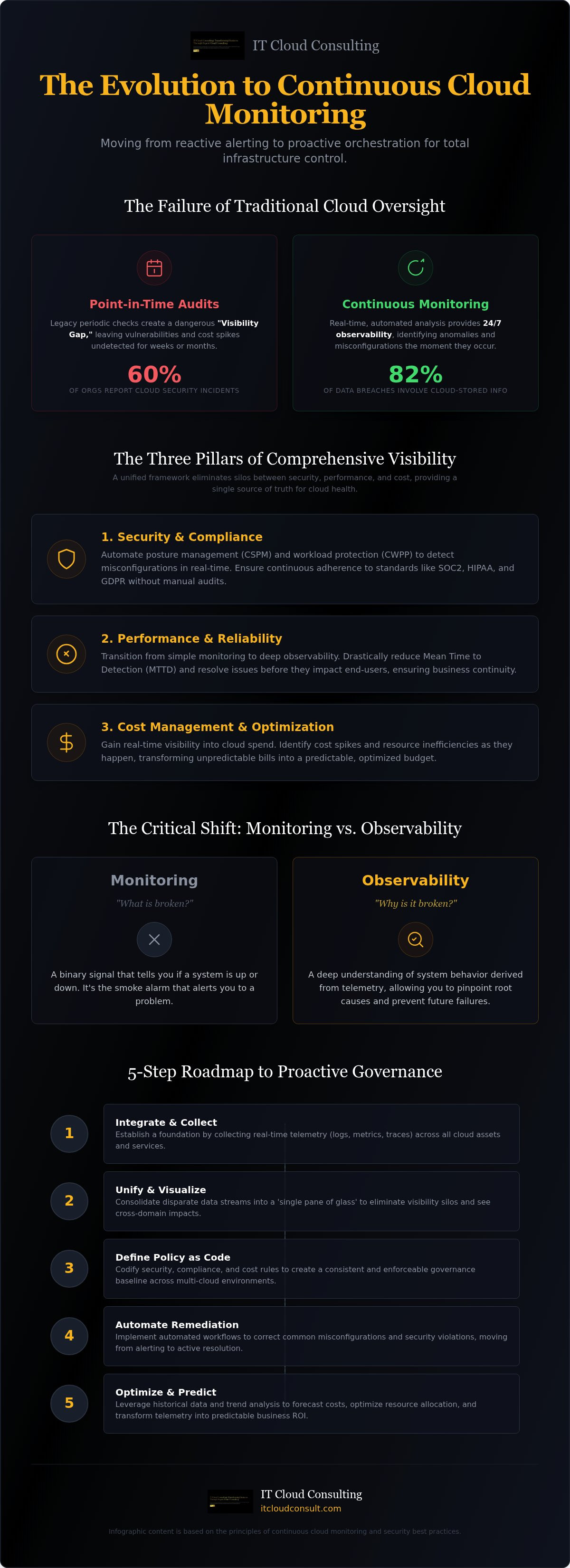
Legacy auditing models are failing because they treat infrastructure as a static asset rather than a living organism. In the current landscape, continuous cloud monitoring has evolved into the automated, real-time collection and analysis of telemetry across security, performance, and cost. It's no longer sufficient to rely on "point-in-time" assessments that only capture a snapshot of your environment. By the end of 2026, experts project that over 200 zettabytes of data will be stored in the cloud, making the traditional manual audit obsolete before the results are even published. This shift creates a dangerous Visibility Gap where rapid scaling and shadow IT can introduce vulnerabilities that remain undetected for weeks.
Organizational resilience depends on closing this gap. When your infrastructure is dynamic, your oversight must be equally agile. Relying on periodic checks in an era where 82% of data breaches involve cloud-stored information is a strategic risk that few modern enterprises can afford. True visibility requires a transition toward a system that identifies anomalies as they occur, ensuring that your digital footprint remains secure and optimized regardless of how quickly it expands.
From Reactive Alerting to Proactive Observability
The Business Case for Real-Time Telemetry
Beyond technical performance, real-time visibility is a fundamental pillar of business continuity. In a digital-first economy, the cost of downtime extends far beyond immediate revenue loss; it erodes brand reputation and customer trust. Establishing this level of insight starts with strategic cloud adoption, which creates the necessary foundation for advanced telemetry. By integrating these tools into the core of your cloud computing strategy, you ensure that every deployment is governed by real-time data. This approach protects your bottom line by identifying cost spikes and security lapses the moment they happen, allowing for immediate remediation rather than end-of-month apologies.
The Three Pillars of Comprehensive Cloud Visibility
A fragmented approach to oversight often results in blind spots that undermine even the most robust infrastructure. When security, performance, and cost data exist in separate silos, your team loses the ability to see how these domains influence one another. For example, a sudden spike in egress costs might not simply be a billing error; it could be the first sign of data exfiltration or a misconfigured microservice. Effective continuous cloud monitoring requires a shift away from these isolated streams toward a Unified Monitoring Framework. This integrated perspective provides a single pane of glass across multi-cloud environments, allowing you to identify the root cause of an issue before it cascades into a systemic failure.
Security and Compliance (CSPM & CWPP)
Maintaining a secure perimeter requires more than traditional firewalls. Cloud Security Posture Management (CSPM) serves as an essential tool for detecting misconfigurations that could expose sensitive data. As detailed by Gartner on Cloud Security Posture Management, these tools are vital for identifying risks in real time. To secure active processes, Cloud Workload Protection Platforms (CWPP) provide deep visibility into containers and virtual machines. Integrating these with continuous compliance tracking ensures that your environment adheres to standards like SOC2, HIPAA, or GDPR without the need for manual, periodic audits.
Operational Performance and Reliability
Reliability is the foundation of customer trust and business continuity. Leveraging cloud reliability engineering services ensures that your systems maintain high uptime while managing the complexities of distributed architectures. Monitoring metrics such as latency, throughput, and error rates allows you to observe system health through a technical lens. Additionally, synthetic monitoring acts as an early warning system, simulating user interactions to predict and resolve potential friction points before they impact your actual customers.
Financial Operations (FinOps) and Cost Monitoring
Cost monitoring prevents the "bill shock" that frequently occurs at the end of a rapid scaling cycle. By implementing real-time tracking of cloud spend, you can identify underutilized "zombie instances" and right-size your resources based on actual demand. This pillar of continuous cloud monitoring links specific expenditures to business units or projects, creating a culture of financial accountability. By adopting this unified approach, organizations gain the clarity needed to scale with confidence. To ensure your framework is professionally managed and optimized, engaging with Ongoing Cloud Support can help you transform these data points into actionable business intelligence.
Continuous Monitoring vs. Managed Cloud Support
Many enterprises invest heavily in sophisticated software, only to find themselves overwhelmed by the sheer volume of data generated. It's vital to distinguish between the Tooling Layer and the Action Layer. While continuous cloud monitoring software provides the necessary telemetry, it doesn't solve the underlying problem of resource management or strategic response. Tools provide raw data; expertise provides resolution. Without a dedicated strategy to act on the insights gathered, even the most expensive monitoring platform becomes little more than a sophisticated noise generator.
The realization of latent potential in your infrastructure requires moving beyond the "set and forget" mentality. You need ongoing cloud support to interpret complex telemetry and turn it into actionable business improvements. This professional oversight ensures that the technical processes are directly linked to your broader organizational benefits, transforming a technical requirement into a strategic advantage.
The Alert Fatigue Crisis
Excessive notifications often lead to a dangerous state of desensitization within internal IT teams. Some industry professionals report that up to 70% of IT alerts go unaddressed in unmanaged environments because the signal-to-noise ratio is too low. When every minor fluctuation triggers a high-priority notification, critical security or performance issues are easily buried. Professional management solves this by tuning monitoring thresholds to eliminate false positives. This methodical approach ensures that your team only responds to events that require genuine intervention, maintaining a high level of operational focus and preventing the burnout associated with fragmented monitoring tools.
Bridging the Talent Gap with Managed Services
The difficulty of hiring and retaining 24/7 cloud security and operations specialists is a significant hurdle for many organizations in 2026. Maintaining a round-the-clock internal team is often cost-prohibitive and difficult to scale as your multi-cloud footprint expands. Utilizing managed cloud services provides you with a scalable Security Operations Center (SOC) and Network Operations Center (NOC) without the overhead of internal recruitment. This partnership moves your organization toward a model of proactive remediation. Instead of simply receiving a notification that a system has failed, you benefit from a system where common misconfigurations are automatically resolved and complex issues are handled by seasoned experts before they impact your ROI.
Implementing Continuous Monitoring: A Strategic Roadmap
Establishing a culture of 24/7 visibility requires a methodical transition from fragmented tools to a unified framework of governance. This evolution isn't merely a technical upgrade; it's a strategic realignment of how your organization interacts with its digital assets. By adopting a "Policy as Code" approach, you can embed security and performance requirements directly into your infrastructure templates. This ensures that every new resource is born into a monitored state, effectively integrating continuous cloud monitoring into your existing CI/CD pipelines. This DevSecOps alignment prevents the operational drift that often occurs when deployment speed is prioritized over system stability.
Managing this roadmap becomes increasingly complex when operating across diverse providers. You'll need to utilize multi cloud management services to maintain a consistent posture regardless of where your data resides. A successful implementation follows a structured five-step process: asset discovery, baseline definition, pipeline integration, multi-cloud governance, and finally, the shift toward automated remediation. Each step serves as a building block toward a more optimized and advanced future state.
Inventory and Asset Discovery
You can't monitor what you can't see. The rise of "shadow cloud" projects often leads to unmanaged buckets and APIs that exist outside the view of central IT, creating significant security gaps. Automation is the only viable solution for discovering these ephemeral resources in real time. By deploying tools that automatically detect new instances and storage volumes, you can categorize assets based on their business criticality and data sensitivity. This ensures that your most vital systems receive the highest level of scrutiny while maintaining a comprehensive map of your entire digital footprint.
Defining Baseline Metrics and Thresholds
Success in continuous cloud monitoring depends on your ability to distinguish between normal operational fluctuations and genuine threats. Static thresholds often lead to false positives; therefore, modern strategies utilize AI and machine learning for anomaly detection. By establishing a baseline of "normal" behavior for both performance and spend, your system can identify subtle deviations that might indicate a security breach or a resource leak. Clear escalation paths must be defined for different severity levels, ensuring that the right stakeholders are engaged at the right time without causing unnecessary alert fatigue.
Automation and Auto-Remediation
The ultimate goal of a modern monitoring strategy is to move from "detect and notify" to "detect and fix." Auto-remediation allows your system to resolve common misconfigurations without human intervention. For instance, if a storage bucket is accidentally set to public, an automated policy can immediately revert it to private. Similarly, idle development environments can be automatically scaled down to preserve ROI. Maintaining detailed audit trails for every automated action is essential for transparency and regulatory compliance. To begin building this resilient infrastructure, consider a professional assessment for Strategic Cloud Adoption to ensure your foundation is built for scale.
Optimizing Your Monitoring Strategy for 2026 and Beyond
Survival in the cloud was the objective of the previous decade. In 2026, the goal has shifted toward innovation and the realization of latent organizational potential. A holistic strategy for continuous cloud monitoring transforms your infrastructure from a technical overhead into a source of strategic competitive advantage. When your systems are fully visible, you stop managing the fallout of failures and start leveraging telemetry to drive business growth. This data-rich environment serves as the essential foundation for cloud optimization consulting, which allows you to maximize enterprise ROI through precise, real-time adjustments that align with your long-term modernization goals.
Leaders who view monitoring as a strategic asset rather than a cost center are better positioned to scale in dynamic markets. By integrating security, performance, and cost into a single source of truth, you create a culture of accountability and precision. This transition requires moving beyond the "tooling layer" and focusing on a comprehensive framework that connects technical processes directly to broader organizational benefits. The result is a resilient, agile enterprise that isn't just surviving the cloud but is actively optimized for the future.
The Role of AI-Native Monitoring Platforms
The adoption of AI-powered observability platforms is a dominant trend in 2026. Generative AI is now assisting in complex log analysis, identifying root causes in seconds that previously required hours of manual investigation. We're seeing a fundamental shift toward predictive monitoring, where machine learning models analyze vast amounts of data to identify potential failures before they manifest. These AI-native tools must be carefully integrated to ensure they align with corporate governance and compliance standards, such as the updated NIST CSF 2.0. When properly tuned, AI reduces the noise of continuous cloud monitoring, allowing your team to focus on high-level strategic initiatives rather than routine maintenance.
Securing the Future with IT Cloud Consulting
IT Cloud Consulting integrates the pillars of security, performance, and cost into a seamless managed service designed for the modern enterprise. We recognize that one-size-fits-all software cannot address the unique complexities of your multi-cloud environment. Instead, we focus on providing customized roadmaps that evolve alongside your business. Our expertise bridges the talent gap, offering the "Action Layer" required to turn raw telemetry into meaningful remediation and optimization. Empower your enterprise with professional cloud management to ensure your infrastructure remains a catalyst for innovation and a reliable partner in your long-term development.
Transforming Oversight into Strategic Opportunity
The shift toward continuous cloud monitoring represents a fundamental evolution in how modern enterprises maintain resilience and drive growth. By unifying the pillars of security, performance, and cost, your organization can move beyond the limitations of point-in-time audits and embrace a future defined by proactive orchestration. This transition ensures that every technical metric is directly linked to measurable business outcomes, allowing you to scale with confidence in a multi-cloud landscape.
Realizing this level of operational excellence requires more than just the right tools; it demands a partner with the expertise to execute a customized roadmap. IT Cloud Consulting provides expert advisory for national enterprise cloud transformations and comprehensive multi-cloud management expertise. We focus on measurable ROI and operational efficiency to ensure your infrastructure remains a catalyst for success. Schedule a Strategic Cloud Assessment with IT Cloud Consulting today to unlock the full potential of your cloud environment. Your journey toward a more optimized and advanced future starts with a single, strategic step.
Frequently Asked Questions
What is the difference between cloud monitoring and continuous cloud monitoring?
Traditional monitoring typically relies on periodic checks or siloed data streams, whereas continuous cloud monitoring provides an uninterrupted, automated flow of telemetry across security, cost, and performance. This modern approach ensures that visibility is persistent rather than episodic. It allows your organization to move beyond reactive snapshots and maintain a real-time understanding of your entire digital ecosystem.
How does continuous monitoring improve cloud security posture?
It improves security by providing immediate detection of misconfigurations and unauthorized access attempts. By aligning with the "Govern" function of the NIST Cybersecurity Framework (CSF) 2.0, this strategy elevates security to an enterprise-level risk management priority. Real-time visibility ensures that vulnerabilities are identified and remediated before they can be exploited by external threats.
Will implementing continuous monitoring significantly increase my cloud costs?
The initial investment in monitoring tools is frequently offset by the significant savings realized through FinOps and resource optimization. By identifying underutilized instances and preventing "bill shock" from unexpected egress spikes, you gain greater control over your cloud budget. Professional oversight transforms this technical requirement into a driver for predictable ROI and long-term financial stability.
Can continuous monitoring tools work across AWS, Azure, and Google Cloud simultaneously?
Modern observability platforms are specifically architected to provide a unified view across AWS, Azure, and Google Cloud environments. This "single pane of glass" eliminates the blind spots created by provider-specific tools. It ensures that your governance policies remain consistent across your entire multi-cloud footprint, regardless of the underlying infrastructure.
What are the most important metrics to track in continuous cloud monitoring?
Effective continuous cloud monitoring focuses on a mix of operational, security, and financial telemetry. Key metrics include request latency, error rates, and resource saturation alongside compliance drift and real-time spend per business unit. Tracking these indicators allows leaders to connect technical performance directly to organizational health and efficiency.
How do I prevent alert fatigue when setting up a new monitoring system?
Preventing alert fatigue requires shifting from static thresholds to AI-driven anomaly detection that filters out insignificant fluctuations. By tuning the signal-to-noise ratio, your team only receives notifications for events that require genuine human intervention. Professional management ensures that escalation paths are clearly defined, maintaining operational focus and reducing the burnout associated with fragmented tools.
What is the role of AI in continuous cloud monitoring for 2026?
In 2026, AI is the primary engine for predictive monitoring and automated root cause identification. It enables systems to analyze vast data sets in seconds, identifying potential failures before they impact the end user. This shift toward AI-native observability allows your organization to transition from simple survival to a state of continuous innovation and system resilience.
Is continuous monitoring required for SOC2 or HIPAA compliance?
While specific regulations vary, the latest standards like ISO 27001:2022 and proposed HIPAA updates increasingly necessitate real-time oversight. Organizations must transition to the ISO 27001:2022 standard by October 31, 2025, which emphasizes cybersecurity as a persistent enterprise risk. Implementing a real-time monitoring framework is the most reliable path to maintaining these stringent compliance requirements.


