
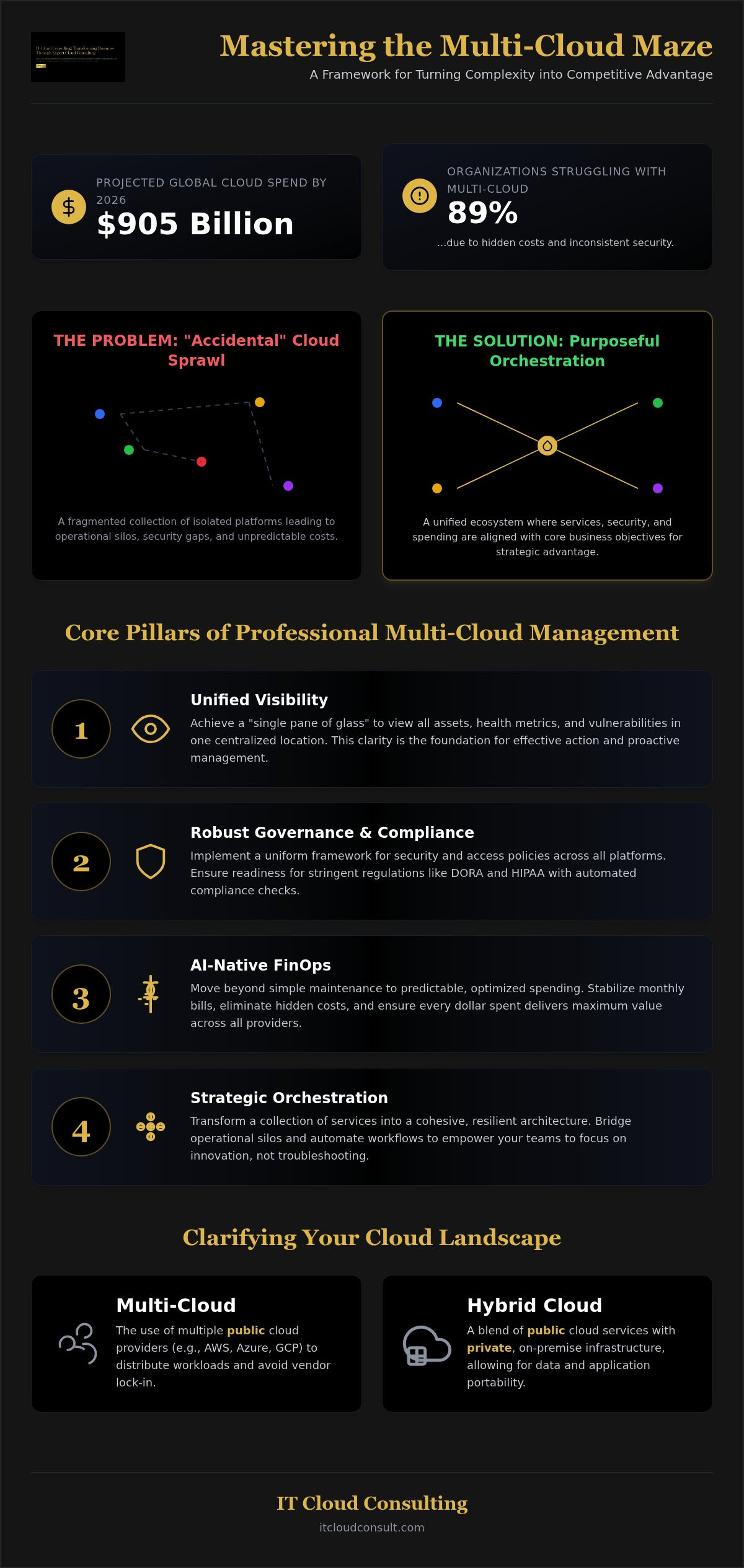
With global cloud spending projected to reach $905 billion by 2026, the shift toward distributed infrastructure is no longer an option; it's the foundation of modern enterprise. You've likely adopted a multi-provider strategy to avoid vendor lock-in, yet 89% of organizations now find themselves wrestling with the unintended consequences of hidden costs and inconsistent security. Utilizing professional multi cloud management services has become the essential bridge between this fragmented reality and a state of true operational excellence.
You deserve a strategy that turns this complexity into a competitive advantage. This article outlines a service-led framework for achieving unified visibility and automated compliance, ensuring your organization is ready for the stringent DORA and HIPAA updates arriving this year. We'll examine how to implement AI-native FinOps to stabilize your monthly spend and eliminate the silos that hinder growth. This approach moves beyond simple maintenance, allowing you to realize the latent potential of your digital evolution and build a resilient architecture for the future.
Key Takeaways
- Transition from accidental cloud sprawl to a purposeful orchestration model that aligns disparate infrastructure with your overarching business objectives.
- Leverage professional multi cloud management services to achieve unified visibility and implement AI-native FinOps for predictable, optimized spending across all providers.
- Recognize the vital distinction between management software and service-led strategy to bridge the specialized cloud talent gap within your organization.
- Establish a resilient governance framework through comprehensive infrastructure audits and the implementation of unified Identity and Access Management policies.
- Position your enterprise for long-term evolution by shifting from a vendor-client relationship to a strategic partnership focused on continuous cloud optimization and support.
The Strategic Necessity of Multi-Cloud Management in 2026
Enterprise evolution in 2026 requires more than just possessing cloud accounts. It demands a cohesive strategy. Multi cloud management services provide the sophisticated orchestration of services, security, and expenditure across disparate providers. This framework transforms a collection of isolated platforms into a unified ecosystem. It’s no longer about mere hosting. It’s about strategic advantage.
Organizations often struggle with operational silos between AWS, Azure, and GCP teams. These divisions create friction. Professional management bridges these gaps, ensuring that data flows and security protocols remain consistent across every environment. This transition from "accidental" sprawl to "intentional" adoption is the hallmark of a mature digital strategy. It allows leaders to realize latent potential within their existing infrastructure.
Multi-Cloud vs. Hybrid Cloud: Understanding the Nuance
Many leaders confuse hybrid environments with multi-cloud setups. To understand what is multi-cloud, one must look at the use of multiple public providers to distribute workloads. Hybrid cloud, conversely, blends public services with private, on-premise infrastructure. By 2026, the complexity of global regulations and AI-driven performance needs means enterprises often require both models simultaneously. This dual-layered approach is a core component of strategic cloud adoption, allowing for maximum flexibility and risk mitigation.
The 'Cloud Sprawl' Crisis and the Need for Professional Oversight
Unmanaged cloud environments eventually become high-risk liabilities. What begins as a fast-track to innovation often devolves into "cloud sprawl," where hidden costs and security gaps multiply. Professional multi cloud management services act as a visionary architect for your infrastructure. They provide the high-level perspective needed to reorganize chaotic systems into optimized pathways for growth. Complexity shouldn't be a barrier.
Common triggers that necessitate external cloud consulting include:
- Unpredictable spikes in monthly billing across multiple providers.
- Inconsistent security patches or compliance failures across platforms.
- Operational friction between specialized cloud teams.
- The need to integrate "neoclouds" for specialized AI workloads.
Effective management isn't just about maintenance. It’s a catalyst for progress. By removing the technical debt that hinders speed, you empower your teams to focus on innovation rather than troubleshooting. This systematic approach ensures that your cloud environment evolves alongside your business objectives.
To read more about how specialized IT support and security standards can further drive this evolution, explore professional resources on modern business infrastructure.
Core Pillars of Professional Multi-Cloud Management Services
Professional multi cloud management services rely on a foundation of four critical pillars. These aren't just technical features; they are strategic imperatives for any enterprise aiming to thrive in 2026. Without these core components, the promise of a multi-provider environment quickly dissolves into a fragmented collection of high-risk liabilities. Efficiency requires a deliberate structure.
The first pillar is unified visibility. Many enterprises suffer from data fragmentation across AWS, Google Cloud, and specialized providers. Achieving a "single pane of glass" allows your leadership to view all assets, health metrics, and vulnerabilities in one location. This clarity is the precursor to effective action. Second, a robust multi-cloud governance framework ensures that security and access policies remain uniform across every platform. Consistency is non-negotiable. A unified approach to security ensures that sensitive data remains protected by the same rigorous standards, whether it resides in a hyperscale environment or a specialized neocloud.
Unified Performance and Resource Monitoring
Monitoring must evolve beyond simple uptime alerts. By implementing continuous cloud monitoring, you shift from reactive troubleshooting to proactive system health management. This observability reduces incident response times by pinpointing the root cause of failures across provider boundaries. It keeps operations fluid and predictable. Sophisticated multi cloud management services use these metrics to anticipate bottlenecks before they impact the end-user experience, realizing the latent potential of your digital infrastructure.
FinOps: Strategic Cost Allocation Across Providers
FinOps in 2026 is AI-native. It’s about more than just reading a bill; it's about real-time cost intelligence. Professional cloud optimization consulting identifies redundant resources and "zombie" instances that internal teams often overlook. The cause of financial leakage is usually unmanaged sprawl, but the effect is a direct erosion of your margins. Management services reverse this trend by utilizing automated scaling and spot instance management. This ensures you only pay for the resources you actually consume. This methodical approach to spending directly improves enterprise ROI and provides the financial headroom needed for further innovation.
If you're ready to stabilize your infrastructure and eliminate hidden costs, consider how our ongoing cloud support can secure your long-term trajectory and empower your teams to focus on growth.
Evaluating Multi-Cloud Management: Platforms vs. Services
Many organizations mistake the acquisition of a software platform for a complete strategy. While modern platforms offer impressive dashboards, they remain tools that require skilled hands to operate. Choosing multi cloud management services ensures that these tools are guided by a high-level strategic framework rather than just being left to run on autopilot. The real value lies in the human expertise that interprets data and executes complex cross-platform migrations. Strategy must always precede technology.
Internal DIY management carries significant hidden costs. In 2026, the scarcity of specialized cloud engineers has driven recruitment costs higher, making it difficult for many firms to retain the talent necessary for comprehensive oversight. Managed services provide immediate access to this expertise without the overhead of constant training. This approach accelerates your speed-to-value, allowing your business to evolve while we handle the underlying complexities of your infrastructure. We don't just manage your environment; we architect it for success.
The Limitations of Provider-Native Tools
Native monitoring tools like AWS CloudWatch or Azure Monitor are excellent for their respective ecosystems, but they possess an inherent vendor bias. They aren't designed to provide an objective comparison of performance or cost across a competitor's environment. Relying solely on these tools often results in a fragmented view that obscures the big picture. Professional multi cloud management services introduce a necessary layer of objectivity. We utilize third-party observability frameworks to ensure your decisions are based on performance data, not provider-specific incentives. This ensures your resource allocation remains neutral and efficient.
Why Managed Services Outperform Internal Operations
Internal IT teams are frequently consumed by day-to-day maintenance, leaving little room for long-term strategic planning. By contrast, ongoing cloud support from an external partner prioritizes continuous evolution. Our Architecture Review process serves as a differentiator, providing a methodical evaluation of your systems to identify latent potential for optimization. It's a proactive rather than reactive model.
This partnership bridges the widening knowledge gap in 2026 technologies, such as specialized AI neoclouds and sovereign data requirements. Instead of struggling to keep pace with rapid industry shifts, your organization gains a visionary guide. We refine the tools you already use, ensuring your infrastructure remains a robust engine for business growth rather than a stagnant cost center. The result is a more resilient, future-proof organization.
Implementing a Multi-Cloud Governance Framework
Success in a multi-provider environment isn't accidental. It’s the result of a methodical implementation strategy. By adopting a structured governance model, your enterprise can move from reactive firefighting to a state of controlled, strategic evolution. Professional multi cloud management services provide the necessary scaffolding for this transition, ensuring that every cloud resource aligns with your broader business objectives. This structure creates a predictable path forward.
Establishing this framework follows a logical, five-step progression:
- Step 1: Comprehensive Infrastructure Audit. You must map every existing asset across your providers to eliminate "shadow IT" and identify redundant resources.
- Step 2: Unified Identity and Access Management (IAM). Fragmented access policies are a liability. Centralizing IAM ensures that permissions are consistent and verifiable across all platforms.
- Step 3: Cross-Cloud Compliance Standards. Define clear rules for data residency and privacy that apply globally, regardless of where the specific workload resides.
- Step 4: Automated Policy Enforcement. Manual oversight is insufficient at scale. Use automation to detect and remediate configuration drift in real time.
- Step 5: Continuous Optimization Loops. Integrate performance and cost analysis into your daily operations to maintain peak efficiency.
Standardizing Security Across Disparate Clouds
A "security-first" posture is the only viable approach in 2026. Disparate clouds often have conflicting default configurations, which creates a dangerous "security gap" that attackers can exploit. Systematic cloud infrastructure maintenance is the primary defense against these vulnerabilities. It ensures that security patches and encryption protocols are applied uniformly across the entire ecosystem. By centralizing key management, you maintain control over your data sovereignty, even as workloads shift between providers. This proactive stance protects your brand’s integrity.
Compliance and Data Governance in 2026
Managing international regulations like GDPR or the 2026 HIPAA updates requires a sophisticated approach to data governance. Professional multi cloud management services replace manual spreadsheets with automated "guardrails." These guardrails empower your developers to innovate within safe boundaries without risking compliance failures. This approach ensures you're always audit-ready, transforming compliance from a periodic hurdle into a continuous business advantage. You gain the freedom to scale without the fear of regulatory friction.
If you're ready to secure your infrastructure with a professional governance model, explore how our strategic cloud adoption services can accelerate your journey toward operational excellence.
Architecting the Future with IT Cloud Consulting
Enterprise evolution in 2026 is a marathon, not a sprint. It requires a foundation that is both resilient and adaptable. Our multi cloud management services are designed to guide organizations through this transition, moving beyond the limitations of fragmented infrastructure toward a state of unified operational excellence. We don't just act as a service provider. We function as a visionary architect, ensuring that your digital landscape is built to support long-term growth and innovation. Strategy precedes execution.
The transition from reactive maintenance to strategic innovation marks the point where technology stops being a burden and starts being an engine. By centralizing the orchestration of your cloud assets, we eliminate the friction that typically slows down large-scale modernization. This methodical approach allows your leadership to focus on the realization of latent potential within the business, rather than being bogged down by the technical debt of unmanaged sprawl. We provide the steady assurance needed to navigate a complex, multi-provider world.
Our Strategic Advisory Process
Every successful transformation begins with a clear roadmap. For complex enterprises, this means developing a comprehensive plan that accounts for existing legacy systems, current cloud footprints, and future scalability requirements. Our advisory process utilizes a "Cause and Effect" model. We link every technical change directly to a specific business outcome, such as reduced operational overhead or improved incident response times. This clarity ensures that your investment in multi cloud management services delivers a measurable return. We're committed to a long-term partnership that evolves alongside your organizational goals, providing the expertise necessary to bridge the gap between your current state and an optimized future.
Managed Operations for Enterprise Continuity
Maintaining a multi-cloud environment requires constant vigilance and specialized knowledge. We offer various levels of ongoing support to handle the heavy lifting of cloud maintenance, from automated scaling to real-time security posture management. This comprehensive oversight ensures enterprise continuity even during the hyperscale outages predicted for 2026. By offloading the complexities of cross-platform resource allocation and compliance monitoring to our experts, your internal teams gain the freedom to focus on high-value projects. Our architecture for success is built on a foundation of proactive health management and strategic planning.
Consult with our visionary architects to optimize your multi-cloud strategy and begin your journey toward a more resilient, future-proof infrastructure today.
Realizing Your Enterprise Potential Through Strategic Orchestration
Navigating the complexities of 2026 requires a transition from accidental cloud sprawl to intentional, service-led orchestration. By implementing a unified governance framework and AI-native FinOps, your organization can eliminate hidden costs and ensure total compliance with evolving regulations. Professional multi cloud management services provide the objective perspective necessary to bridge the gap between provider-native tools and a truly optimized infrastructure. This methodical approach transforms your cloud environment from a series of silos into a cohesive engine for growth.
Success depends on the union of visionary architecture and technical proficiency. We offer deep expertise in AWS, Azure, and Google Cloud optimization, providing a proven strategic roadmap for your enterprise modernization. Our proactive managed support is designed to maintain 99.9% operational continuity, allowing your teams to focus on innovation rather than infrastructure maintenance. It's time to move beyond reactive operations and embrace a state of continuous evolution.
Partner with IT Cloud Consulting to Master Your Multi-Cloud Environment and secure the future of your digital landscape. We're ready to guide your journey toward long-term success and operational excellence.
Frequently Asked Questions
What are the primary benefits of multi-cloud management services?
The primary benefits of multi cloud management services include unified visibility across all cloud providers, standardized security postures, and significant cost optimization. By centralizing operations, enterprises eliminate the friction of managing disparate platforms like AWS and Azure independently. This orchestration allows leaders to realize latent potential within their infrastructure, ensuring that every resource aligns with broader business objectives and long-term evolutionary goals.
How do multi-cloud management services help reduce monthly cloud spend?
Professional management services reduce monthly spend by implementing AI-native FinOps and identifying redundant or underutilized resources across providers. Through methodical cloud optimization, experts eliminate "zombie" instances and leverage automated scaling to ensure you only pay for what you consume. This cause and effect relationship between professional oversight and financial discipline directly improves enterprise ROI, providing the capital necessary for further modernization.
Is multi-cloud management only for large enterprises?
No, multi-cloud management is essential for any organization utilizing more than one public cloud provider, regardless of company size. Small and mid-sized enterprises often face the same risks of cloud sprawl and security fragmentation as larger firms. Implementing a professional framework early prevents technical debt from accumulating, allowing growing businesses to scale their infrastructure with the same architectural precision as a global enterprise.
What is the difference between a multi-cloud platform and a managed service?
A multi-cloud platform is a technical tool that provides dashboards and data, while a managed service provides the strategic expertise and execution required to operate those tools. Software alone cannot architect a long-term roadmap or interpret complex cross-platform dependencies. Managed services bridge the gap between raw data and actionable business outcomes, offering the visionary guidance needed to navigate the evolving technological landscape.
How does multi-cloud management improve disaster recovery and resilience?
Multi-cloud management improves resilience by distributing critical workloads across independent cloud providers to eliminate single points of failure. This approach ensures that an outage at one hyperscaler doesn't result in total business disruption. Professional services architect these failover mechanisms with precision, maintaining 99.9% operational continuity through proactive health monitoring and automated disaster recovery protocols that function seamlessly across disparate environments.
Can multi-cloud management services help with vendor lock-in?
Yes, multi cloud management services are a primary defense against vendor lock-in by ensuring workload portability and utilizing provider-neutral standards. By avoiding proprietary dependencies, experts allow your organization to shift resources to the provider that offers the best performance or cost at any given time. This strategic flexibility empowers your business to remain agile and responsive to market shifts without being tethered to a single ecosystem.
What should I look for when choosing a multi-cloud consulting partner?
You should prioritize a partner with deep expertise across AWS, Azure, and Google Cloud who offers a clear, strategic roadmap for modernization. A dependable guide focuses on the "big picture" while possessing the technical proficiency required for execution. Look for a consultant that emphasizes cloud optimization and ROI, demonstrating a clear commitment to your long-term development rather than just providing basic technical maintenance.
How long does it take to implement a multi-cloud governance framework?
The initial implementation of a multi-cloud governance framework typically takes between three to six months for mid-to-large enterprises. This timeline begins with a comprehensive infrastructure audit followed by the establishment of unified IAM and security policies. While the foundational framework is established relatively quickly, professional management is a continuous process of refinement and optimization that evolves alongside your business’s growth and shifting technological requirements.


