
If a catastrophic outage struck your multi-cloud environment tomorrow, would your recovery process be a choreographed symphony or a desperate scramble through fragmented data silos? Maintaining expensive, idle secondary data centers is no longer a viable strategy for the modern enterprise. You've likely realized that legacy frameworks struggle to keep pace with the complexity of distributed systems, often resulting in recovery times that threaten your bottom line. This guide empowers you to master cloud disaster recovery planning by shifting focus from mere data restoration to comprehensive operational continuity.
We'll examine the strategic architecture required to lower your RTO and RPO metrics, providing a clear roadmap to ensure your organization remains resilient against the evolving threats of 2026. By aligning technical execution with high-level business objectives, you can transform disaster recovery from a costly insurance policy into a streamlined engine of organizational confidence. We'll begin by deconstructing the components of a modern resilient architecture before outlining the steps to achieve full-scale orchestration across your entire cloud footprint.
Key Takeaways
- Shift your perspective from passive data restoration to an automated resilience strategy that protects business logic and operational continuity.
- Master the relationship between recovery metrics and infrastructure costs to optimize your investment while meeting aggressive uptime requirements.
- Strengthen your defenses against ransomware by integrating immutable backups and air-gapped cloud storage into your primary security architecture.
- Develop a resilient roadmap for cloud disaster recovery planning by conducting a business impact analysis that accurately prioritizes your most critical workloads.
- Transition from static documentation to a state of continuous readiness through managed services that adapt to your evolving cloud footprint.
The Evolution of Resilience: Why Cloud Disaster Recovery Planning Matters in 2026
Cloud Disaster Recovery (CDR) has transitioned from a technical afterthought to a foundational pillar of modern infrastructure. In 2026, CDR is defined as an automated, cloud-based framework designed to restore critical business functions within minutes, not days. Unlike traditional on-premise solutions that rely on expensive hardware and manual intervention, cloud-native orchestration leverages the elasticity of the cloud to provide instant failover capabilities. This shift represents a move away from simple Backup as a Service toward a comprehensive model of Resilience as a Strategy. It's a fundamental change in how organizations view survival in a digital-first economy.
Organizations that fail to prioritize cloud disaster recovery planning face consequences far beyond immediate data loss. The cost of downtime now includes devastating brand reputation damage and aggressive regulatory fines that can cripple a business. By utilizing Recovery as a Service (RaaS), enterprises can achieve a level of agility that was previously impossible. This architecture ensures that business logic remains intact even when underlying components fail. The transition from physical tapes to virtualized, multi-region replication provides several critical advantages:
- Reduced Capital Expenditure: Eliminate the need for secondary physical data centers that sit idle and consume resources.
- Accelerated Restoration: Automated scripts trigger recovery processes without waiting for human approval, slashing recovery times.
- Elastic Scalability: Recovery resources expand or contract based on the specific needs of the incident, ensuring you only pay for what you use.
From Passive Insurance to Active Operational Resilience
Disaster recovery must be woven into the fabric of daily IT operations. It's no longer effective to treat DR as a separate silo that only exists for emergencies. A visionary architect views resilience as a competitive advantage; they build systems that are born with recovery in mind. This mindset ensures that every new deployment is inherently recoverable. Integrating these protocols into your strategic cloud adoption roadmap allows for long-term scalability without sacrificing security. It's about evolving from a state of waiting for failure to a state of designing for continuity.
Modern Threats: Beyond Natural Disasters
The threat landscape of 2026 is dominated by more than just hurricanes or power outages. Software update errors, sophisticated cyber-attacks, and cascading system failures are the new norm. As systems become more interconnected, a single failure point can trigger a massive disruption across multiple platforms. Identifying these vulnerabilities requires a rigorous cloud security audit to pinpoint gaps before they become active liabilities. Effective cloud disaster recovery planning anticipates these complexities, ensuring that your organization remains operational through unforeseen technical volatility. Relying on outdated methods in this high-stakes environment is a risk that modern leaders cannot afford to take.
Core Metrics and Strategies: Architecting Your Recovery Framework
Designing a resilient architecture starts with data-driven parameters. Without clear targets, your cloud disaster recovery planning remains a theoretical exercise rather than a functional safeguard. To build a system that truly protects your organization, you must first define the technical thresholds that dictate how your infrastructure responds to failure. These metrics don't just guide IT; they provide a baseline for business continuity that aligns technical capabilities with organizational survival. Achieving this balance requires a deep understanding of how recovery objectives influence both operational speed and long-term financial efficiency.
Defining Your RTO and RPO Targets
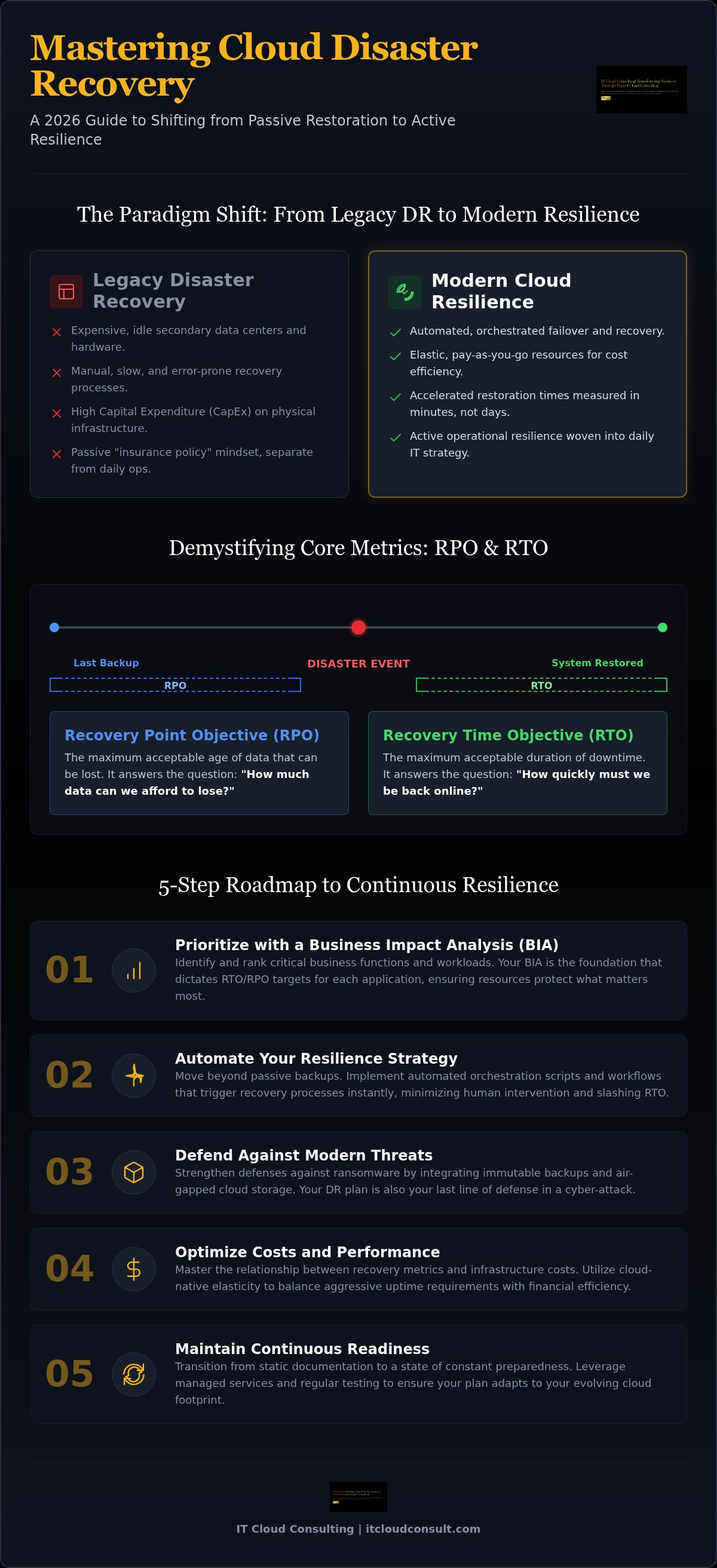
Recovery Point Objective (RPO) is the maximum allowable data loss your organization can sustain, measured in the duration of time between the last successful backup and the moment of a system failure. While RPO focuses on data integrity, Recovery Time Objective (RTO) measures the duration of downtime your business can tolerate before services must be fully restored. Aligning these metrics with stakeholder expectations is a critical step in building a successful cloud disaster recovery plan. It's often tempting to aim for zero downtime across all systems, but this rarely makes financial sense. Engaging in cloud optimization consulting helps you identify which workloads require immediate failover and which can afford a more gradual restoration, effectively balancing cost with recovery speed.
The Spectrum of Cloud DR Strategies
There's a direct cause-and-effect relationship between the complexity of your chosen strategy and the resulting infrastructure costs. Selecting the right model depends entirely on the criticality of the application in question. Modern cloud disaster recovery planning typically utilizes one of four architectural patterns:
- Backup and Restore: This is the most cost-effective foundation for non-critical workloads, where data is regularly backed up to cloud storage and restored only when needed.
- Pilot Light: A small version of your core infrastructure remains "on" in the cloud to keep data synchronized, while application servers remain dormant until a disaster is declared.
- Warm Standby: This strategy maintains a scaled-down but fully functional version of your environment that's always running, allowing for rapid failover with minimal manual intervention.
- Multi-Site Active-Active: The gold standard for zero-downtime requirements, where traffic is split between two or more live cloud regions simultaneously.
Choosing between these options requires a clear decision matrix based on application priority. For mission-critical revenue engines, the investment in a Multi-Site or Warm Standby approach is justified by the prevention of catastrophic financial loss. For internal development tools, a Backup and Restore model provides sufficient protection without unnecessary overhead. If you're struggling to categorize your workloads effectively, strategic roadmap development can provide the clarity needed to optimize your resilience spend. By matching the strategy to the specific business impact, you transform your DR framework from a generic backup plan into a precise instrument of operational stability.
Addressing the #1 Modern Threat: DR Planning for Ransomware
Many organizations rely on standard backups, assuming they provide a safety net against cyber extortion. In 2026, AI-powered ransomware specifically targets backup repositories and administrative consoles to prevent any hope of restoration. This reality necessitates a more rigorous approach to cloud disaster recovery planning. It's no longer enough to just have a copy of your data; you must ensure that copy is unreachable by the primary network's compromise. Air-gapped cloud storage provides this isolation by creating a logical barrier that prevents lateral movement from the production environment to your recovery assets. This architecture ensures that your last line of defense remains untainted even when your primary systems are breached.
Immutable Backups and Data Integrity
The standard for data protection has evolved into a Write-Once-Read-Many (WORM) model. This technology ensures that once a backup is created, it cannot be modified, encrypted, or deleted by any user or automated script for a predefined period. By 2026, continuous data protection (CDP) has become the expected baseline, allowing for sub-minute recovery points that significantly reduce the impact of an attack. Building these systems correctly requires professional cloud infrastructure consulting to ensure the underlying architecture supports both the performance needs of the business and the strict security requirements of immutability. It's a strategic investment in maintaining the absolute integrity of your digital assets.
The Orchestrated Recovery Process
Restoring data after a ransomware event is a high-stakes operation that demands precision. Automated threat detection systems now integrate directly with DR protocols, triggering an immediate isolation of affected workloads. This automation is critical, but it must be followed by a structured verification process. You shouldn't restore data directly into your production environment without first utilizing a "Clean Room." This isolated environment allows IT teams to perform deep forensic analysis and verify data health before any services go live. This methodical approach ensures you don't inadvertently re-infect your systems while also maintaining the audit trails required for regulatory compliance during a breach recovery scenario. Success in these moments depends on a pre-orchestrated workflow that prioritizes safety over raw speed.
How to Build Your Cloud Disaster Recovery Plan: A Step-by-Step Guide
Building a resilient enterprise requires more than just technical intent; it demands a structured, step-by-step roadmap that aligns your digital assets with business survival. Cloud disaster recovery planning in 2026 is an architectural journey that transforms your current infrastructure into a self-healing ecosystem. This process begins with a deep recognition of your operational priorities and ends with a state of continuous readiness. By following a methodical execution plan, you can eliminate the guesswork that often leads to catastrophic downtime during a crisis.
- Step 1: Business Impact Analysis (BIA). Quantify the financial and operational consequences of downtime for every department to set your recovery priorities.
- Step 2: Dependency Mapping. Use automated discovery tools to visualize how applications interact across your cloud infrastructure, ensuring no critical API or database is overlooked.
- Step 3: Strategy Alignment. Assign one of the four DR strategies (from Backup and Restore to Multi-Site) to each workload based on its tier of criticality.
- Step 4: Orchestration Deployment. Implement tools that automate the provisioning of resources and the redirection of traffic during a failover event.
- Step 5: Iterative Lifecycle Management. Establish a schedule for regular testing and documentation updates to keep pace with your evolving cloud footprint.
Categorizing Workloads and Data Mapping
Not all applications are created equal. You must distinguish between "Mission Critical" systems that drive immediate revenue and "Business Important" tools that can tolerate a longer recovery window. Mapping data flows is essential to ensure that your recovery vault contains every necessary dependency for a full restoration. Before you commit to a specific architecture, performing a strategic cloud adoption assessment will help you identify legacy gaps that might hinder your recovery speed. This clarity allows you to allocate your budget where it will have the most significant impact on your organizational resilience.
Automation, Orchestration, and Testing
In 2026, manual DR failover is a significant liability. The complexity of modern distributed systems makes human intervention too slow and prone to error. You should utilize Infrastructure as Code (IaC) to ensure that your recovery environment is an exact, reproducible replica of your production site. To achieve true confidence, adopt a "Chaos Engineering" approach to testing. By intentionally introducing failures into controlled environments, you can verify that your orchestration tools respond as expected. This proactive stance ensures that your plan isn't just a document on a shelf but a functional reality. If your team needs assistance in architecting these automated workflows, our experts provide ongoing cloud support to ensure your resilience remains at its peak.
From Planning to Execution: Managed Services for Continuous Resilience
A static document is no longer a sufficient defense against the dynamic threats of 2026. In a modern enterprise, your infrastructure evolves every time a developer pushes code or a new cloud instance is provisioned. This constant change creates "DR Drift," a state where your recovery protocols no longer align with your production reality. Effective cloud disaster recovery planning must therefore transition from a one-time project to a continuous operational cycle. Without ongoing oversight, even the most sophisticated architecture becomes a legacy liability that may fail when you need it most. Ensuring your resilience keeps pace with your innovation requires a shift toward managed orchestration.
Managed services bridge the gap between strategic intent and daily execution. Instead of burdening your internal teams with the exhaustive task of manual verification, a managed approach utilizes automated tools and expert oversight to maintain readiness. This model transforms disaster recovery from a reactive insurance policy into a proactive engine of business stability. It allows your leadership to focus on growth while seasoned architects manage the complexities of cross-region replication and failover synchronization.
The Role of Ongoing Cloud Support
The complexity of multi-cloud environments makes 24/7 monitoring a non-negotiable requirement. Detecting failure triggers in real-time allows for immediate automated intervention, often resolving issues before they impact the end-user experience. Managed providers handle the intricate task of balancing performance with cost, ensuring that your recovery environment doesn't become a financial drain. For organizations seeking clarity on the investment required for this level of protection, reviewing managed cloud support fees provides a transparent baseline for budgeting. This ongoing support ensures that your technical trajectory remains secure, regardless of how your underlying systems change.
Strategic Evolution and Future-Proofing
Resilience is not a destination; it's a state of being that must be nurtured through every stage of your enterprise cloud transformation. As you adopt new technologies like serverless computing or edge AI, your disaster recovery plan must be updated to encompass these new data flows and logic patterns. Regular strategic reviews with cloud consultants ensure that your recovery vault remains a faithful reflection of your production environment.
By positioning cloud disaster recovery planning as a core component of your long-term modernization strategy, you build an organization that is not just prepared for failure, but optimized for survival. IT Cloud Consulting serves as your strategic partner in this journey, providing the visionary architecture and technical proficiency required to secure your digital future. It's time to evolve beyond basic backups and embrace a future of uninterrupted operational excellence. Partner with our experts today to realize the full potential of a truly resilient cloud ecosystem.
Architecting a Future of Uninterrupted Continuity
Mastering the complexities of 2026 requires a departure from reactive data management. You've seen how shifting toward automated orchestration and immutable, air-gapped storage transforms resilience from a technical burden into a strategic asset. By aligning your recovery metrics with specific business outcomes, you ensure that every investment in your infrastructure directly supports your organization's survival. Effective cloud disaster recovery planning is no longer a static checkbox; it's a living framework that evolves alongside your digital footprint.
Success in this landscape demands a partner who combines visionary perspective with technical execution. IT Cloud Consulting delivers the Strategic Cloud Advisory and National Managed Support necessary to maintain Enterprise-Grade Resilience Frameworks across your entire cloud ecosystem. We don't just help you recover; we help you build an environment where failure is accounted for and continuity is guaranteed. Secure your business continuity with our Cloud Disaster Recovery expertise and move forward with the confidence that your operations are fully protected. Your journey toward a modernized, resilient future begins with a single strategic decision today.
Frequently Asked Questions
What is the difference between cloud backup and cloud disaster recovery?
Cloud backup focuses on long-term data retention and granular file recovery, while cloud disaster recovery ensures the rapid restoration of your entire application stack. Backup is a preservation tool, whereas disaster recovery is a continuity strategy designed to minimize downtime during a catastrophic failure. While you might use backups to recover a deleted file, you utilize disaster recovery to reboot your entire business operation after a system-wide outage.
How much does cloud disaster recovery planning cost for an enterprise?
The investment required for cloud disaster recovery planning varies based on your specific RTO and RPO targets and the complexity of your multi-cloud environment. Highly critical systems requiring near-zero downtime will naturally necessitate a larger investment in active-active architectures compared to simpler backup and restore models. You should evaluate these costs against the potential revenue loss of an unmanaged outage to determine your optimal resilience budget.
Can cloud disaster recovery help with ransomware protection?
Modern disaster recovery strategies are essential for ransomware resilience, particularly when they incorporate immutable storage and air-gapped vaults. These technologies prevent attackers from encrypting your recovery data, ensuring you have a clean, verified point of restoration after an incident. Integrating these safeguards into your architecture allows you to bypass the need for ransom negotiations by restoring your environment to a known healthy state.
What are the most common mistakes in cloud disaster recovery planning?
Many organizations fail by treating their plan as a static document or by neglecting to map complex inter-service dependencies. Relying on manual failover processes is another common error that often leads to extended outages during high-pressure recovery scenarios. Successful planning requires a move toward automation and a recognition that your recovery protocols must evolve alongside your production infrastructure to remain effective.
How often should an organization test its cloud disaster recovery plan?
You should test your recovery protocols at least quarterly to ensure they remain effective against your evolving infrastructure. Continuous testing, often through chaos engineering, identifies "DR Drift" before a real emergency occurs, maintaining your state of operational readiness. Regular testing also provides your team with the muscle memory required to execute a recovery with confidence and precision when every minute counts.
What is the role of RTO and RPO in a disaster recovery plan?
RPO and RTO serve as the foundational metrics that dictate your architectural choices and infrastructure spend. RPO determines how much data loss your business can tolerate, while RTO sets the deadline for when services must be fully operational to avoid significant revenue loss. These targets allow you to categorize workloads and apply the most cost-effective recovery strategy to each tier of your application stack.
Is multi-cloud disaster recovery better than single-cloud?
Multi-cloud disaster recovery provides superior protection against provider-specific outages but introduces significant management complexity. For many enterprises, the added resilience of a multi-cloud approach justifies the overhead, provided they have the managed support required to orchestrate such a sophisticated environment. This strategy ensures that a regional failure in one cloud provider doesn't result in a total blackout for your critical business functions.


