
What if the true cost of your cloud infrastructure isn't found in your usage, but in the visibility you lack? With networking price increases implemented in May 2026 and new defaults for Committed Use Discount sharing as of June, staying ahead of your monthly bill requires more than just occasional spot checks. You've likely experienced the frustration of unpredictable billing spikes or the persistent fear that under-provisioning might compromise your most critical workloads. It's a common challenge to feel like you're reacting to your bill rather than controlling it. Implementing gcp cost optimization best practices is no longer a luxury for the budget-conscious; it's a fundamental requirement for any organization aiming to scale sustainably in a complex digital economy.
We understand that your goal isn't just to cut costs, but to realize the latent potential of your cloud investment through strategic modernization. This guide will empower you to master the technical and strategic frameworks required to eliminate waste and maximize ROI across your entire Google Cloud Platform footprint. You'll learn how to transition from a reactive state of "bill-cutting" to a proactive, mature FinOps culture that treats efficiency as an architectural discipline. We'll provide a clear roadmap to achieve a predictable cloud budget and a transparent view of departmental spending, ensuring your infrastructure supports innovation without financial surprises.
Key Takeaways
- Understand how the 2026 pricing updates impact your bottom line and why visibility is the essential foundation of any successful strategy.
- Cultivate a FinOps culture that establishes clear financial accountability through rigorous resource labeling and tagging schemas.
- Master technical gcp cost optimization best practices by leveraging Committed Use Discounts and rightsizing Compute Engine workloads with Spot VMs.
- Transition from reactive bill-cutting to a sustainable, continuous improvement cycle guided by specific efficiency KPIs.
- Explore why enterprise-scale efficiency often requires strategic cloud optimization consulting to maintain a lean, high-performing environment.
The State of GCP Cost Management in 2026
The cloud is no longer a novelty; it's the engine of modern enterprise. Yet, as we move through 2026, many organizations find themselves facing a stark reality where monthly invoices consistently outpace initial forecasts. This discrepancy often stems from a "cloud-first" mentality that prioritizes speed over structural efficiency. To thrive, leaders must transition to a "cloud-smart" strategy. This approach treats infrastructure as a dynamic asset that requires constant calibration. Understanding the state of the market today means recognizing that gcp cost optimization best practices have evolved from simple cleanup tasks into a core architectural discipline.
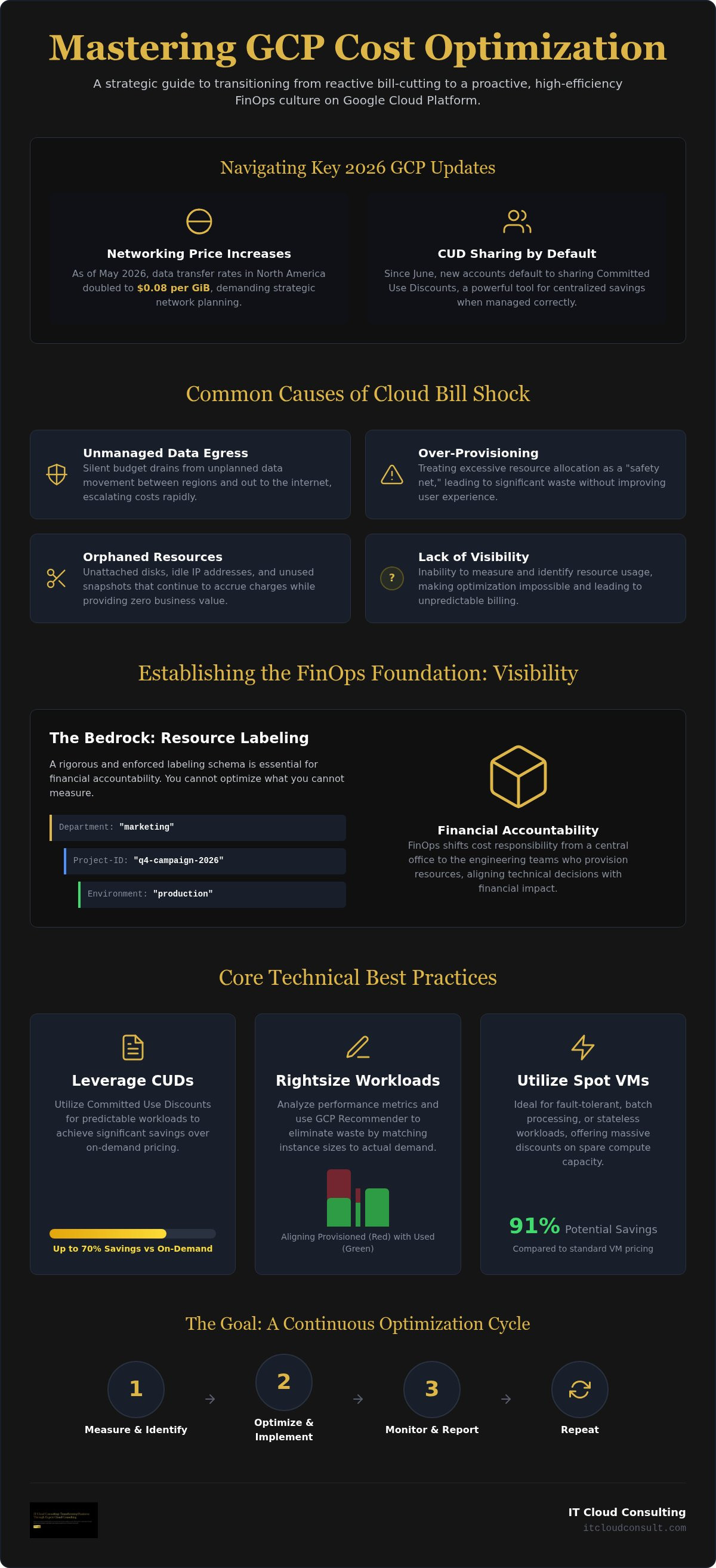
The evolution of Google Cloud's pricing models in 2026 has introduced new variables into the financial equation. For instance, the May 2026 networking price increases saw data transfer rates in North America double to $0.08 per GiB. Meanwhile, the June 16 update making Committed Use Discount (CUD) sharing the default for new accounts offers a powerful tool for centralized savings, provided it's managed correctly. Success in this environment requires a deep understanding of cloud management principles to balance "hard" costs, like compute and storage, against "soft" costs such as the operational overhead required to maintain these systems.
Common Causes of GCP Bill Shock
Surprise expenses often originate from overlooked corners of the environment. Unmanaged data egress and complex cross-region traffic fees frequently act as silent budget drains. When data moves between regions without a strategic networking plan, costs can escalate rapidly. Additionally, orphaned resources like unattached disks or idle IP addresses continue to accrue charges despite providing zero business value. Many teams also fall into the trap of over-provisioning. They treat excessive resource allocation as a "safety net" for performance, which leads to significant waste without necessarily improving the end-user experience.
The ROI of Strategic Optimization
Effective optimization isn't just about saving money; it's about realizing your organization's latent potential. By reducing waste, you can reallocate saved capital toward high-impact digital transformation and innovation projects. Beyond the balance sheet, applying gcp cost optimization best practices often leads to better architectural health. Systems that are right-sized and efficiently routed tend to be more resilient and easier to maintain. Modern enterprises are also increasingly linking cloud efficiency to corporate sustainability goals, as reducing unnecessary compute cycles directly lowers the carbon footprint of their digital operations.
Establishing Visibility: The FinOps Foundation
GCP FinOps is the cultural practice of taking financial accountability for the cloud, shifting the responsibility of spend from a centralized procurement office to the distributed engineering teams that actually provision resources. This transition is essential because technical decisions now have immediate financial consequences. To manage these impacts effectively, visibility must be absolute. You cannot optimize what you do not measure, and you certainly cannot measure what you haven't identified. Implementing gcp cost optimization best practices starts with a commitment to transparency across every layer of your infrastructure.
The Google Cloud Recommender serves as a powerful entry point for this journey. It utilizes machine learning to surface underutilized resources and suggests immediate corrective actions. However, these automated insights only reach their full potential when they're integrated into a broader organizational strategy. If your team is struggling to translate raw billing data into actionable business intelligence, engaging with professional cloud optimization services can provide the strategic oversight needed to turn these signals into a sustainable financial roadmap.
Resource Labeling for Accountability
A rigorous labeling schema is the bedrock of cloud financial management. It's not enough to simply tag resources; you must design a comprehensive hierarchy that reflects your organizational structure. Effective schemas typically categorize resources by department, specific project ID, and environment type, such as production or staging. By automating label enforcement through IAM policies, you ensure that no resource is created without the metadata required for tracking. This level of detail enables internal cost-center chargebacks, forcing teams to see the direct correlation between their architectural choices and the company's bottom line.
Advanced Billing Analysis Tools
While native billing reports offer a snapshot of spend, enterprise-scale operations require deeper analytical capabilities. Exporting your billing data to BigQuery allows your financial analysts to run custom SQL queries that reveal complex cost drivers. For instance, you can precisely track how the May 2026 networking price increases impacted specific regional traffic patterns. Connecting BigQuery to Looker Studio further enhances this visibility by creating executive-level dashboards. These visualizations make it easier to identify anomalous spend patterns in real time, allowing you to intervene before a minor misconfiguration escalates into a significant budget overrun. This proactive approach transforms the billing cycle from a monthly surprise into a predictable, managed process.
Core Technical Best Practices for GCP Efficiency
Transitioning from visibility to execution requires a precise application of technical levers. While visibility highlights where the money goes, technical optimization determines how much you actually need to spend. Adopting gcp cost optimization best practices involves a tiered approach, starting with how you purchase capacity. For predictable, long-running workloads, moving away from on-demand pricing toward Committed Use Discounts (CUDs) can yield savings of up to 57% for standard machine types and up to 70% for memory-optimized instances. For fault-tolerant or batch processing tasks, Spot VMs provide an even more aggressive reduction, offering discounts of up to 91% compared to standard rates.
Storage management represents another significant opportunity for cost avoidance. By implementing automated lifecycle policies, you can transition data from Standard storage ($0.020/GB) to Archive tiers ($0.0012/GB) as it ages. This shift ensures you aren't paying premium rates for data that is rarely accessed, though you must account for retrieval fees if that data is suddenly needed. These technical shifts transform your cloud environment from a static cost center into a lean, high-performance asset.
Compute Engine and GKE Optimization
Rightsizing is the process of aligning your resource allocation with actual demand. Google's machine type recommendations help eliminate idle CPU cycles by identifying instances that are consistently under-utilized. For those running containerized environments, implementing kubernetes cost optimization strategies is vital. This includes using horizontal pod autoscaling and selecting the correct machine families for your node pools. Automating the lifecycle of non-production environments, such as shutting down development clusters during off-hours, prevents unnecessary spend on idle resources that provide no business value during nights or weekends.
BigQuery Cost Control Strategies
BigQuery can quickly become a major expense for data-driven enterprises if left unmanaged. Choosing between on-demand and capacity-based (slot) pricing is a strategic decision. On-demand pricing is often suitable for smaller, spikey workloads, but larger organizations usually benefit from the predictability of slot reservations. To maintain control, you should set per-user and per-project query usage quotas. This prevents a single inefficient query from consuming a disproportionate share of your budget. Optimizing query performance by selecting only necessary columns and using partitioned tables also reduces the total data processed, leading to immediate savings.
Architecting for Lower Egress
Data movement is often the most overlooked cost in a GCP environment. Following the May 2026 price adjustments, which set egress rates at $0.08 per GiB in North America and Europe, architectural choices have direct financial impacts. Utilizing Cloud CDN can significantly reduce origin traffic costs by caching content closer to the user. Additionally, keeping data movement within a single region avoids cross-region fees entirely. Using VPC Service Controls allows you to monitor and govern data flow, ensuring that egress patterns remain within expected parameters. These gcp cost optimization best practices ensure your architecture is as financially efficient as it is technically sound.
Implementing a Continuous Optimization Workflow
Technical adjustments provide immediate relief, but long-term financial health depends on your ability to transform these actions into a repeatable operational rhythm. Moving from reactive, one-off cleanups to a continuous improvement cycle ensures that your infrastructure evolves alongside your business requirements. This transition requires a shift in perspective where efficiency is treated as a core performance metric rather than an afterthought. By implementing gcp cost optimization best practices as a standard part of your development lifecycle, you prevent the gradual "cost creep" that often erodes cloud margins over time.
Establishing a monthly Cost Review Board between IT and Finance is a critical component of this workflow. This collaborative body analyzes spending trends against Key Performance Indicators (KPIs), such as the ratio of idle resources to active compute or the percentage of spend covered by Committed Use Discounts. To ensure your optimization efforts remain consistent and professional, engaging in ongoing cloud support can provide the external oversight and technical depth required to maintain these high standards of efficiency.
The 5-Step Optimization Sprint
A structured sprint model allows teams to tackle optimization in manageable, high-impact phases. The process begins with a comprehensive audit using native tools like the GCP Recommender and BigQuery billing exports to identify waste. Next, teams rightsize underutilized instances and databases, ensuring that every dollar spent aligns with actual performance needs. The third step involves committing to predictable workloads through CUDs, leveraging the June 16, 2026, update that enables discount sharing by default for new accounts. Finally, teams automate scaling and environment scheduling to eliminate human error, followed by a period of monitoring to adjust the strategy based on real-world results.
Establishing Governance and Guardrails
Proactive governance prevents overspending before it occurs. By utilizing the Organization Policy Service, you can restrict the deployment of expensive or unnecessary machine types in specific projects. Implementing automated "kill switches" for non-critical budget overruns provides a safety net for development environments, preventing accidental spikes from impacting your primary budget. Integrating cost guardrails directly into your CI/CD pipeline allows you to "shift left" on financial accountability, training engineering teams to understand the financial impact of their architectural choices during the deployment phase. This structured approach ensures that gcp cost optimization best practices are woven into the very fabric of your organizational culture.
Strategic Cloud Optimization: Beyond the Quick Fixes
Tactical adjustments like rightsizing or deleting idle IP addresses are essential, but they represent only the first stage of a mature cloud journey. True excellence in gcp cost optimization best practices requires a shift from operational maintenance to architectural evolution. At the enterprise level, the complexity of distributed systems often demands specialized cloud optimization consulting to align technical infrastructure with overarching business objectives. This strategic approach ensures every architectural decision serves as a catalyst for growth rather than a drain on resources. It's about realizing the latent potential of your cloud investment through a methodical, high-level perspective.
Modernizing your environment is a precursor to sustainable innovation. While previous sections focused on managing existing resources, the most profound savings often come from changing the nature of those resources. IT Cloud Consulting bridges the gap between complex technical execution and business ROI by guiding organizations through these transformative transitions. By shifting the focus from reactive bill-cutting to proactive design, you create an environment where efficiency is built into the foundation of every project.
For professionals working from home, technical efficiency is just as critical in the home office as it is in the cloud. To optimize your personal connectivity and ensure your setup is cost-effective, learn more about Professional Consulting and Assessment Fees for independent home technology guidance.
Modernization as a Cost Strategy
Transitioning from legacy virtual machine environments to serverless architectures, such as Cloud Run or Cloud Functions, offers inherent savings by eliminating the cost of idle capacity. While rehosting provides a quick path to the cloud, the long-term financial benefits of refactoring applications into cloud-native structures are far more substantial. By utilizing strategic cloud adoption frameworks, you build cost-aware foundations from the outset. This forward-looking methodology transforms your cloud environment into a dynamic ecosystem that scales precisely with demand, ensuring you only pay for the exact value your applications deliver to the business.
Partnering for Long-Term Efficiency
Maintaining a lean cloud environment in a rapidly changing market requires more than internal vigilance. Professional cloud infrastructure audits provide an objective assessment of your current state, revealing hidden inefficiencies that internal teams might overlook. Ongoing managed support acts as a safeguard against "cloud sprawl," where uncoordinated resource deployment leads to fragmented and expensive environments. We specialize in customizing optimization roadmaps for specific organizational goals, ensuring that your transition to gcp cost optimization best practices is both methodical and transformative. This steady assurance allows your team to focus on development while we ensure the underlying platform remains a model of efficiency and performance.
Realizing the Potential of a Modernized Cloud
Mastering your cloud spend in 2026 requires a transition from simple cost-cutting to a sophisticated architectural discipline. We've explored how establishing a FinOps foundation and implementing continuous optimization workflows can transform your infrastructure from a financial burden into a strategic asset. By embracing technical levers like machine rightsizing and data lifecycle management, you ensure every dollar spent aligns with your organizational goals. This evolution from reactive billing to proactive management is the key to sustainable growth.
Realizing the full potential of your environment often requires a partner with a visionary perspective. You can maximize your cloud ROI with IT Cloud Consulting’s professional optimization services. Our team provides expert assessments of cloud infrastructure performance and cost-efficiency; we deliver the strategic guidance necessary for complex enterprise cloud transformations. Through continuous monitoring and managed cloud support, we help you maintain a lean, high-performing environment that scales with your ambition. Adopting these gcp cost optimization best practices isn't just about saving capital; it's about clearing the path for your next phase of innovation. Your journey toward a more optimized and advanced future state is within reach.
Frequently Asked Questions
What is the most effective way to reduce GCP costs quickly?
The most immediate path to cost reduction involves identifying and terminating orphaned resources such as unattached persistent disks and idle static IP addresses. Rightsizing over-provisioned Compute Engine instances based on Google Cloud Recommender data also provides rapid relief. These actions eliminate waste without requiring significant architectural changes, making them the ideal starting point for any efficiency drive.
How do Committed Use Discounts (CUDs) differ from AWS Savings Plans?
Committed Use Discounts typically require a commitment to a specific resource type or spend level within a region for a one or three-year term. While AWS Savings Plans offer broader flexibility across various services, GCP CUDs provide targeted discounts of up to 70% for specific memory-optimized machine types. This makes them exceptionally effective for predictable, high-performance workloads that remain stable over long periods.
Is it possible to automate GCP cost optimization without manual intervention?
You can automate significant portions of your cost management through native features like Instance Group autoscaling and Cloud Storage lifecycle policies. Modernizing your approach by integrating gcp cost optimization best practices into your CI/CD pipeline allows for automated resource scheduling. This ensures that non-production environments are active only when they're actually needed by your development teams.
What are the most common hidden costs in a Google Cloud bill?
Hidden costs often manifest as network egress fees, cross-region data transfer, and retrieval charges from colder storage tiers. Additionally, frequently overlooked expenses include the accumulation of old disk snapshots and unattached persistent disks. These resources continue to accrue charges even if the associated virtual machines have been deleted, leading to gradual budget erosion over time.
How does BigQuery pricing work, and how can I control it?
BigQuery operates on two primary models: on-demand pricing based on the volume of data processed and capacity-based pricing using reserved slots. You can maintain control by implementing per-project and per-user query quotas to prevent runaway costs. Utilizing partitioned tables and selecting only the specific columns required for your analysis further minimizes data scanning expenses.
Can I set a hard limit on my GCP monthly spend to prevent overages?
Google Cloud doesn't offer a native "hard stop" button for billing because it could cause catastrophic service disruptions for production environments. However, you can architect a custom solution by connecting budget alerts to a Pub/Sub topic and a Cloud Function. This allows you to programmatically disable billing or shut down specific non-critical projects once a predefined threshold is reached.
Why is my data egress cost so high on GCP?
High egress costs often stem from unoptimized cross-region traffic or large-scale data transfers to the public internet. Following the May 2026 price increases to $0.08 per GiB in North America and Europe, architectural efficiency is more critical than ever. Leveraging Cloud CDN for external traffic and keeping internal data movement within a single region are essential strategies to avoid these premium rates.
Should I use Spot VMs for production workloads?
Spot VMs are suitable for production only if the workload is stateless and designed for fault tolerance, such as batch processing or containerized web tiers. Since Google can reclaim these instances with very little notice, they shouldn't host critical databases or legacy applications. When used correctly within a resilient architecture, they offer a powerful way to reduce compute costs by up to 91%.


