
With CPU overprovisioning in Kubernetes environments reaching a staggering 69% in 2026, most enterprises are effectively subsidizing idle cloud capacity they don't use. It's a frustrating reality where technical safety margins translate directly into financial waste. If you're struggling to balance high-performance application delivery with the pressure of rising cloud invoices, you're not alone. Achieving sustainable kubernetes cost optimization requires moving beyond reactive manual adjustments toward a more sophisticated, architectural approach to resource management.
You likely recognize that manual rightsizing is no longer a viable strategy for complex clusters running the latest Kubernetes 1.36.3. Discover how to eliminate Kubernetes over-provisioning and align your container spend with actual business value by implementing systems that provide clear visibility into cost per service. We'll outline five strategic pillars to reduce your monthly cloud spend while ensuring your infrastructure scales precisely with business demand. We'll explore how AI-driven forecasting and mature FinOps frameworks can transform your cloud environment into a model of operational efficiency.
Key Takeaways
- Identify why static resource limits contribute to significant cloud waste and how shifting to demand-based allocation secures your infrastructure's future.
- Implement a comprehensive kubernetes cost optimization strategy that integrates historical rightsizing with automated Horizontal and Vertical Pod Autoscaling.
- Evaluate specialized tools like ScaleOps and Cast AI to achieve autonomous, real-time cluster management and enhanced spot instance utilization.
- Execute a structured five-step roadmap to transition your infrastructure from initial visibility audits to mature, governed resource management.
- Bridge the gap between engineering complexity and financial performance by aligning technical modernization with measurable business ROI.
What is Kubernetes Cost Optimization and Why It Matters in 2026
At its core, kubernetes cost optimization is the strategic process of aligning cluster resource allocation with actual workload demand. It is no longer sufficient to simply deploy containers; organizations must now ensure that every dollar spent on cloud infrastructure translates directly into operational value. In 2026, the "set and forget" approach to resource limits has become the primary driver of cloud waste. Modern environments require a transition from static configurations to dynamic, intent-based resource management. Before refining your financial strategy, it's helpful to revisit the foundational principles of What is Kubernetes? to understand why its distributed nature makes cost management so complex.
This evolution in infrastructure management has a direct impact on the effectiveness of cloud optimization consulting and overall enterprise ROI. We're seeing a decisive shift from reactive cost-cutting, which often happens after a budget breach, to proactive, autonomous resource management. By integrating financial accountability into the engineering workflow, businesses can transform their cloud spend from a runaway expense into a predictable, strategic asset that supports long-term growth and modernization.
The Hidden Cost of Over-Provisioning
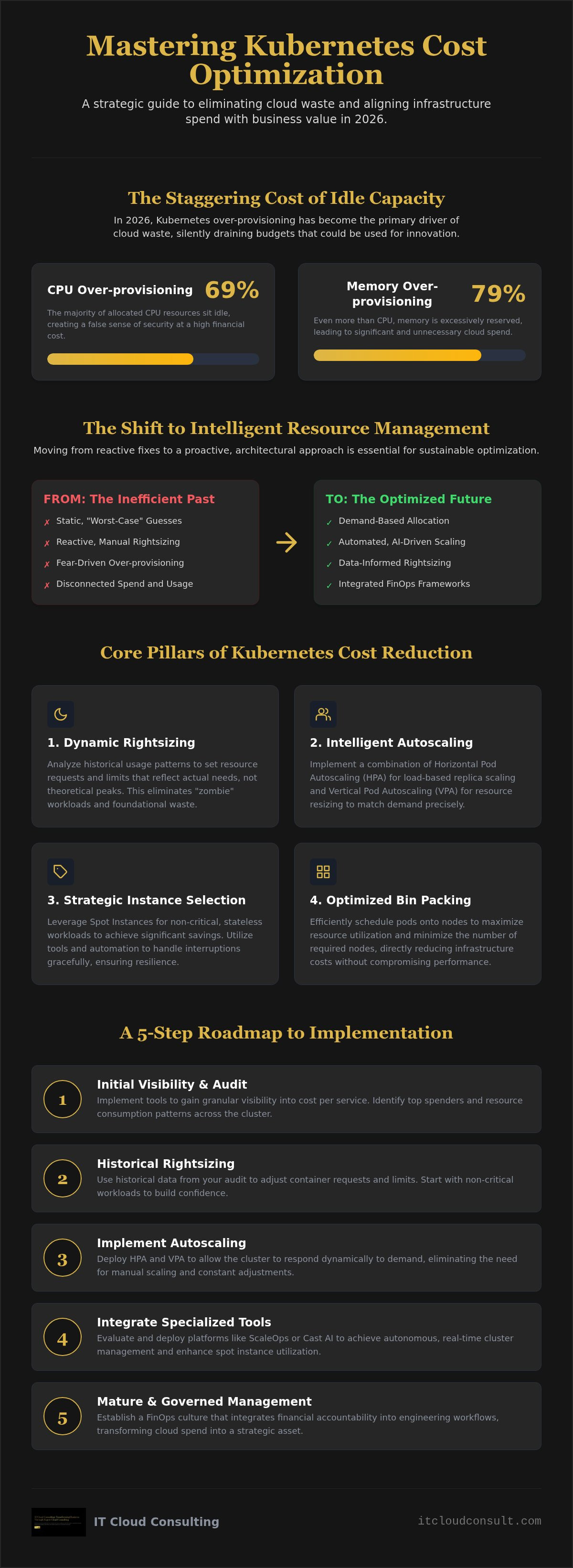
The "Idle Capacity" problem remains a significant hurdle for most technical teams. In 2026, CPU over-provisioning in Kubernetes environments reached 69% year-over-year, while memory over-provisioning sits at an even higher 79%. This excess capacity creates a false sense of security for engineers who fear application downtime, yet it silently drains budgets that could be allocated to product development. When 80% of your provisioned CPUs sit unused during off-peak hours, you're not just wasting money; you're stalling innovation cycles by diverting capital away from new features and modernization efforts.
Balancing Performance and Spend
There's a persistent myth that aggressive cost reduction must inevitably degrade application reliability. On the contrary, sophisticated cloud cost reduction strategies focus on finding the "Golden Ratio" of resource utilization. For most production environments, this means maintaining enough headroom for traffic spikes while keeping baseline utilization high enough to avoid waste. Visibility is the critical first step in this journey. Without granular data on cost per service, it's impossible to make the architectural adjustments required to sustain peak performance without the burden of unnecessary overhead. Achieving this balance is the hallmark of a mature, optimized container strategy.
Core Pillars of an Effective Kubernetes Cost Reduction Strategy
To achieve sustainable kubernetes cost optimization, organizations must look beyond superficial tweaks and embrace a multi-layered architectural framework. Success depends on a strategy that balances compute efficiency with application resilience. This framework rests on four essential pillars: rightsizing, intelligent autoscaling, strategic instance selection, and optimized bin packing. Together, these elements transform a bloated infrastructure into a lean, high-performance engine that scales precisely with business demand.
Rightsizing Containers and Nodes
Accurate rightsizing begins with a clear distinction between resource requests and limits. While requests dictate how the scheduler places pods on nodes, limits prevent a single container from consuming excessive resources. Most teams set these values based on "worst-case" guesses, which leads to the massive over-provisioning that characterizes modern cloud waste. Transitioning to dynamic rightsizing requires analyzing historical usage patterns to set requests that reflect actual needs rather than theoretical peaks. This process also helps identify "zombie" workloads, which are orphaned resources that continue to consume budget despite providing no business value. Eliminating these inefficiencies is a foundational step in any modernization journey.
Leveraging Spot Instances and Commitments
For non-critical workloads or stateless applications, Spot Instances offer a pathway to significant savings. However, running production-grade apps on Spot requires robust automation guardrails. You must balance instance diversity with on-demand fallback mechanisms to maintain high availability during spot interruptions. By integrating these technical tactics with Cloud Service Provider (CSP) savings plans, you can secure long-term discounts for steady-state workloads while staying agile. For teams looking for a structured approach to these technical shifts, A 5-Step Roadmap for Implementing K8s Cost Optimization provides a peer-reviewed framework for improving pod eviction and resource utilization through advanced scheduling logic.
Effective bin packing ensures that nodes are utilized to their maximum potential. By optimizing pod placement, you can reduce the total node count and associated management fees. This works in tandem with Horizontal Pod Autoscalers (HPA) and Vertical Pod Autoscalers (VPA). HPA scales the number of pod replicas based on real-time metrics, while VPA adjusts the resource requests of the pods themselves. When these systems are orchestrated correctly, the cluster becomes an elastic entity that expands and contracts in real-time. Navigating these architectural decisions requires a deep understanding of both cloud finance and container orchestration. If your team is struggling to align these technical pillars with your financial objectives, exploring professional cloud optimization services can provide the expertise needed to bridge the gap and realize your infrastructure's latent potential.
Roundup: Leading Kubernetes Cost Optimization Tools for 2026
Selecting the right technology stack is essential for transforming a theoretical strategy into a tangible operational reality. As organizations mature, the tools they utilize must evolve from simple monitoring dashboards to sophisticated platforms that actively and intelligently manage resources. In 2026, the market offers a diverse range of solutions designed to address specific infrastructure needs, from open-source provisioners to AI-driven autonomous engines. These tools are the catalysts for achieving sustainable kubernetes cost optimization across complex, multi-cloud environments.
- ScaleOps: This platform represents the cutting edge of autonomous, real-time resource management. It's particularly effective for AI and machine learning workloads where demand can be highly volatile and difficult to predict through traditional manual methods.
- Cast AI: This is a premier choice for automated cluster optimization. It specializes in Spot Instance management, providing the necessary guardrails to ensure high availability while slashing compute costs through intelligent automation.
- Kubecost: As the industry standard for cost allocation, Kubecost provides the granular visibility required for effective FinOps. It allows teams to track spend at the namespace and label level with high precision.
- Karpenter: An open-source favorite for AWS users, Karpenter offers high-performance node provisioning. It bypasses the limitations of traditional cluster autoscalers by launching the most efficient nodes for the current workload in seconds.
- Goldilocks: For teams starting their journey, Goldilocks provides a simple yet effective way to visualize "just right" resource requests, helping engineers move away from bloated configurations and toward a leaner architecture.
Autonomous vs. Manual Tools
Manual rightsizing is no longer sustainable for enterprise-scale clusters where hundreds of microservices interact in real-time. The complexity of modern workloads makes human intervention an operational bottleneck that leads to both waste and performance risks. AI and machine learning now play a central role in predictive resource scaling, allowing systems to anticipate traffic spikes before they impact the user experience. When evaluating your options, the primary criteria should be whether your team has the internal bandwidth to manage open-source tools or if the business requires the strategic assurance of an enterprise-grade, autonomous platform.
Cost Visibility and Allocation
True efficiency is impossible without namespace-level and label-based cost tracking. These metrics enable engineering accountability by implementing "Showback" models, where every team understands the financial impact of their architectural choices. Insights from the State of Kubernetes Cost Optimization report highlight that lack of visibility is the most significant hurdle to achieving ROI. Integrating this granular data into your broader enterprise cloud transformation reports ensures that technical progress is always aligned with the organization's overarching financial objectives.
A 5-Step Roadmap for Implementing K8s Cost Optimization
Transitioning from a state of fragmented cloud spend to a model of high-efficiency infrastructure requires more than just deploying a new tool. It demands a structured, chronological execution plan that aligns technical adjustments with organizational goals. While the tools discussed previously provide the necessary capabilities, this roadmap ensures that your kubernetes cost optimization journey is both sustainable and measurable. By following a logical progression from visibility to automation, you can eliminate the 32% to 40% of cloud spend typically wasted by organizations without a formal FinOps program.
- Step 1: Baseline Visibility: Begin by auditing your current infrastructure to identify the most significant areas of waste. You can't manage what you don't measure; therefore, establishing a clear view of cost per namespace and service is the essential starting point.
- Step 2: Establish Governance: Define strict resource quotas and tagging standards. This creates a framework of accountability and ensures that every provisioned resource is mapped to a specific business unit or project.
- Step 3: Implement Quick Wins: Focus on immediate impact by enabling bin packing and purging unused volumes or orphaned load balancers. These actions provide instant relief to your cloud invoice while building momentum for deeper architectural changes.
- Step 4: Automate Scaling: Once your baseline is stable, deploy autonomous rightsizing and autoscaling tools. This removes the burden of manual tuning from your engineering team and ensures resources scale in real-time with actual demand.
- Step 5: Continuous Optimization: Integrate cost reviews directly into your CI/CD pipeline. This final step ensures that cost efficiency is a core component of the software development lifecycle, preventing the recurrence of over-provisioning.
Establishing a FinOps Culture
Successful optimization bridges the traditional gap between finance, operations, and engineering. It's about moving away from "blame-shifting" and toward a model of shared responsibility. By setting realistic unit cost metrics, such as cost per customer transaction, you provide developers with a clear understanding of how their code impacts the bottom line. This empowers teams to make cost-aware architectural decisions during the design phase rather than as an afterthought. It's a fundamental shift that transforms cloud spend into a transparent, strategic metric.
Governance and Guardrails
To maintain long-term efficiency, you must implement technical guardrails that prevent "cost drift." Utilizing admission controllers allows you to enforce resource limits at the moment of deployment, ensuring that no unoptimized workloads enter your production environment. Many enterprises find that leveraging managed cloud services provides the necessary oversight to maintain these standards without overextending internal resources. Automated policy enforcement acts as a silent sentry, protecting your budget while your team focuses on higher-value innovation. If you're ready to move beyond manual intervention and secure your infrastructure's financial future, you can request a cloud optimization audit to identify your most immediate opportunities for savings.
Modernizing Your Infrastructure with IT Cloud Consulting
Navigating the intricacies of a modern containerized environment requires more than technical proficiency. It demands a visionary approach to resource management that aligns every node and pod with your organization's financial trajectory. As we've explored, the path to sustainable kubernetes cost optimization is paved with architectural shifts and cultural evolution. While the tools and roadmaps provide a foundation, a strategic partner is essential for translating these complex technical processes into consistent business value. We act as your seasoned guide, ensuring that your transition from manual oversight to autonomous efficiency is seamless and secure.
At IT Cloud Consulting, we specialize in bridging the gap between engineering execution and business ROI. We understand that technical teams prioritize performance and uptime, while financial stakeholders focus on the bottom line. Our role is to synthesize these priorities into a single, cohesive strategy. By providing ongoing cloud support, we help your organization maintain long-term efficiency, preventing the gradual "cost drift" that often erodes the benefits of initial optimization efforts. We don't just solve today's billing spikes; we build the frameworks that support your future growth.
Our Strategic Approach to Optimization
Our methodology extends far beyond simple tool recommendations. We architect scalable, cost-aware systems that are designed to evolve alongside your business. By leveraging our deep cloud infrastructure consulting expertise, we help you realize the latent potential of your container strategy. We focus on transformative results, moving your infrastructure from a state of reactive maintenance to one of proactive, strategic advantage. This approach ensures that your modernization journey drives measurable organizational growth rather than just incremental savings.
Take the First Step Toward Efficiency
The complexity of Kubernetes in 2026 doesn't have to result in financial uncertainty. You can eliminate the guesswork in your cloud bill by implementing a governed, automated, and transparent resource management model. Whether you're running the latest Kubernetes 1.36.3 or managing a complex multi-cloud fleet, your infrastructure must be ready for the demands of the future. We're here to ensure that your cloud spend is an investment in innovation, not a tax on your operations.
The realization of a truly optimized cloud environment begins with a single, purposeful action. Scheduling a strategic architecture review allows us to audit your current environment and identify the most impactful opportunities for modernization. Don't let over-provisioning stall your innovation cycles any longer. Contact IT Cloud Consulting for a Strategic Cloud Assessment today and begin the transition toward a more efficient and empowered future.
Mastering the Economics of Modern Containerization
Achieving sustainable efficiency in 2026 requires more than just technical adjustments; it demands a fundamental shift toward an architectural model where resources scale in lockstep with business value. By moving away from static over-provisioning and adopting autonomous tools and a structured FinOps roadmap, your organization can reclaim significant cloud spend while maintaining peak application performance. This evolution transforms your infrastructure from a hidden cost center into a transparent engine for growth. Realizing the full potential of kubernetes cost optimization is a journey that bridges the gap between engineering excellence and financial accountability.
As you transition toward this modernized future, having a dependable guide ensures your strategy remains resilient against the complexities of the cloud. IT Cloud Consulting provides the Strategic Cloud Adoption Expertise and Managed Cloud Support Excellence required to deliver Proven ROI through Modernization. We're committed to helping you navigate these transitions with steady assurance and technical precision. Take the definitive step toward a more efficient infrastructure today. Optimize Your Kubernetes Environment with IT Cloud Consulting and unlock the latent potential of your containerized workloads.
Frequently Asked Questions
What is the primary cause of high Kubernetes costs?
The primary cause of high Kubernetes costs is the widespread practice of over-provisioning, where technical teams set resource requests far higher than actual usage to ensure application stability. This results in significant idle capacity. In 2026, CPU over-provisioning reached 69% year-over-year. Without active management, organizations pay for compute power that never actually executes a workload.
How much can I realistically save with Kubernetes cost optimization?
Organizations can realistically reduce their cloud waste by significant margins through a structured kubernetes cost optimization program. Industry data suggests that businesses without a formal FinOps strategy often waste 32% to 40% of their cloud spend. By implementing rightsizing and automated scaling, mature teams can bring this waste down to roughly 15% to 20%, directly improving the organization's bottom line.
Is it safe to use Spot Instances for production workloads?
It's safe to use Spot Instances for production workloads provided you have robust automation guardrails and fallback mechanisms in place. Stateless applications and microservices are ideal candidates for this strategy. By utilizing a diverse range of instance types and automated cluster management tools, you can maintain high availability even when cloud providers reclaim capacity for on-demand users.
What is the difference between HPA and VPA in Kubernetes?
The Horizontal Pod Autoscaler (HPA) increases or decreases the number of pod replicas based on metrics like CPU utilization. In contrast, the Vertical Pod Autoscaler (VPA) automatically adjusts the resource requests and limits of existing pods. While HPA handles traffic volume spikes, VPA ensures that individual containers have the "just right" amount of memory and CPU allocated for their specific tasks.
How do I choose between open-source and commercial optimization tools?
Choosing between open-source and commercial tools depends on your team's internal bandwidth and the scale of your operations. Open-source solutions like Karpenter offer powerful node provisioning but require significant manual configuration. Commercial platforms provide autonomous, AI-driven management and enterprise-grade support, making them more suitable for organizations that prioritize strategic modernization over building custom internal tooling.
Does Kubernetes cost optimization impact application performance?
Strategic optimization shouldn't degrade application performance; in fact, it often improves it by reducing resource contention and fragmentation within the cluster. By aligning resource allocation with actual demand, you ensure that critical services always have the necessary headroom to handle traffic spikes. Effective optimization is an architectural exercise that balances financial efficiency with technical resilience.
What role does FinOps play in Kubernetes management?
FinOps introduces a culture of financial accountability into the engineering process by creating a shared language between finance, operations, and development teams. It focuses on understanding the unit economics of your cloud spend, such as the cost per transaction or customer. This visibility allows teams to treat kubernetes cost optimization as a continuous business process rather than a one-time technical fix.
How often should we perform a Kubernetes cost audit?
You should integrate cost monitoring into your continuous CI/CD pipelines for real-time visibility, but a deep strategic architecture review is recommended at least quarterly. Regular audits allow your team to identify "cost drift" and adjust governance policies as your workloads evolve. This methodical approach ensures that your infrastructure remains lean and aligned with your long-term business trajectory.


