
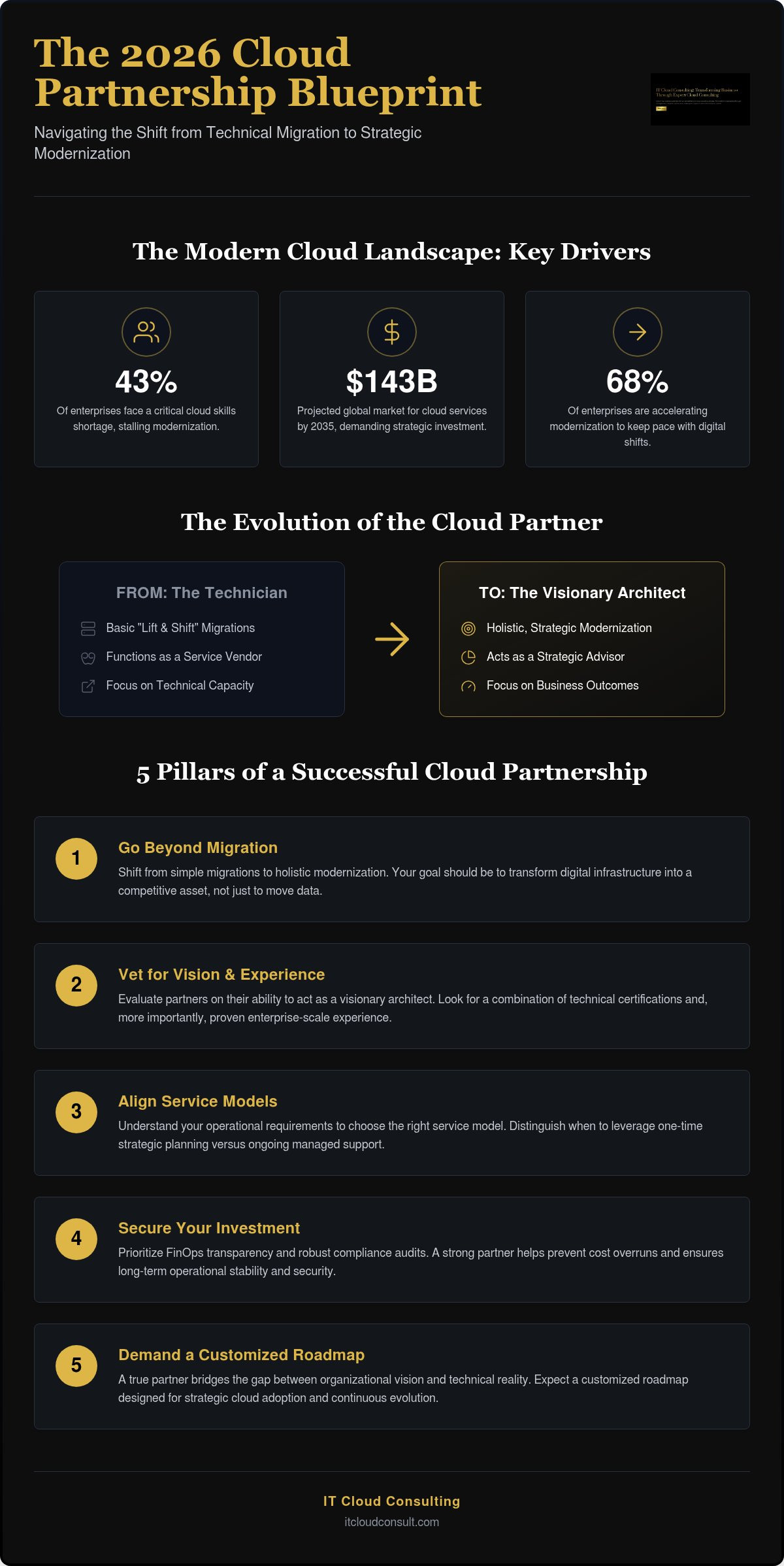
Did you know that 43% of enterprises are currently facing a critical cloud skills shortage that stalls their most ambitious modernization efforts? As the global market for cloud services accelerates toward a projected $143 billion by 2035, the decision to partner with a cloud consulting company has become the most significant architectural choice your organization will make this decade. It's no longer just about moving data; it's about engineering an environment where innovation isn't hindered by fragmented multi-cloud silos or unexpected cost spikes.
We understand that the transition to modern infrastructure often feels like a high-stakes gamble against hidden migration costs and the threat of vendor lock-in. You deserve a predictable roadmap that transforms these technical challenges into scalable opportunities for AI integration and operational efficiency. This article provides a definitive 2026 checklist for evaluating cloud partnerships, ensuring your choice aligns with the latest regulatory frameworks like the EU Cloud and AI Development Act. You'll gain a clear framework for vetting expertise, establishing strategic alignment, and securing the long-term stability required for a truly optimized enterprise.
Key Takeaways
- Modern cloud strategy requires a shift from simple migrations to holistic modernization that transforms your digital infrastructure into a competitive asset.
- Evaluate potential partners based on their ability to act as a visionary architect, ensuring the cloud consulting company you select possesses both technical certifications and proven enterprise-scale experience.
- Align your operational requirements with the right service model by understanding when to leverage one-time strategic planning versus ongoing managed support.
- Secure your investment by prioritizing FinOps transparency and robust compliance audits to prevent cost overruns and ensure long-term operational stability.
- Bridge the gap between organizational vision and technical reality with a customized roadmap designed for strategic cloud adoption and continuous evolution.
Defining the Strategic Role of a Cloud Consulting Company in 2026
The enterprise environment in 2026 demands far more than a functional migration of legacy data. The era of "lift and shift" has matured into an era of holistic modernization, where the primary objective is the realization of latent organizational potential. Today, over 68% of enterprises are accelerating cloud modernization efforts to keep pace with global digital shifts. A premier cloud consulting company no longer functions as a mere technician for hire. Instead, they operate as a visionary architect, mapping technical infrastructure to the high-level strategic goals of the business.
Market demands have evolved with remarkable speed. With the rapid integration of AI-as-a-Service and the expansion of decentralized edge computing, the complexity of modern cloud computing requires a partner who understands the comprehensive "big picture." This distinction is vital for long-term success; while a service vendor provides technical capacity, a strategic cloud advisor provides a clear trajectory for sustainable development.
From Infrastructure to Innovation
True modernization is about enabling business agility rather than just managing servers. When an organization transitions from legacy systems to a cloud-native environment, they aren't just changing where data resides. They're actively accelerating their time-to-market for new products and services. A specialized partner ensures your technical stack doesn't just function; it drives progress.
Cloud consulting acts as the definitive bridge between technical capability and tangible business outcomes. By focusing on transformative actions like "optimize," "evolve," and "modernize," these experts help you move past the limitations of traditional IT structures. This transition allows organizational leadership to focus on core innovation while the consultant ensures the underlying systems remain resilient, scalable, and supportive of modern workloads.
The Value of Strategic Alignment
Success in the cloud requires more than technical proficiency. It demands a sophisticated understanding of your specific industry's regulatory landscape, including evolving frameworks like NIST CSF 2.0 or the EU Cloud and AI Development Act. Without this alignment, technical choices can quickly become liabilities rather than strategic assets.
Aligning your cloud architecture with a comprehensive IT modernization strategy ensures that every resource allocated contributes to a broader vision of success. This methodical approach builds trust through clarity and comprehensive coverage. It ensures that technology choices made today, whether they involve multi-cloud environments or zero-trust security, support future scalability. A dependable cloud consulting company guides you through these complex decisions, ensuring your infrastructure is prepared for the demands of 2026 and beyond.
Essential Evaluation Criteria for Cloud Consulting Partners
Selecting a cloud consulting company is a decision that extends far beyond procurement; it's the selection of a long-term strategic ally. While technical qualifications are necessary, they represent only the foundation of a successful partnership. Organizations must establish critical criteria for evaluation that prioritize operational resilience and the ability to manage complex, multi-layered environments. A partner's value is truly measured by their methodology for converting technical migration into sustained business optimization.
Transparency remains the cornerstone of any enterprise-grade collaboration. You should look for project management frameworks that provide real-time visibility into progress, spend, and risk mitigation. A dependable guide doesn't just deliver a finished product; they provide a clear, documented path that allows your leadership to make informed decisions at every milestone. This structured approach builds the trust necessary to navigate the inevitable complexities of large-scale digital evolution.
Certifications vs. Real-World Execution
Vendor-specific certifications from providers like AWS, Azure, or Google Cloud are essential baselines, but they shouldn't be the primary differentiator in your selection process. Theoretical knowledge doesn't always translate to the nuanced reality of legacy system transitions. You need to ask potential partners specific questions about how they've handled data integrity during high-volume migrations or how they've resolved unforeseen latency issues in hybrid environments. Specialized expertise is the engine behind a successful enterprise cloud transformation, ensuring that your unique technical debt is addressed with precision rather than generic templates.
Cultural and Operational Fit
A consultant's workflow must integrate seamlessly with your internal DevOps teams to prevent friction and fragmented delivery. The ideal partner doesn't just execute tasks in a vacuum; they provide proactive mentorship that elevates your internal skill sets. This collaborative spirit ensures that your team is prepared to manage the new infrastructure once the initial implementation is complete. We believe that a true partner should pass the "Visionary Guide" test: they should possess the confidence to challenge your existing assumptions when a more efficient or scalable path exists. If you're ready to move beyond basic vendor relationships, you can explore our strategic roadmap services to see how we align technical execution with your specific organizational culture.
Analyzing Service Models: Advisory vs. Managed Services
Choosing the right engagement model is a pivotal step in your modernization journey. Many organizations mistake a project's completion for the end of their cloud evolution, yet the transition from a legacy state to an optimized future requires distinct types of expertise. You must decide whether your current needs prioritize high-level strategic planning or the technical discipline of daily operations. A premier cloud consulting company typically offers a spectrum of services, ranging from one-time advisory fees to comprehensive, ongoing support structures.
A hybrid model often yields the most significant business results. By combining the visionary architecture of a roadmap with the dependable stability of maintenance, you ensure that your infrastructure doesn't just launch; it thrives. When reviewing an enterprise evaluation checklist, pay close attention to how a partner balances these two worlds. The depth of their managed cloud services should match your internal capacity to handle complex multi-cloud environments.
Strategic Advisory and Roadmap Development
Strategic advisory serves as the blueprint for your digital future. This phase begins with a comprehensive cloud readiness assessment, which identifies technical debt and evaluates your organization's cultural preparedness for change. These roadmaps are essential for preventing the common pitfalls of fragmented adoption, such as overlapping services or security gaps. During this planning phase, your consultant should focus on establishing clear ROI and performance benchmarks. This methodical approach ensures every technical decision supports a broader business outcome, transforming your infrastructure into an engine for growth.
The Role of Ongoing Managed Support
Operational excellence doesn't happen by accident. Post-migration support is the primary driver of cloud operational efficiency, providing the continuous tuning required to keep costs low and performance high. You should look for Service Level Agreements (SLAs) that guarantee not just uptime, but also proactive security monitoring and 24/7 incident response. Modern managed support has evolved beyond reactive troubleshooting. It now centers on proactive infrastructure tuning, where your partner identifies potential bottlenecks before they impact your users. This steady assurance allows your internal teams to focus on innovation while a dependable guide handles the complexities of your cloud environment.
The Cloud Modernization Readiness Checklist
Preparing for enterprise-scale modernization requires more than a technical inventory. It demands a methodical evaluation of your organization's current state to ensure that new infrastructure supports, rather than hinders, your strategic goals. A seasoned cloud consulting company facilitates this transition by identifying potential friction points before they impact your bottom line. This readiness phase is the realization of latent potential, turning existing challenges into a structured path for evolution.
- Security and Compliance Audit: Establishing a baseline for data integrity ensures that your migration doesn't introduce new vulnerabilities from day one.
- FinOps and Cost Transparency: Creating financial guardrails prevents the common "sticker shock" associated with unmanaged cloud consumption.
- Performance Benchmarking: Defining success for your specific workloads allows for objective measurement of modernization benefits.
- Skill Gap Analysis: Recognizing where your internal team requires support or training is vital for long-term operational stability.
- Automation and IaC Integration: Architecting for speed through Infrastructure as Code (IaC) ensures your environment remains scalable and repeatable.
This systematic approach builds trust through clarity. Each step serves as a building block in a larger argument for modernization, leading your organization from a recognition of need to a clear understanding of the path forward. By addressing these five pillars, you ensure that your cloud environment is not just functional, but truly optimized for the demands of 2026.
Prioritizing Security and Governance
Security is no longer a perimeter concern; it's a foundational architectural requirement. Integrating a comprehensive cloud security assessment checklist into your partner selection process ensures that governance is baked into the environment from the beginning. Your partner must verify compliance with rigorous industry standards such as HIPAA, SOC2, or GDPR, especially as regulatory bodies increase oversight. Automated governance tools are essential to prevent shadow IT, where unvetted cloud usage can lead to fragmented security postures and significant compliance risks.
FinOps: Beyond Simple Cost Reduction
Effective financial operations (FinOps) represent a shift from a fixed-cost mindset to a variable-value optimization strategy. A top-tier cloud optimization consulting firm focuses on unit economics, helping you understand the precise cost of every transaction or user interaction. This level of granularity allows for real-time visibility into resource utilization, ensuring you only pay for the capacity that directly contributes to business outcomes. By establishing these financial guardrails early, you protect your ROI and create a predictable roadmap for future investment. If you're ready to audit your current infrastructure for these efficiencies, you can start your strategic cloud adoption journey here to ensure your modernization efforts are built on a secure and cost-effective foundation.
Partnering with IT Cloud Consulting for Long-Term Evolution
Enterprise evolution is a continuous state of progress rather than a final destination. As a specialized cloud consulting company, IT Cloud Consulting bridges the gap between high-level organizational vision and the granular technical execution required to achieve it. We don't just provide services; we engineer the future of your digital infrastructure through Strategic Cloud Adoption and meticulous architectural planning.
Our approach centers on delivering continuous value. By integrating Cloud Optimization and Ongoing Cloud Support into your operational fabric, we ensure that your environment remains efficient and secure long after the initial migration. This promise of steady assurance empowers your organization to focus on the next decade of innovation with total confidence in your underlying technology.
The Visionary Architect Approach
We prioritize your business trajectory over simple server counts. Our team has successfully accelerated digital transformation for national enterprises by aligning technical roadmaps with long-term commercial objectives. This commitment to transparency and technical excellence ensures that every architectural decision serves your broader strategic goals. We act as your dependable guide, providing the "big picture" perspective and the technical proficiency required for flawless execution. Our focus remains on the transition from your current state to a more optimized and advanced future state.
Taking the Next Step in Your Cloud Journey
Realizing your organization's latent potential begins with a clear understanding of your current state. Initiating a professional assessment of your cloud maturity allows us to identify immediate opportunities for improvement and long-term scaling. A strategic consultation provides the clarity needed to build a roadmap that's both ambitious and achievable. This methodical process builds trust through comprehensive coverage of your unique operational needs.
- Evaluate your current infrastructure against 2026 performance benchmarks.
- Identify critical skill gaps within your internal DevOps teams.
- Establish a customized roadmap for Strategic Cloud Adoption.
- Pinpoint areas where Cloud Optimization can reduce immediate operational overhead.
We invite you to partner with a cloud consulting company that's deeply invested in your trajectory and ready to transform your cloud from a cost center into a powerful competitive advantage.
Architecting Your Digital Future
The landscape of 2026 requires a transition from tactical IT management to strategic modernization. As we've explored, the right cloud consulting company serves as more than a vendor; they act as a visionary guide through the complexities of multi-cloud environments and evolving regulatory standards. By prioritizing FinOps transparency and robust security frameworks, your organization can effectively eliminate hidden costs while building an infrastructure that supports advanced AI workloads.
True evolution occurs when technical processes are directly linked to organizational benefits. This methodical approach ensures that every resource spent contributes to a broader vision of success. Our team brings deep expertise in complex enterprise modernization and utilizes proactive cost optimization frameworks to maximize your ROI. With dedicated national support for US-based organizations, we provide the steady assurance needed to navigate long-term development.
If you're ready to move beyond fragmented systems and realize your latent potential, we're here to help. Schedule a Strategic Consultation with IT Cloud Consulting today to begin your transformation. Your path to a scalable, efficient, and future-proof enterprise is within reach.
Frequently Asked Questions
What exactly does a cloud consulting company do?
A cloud consulting company acts as a strategic architect and execution partner for enterprise digital transformation. They provide specialized services such as strategic roadmap development, infrastructure optimization, and ongoing technical support to ensure your technology aligns with business goals. By bridging the gap between high-level vision and technical reality, they help organizations modernize legacy systems while maintaining operational stability and security.
How much do cloud consulting services typically cost?
Costs for these services vary based on project scope, firm size, and the level of specialization required. Industry data from 2026 suggests that average hourly rates for consultants in the United States typically range from $100 to over $300. Most enterprises choose between fixed-fee models for specific migration projects or recurring monthly retainers; for instance, you can learn more about Project-based professional consulting fees to see how specialized firms like Delphi Consulting Ltd structure their tailored engagements.
How do I choose between a boutique cloud consultant and a large global firm?
Your decision should depend on the required level of personalized attention and the specific complexity of your environment. Boutique firms often provide a client-centric, agile experience with direct access to senior architects who understand your industry's nuances. Large global firms offer extensive resources and geographic reach, which may be necessary for massive, multi-national organizations with highly fragmented global infrastructures.
Can a cloud consulting company help reduce our monthly AWS or Azure bill?
Yes, a professional cloud consulting company specializes in FinOps and cost optimization frameworks designed to eliminate wasteful spending. They implement real-time visibility tools and rightsizing strategies that align resource consumption with actual workload demands. This approach shifts your organization from a fixed-cost mindset to a variable-value model, often resulting in reduced operational overhead and improved ROI.
What is the difference between a cloud consultant and a managed service provider (MSP)?
A cloud consultant focuses on high-level strategy, architectural design, and transformative roadmap development to evolve your business infrastructure. In contrast, a traditional MSP typically handles the day-to-day tactical maintenance and reactive troubleshooting of existing systems. Many modern partners now offer a hybrid model that combines the visionary planning of a consultant with the steady, ongoing support expected from an MSP.
How long does a typical enterprise cloud transformation project take?
Project timelines depend on the complexity of your legacy debt and the scale of your modernization goals. A standard enterprise-level transformation often spans six to eighteen months, starting with a comprehensive readiness assessment and moving through iterative phases of migration. A methodical roadmap ensures that progress is logical and steady, allowing your organization to realize incremental value throughout the journey.
What certifications should I look for in a cloud consultant?
You should prioritize professional-level certifications from major providers like AWS, Microsoft Azure, or Google Cloud. Beyond vendor-specific credentials, it's vital to verify compliance with modern security frameworks such as NIST CSF 2.0 or ISO/IEC 27001:2022. A qualified cloud consulting company should demonstrate a balance of theoretical expertise and proven real-world execution in complex, large-scale enterprise environments.
Does my business need a cloud consultant if we already have an in-house IT team?
A consultant acts as a specialized extension of your in-house team, filling critical skill gaps that often emerge during rapid modernization. While your internal staff possesses deep knowledge of your business logic, external consultants provide the "big picture" perspective and technical proficiency required for complex architectural changes. This partnership empowers your internal team to focus on core innovation while the consultant handles infrastructure resilience.


