
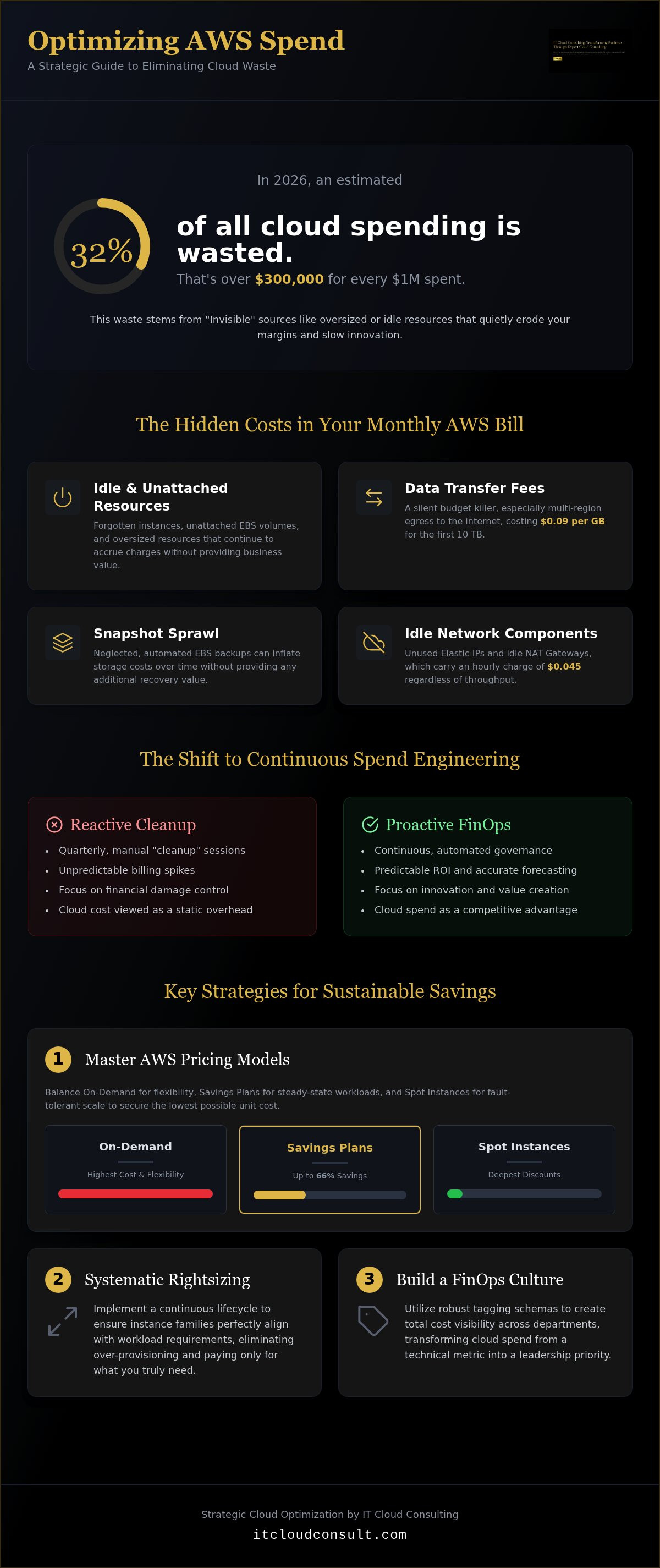
Did you know that in 2026, approximately 32% of all cloud spending is still wasted on oversized or idle resources? For every $1 million your organization invests in the cloud, over $300,000 likely evaporates without providing any tangible business value, which makes optimizing aws spend more than a technical task; it's a strategic necessity. It's common to feel overwhelmed by unpredictable monthly billing spikes and pricing models that seem designed to resist accurate forecasting. You've likely seen how technical debt leads to resource waste that quietly erodes your margins and complicates your path to modernization.
We understand that you're looking for steady assurance in your cloud investments rather than constant financial surprises. This professional guide offers a strategic roadmap to eliminate AWS waste and align your infrastructure with long-term business growth. We'll examine the shift toward continuous spend engineering, from leveraging Graviton processors to implementing AI-driven cost management. By following this framework, you'll understand how to transform your cloud costs from a liability into a scalable FinOps culture that delivers predictable ROI and a clear competitive advantage.
Key Takeaways
- Identify and eliminate "invisible waste" by addressing idle resources and unattached volumes that quietly inflate your monthly bill.
- Master the strategic allocation of Savings Plans and Reserved Instances to achieve a sophisticated balance when optimizing aws spend.
- Implement a systematic rightsizing lifecycle that ensures your instance families perfectly align with your specific workload requirements.
- Establish a sustainable FinOps culture by utilizing robust tagging schemas to create total cost visibility across every department.
- Discover how ongoing managed cloud support serves as a critical safeguard to prevent cost creep and protect your long-term optimization gains.
The Landscape of AWS Spending: Why Costs Spiral in 2026
Effective cloud management has evolved far beyond the simple act of reducing a monthly invoice. True AWS cost optimization represents a strategic alignment where infrastructure investment directly fuels business velocity. While many organizations view their cloud bill as a static overhead, visionaries recognize it as a dynamic variable that, when tuned correctly, creates a significant competitive advantage. Success in optimizing aws spend requires a shift in perspective; you must move from viewing the cloud as a digital utility toward treating it as a sophisticated engine for value creation.
The challenge lies in the "Invisible Waste" that quietly accumulates within complex environments. Industry data from 2026 indicates that approximately 30% to 32% of all cloud spending is wasted on oversized or idle resources. This inefficiency often stems from the inherent flexibility of the cloud computing model, where the ease of provisioning can lead to forgotten instances or unattached EBS volumes that continue to accrue charges. Technical debt further complicates this landscape. Architectural shortcuts taken during initial migrations often result in inefficient resource utilization patterns that become increasingly expensive as your operations scale.
The Hidden Costs in Your Monthly AWS Bill
Budget leaks often occur in the most overlooked areas of the architecture. Data transfer fees remain a silent budget killer, especially in multi-region architectures where egress to the internet costs $0.09 per GB for the first 10 TB. Snapshot sprawl is another common culprit; neglected backups for EBS volumes can inflate storage costs over time without providing additional recovery value. Furthermore, idle NAT Gateways carry an hourly charge of $0.045 regardless of throughput. When combined with unused Elastic IPs, these micro-costs aggregate into a substantial financial burden that provides zero operational benefit.
The Shift from Reactive to Proactive Optimization
Relying on quarterly "cleanup" sessions is a failing strategy in the era of dynamic scaling. Modern governance requires a continuous, automated approach to optimizing aws spend that prevents waste before it manifests. By connecting cloud performance metrics directly to business outcomes, you transform cost from a technical metric into a leadership priority. This evolution ensures that every dollar spent on compute or storage is a deliberate choice tied to a specific organizational goal. Cloud ROI is the ratio of business value generated to total infrastructure spend. Transitioning to this proactive stance allows your team to focus on innovation rather than financial damage control, securing the margins necessary for long-term growth.
Mastering AWS Pricing Models: RIs, Savings Plans, and Spot Instances
Securing the lowest possible unit cost for cloud resources is a cornerstone of any professional FinOps strategy. In 2026, the commitment-based discount landscape has become increasingly sophisticated, requiring a shift from simple "buy and forget" tactics to a more dynamic allocation model. This evolution requires a strategic cloud cost optimization framework that moves away from reactive buying toward intentional, data-driven commitments. By correctly optimizing aws spend through these models, you can achieve a baseline of efficiency that supports aggressive business scaling without a linear increase in costs.
Strategic allocation involves balancing three distinct pillars: On-Demand for unpredictable spikes, Savings Plans for steady-state flexibility, and Spot Instances for fault-tolerant scale. While On-Demand rates provide the highest agility, they also carry the highest price tag. Over-reliance on this model often signals a lack of visibility into long-term architectural needs. Conversely, the risks of over-commitment are equally real; locking into a three-year contract for an instance family that becomes obsolete in eighteen months creates "locked-in" waste that can be difficult to remediate.
Choosing Between Savings Plans and Reserved Instances
Savings Plans have largely superseded Reserved Instances (RIs) for most modern enterprises due to their flexibility. Compute Savings Plans offer up to 66% savings and apply automatically across EC2, Lambda, and Fargate, regardless of region or instance family. For workloads with highly predictable requirements, EC2 Instance Savings Plans provide deeper discounts of up to 72% but require a commitment to a specific instance family within a region. Standard RIs still hold value for static, long-term legacy workloads where the highest possible discount of 75% is the primary objective. Utilizing AWS Cost Explorer recommendations allows you to automate this planning, ensuring your commitments align with actual usage patterns rather than optimistic forecasts.
Spot Instances: Maximizing Value for Non-Critical Workloads
Spot Instances represent the most aggressive tool for optimizing aws spend, offering discounts of up to 90% off On-Demand prices. These are ideal for stateless, fault-tolerant applications such as CI/CD pipelines, batch processing, and high-scale data analytics. By using Spot Fleet and Auto Scaling groups, you can maintain high availability even when AWS needs to reclaim capacity. Integrating these volatile resources into a broader cloud optimization consulting strategy ensures that performance remains stable while costs plummet. Navigating these complex pricing structures is often the first step toward Strategic Cloud Adoption, where every architectural choice is backed by financial intelligence.
Architectural Modernization: Rightsizing for the 2026 Enterprise
Modernizing your architecture represents the most profound shift in the journey toward efficiency. While securing discounts through pricing models is essential, those gains are often neutralized if the underlying infrastructure remains bloated or poorly aligned with workload demands. Rightsizing in 2026 is no longer a static, one-time adjustment; it's a continuous lifecycle consisting of rigorous assessment, implementation, and verification. This methodical approach ensures that every provisioned resource serves a specific business purpose, turning infrastructure from a cost center into a lean engine for growth.
Adopting a framework of Intelligent FinOps allows your team to move beyond simple instance sizing. By utilizing predictive analytics, you can identify when to shift workloads between specialized families, such as moving a high-traffic database to a memory-optimized instance or offloading batch jobs to compute-intensive tiers. Successfully optimizing aws spend requires this level of granular architectural awareness. Transitioning toward serverless evolution through AWS Lambda and Fargate further accelerates this progress by removing the operational burden of managing idle servers, ensuring you only pay for the exact compute time your code consumes.
Leveraging ARM-Based Compute for 40% Better Performance
Graviton4 instances have become the cornerstone of sophisticated cost strategies in 2026. These AWS-designed, ARM-based processors offer up to 40% better price-performance compared to traditional x86-based alternatives. While transitioning requires initial testing for application compatibility, the long-term rewards are substantial. Beyond the immediate reduction in compute costs, these instances provide superior energy efficiency, helping your organization meet corporate sustainability goals without sacrificing performance. Embracing this technological shift is a prerequisite for any enterprise serious about optimizing aws spend at scale.
Storage Tiering and Life Cycle Policies
Storage optimization remains one of the most effective ways to realize immediate savings. By automating data movement through S3 Intelligent-Tiering, your system can dynamically shift data between frequent and infrequent access tiers based on actual usage patterns. This eliminates the risk of paying premium rates for "cold" data that's rarely accessed. For block storage, migrating from legacy gp2 volumes to gp3 is a critical move; gp3 volumes are priced at $0.08 per GB-month and allow you to provision IOPS and throughput independently of storage capacity. Implementing automated deletion policies for orphaned snapshots and volumes ensures that neglected technical debt doesn't quietly erode your cloud margins over time.
Building a Sustainable FinOps Framework
A successful strategy for optimizing aws spend requires more than technical adjustments; it demands a fundamental cultural transformation. FinOps represents the evolution of cloud financial management, bridging the traditional gap between engineering, finance, and business leadership. By fostering a shared sense of ownership, organizations move away from siloed decision-making and toward a collaborative model where every stakeholder understands the financial impact of their operational choices. This alignment ensures that cloud investments aren't just costs to be managed, but strategic assets that drive measurable business value. To ensure your broader financial reporting and bank reconciliations are handled with similar precision, you can find out more about the services provided by McConnell Bookkeeping.
Establishing cost visibility is the first step in this cultural shift. A robust tagging schema serves as the foundation for accountability, allowing you to attribute every dollar spent to specific products, departments, or development teams. Without this granular data, optimization remains a guessing game. To maintain these gains, you must implement automated guardrails through AWS Organizations and Service Control Policies (SCPs). These tools empower leadership to restrict the use of expensive, non-standard resources, ensuring that teams operate within pre-defined architectural standards that prevent cost creep before it starts.
The Three Phases of FinOps: Inform, Optimize, Operate
The journey toward operational excellence typically follows three iterative phases. During the Inform phase, the focus is on achieving 100% visibility into spending patterns. You can't manage what you can't see, so mapping costs to business units is critical. The Optimize phase involves identifying efficiency opportunities, such as the rightsizing and pricing strategies discussed in previous sections. Finally, the Operate phase integrates these practices into the software development lifecycle (SDLC). This makes cost-efficiency a standard requirement for every new feature, rather than an afterthought addressed during quarterly reviews.
Establishing Accountability with Unit Economics
Mature organizations are moving away from looking at total cloud spend and instead focusing on unit economics. By calculating the cost per customer or cost per transaction, you gain a nuanced understanding of how infrastructure efficiency impacts your bottom line. Creating internal dashboards empowers engineers to see the real-time financial consequences of their code, turning abstract cloud fees into actionable data. You can learn more about integrating these practices into your enterprise cloud transformation roadmap to ensure long-term scalability. If you're ready to formalize this culture within your organization, our team provides the expert Cloud Optimization guidance needed to turn these frameworks into reality.
Partnering for Success: Strategic Cloud Optimization Consulting
While native tools like AWS Cost Explorer provide essential visibility, they often lack the contextual intelligence required for optimizing aws spend in complex, multi-layered environments. Relying solely on automated recommendations can lead to a state of "alert fatigue" where engineering teams overlook critical savings opportunities that don't align with specific business goals. A strategic partner bridges this gap by translating raw data into a coherent business strategy, ensuring that every architectural decision supports your broader financial objectives rather than just meeting a technical checkbox.
The transition from a reactive cost-cutting mindset to a proactive FinOps culture requires more than software; it requires a seasoned perspective that understands the intersection of finance and cloud engineering. For organizations ready to modernize their cloud financial management, the path forward involves moving beyond surface-level cleanup toward deep-seated architectural evolution. This ensures that your infrastructure remains lean, agile, and fully prepared to support the next phase of your digital journey.
The Role of an Optimization Partner
A professional advisory partner brings the objective oversight needed to challenge legacy infrastructure assumptions that often go unquestioned internally. By conducting a deep-dive cloud architecture review, consultants identify performance and cost gaps that automated scanners typically miss. This process goes beyond finding idle resources; it involves developing a customized roadmap for strategic cloud adoption. This roadmap serves as a visionary guide, aligning your technical execution with the high-level strategy required for sustainable enterprise growth.
Securing Long-Term Efficiency with Managed Services
The most significant challenge in optimizing aws spend is not the initial reduction, but the prevention of "drift" back into inefficient resource usage. Ongoing Cloud Support provides the continuous monitoring necessary to safeguard your optimization gains against the natural entropy of rapid development. By linking security, performance, and cost into one managed framework, you create a proactive system health model that anticipates needs before they become financial liabilities. This steady assurance allows your leadership team to focus on high-impact initiatives rather than monthly budget variances. The ultimate goal of cloud optimization is to liberate capital and resources to fund further innovation.
Securing Your Cloud Margins for 2026 and Beyond
Navigating the complexities of cloud finance requires a transition from viewing infrastructure as a static cost to managing it as a strategic asset. By embracing a continuous lifecycle of rightsizing and adopting modern silicon like Graviton4, you establish a foundation where performance and efficiency coexist. This evolution is solidified through a robust FinOps framework that empowers every team with cost visibility and shared accountability. Successfully optimizing aws spend isn't just about reducing a monthly bill; it's about reclaiming the capital necessary to drive your next phase of innovation.
Achieving this level of operational excellence often requires the objective oversight of a seasoned advisor. We provide the expert assessment of existing cloud infrastructure and the strategic planning needed for cloud-native modernization. Our ongoing managed support ensures that your optimization gains are sustained through long-term operational excellence. Maximize your ROI with IT Cloud Consulting’s Strategic Optimization Services. The path to a more efficient future is clear, and with the right strategy, your cloud environment will become your most powerful engine for growth.
Frequently Asked Questions
What is the most effective way to start optimizing AWS spend in 2026?
The most effective starting point is establishing total cost visibility through a comprehensive tagging schema and architectural audit. You can't manage what you can't see, so mapping resources to specific business units is a prerequisite for optimizing aws spend. This baseline allows you to identify immediate waste, such as idle NAT Gateways or unattached EBS volumes, before moving into more complex architectural refactoring.
How much can a typical enterprise save through AWS cost optimization?
While individual results vary based on infrastructure maturity, industry data indicates that approximately 30% to 32% of cloud spending is often wasted on idle or oversized resources. By implementing a systematic FinOps framework and rightsizing initiatives, enterprises frequently reclaim substantial portions of their budget. These savings are then typically reinvested into modernization efforts that further improve operational efficiency and competitive advantage.
Will reducing my AWS spend impact the performance of my applications?
Strategic cost reduction focuses on efficiency rather than arbitrary cuts, ensuring that application performance remains stable or even improves. Rightsizing involves matching resource capacity to actual demand patterns, which often eliminates bottlenecks caused by poorly configured legacy instances. When you align your architecture with modern standards like Graviton4, you achieve superior price-performance without compromising the user experience or system reliability.
What is the difference between AWS Savings Plans and Reserved Instances?
The primary difference lies in flexibility; Savings Plans apply automatically across various compute services and regions, while Reserved Instances are generally tied to specific instance families. Savings Plans have become the preferred choice for dynamic environments due to their ease of management. However, Standard RIs still provide the highest possible discounts for static, long-term workloads where architectural changes are unlikely to occur over a three-year period.
Should I use a third-party tool or AWS native tools for cost management?
Native tools like AWS Cost Explorer provide an excellent foundation for basic visibility, but complex enterprises often require the deeper contextual intelligence found in third-party platforms or professional advisory. Native tools frequently lack the objective, cross-platform perspective needed for optimizing aws spend in multi-cloud or hybrid environments. A strategic partner can bridge this gap by translating technical data into actionable business roadmaps that native automation might overlook.
How does FinOps differ from traditional IT budgeting?
FinOps is a continuous, collaborative discipline that integrates engineering, finance, and leadership into a real-time feedback loop. Traditional IT budgeting typically relies on static, annual forecasts that struggle to account for the variable nature of cloud consumption. By focusing on unit economics and shared accountability, FinOps transforms cost management from a periodic administrative task into a core component of the software development lifecycle.
Can I optimize my AWS spend if I have a multi-cloud environment?
You can absolutely optimize costs in a multi-cloud environment by implementing a unified FinOps framework that standardizes tagging and reporting across all providers. While each cloud vendor has unique pricing models, the core principles of rightsizing and commitment-based discounts remain consistent. Success in multi-cloud cost management requires a centralized visibility strategy to prevent siloed spending and to ensure that workloads are placed in the most cost-effective environment.
How often should an enterprise perform a cloud cost audit?
Enterprises should move toward continuous, automated monitoring, but formal architectural and financial audits should occur at least once per month. The dynamic nature of cloud scaling means that waste can accumulate rapidly if left unchecked. Regular reviews ensure that your infrastructure remains aligned with shifting business priorities and that new features don't inadvertently introduce technical debt or inefficient resource utilization patterns.


