
By 2026, the traditional boundary between managing infrastructure and driving business growth has effectively vanished. You've likely experienced the mounting pressure of rising operational costs and the persistent threat of downtime triggered by simple configuration errors. These manual bottlenecks don't just drain resources; they actively hinder your ability to compete in a market that demands instant deployment. Integrating comprehensive cloud automation services is no longer an optional upgrade for the forward-thinking enterprise. It's the foundational requirement for any organization that intends to maintain a strategic advantage.
We understand that the transition from legacy management to autonomous orchestration requires more than just new tools. This guide provides a clear roadmap for transforming your complex cloud environment into a resilient, self-healing engine. You'll discover how to implement standardized security guardrails that ensure continuous compliance while accelerating your time-to-market for digital products. We'll examine the shift toward outcome-based pricing models and the specific architectural frameworks that allow your team to focus on innovation rather than maintenance.
Key Takeaways
- Understand the fundamental shift from reactive manual management to proactive cloud automation services to eliminate operational bottlenecks.
- Discover how integrating AIOps and machine learning enables a self-healing infrastructure that autonomously identifies and resolves system anomalies.
- Evaluate the financial impact of automated orchestration by comparing rapid deployment cycles against the hidden costs of manual configuration and technical debt.
- Identify high-impact, low-complexity tasks as the first step in a strategic leadership roadmap for enterprise-wide cloud modernization.
- Learn how professional advisory services bridge the internal expertise gap to accelerate strategic cloud adoption and long-term optimization.
What are Cloud Automation Services in the Modern Enterprise?
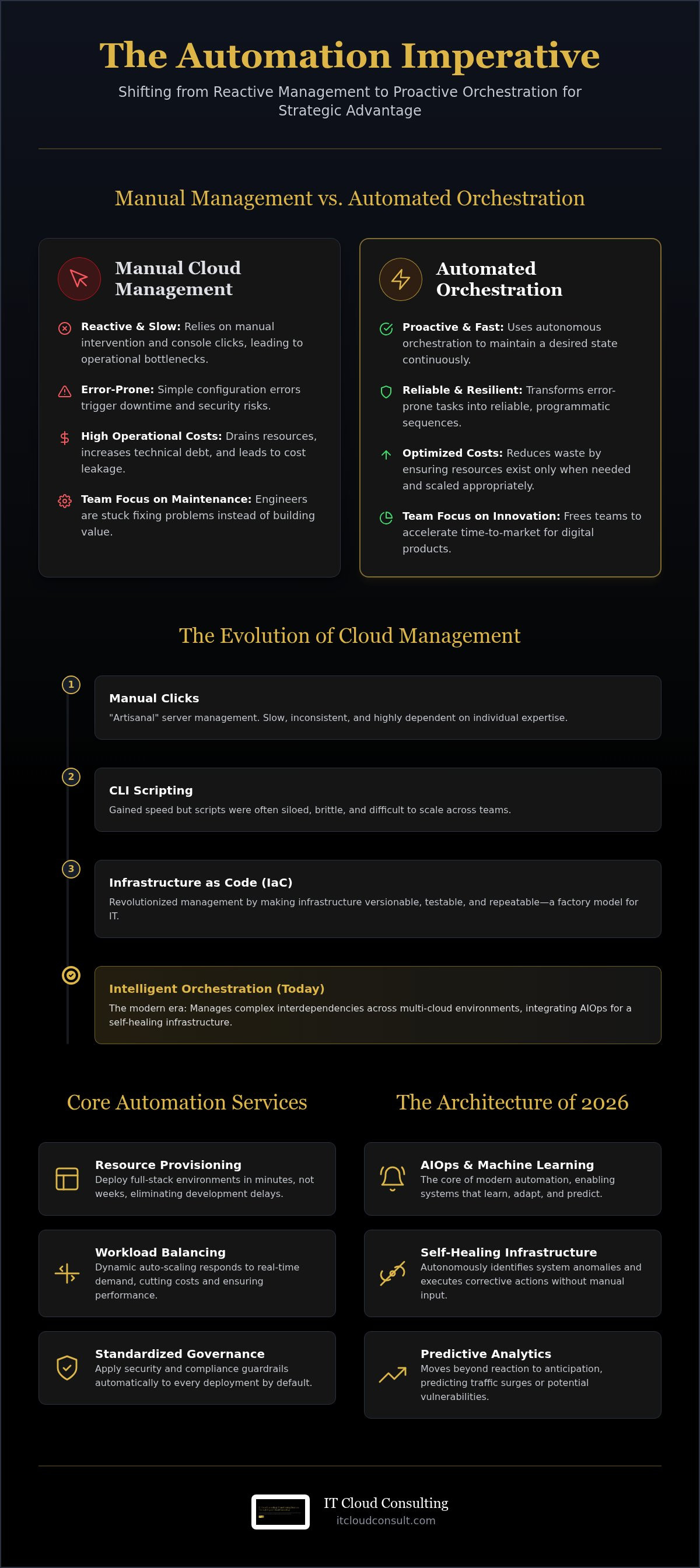
Cloud automation services represent the sophisticated application of technology to execute recurring tasks and complex workflows with minimal human intervention. At its core, this discipline transforms manual, error-prone processes into reliable, programmatic sequences. While traditional cloud management often relies on reactive monitoring and manual intervention, true automation is inherently proactive. It doesn't just watch for problems; it defines the desired state of the environment and uses automated orchestration to maintain that state continuously. This shift is essential for organizations that have outgrown the capacity of human operators to manage the sheer volume of modern microservices and distributed data.
By 2026, the definition of success has moved beyond simple "scripted" automation. In previous years, engineers wrote static scripts to handle specific triggers. Today, intelligent orchestration uses real-time data to make autonomous decisions about the entire lifecycle of a resource. This lifecycle spans from initial provisioning and configuration to the eventual decommissioning of assets that are no longer providing value. Effective cloud automation services ensure that every resource exists only as long as it's needed, optimized for the specific workload it supports, and retired securely to prevent cost leakage.
The Evolution of Cloud Management
The journey toward modernization began with a move away from manual console clicks. Early administrators relied on Command Line Interface (CLI) scripting to gain speed, but these scripts were often siloed and difficult to scale. The rise of Infrastructure as Code (IaC) revolutionized this process by allowing teams to treat hardware definitions exactly like software code. This transition is a critical prerequisite for strategic cloud adoption across the enterprise. When infrastructure is codified, it becomes versionable, testable, and repeatable. It allows your organization to move from "artisanal" server management to a standardized factory model where speed and security are built into the foundation.
Key Components of Service Automation
To realize the full potential of an automated environment, several core components must work in unison. These elements bridge the gap between technical execution and business outcomes:
- Resource Provisioning: The ability to deploy full-stack environments in minutes rather than weeks, ensuring that developers have the tools they need without delay.
- Workload Balancing: Dynamic auto-scaling that responds to real-time demand, preventing performance degradation during peak hours while reducing costs during quiet periods.
- Standardized Governance: Automated security patching and compliance monitoring that apply "guardrails" across all accounts, ensuring that every deployment meets NIST or ISO standards by default.
This systematic approach eliminates the "expertise gap" that often stalls growth. By codifying best practices into the automation layer, your enterprise gains the agility to pivot quickly without sacrificing the stability of your core systems.
The Architecture of 2026 Cloud Automation: Beyond Scripting
Modern enterprise architecture has evolved past the era of static scripts and siloed workflows. In 2026, the focus has shifted toward intelligent orchestration that manages complex interdependencies across multi-cloud environments. While basic automation handles repetitive tasks, orchestration coordinates these tasks into a cohesive, goal-oriented process. This advanced approach is essential for maintaining a resilient IT modernization strategy, as it ensures that disparate systems work in harmony rather than in isolation. By integrating AI and Machine Learning directly into the management layer, organizations can now achieve a self-healing infrastructure. These systems don't just alert a human to a failure; they identify anomalies in real time and execute corrective actions without any manual input.
The transition to these sophisticated cloud automation services is driven by the need for unprecedented scale and precision. When your infrastructure can predict a surge in traffic or a potential security vulnerability, it moves from being a cost center to a strategic asset. Citing the ROI of cloud automation becomes straightforward when downtime is virtually eliminated through proactive remediation. If you're looking to refine your current roadmap, our experts in strategic cloud optimization can help align these technical capabilities with your broader business objectives.
Infrastructure as Code (IaC) and GitOps
Treating infrastructure with the same rigor as application code is the hallmark of a mature DevOps culture. Infrastructure as Code (IaC) allows teams to define their entire environment through configuration files, which are then managed via version control systems. This practice effectively prevents configuration drift, ensuring that the production environment remains identical to the tested staging area. GitOps further streamlines this by using Git repositories as the single source of truth for infrastructure state. When a change is pushed to the repository, the deployment pipeline automatically synchronizes the cloud environment, providing a transparent audit trail and a rapid path to recovery if issues arise.
AIOps: The Intelligent Edge
The integration of AIOps brings predictive analytics to the forefront of cloud management. Instead of reacting to breaches or outages, these systems analyze historical data to anticipate resource needs before they impact performance. Automated incident response now includes deep root cause analysis, which significantly reduces the time spent on troubleshooting. Autonomous Cloud is the ultimate state of IT maturity where the infrastructure manages its own performance, security, and cost-efficiency through continuous self-optimization.
Manual Management vs. Automated Orchestration: The ROI Case
Leaders frequently miscalculate the true cost of manual cloud management. They often view it as a stable operational expense, but it's actually a compounding source of technical debt. When your engineering talent spends hours on manual configuration, they aren't just moving slowly; they're experiencing burnout. High turnover in IT departments is often a direct result of these repetitive, low-value tasks that stifle professional growth. By shifting to cloud automation services, you convert these manual bottlenecks into programmatic assets that appreciate in value over time. You stop paying for the same task twice and start investing in a system that performs it perfectly every time.
Quantifying the return on investment starts with a comparison of deployment speeds. A manual provisioning process might take days or weeks of ticket exchanges and approvals across different departments. Automated "push-button" deployments reduce this cycle to mere minutes. This acceleration is a primary driver for achieving long-term cloud optimization. It allows your business to respond to market shifts or customer demands before your competitors can even clear their manual backlog. Speed isn't just a technical metric; it's a competitive necessity.
Eliminating Human Error and Security Risks
Standardized templates serve as your most effective defense against data breaches. Most security incidents in the cloud stem from misconfigured storage buckets or open ports left behind during a manual setup. Automation ensures that every environment is compliant by design from the moment it's created. For regulated industries, automated compliance audits for HIPAA or GDPR are no longer a luxury. They're a necessity for maintaining trust. This consistency ensures that what worked in development will work identically in production, removing the friction that usually occurs during the final stages of a release.
Operational Efficiency and Scalability
The most compelling part of the ROI case is the ability to decouple business growth from IT headcount growth. You shouldn't have to hire a new engineer every time you add a dozen new customers or launch a new service. Self-service infrastructure portals empower your developers to provision their own resources within predefined boundaries. This scalability is vital for managing the complex hybrid cloud architectures that define 2026. It enhances overall cloud operational efficiency by letting your most expensive talent focus on building products, not maintaining the plumbing of your servers.
Implementing a Cloud Automation Strategy: A Leadership Roadmap
Transitioning from manual management to a fully orchestrated environment requires a deliberate, multi-phased approach. It isn't enough to simply deploy tools; leadership must align technical capabilities with organizational goals to ensure long-term viability. The first step involves conducting a thorough cloud readiness and automation assessment. This audit identifies specific bottlenecks where manual intervention currently delays delivery or increases risk. Once these gaps are visible, you can prioritize "low-hanging fruit"—high-impact, low-complexity tasks like automated resource tagging or environment scheduling—to demonstrate immediate value and build momentum.
Success at scale depends on the establishment of a Cloud Center of Excellence (CCoE). This cross-functional team governs automation standards, ensuring that every script and workflow aligns with enterprise security and cost objectives. As your environment evolves, continuous monitoring and iterative improvement of automated workflows become the standard operating procedure. Because the landscape changes so rapidly, selecting the right cloud consulting company is critical for maintaining strategic alignment and staying ahead of emerging trends. If you're ready to define your path forward, our team provides the strategic cloud advisory necessary to turn this vision into a functional reality.
Toolchain Selection and Governance
Choosing the right technology stack is a balancing act between cloud-native tools and third-party orchestration platforms. While native tools offer deep integration, provider-agnostic frameworks help you avoid vendor lock-in, which is essential for 2026's multi-cloud reality. Governance must be baked into the selection process. You need to define clear security guardrails that prevent automated processes from creating unintended vulnerabilities. These guardrails act as invisible fences, allowing for rapid innovation within safe, pre-approved parameters.
Cultural Transformation: The Human Element
Scaling Success with IT Cloud Consulting
The transition from a manual infrastructure to a fully orchestrated engine is a complex evolution that requires more than just technical proficiency. Many organizations possess the vision for a self-healing environment but struggle to bridge the gap between high-level strategy and technical execution. IT Cloud Consulting acts as both a visionary architect and a dependable guide, providing the specialized expertise needed to implement comprehensive cloud automation services. We don't just deliver tools; we facilitate a holistic enterprise cloud transformation that aligns your infrastructure with your long-term business trajectory.
Our methodology focuses on identifying and realizing the latent potential within your existing systems. By standardizing processes and codifying best practices, we ensure that your modernization efforts result in measurable operational efficiency and a stronger bottom line. This systematic approach allows your leadership team to focus on high-level innovation while we manage the intricate complexities of orchestration and governance. We believe that technology should serve as a catalyst for growth, not a source of friction.
Strategic Automation Advisory
Success begins with a clear, objective understanding of your current operational state. We conduct customized assessments of your cloud maturity to identify specific areas where automation can drive the most significant ROI. From there, we develop a phased roadmap that integrates seamlessly into your broader digital transformation strategy. This isn't a one-size-fits-all solution; it's a tailored plan that considers your specific industry regulations and performance requirements. We help you select the right toolsets that offer flexibility and prevent vendor lock-in, ensuring your architecture remains adaptable for years to come.
Managed Implementation and Support
Execution is where strategy meets reality, and our team provides the technical proficiency required for flawless deployment. We implement robust Infrastructure as Code (IaC) frameworks, CI/CD pipelines, and advanced AIOps to create a resilient, autonomous environment. Beyond the initial setup, our managed cloud services provide the ongoing support required to keep these systems optimized. We monitor performance and cost-efficiency continuously, adjusting your cloud automation services as your business needs evolve. This commitment to long-term development ensures that your infrastructure remains a scalable, self-healing engine for growth. We invite you to evolve your infrastructure and realize your organization's full potential with the steady assurance of IT Cloud Consulting as your strategic partner.
Architecting Your Autonomous Infrastructure
The transition to intelligent orchestration represents a fundamental shift that moves your IT department from a reactive support function to a proactive growth driver. By replacing fragmented manual processes with cohesive cloud automation services, your organization gains the agility to scale without the burden of technical debt or configuration drift. You've seen how a structured roadmap and the integration of AIOps can transform complex systems into self-healing assets that deliver consistent results. True orchestration isn't just a technical upgrade; it's a strategic mandate for 2026.
Realizing this potential requires a partner with a deep understanding of both high-level strategy and technical execution. As Strategic Cloud Adoption Specialists, we provide National US Cloud Advisory Expertise with an unwavering focus on operational excellence and ROI. It's time to move beyond simple task repetition and embrace a future of autonomous efficiency. Modernize your infrastructure with IT Cloud Consulting and unlock the full potential of your digital landscape. We're ready to guide your evolution toward a more optimized and resilient future.
Frequently Asked Questions
What is the difference between cloud automation and cloud orchestration?
Automation focuses on making a single, repetitive task repeatable without human intervention, such as provisioning a virtual machine or running a backup. Orchestration coordinates these individual automated tasks into a cohesive, end-to-end workflow across multiple systems and environments. While automation handles the execution of a specific step, orchestration manages the logic, timing, and integration of the entire process.
How do cloud automation services help reduce IT costs in 2026?
These services reduce operational overhead by eliminating the manual labor required for routine maintenance and resource provisioning. Cloud automation services also prevent costly over-provisioning through dynamic scaling that adjusts to real-time demand, ensuring you only pay for the resources you actually use. By reducing human configuration errors, organizations avoid the significant financial impact of unplanned downtime and emergency remediation.
Is cloud automation secure for highly regulated industries?
Automation actually enhances security in regulated sectors by enforcing standardized configuration guardrails that human operators might overlook. It provides a transparent, immutable audit trail for every change made to the environment, which is essential for HIPAA or GDPR compliance. Standardized templates ensure that security patches and access controls are applied consistently across every account by default, reducing the attack surface.
What are the most common tools used for enterprise cloud automation?
Enterprises typically utilize a mix of provider-specific and agnostic tools to maintain flexibility and avoid vendor lock-in. Standard choices include Terraform for infrastructure provisioning and Kubernetes for container orchestration. For configuration management, Ansible remains a staple, while cloud-native services like AWS CloudFormation or Azure Resource Manager are used for deep integration within specific cloud environments.
How long does it typically take to see ROI from cloud automation services?
Most organizations realize immediate efficiency gains by automating high-impact, low-complexity tasks like environment scheduling or resource tagging. A comprehensive return on investment for large-scale enterprise orchestration typically materializes within six to twelve months. This timeline accounts for the initial cultural transition and the time required to retire legacy manual processes that previously drained engineering resources.
Can we automate a hybrid cloud environment with legacy systems?
Modern orchestration frameworks are designed to bridge the gap between legacy on-premise systems and the public cloud. You can use specialized agents and API-driven middleware to bring legacy infrastructure under the same automation umbrella as your cloud-native assets. This unified approach ensures that your hybrid environment operates as a single, cohesive system rather than a collection of disconnected and inefficient silos.
What role does AI play in cloud automation today?
AI has moved from a monitoring tool to an active participant in infrastructure management through AIOps. It uses predictive analytics to anticipate resource needs and identifies security threats before they escalate into breaches. In 2026, AI enables the self-healing capabilities that allow systems to autonomously resolve performance bottlenecks or configuration drift without requiring an engineer's direct attention.


