
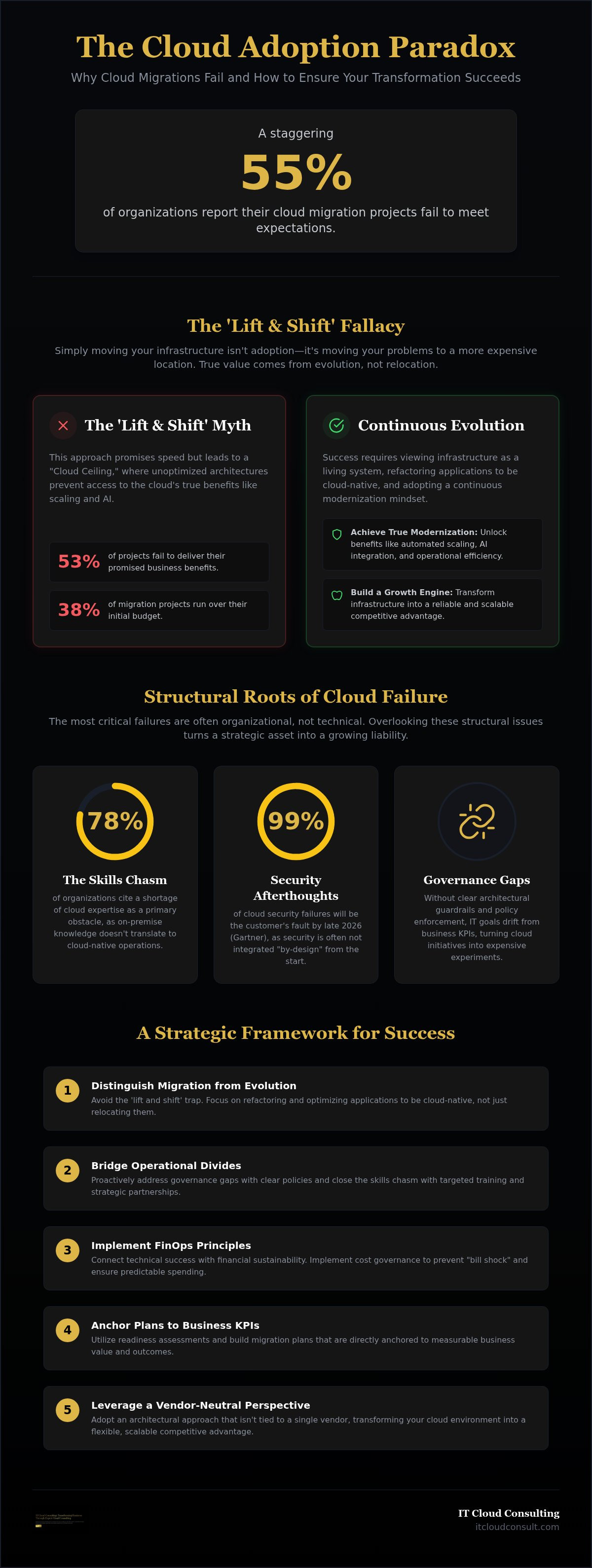
Did you know that 55% of organizations report their cloud migration projects fail to meet expectations? While the promise of modernization is compelling, the reality for many leaders in 2026 is a cycle of uncontrolled spending and mounting technical debt. This high rate of cloud adoption failure often stems from treating the cloud as a mere destination rather than a fundamental shift in your operating model. You’ve likely felt the sting of sticker shock after recent price hikes from providers like Google Cloud and Hetzner, or faced resistance from teams clinging to legacy workflows.
It's natural to feel concerned when technical processes don't immediately translate into organizational benefits. This guide provides a clear understanding of common failure modes and offers a professional framework to align your technical migration with actual business value. We'll explore how to evolve your strategy to ensure long-term success, improve operational efficiency, and finally bring your cloud costs under control. By shifting from a simple migration mindset to a model of continuous evolution, you can transform your infrastructure into a reliable engine for growth.
Key Takeaways
- Distinguish between simple data migration and true organizational evolution to avoid the performance and cost pitfalls of the 'lift and shift' approach.
- Identify how governance gaps and internal skills shortages contribute to cloud adoption failure, and learn the strategies to bridge these operational divides.
- Connect technical success with financial sustainability by implementing FinOps principles that prevent the common phenomenon of cloud bill shock.
- Master a two-step strategic framework that utilizes readiness assessments and KPI-anchored migration plans to align infrastructure with business value.
- Leverage a vendor-neutral, architectural perspective to transform your cloud environment from a complex risk into a scalable competitive advantage.
Debunking the 'Lift and Shift' Myth: Why Simple Migration Isn't Adoption
Many organizations treat the cloud as a digital warehouse, a place to park existing servers and forget them. This fundamental misunderstanding is a primary driver of cloud adoption failure in 2026. While migration is a technical event, adoption is an operational evolution. If you simply replicate your on-premise infrastructure in a virtual environment, you haven't modernized; you've just moved your existing inefficiencies to a more expensive location. The cloud isn't a place. It's a way of working.
The 'Lift and Shift' approach promises speed, but it often leads to a 'Cloud Ceiling.' This is the point where legacy mindsets and unoptimized architectures prevent you from accessing the true benefits of the cloud, such as automated scaling or high-level AI integration. When you don't refactor applications to be cloud-native, you're essentially paying a premium to run old software on modern hardware. In the current market, where 53% of organizations report that projects fail to deliver promised benefits, the distinction between moving and evolving is the difference between growth and stagnation.
The Destination vs. Evolution Fallacy
Treating the cloud as a one-time project with a clear finish line is the fastest way to hit a technical dead end. Success requires a continuous modernization mindset that views infrastructure as a living system. Without this perspective, organizations fail to implement essential cloud management principles that govern performance and security. This fallacy leads to stagnant ROI because the organization remains tethered to rigid, legacy workflows that can't handle the speed of a cloud-native ecosystem. For enterprise survival in 2026, you must stop looking for a destination and start building for evolution.
Hidden Costs of the 'Quick Move'
Rushed migrations frequently result in 'cloud-washing,' where legacy applications are moved without any architectural changes. This creates a trap of unoptimized resource allocation. Research indicates that 38% of cloud migration projects exceed their budget, often because the hidden costs of operational friction and technical debt weren't factored into the initial plan. While the 'quick move' might satisfy a quarterly deadline, it often leads to long-term cloud adoption failure as the business struggles with mounting costs and decreasing performance. True efficiency comes from refactoring and optimization, not just speed. You can't outrun a bad strategy with a fast migration.
Ultimately, failure in 2026 is defined by more than just downtime. It's the inability to leverage the cloud's potential for innovation and cost-efficiency. By recognizing that migration is only the first step of a much larger journey, you can begin to dismantle the myths that hold your organization back.
The Structural Roots of Cloud Adoption Failure: Beyond the Technology
While technical glitches grab headlines, the primary cause of cloud adoption failure is often structural rather than digital. Organizations frequently overlook the necessity of architectural guardrails and policy enforcement, leading to a fragmented environment where IT goals drift away from business KPIs. Without executive alignment, cloud initiatives become expensive experiments rather than strategic investments. By focusing on the cause and effect between technical governance and organizational health, leaders can prevent the post-migration slump that characterizes so many failed initiatives.
The "Skills Chasm" remains a significant hurdle. In 2026, 78% of organizations cite a shortage of expertise as a main issue in cloud migration. Your internal team's current knowledge of on-premise hardware doesn't naturally translate to cloud-native operations like auto-scaling or serverless architecture. Security often becomes an afterthought in this environment. Instead of "security-by-design," companies build "outside-in," leaving vulnerabilities that Gartner predicts will cause 99% of cloud security failures to be the customer's fault by late 2026. This technical debt accumulates quickly, turning a supposed asset into a liability.
The Human Element and Change Management
Overcoming organizational inertia is harder than deploying code. Resistance to new workflows can stall even the most advanced migrations, particularly when teams feel their existing roles are threatened. While upskilling is vital, many businesses find that partnering for ongoing cloud support provides the immediate expertise needed to bridge the gap. Cloud Culture is a shared organizational mindset that prioritizes agility, continuous learning, and data-driven decision-making to fuel technical success.
Governance and Compliance Deficits
Lack of centralized control leads to "Shadow IT," where departments spin up unmanaged resources, creating massive security holes and redundant costs. These federal cloud adoption challenges highlighted by the GAO demonstrate how outdated rules and conflicting guidance hinder progress even at the highest levels. To avoid these pitfalls, conducting a comprehensive cloud readiness assessment is essential. This process identifies gaps before they become crises, allowing you to establish guardrails that protect the business without stifling developer innovation. Effective governance provides a safe path for exploration, ensuring that when developers push boundaries, they do so within a secure, compliant framework.
Performance vs. Profit: When Technical Success Leads to Financial Failure
Technical success often masks fiscal instability. An engineering team might celebrate a seamless migration while the finance department reels from "Cloud Bill Shock." This phenomenon occurs when organizations fail to bridge the gap between technical deployment and financial governance. In 2026, cloud bills frequently exceed forecasts by 30% to 40%, a trend exacerbated by significant price adjustments from major providers. For instance, Google Cloud increased North American CDN Interconnect rates to $0.08 per GiB in May 2026, while Hetzner raised cloud server prices by up to 37% in certain regions. Without a proactive strategy, these rising costs turn a modernization effort into a cloud adoption failure.
The absence of FinOps, the practice of bringing financial accountability to the variable spend model of the cloud, creates a dangerous disconnect. Engineers prioritize performance and uptime, often leading to over-provisioning and underutilization. If you're paying for peak capacity 24/7 but only using it during business hours, you're subsidizing the provider's profit at the expense of your own. Engaging in cloud optimization consulting is no longer optional; it's a requirement for organizations that want to realize the latent potential of their digital investments. You must treat cost as a primary architectural pillar to ensure long-term sustainability.
The Cost of Invisibility
Granular tagging and real-time monitoring are the only defenses against budget overruns. When resources are deployed without clear ownership or purpose, they become "zombie" assets that drain capital without providing value. The challenges in cloud adoption often stem from this lack of transparency, where businesses struggle to integrate existing applications into a cohesive financial framework. Continuous monitoring ensures financial health by identifying these leaks early. While some hesitate at the cost of managed support, these fees often reduce the total cost of ownership (TCO) by preventing expensive misconfigurations and waste.
Scaling Without Strategy
Automated waste is a silent killer in cloud-native environments. Features like auto-scaling are powerful, but without strict parameters, they can trigger massive spending during minor traffic spikes or code loops. Aligning cloud consumption with actual business demand cycles requires a methodical approach to infrastructure. Strategic resource optimization ensures that technical capacity mirrors business demand, directly translating infrastructure efficiency into organizational agility. By moving away from a "set and forget" mentality, you avoid the trap of cloud adoption failure and ensure your transformation delivers on its promise of measurable value.
A Strategic Framework for Preventing and Reversing Cloud Stagnation
Recovery from stagnation isn't accidental; it's engineered. To reverse cloud adoption failure, you must transition from reactive troubleshooting to a professional framework that connects technical processes to organizational benefits. This shift requires a methodical approach that addresses both immediate bottlenecks and the long-term strategic vision. By following a structured five-step recovery plan, you can transform a stalled migration into a scalable engine for growth.
Step one involves a comprehensive cloud readiness assessment to uncover the root causes of current inefficiencies. This leads directly to step two: defining a business cloud migration plan anchored in measurable KPIs. Step three establishes a robust governance and security framework to act as digital guardrails, while step four introduces a continuous optimization loop through FinOps. Finally, step five leverages professional advisory to bridge internal skill gaps, ensuring your team isn't left to manage complex transitions alone. Without this framework, the risk of cloud adoption failure remains a constant threat to your digital transformation journey.
Auditing Your Current Environment
Stagnation often hides in "zombie" resources, such as orphaned instances and unattached storage that drain capital without providing utility. Auditing your environment allows you to identify these architectural bottlenecks and re-align technical debt with your strategic cloud adoption objectives. If your current trajectory is missing targets, a professional cloud migration strategy offers the framework needed to course-correct mid-stream without disrupting core operations. This process transforms a cluttered, reactive environment into a streamlined asset that supports business agility.
Building for 2026 and Beyond
As we move through 2026, the demand for AI-heavy infrastructure and multi-cloud flexibility is accelerating significantly. Modern organizations must shift from reactive maintenance to proactive managed support to handle the complexities of custom silicon and distributed cloud models. Automated governance is the key to ensuring long-term scalability, allowing your team to focus on innovation rather than manual compliance checks. By building with a "security-by-design" philosophy, you ensure that your organization is prepared for future regulatory shifts and technological breakthroughs. To secure your organization's trajectory, consider partnering for professional strategic cloud adoption to turn these complexities into a distinct market advantage.
Partnering for Success: How IT Cloud Consulting Secures Your Transformation
IT Cloud Consulting acts as the visionary architect your organization needs to navigate the complexities of modern infrastructure. Many businesses fall into the trap of cloud adoption failure because they rely solely on vendor-specific advice that prioritizes consumption over strategy. We provide an objective, vendor-neutral perspective that focuses on your specific business outcomes. By aligning technical execution with executive vision, we transform the cloud from a source of operational risk into a distinct competitive advantage. Our goal is to move your organization out of "survival mode," where you're constantly fighting fires, and into "innovation mode," where your infrastructure actively supports growth.
Recovery requires more than just tools. It demands a partnership rooted in steady assurance and professional expertise. We don't just offer services; we offer a path toward realizing your organization's latent potential. This transition from a current state of stagnation to a more optimized future state is the core of our mission.
Strategic Advisory and Roadmap Development
Our approach begins with a tailored enterprise cloud transformation roadmap. We don't chase technical trends for the sake of novelty. Instead, we prioritize customized solutions that deliver measurable results. This strategic planning bridges the gap between high-level vision and the granular reality of technical execution. While some leaders hesitate to invest in professional advisory, the cost of cloud adoption failure is far higher. When you consider that 31% of migration projects miss their planned timelines, the value of a dependable guide who prevents these delays becomes clear. Professional consulting isn't just an expense; it's an insurance policy against the systemic inefficiencies that derail digital evolution.
Ongoing Managed Support and Optimization
Success doesn't end with a successful migration. The "post-migration slump" is a real threat where environments become neglected, insecure, and bloated with unnecessary costs. We provide ongoing cloud support to ensure your infrastructure remains operational and secure in a landscape where misconfigurations cause 48% of outages. Through continuous cloud optimization, we help you manage the price increases seen in 2026 from providers like OVHcloud and Hetzner. This steady assurance allows your internal teams to focus on their core competencies while we handle the complexities of governance and performance monitoring. You don't have to navigate this transition alone.
Secure your cloud future with a professional consultation from IT Cloud Consulting and take the first step toward a more optimized, advanced future state.
Securing Your Organization's Digital Evolution
The path to a resilient cloud environment requires moving beyond the technical act of migration toward a model of continuous evolution. Successful organizations in 2026 recognize that cloud adoption failure isn't a symptom of poor technology; it's a result of misaligned strategy. By implementing a professional framework that prioritizes governance and cost-efficiency, you can transform your infrastructure into a powerful engine for innovation. You have the potential to turn technical debt into a scalable asset that supports long-term growth.
Bridging the gap between current operational challenges and future potential requires more than just internal effort. It demands a visionary approach to architecture and a commitment to operational excellence. IT Cloud Consulting provides the authoritative strategic roadmap development and performance tuning required to navigate these complexities. As a trusted partner in national advisory for enterprise modernization, we ensure your technical processes directly translate into measurable organizational benefits. We help you realize the latent potential of your digital investments through steady assurance and expert execution.
Optimize your cloud strategy with IT Cloud Consulting to unlock the full potential of your digital transformation. Your journey toward a more advanced and optimized future state begins with a single, strategic step.
Frequently Asked Questions
What are the primary signs that my cloud adoption is failing?
Primary indicators include stagnant ROI, uncontrolled spending, and persistent technical debt that prevents agility. If your organization faces "Cloud Bill Shock" or if teams are bypassing official workflows to use legacy systems, you're likely experiencing a cloud adoption failure. Another red flag is a lack of measurable improvement in deployment speed despite moving to modern infrastructure.
How can I reduce my cloud bill without sacrificing system performance?
Implement FinOps practices such as right-sizing instances and utilizing automated scaling to match actual demand cycles. Continuous monitoring allows you to identify underutilized "zombie" resources that drain capital without adding value. By shifting from a "set and forget" mentality to an active optimization model, you ensure every dollar spent supports system performance and organizational goals.
Is it possible to reverse a failed cloud migration without starting over?
Yes, you can course-correct by refactoring specific workloads rather than attempting a full rollback. This involves conducting a professional audit to identify architectural bottlenecks and applying cloud-native principles to your existing environment. By evolving your current state through targeted optimization and roadmap development, you can salvage your investment and achieve your original modernization goals.
Why do internal IT teams often struggle with cloud-native adoption?
Internal teams often lack the specific expertise required for serverless architectures and automated governance. Traditional IT skills don't naturally translate to the variable, software-defined nature of the cloud environment. This "Skills Chasm" leads to misconfigurations and operational friction. Providing your team with managed support or strategic advisory helps bridge this gap, allowing them to focus on business value.
How much should an enterprise spend on cloud consulting services?
Investment in consulting should be viewed as a strategic percentage of your total cloud spend or project value. While specific rates vary based on organizational complexity, the cost of professional guidance is almost always lower than the financial impact of a cloud adoption failure. You should look for a partner that provides a clear link between their advisory fees and resulting operational savings.
What is the difference between a cloud migration and a strategic cloud transformation?
Migration is the technical act of moving data and applications to the cloud, while strategic transformation is the evolution of your entire operating model. Migration focuses on the "where," but transformation focuses on the "how." A successful transformation ensures that your technical processes are deeply integrated with business KPIs, preventing the common pitfalls that lead to systemic failure.
How does a cloud readiness assessment prevent future project failures?
A readiness assessment identifies technical, financial, and cultural gaps before they become project-ending crises. It provides a baseline for your current state and a clear roadmap for your modernization journey. By evaluating your infrastructure and team expertise early, you establish the guardrails necessary to prevent costly misconfigurations and ensure that your migration stays on schedule and within budget.
What role does security play in the success of cloud adoption?
Security must be a foundational pillar rather than an afterthought. Successful adoption utilizes a "security-by-design" philosophy where guardrails are baked into the architecture from day one. This proactive approach prevents the breaches and compliance failures that often stem from customer misconfigurations. Integrating security into your core strategy ensures that innovation doesn't come at the expense of your organization's safety.


