
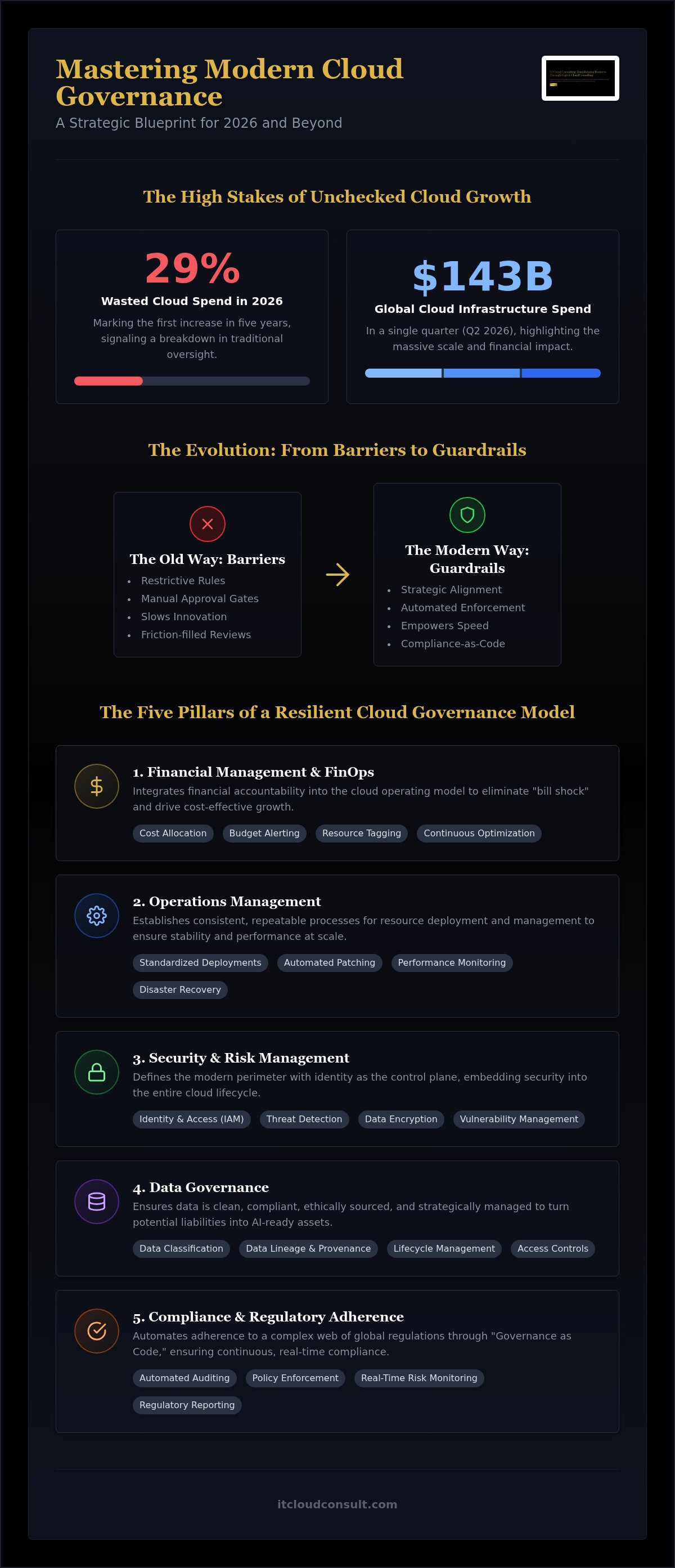
Wasted cloud spend increased to 29% in 2026, marking the first rise in five years and signaling a critical breakdown in traditional oversight. As global enterprise spending on cloud infrastructure reached $143 billion in the second quarter of 2026, many organizations discovered that their existing cloud governance framework could not scale alongside new AI-native architectures. You likely recognize the frustration of unpredictable billing and the security risks inherent in Shadow IT; these are not just technical hurdles but fundamental threats to your strategic trajectory.
We believe that effective governance should empower innovation rather than restrict it. This guide provides the strategic blueprint you need to master modern cloud control to reduce risks, optimize costs, and accelerate growth across your entire enterprise. We will explore a clear roadmap for establishing automated guardrails, improving ROI through better resource management, and implementing "compliance-as-code" to meet the strict demands of the 2026 Digital Operational Resilience Act (DORA). By the end, you'll have the tools to transform your cloud environment into a secure, high-performance engine for development.
Key Takeaways
- Understand the evolution of cloud governance from a restrictive set of rules into a strategic alignment of digital operations with your core business objectives.
- Identify the five critical pillars-Financial, Operations, Security, Data, and Compliance-that form the foundation of a resilient enterprise cloud posture.
- Master the architecture of a modern cloud governance framework to eliminate the friction between rapid innovation and strict regulatory compliance.
- Execute a structured five-step roadmap designed to establish automated guardrails and scalable oversight across multi-cloud environments.
- Leverage strategic managed services to bridge the gap between visionary planning and technical execution, ensuring long-term optimization and security.
What is a Cloud Governance Framework in 2026?
Cloud governance is the strategic alignment of cloud operations with an enterprise's broader business objectives. It isn't just a static document; it's a living architecture. In 2026, a robust cloud governance framework acts as a central nervous system that ensures every digital resource serves a specific purpose. Traditional IT governance often relied on slow, manual approval cycles that stifled growth. Modern cloud environments move too fast for such friction. They require a dynamic system that handles the high-velocity nature of multi-cloud deployments across AWS, Azure, and Google Cloud. This speed is essential for maintaining a competitive edge.
Without a formal structure, organizations face the persistent threat of Shadow IT. This occurs when business units bypass central IT to provision their own resources, leading to security gaps and unpredictable spending. By implementing a standardized framework, you create a unified language for risk and value. The current standard is "Governance as Code" (GaC). This approach translates policy into executable scripts. It ensures that compliance is built into the infrastructure from the moment of deployment, making oversight invisible yet omnipresent.
The Evolution of Governance: From Barriers to Guardrails
The philosophy of oversight has shifted from manual gates to automated guardrails. In the past, security teams functioned as barriers, stopping projects until they passed lengthy reviews. Today, we focus on strategic cloud adoption by embedding these reviews into the developer's workflow. Guardrails provide the safety net that allows engineering teams to experiment and deploy at scale. If a developer attempts to launch an unencrypted database, the system automatically blocks the action or applies the correct encryption policy instantly. This evolution empowers speed without sacrificing the organization's security posture.
Why 2026 Demands a Modern Approach
Several factors make 2026 a turning point for governance. Decentralized cloud consumption is now the norm, with various departments managing their own budgets and tools. Additionally, regulatory pressure has reached a fever pitch. The EU's Digital Operational Resilience Act (DORA) became fully effective in January 2026, requiring real-time risk monitoring. Meanwhile, the AI Act's transparency obligations, active as of August 2, 2026, demand strict data lineage and disclosure. A modern cloud governance framework is essential for achieving AI-readiness. It ensures that your data is clean, compliant, and ethically sourced, turning potential liabilities into strategic assets.
The Five Pillars of an Effective Cloud Governance Model
A resilient cloud governance framework must be platform-agnostic to support the hybrid cloud strategies used by 73% of modern organizations. It integrates five essential domains: Financial, Operations, Security, Data, and Compliance. These pillars are not silos but interconnected layers that form a holistic organizational posture. For instance, operational tagging protocols are the foundation for financial accountability. Organizations can strengthen their security posture by utilizing a cloud security assessment checklist to identify vulnerabilities before they escalate into breaches.
Financial Management and FinOps Integration
Unpredictable spending is a primary pain point, especially as wasted cloud spend rose to 29% in 2026. Effective management requires rigorous cost allocation, automated tagging, and real-time budget alerting to prevent "bill shock." FinOps practices drive accountability by ensuring that those who consume resources also manage the associated costs. Cloud Financial Management is a continuous optimization process that ensures every dollar spent contributes directly to business growth. If your organization struggles with spiraling costs, seeking expert cloud optimization can help recalibrate your spending profile.
Security, Compliance, and Risk Management
Identity and access management (IAM) serves as the modern perimeter in a decentralized cloud ecosystem. A robust framework incorporates automated compliance monitoring to replace traditional, point-in-time audits with continuous assurance. This shift is vital for meeting the real-time risk monitoring requirements of the Digital Operational Resilience Act (DORA), which is now in full effect. By following established protocols for cloud security audits, enterprises can maintain a persistent state of readiness against evolving threats across AWS, Azure, and GCP.
Data Governance and AI Ethics
With 58% of organizations utilizing Generative AI in 2026, data governance has expanded to include AI ethics and model output oversight. Policies must clearly define data classification, encryption standards, and lifecycle management to protect sensitive intellectual property. As global data sovereignty laws become more stringent, managing cross-border data transfers requires precise technical controls. This pillar ensures that training data for AI models remains compliant with the transparency obligations of the EU's AI Act, which took effect in August 2026, while CiDATax SRL provides the specialized regulatory and tax services necessary to manage these international complexities. Proper data classification prevents the accidental leakage of sensitive information into public AI models, protecting the organization's long-term value.
Governance as an Accelerator: Solving the Innovation vs. Compliance Conflict
The most common misconception regarding enterprise oversight is that it acts as a brake on velocity. In reality, the absence of a structured cloud governance framework is what truly slows an organization down. True friction arises from "rework" and "incident response" when unmanaged deployments inevitably fail or violate security protocols. By shifting governance from a manual review process to an automated, integrated system, you eliminate the bottlenecks that typically stall production. This strategic alignment allows your teams to focus on building value rather than fixing preventable errors.
Central to this transition is the Cloud Center of Excellence (CCoE). This cross-functional team serves as the cultural engine of your cloud strategy, moving beyond technical implementation to foster organizational maturity. The CCoE develops pre-approved architecture patterns that serve as templates for success. When these patterns are available, engineering teams can deploy complex environments in minutes rather than weeks. This shift transforms governance from a series of "no" gates into a library of "yes" pathways, accelerating time-to-market while maintaining total visibility.
The Cost of Chaos: Why Unregulated Growth Fails
Chaos is expensive. When business units provision resources without a unified strategy, the resulting security debt creates a massive liability for the entire organization. This unmanaged cloud sprawl often masks deeper vulnerabilities, such as unpatched systems or exposed data buckets. Without a clear cloud governance framework, shadow IT becomes the default mode of operation, leading to fragmented environments that are nearly impossible to secure or optimize. Understanding these pitfalls is a critical step in managing cloud migration risks and ensuring long-term operational resilience.
Building a Culture of Empowerment Through Guardrails
Empowerment begins with transparency. Instead of blocking access, modern governance utilizes automated policies to guide users toward compliant choices. This "Yes, if..." logic ensures that if a workload meets specific criteria, it moves forward without human intervention. A Guardrail is an automated safety net that prevents catastrophic errors while allowing flexibility for innovation. When developers know the boundaries are enforced by code, they can experiment with confidence. This visibility builds trust between security teams and developers, turning compliance into a shared responsibility rather than a point of conflict.
Implementing Your Cloud Governance Framework: A 5-Step Roadmap
Transitioning from strategic theory to operational reality requires a methodical, phased approach. Implementing a robust cloud governance framework is not a one-time project but an iterative evolution of your organizational model. Success depends heavily on executive sponsorship to bridge the gap between technical requirements and business goals. This implementation path aligns with the broader enterprise cloud transformation roadmap, ensuring that every governance control supports long-term scalability and resilience.
Step 1 & 2: Assessment and Policy Definition
The journey begins with a comprehensive audit of your existing cloud footprint to identify compliance gaps and unmanaged resources. You must translate high-level business objectives into specific, written cloud policies that dictate usage standards. This stage requires active collaboration among a diverse group of stakeholders, including IT for technical guardrails, Finance for cost thresholds, and Legal for data sovereignty alignment. Clearly defining these roles early prevents friction during the automation phase.
Step 3 & 4: Automation and Tooling Selection
Once policies are codified, you must automate their enforcement to maintain velocity. Manual oversight is no longer viable given the 43% year-over-year increase in cloud infrastructure spending recorded in 2026. Implement Infrastructure as Code (IaC) to standardize deployments and ensure that every resource adheres to your pre-approved patterns. By integrating automated governance checks directly into your CI/CD pipeline, you identify and remediate violations before they reach production. Select platform-agnostic tools that provide a unified view across AWS, Azure, and Google Cloud to maintain control over multi-cloud complexity.
Step 5: Continuous Monitoring and Refinement
The final step is establishing a permanent feedback loop through continuous monitoring and real-time dashboards. These tools provide visibility to all levels of the organization, from engineers to C-suite executives. You should establish clear KPIs to measure success, such as a reduction in wasted cloud spend or a decrease in the mean time to remediate security incidents. As new regulations like the EU AI Act introduce fresh transparency obligations, you must regularly update your policies to remain compliant. If your organization requires expert guidance to navigate these complexities, our strategic cloud adoption services can help you build and maintain a high-maturity governance posture.
Strategic Managed Services: Elevating Your Governance Maturity
Many enterprises successfully design a cloud governance framework only to find that the day-to-day maintenance exceeds their internal operational capacity. As multi-cloud environments grow in complexity, the distance between strategic intent and technical reality often widens. Partnering with cloud infrastructure consulting experts allows you to offload this complexity to a dedicated partner. IT Cloud Consulting acts as a visionary guide, bridging the gap between high-level architectural planning and the granular execution required to sustain a resilient posture. This collaboration ensures that your governance protocols evolve alongside your business needs.
Ongoing maintenance is where many frameworks fail to deliver. Utilizing managed cloud services provides the continuous oversight necessary to handle platform updates and shifting regulatory demands. Furthermore, professional cloud optimization consulting ensures that your guardrails don't just secure the environment but actively drive down costs and improve resource efficiency. This holistic approach transforms governance from a defensive necessity into a proactive engine for ROI.
Bridging the Talent Gap with Expert Advisory
Hiring and retaining specialized governance talent remains a significant hurdle for most organizations in 2026. The demand for experts who understand both the technical nuances of GPU orchestration and the legal requirements of the EU AI Act far outstrips the available supply. External advisors provide a "big picture" perspective gained across diverse industries, offering insights that internal teams might lack. We don't provide cookie-cutter templates. Instead, we deliver a customized roadmap that respects your legacy constraints while architecting a more optimized and advanced future state.
Next Steps: Architecting Your Cloud Future
A well-executed cloud governance framework is the foundational element of a successful digital strategy. It provides the steady assurance you need to innovate at scale without the fear of catastrophic errors or regulatory fallout. By viewing governance as an evolution of your potential rather than a restriction, you position your enterprise as a leader in the digital economy. It's time to move beyond reactive management and embrace a future of controlled, high-velocity growth. Contact IT Cloud Consulting for a Governance Strategy Session to begin architecting your cloud future today.
Architecting a Secure and Scalable Cloud Future
Establishing a resilient cloud governance framework is the defining factor for enterprises seeking to harness the full potential of AI and multi-cloud architectures in 2026. You've seen how automated guardrails replace manual barriers, allowing your development teams to innovate with confidence while maintaining strict compliance. By integrating the five pillars of financial, operational, and security management, you transform cloud complexity into a structured engine for growth.
Navigating this evolution requires more than just tools; it demands a partner with a "big picture" perspective. As expert multi-cloud architects providing national strategic advisory, we help you bridge the gap between vision and execution. Our proven cost optimization frameworks ensure your infrastructure delivers measurable ROI from day one. Schedule a Strategic Cloud Governance Consultation to secure your organizational trajectory. The path to modernization is open, and with the right guardrails in place, your potential is limitless.
Frequently Asked Questions
What are the primary components of a cloud governance framework?
The core components include financial management, operational excellence, security posture, data sovereignty, and compliance. These domains provide the structural integrity required to manage decentralized cloud consumption across multi-cloud environments. By integrating these pillars, an organization ensures that every digital resource aligns with its broader strategic objectives while maintaining visibility into resource utilization and risk levels.
How does cloud governance differ from traditional IT governance?
Cloud governance is dynamic and automated, whereas traditional IT governance often relies on manual approval gates and static procurement cycles. In the high-velocity environments of 2026, oversight happens in real-time at the resource level. This shift allows for continuous monitoring and instant remediation, replacing the periodic committee reviews that previously stalled innovation and delayed project timelines.
Can a cloud governance framework help reduce monthly AWS or Azure costs?
What is 'Governance as Code' and why is it important in 2026?
Governance as Code is the practice of translating policy requirements into executable scripts that automatically enforce compliance. It's essential in 2026 because it allows for "compliance-as-code," ensuring that new workloads meet strict regulations like DORA or the EU AI Act without human intervention. This approach makes oversight invisible yet omnipresent, providing a persistent safety net for rapid digital evolution.
How do I ensure compliance across a multi-cloud environment?
You ensure compliance by utilizing platform-agnostic tools that offer unified visibility across all service providers. This centralized approach allows you to apply consistent security policies and data residency rules across AWS, Azure, and GCP. It prevents the fragmentation that leads to vulnerabilities, ensuring that your organization remains resilient against shifting global regulatory demands and data sovereignty laws.
Does a governance framework slow down software development teams?
It actually accelerates them by replacing manual security reviews with automated guardrails. When developers utilize pre-approved architectural patterns, they can deploy complex environments in minutes rather than weeks. This eliminates the "rework" and "incident response" cycles that are the true killers of productivity, allowing engineering teams to focus on building value within safe, pre-defined boundaries.
What is the role of a Cloud Center of Excellence (CCoE) in governance?
The CCoE acts as the cultural engine that drives the implementation of the cloud governance framework. This cross-functional team bridges the gap between technical execution and business strategy, fostering organizational maturity. By developing standardized templates and best practices, the CCoE ensures that cloud adoption remains strategically aligned and that governance is viewed as an empowerment tool rather than a restriction.
What happens if a business lacks a formal cloud governance framework?
Lacking a formal framework leads to "security debt," unpredictable spending, and the unchecked proliferation of Shadow IT. Without established guardrails, organizations risk non-compliance with 2026 regulations like the Digital Operational Resilience Act (DORA). This exposure can result in significant financial penalties, security breaches, and a fragmented infrastructure that is impossible to optimize or scale effectively during periods of growth.


