
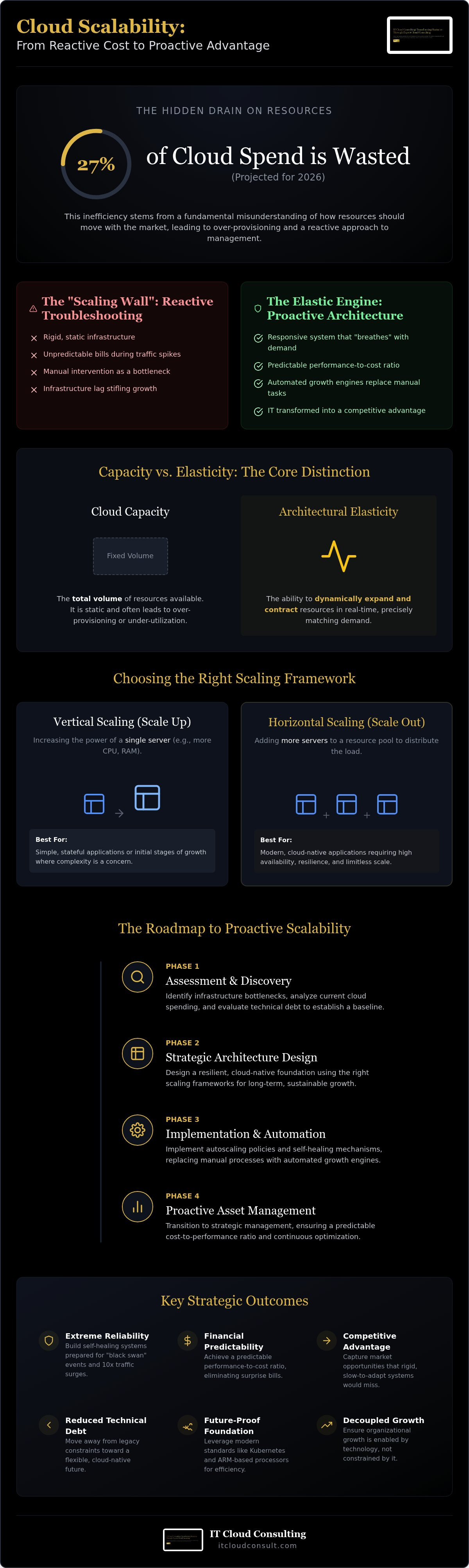
Did you know that organizations estimate 27% of their total cloud spending is wasted in 2026? This staggering inefficiency often stems from a fundamental misunderstanding of how resources should move with the market. You've likely felt the frustration of unpredictable bills during traffic spikes or the stagnation caused by infrastructure lag when demand is highest. Engaging in expert cloud scalability consulting addresses these pains by replacing reactive troubleshooting with a visionary architecture built for the long term.
This strategic approach transforms your rigid, static infrastructure into a responsive, elastic engine designed for sustainable enterprise growth. By aligning technical processes with organizational benefits, you can move toward a state of steady assurance and realize your latent potential. We'll explore how to achieve a predictable performance-to-cost ratio through automated systems and a strategic roadmap that turns your cloud environment into a competitive advantage. We'll also examine the shift toward ARM-based processors and the latest Kubernetes 1.37 standards to ensure your architecture is ready for the demands of the next decade.
Key Takeaways
- Differentiate between simple cloud capacity and true architectural elasticity to build a system that breathes with your business.
- Identify how expert cloud scalability consulting uncovers hidden infrastructure bottlenecks and replaces manual processes with automated growth engines.
- Evaluate the strategic trade-offs between horizontal and vertical scaling to establish a resilient, cloud-native foundation for 2026 and beyond.
- Implement a structured scalability roadmap that transitions your organization from reactive troubleshooting to proactive, strategic asset management.
- Align your technical architecture with broader business objectives to improve time-to-market and maintain a predictable performance-to-cost ratio.
Beyond Growth: Defining Cloud Scalability Consulting in 2026
In 2026, the distinction between owning cloud space and possessing true architectural elasticity defines the gap between market leaders and those struggling with overhead. Cloud scalability consulting is no longer about just "getting bigger." It's about designing a system that breathes with the market. While capacity refers to the total volume of resources available, elasticity is the ability to expand and contract those resources dynamically. This distinction is critical for enterprises that aim to maintain a high performance-to-cost ratio as they navigate volatile demand cycles.
Modern enterprise agility depends on infrastructure that doesn't require permission to grow. When technical capabilities are siloed from business goals, companies often face the "Scaling Wall." This is where manual intervention becomes a bottleneck, and technical debt prevents rapid pivots. Expert cloud scalability consulting bridges this gap by shifting the focus from reactive scaling, where teams scramble to add servers after a crash, to proactive, predictive architecture. By leveraging sophisticated cloud computing autoscaling, businesses can ensure their digital footprint matches their real-world demand in real-time.
The Core Objectives of Scalability Consulting
The primary goal is achieving high availability without the financial burden of over-provisioning. With organizations estimating that 27% of their cloud spending is wasted in 2026, efficiency is now as important as uptime. A well-architected system utilizes distributed architecture to reduce latency for a global user base, ensuring that a customer in London experiences the same speed as one in New York. Beyond simple performance, it prepares the enterprise for "black swan" events, such as 10x traffic surges, by ensuring the infrastructure is stable and self-healing under sudden, intense pressure.
Why Traditional IT Management Fails at Scale
Traditional IT management often relies on a rigid on-premise mindset that treats servers as fixed assets. This approach fails because it cannot account for the volatility of modern digital markets. As systems grow, the complexity of managing multi-cloud environments increases, often leading to significant technical debt. This debt acts as a drag on elasticity, making even simple updates feel like major operations. Moving to cloud-native flexibility requires a fundamental shift in how we view resources. Instead of manual management, 2026 standards demand automated, policy-driven scaling that utilizes cost-effective technologies like ARM-based processors to drive sustainable, long-term growth.
The Strategic Value of Scalability Architecture
Enterprises often mistake cloud scalability for a simple technical requirement, yet in 2026, it functions as a primary competitive advantage. In a market where 75% of organizations have shifted to multi-cloud or hybrid environments, the ability to pivot infrastructure in real-time is a strategic necessity. Scalability architecture allows your business to capture fleeting market opportunities that rigid systems would miss. When your infrastructure is elastic, you decouple organizational growth from technical constraints, ensuring that a sudden influx of users translates into revenue rather than a system crash.
The strategic value of cloud adoption extends far beyond simple storage or compute power. It directly influences your time-to-market. Elastic environments allow development teams to provision resources instantly, test new features under load, and deploy at a global scale without waiting for hardware procurement. Through professional cloud scalability consulting, technical scaling is aligned with corporate revenue milestones, transforming the IT department from a cost center into a high-velocity growth engine.
Scalability as a Revenue Driver
Rapid user acquisition is only successful if the underlying system maintains peak performance. Performance degradation during a marketing push leads to high churn and lost lifetime value. Elastic infrastructure supports this growth by automatically adjusting to demand, which also enables faster product experimentation. You can launch a pilot program in a specific market and scale it nationally within hours if it succeeds. This agility makes a strong case for strategic cloud adoption as the fundamental catalyst for modern business evolution. By optimizing your resource allocation, you ensure that every dollar spent on the cloud directly supports a measurable business outcome.
Risk Mitigation and Business Continuity
System outages represent more than just downtime; they are a threat to brand reputation and long-term viability. Scalable design mitigates this risk by eliminating single points of failure. In a high-scale environment, automated failovers detect issues and redirect traffic to healthy nodes before the user ever notices a lag. Strategic disaster recovery is built into the fabric of a scalable cloud framework, ensuring that even during significant regional disruptions, your operations remain steady. This level of resilience is a hallmark of sophisticated cloud optimization, where the focus remains on empowering the enterprise to evolve without the fear of structural collapse. By architecting for the worst-case scenario, you provide the steady assurance your stakeholders require.
Horizontal vs. Vertical Scaling: Choosing the Right Framework
Selecting the right scaling framework is a strategic decision that dictates your long-term cost-efficiency and system resilience. Vertical scaling involves adding more power to a single node, such as increasing CPU or RAM. It's often the first choice for legacy applications because it requires minimal code changes. However, it inevitably hits a hardware ceiling. Once you've reached the maximum specifications of a cloud provider's largest instance, growth stops. This "scaling wall" can lead to significant downtime during mandatory hardware upgrades, which is a risk most modern enterprises can't afford.
Horizontal scaling offers a more sustainable path for cloud-native growth. By adding more instances rather than larger ones, you create a system that can theoretically expand indefinitely. This is the foundation of true elasticity. It allows for high availability; if one node fails, others pick up the slack without impacting the user experience. Professional cloud scalability consulting ensures you don't just add instances blindly. Instead, it helps you architect a system where your software is decoupled enough to handle distribution across a global network.
The consultant's role is to determine the optimal scaling mix for your specific workload. Not every application needs to be fully horizontal. A hybrid approach often yields the best results, where you scale up certain stable components while scaling out the more volatile services. This balance maintains performance while managing the architectural complexity that comes with a distributed system.
Technical Breakdown: Which Path for Your Workload?
Stateless applications are the ideal candidates for horizontal scaling because they don't store user data locally, making them easy to replicate across a cluster. Databases present a more complex challenge. Scaling them often requires sophisticated sharding or replication strategies to maintain data consistency. A consultant analyzes these requirements to determine if you should scale up your database server or move toward a distributed model. Choosing the wrong path here can lead to massive technical debt and performance bottlenecks that are difficult to resolve later.
Scaling for ROI: The FinOps Perspective
Uncontrolled horizontal expansion often leads to cloud sprawl, where unused instances continue to run and inflate your bill. With organizations estimating that 27% of their cloud spending is wasted in 2026, FinOps has become an essential part of the scaling conversation. Utilizing cloud optimization consulting allows you to tune your scaling triggers based on real-time metrics rather than static thresholds. This ensures you only pay for the resources you actually need. Right-sizing your baseline instances before you start scaling is the most effective way to protect your ROI and ensure your infrastructure remains a lean, high-performance asset.
The Scalability Roadmap: From Assessment to Automation
Transitioning from a static environment to an elastic one requires a methodical framework. It's not about flipping a switch; it's about a structured evolution that aligns your technical capabilities with your business trajectory. Cloud scalability consulting provides the blueprint for this transition. We begin with a deep-dive infrastructure audit to identify the precise bottlenecks that throttle growth. Whether it's a database connection limit or a legacy networking protocol, we find the friction points before they become failures.
Once we've mapped the current state, we design the target-state elastic architecture. This phase involves implementing Infrastructure as Code (IaC) to enable rapid, error-free deployment. By 2026, manual provisioning has become an unacceptable risk. IaC allows your team to treat infrastructure like software, versioning it and deploying it across regions in minutes. This leads to the establishment of automated scaling policies and continuous monitoring, ensuring your system remains optimized as demand fluctuates. Ready to build your roadmap? Explore our strategic cloud adoption services to begin your transformation.
Automating the Elasticity Loop
True elasticity closes the gap between market demand and resource allocation. We utilize Auto-Scaling Groups (ASGs) and sophisticated Load Balancers to distribute traffic seamlessly across your environment. For containerized workloads, Kubernetes remains the de facto standard for orchestration. With the release of Kubernetes 1.37 in August 2026, the ability to manage complex, multi-cloud clusters has reached new levels of stability. For many enterprises, the ultimate goal is transitioning to serverless architectures. This "zero-management" approach removes the burden of server maintenance entirely, allowing your developers to focus on product innovation while the cloud provider handles the scaling logic.
Predictive Scaling with AI and Machine Learning
The most significant shift in 2026 is the move from reactive to predictive scaling. Since 78% of organizations now use AI in at least one business function, we leverage machine learning to analyze historical traffic patterns and anticipate surges before they happen. Instead of waiting for a CPU threshold to be hit, the system preemptively provisions resources. This AI-driven approach significantly reduces the cost-to-scale by ensuring you don't over-provision for "just in case" scenarios. It creates an intelligent resource allocation loop that protects your ROI while maintaining peak performance during unpredicted spikes.
Partnering for Success: Why IT Cloud Consulting?
Choosing a partner for enterprise cloud transformation requires more than technical proficiency; it demands a visionary perspective. IT Cloud Consulting bridges the gap between high-level strategic planning and hands-on execution. We don't just build systems that work today. We architect for the latent potential of your business, ensuring your infrastructure evolves alongside your market share. Our cloud scalability consulting focuses on the cause-and-effect relationship between architectural integrity and organizational progress.
Maintaining an elastic environment requires continuous vigilance. Our managed cloud services provide the steady assurance needed to navigate complex multi-cloud scaling. We empower your internal teams through rigorous knowledge transfer, ensuring your staff masters the best practices of modern cloud management. This collaborative model turns your IT department into a center of excellence, capable of sustaining long-term growth without reliance on external fixes.
A Visionary Approach to Infrastructure
We prioritize long-term evolution over quick fixes. By implementing multi-cloud strategies, we help your enterprise avoid vendor lock-in and leverage the best-in-class features of every provider. Every technical decision we make serves a specific business outcome. Whether we're optimizing for cost or performance, the goal remains the same: creating a resilient foundation for sustainable expansion. Our role is to act as your dependable guide, providing both the big-picture strategy and the technical proficiency required for execution.
Ready to Scale Your Cloud Environment?
The path to infinite growth starts with a clear understanding of your current limitations. Partnering with a professional cloud infrastructure consulting firm allows you to identify bottlenecks before they impact your revenue. Specialized cloud scalability consulting identifies the structural friction points that prevent you from reaching your revenue milestones. We invite you to begin your scalability audit today to transform your digital infrastructure into a high-performance engine. Consult with IT Cloud Consulting experts to realize your organization's full potential in 2026.
Architecting Your Enterprise for a Decade of Infinite Growth
The transition from static resource management to dynamic elasticity represents a fundamental evolution in how modern enterprises operate. By moving beyond simple capacity and embracing a proactive, AI-augmented architecture, your organization can decouple technical constraints from business potential. We've explored how a structured roadmap, rooted in Infrastructure as Code and optimized scaling triggers, ensures your digital footprint expands with precision rather than waste.
Achieving this level of architectural maturity requires a partner who understands the direct relationship between technical decisions and corporate revenue. Professional cloud scalability consulting provides the strategic vision needed to navigate multi-cloud complexities while maintaining a lean, high-performance environment. IT Cloud Consulting delivers expert strategic roadmap development and a comprehensive cloud optimization focus to ensure your systems remain secure and elastic. With our national US advisory coverage, we provide the steady assurance your stakeholders require for long-term development.
Scale your infrastructure for the future with IT Cloud Consulting. Your journey toward a more responsive and resilient future begins with a single architectural pivot. The potential for innovation is limitless when your foundation is built to breathe with the market.
Frequently Asked Questions
What exactly does a cloud scalability consultant do?
A cloud scalability consultant acts as a strategic architect for your digital infrastructure. They perform deep-dive audits to identify growth bottlenecks and design a target-state elastic architecture. By leveraging cloud scalability consulting, you move from reactive troubleshooting to a proactive roadmap. This process involves implementing Infrastructure as Code and automated policies that align your technical capabilities with long-term business milestones, ensuring your system remains stable during significant traffic surges.
How do I know if my business needs scalability consulting?
Your business likely requires professional guidance if you experience infrastructure lag during high-demand periods or struggle with unpredictable cloud bills. If your internal team faces a cloud skills shortage, which affects approximately 43% of companies in 2026, external expertise becomes essential. Scalability consulting addresses these pains by transforming rigid infrastructure into an elastic engine, preventing the "Scaling Wall" that often occurs when manual intervention becomes a bottleneck.
Is horizontal scaling always better than vertical scaling?
Horizontal scaling is the standard for cloud-native elasticity, but it isn't always the immediate choice for every workload. Vertical scaling, or scaling up, works well for legacy applications that aren't designed for distributed environments. However, horizontal scaling, or scaling out, provides the resilience needed for modern enterprises. A consultant determines the optimal mix, often recommending a hybrid approach that balances performance needs with architectural complexity to avoid single points of failure.
How can I scale my cloud infrastructure without increasing my budget?
Scaling without budget inflation requires a rigorous focus on cloud optimization. Since organizations estimate that 27% of cloud spending is wasted in 2026, the first step is identifying and eliminating this inefficiency. By right-sizing instances and utilizing cost-effective ARM-based processors like AWS Graviton, you can increase capacity while maintaining a predictable performance-to-cost ratio. Implementing FinOps practices ensures that every scaling trigger is tied to a measurable business outcome.
What are the biggest risks of scaling a cloud environment poorly?
Poorly executed scaling often leads to "cloud sprawl," where unused resources continue to generate costs without providing value. Other risks include performance degradation during user acquisition and the creation of single points of failure. Without automated failovers and a zero-trust security model, a growing environment becomes increasingly vulnerable. Expert cloud scalability consulting mitigates these risks by architecting for elasticity and resilience, ensuring that growth doesn't compromise your system's structural integrity.
Can scalability consulting help with multi-cloud or hybrid environments?
Yes, scalability consulting is specifically designed to manage the complexity of multi-cloud and hybrid environments. With 75% of organizations adopting these strategies in 2026, consultants focus on avoiding vendor lock-in and ensuring seamless resource distribution. They help you leverage the latest standards, such as Kubernetes 1.37, to orchestrate containers across different providers. This approach ensures your infrastructure remains resilient and capable of supporting a global user base through a distributed architecture.
How long does it take to implement a fully scalable cloud architecture?
The timeframe for implementation depends on your current technical debt and the complexity of your workloads. While a comprehensive infrastructure audit and strategic roadmap can be developed in a matter of weeks, achieving a fully automated elastic loop is an ongoing process of evolution. Most enterprises see significant improvements in stability and cost-efficiency within the first few months of implementing Infrastructure as Code and predictive scaling policies driven by historical traffic data.
What is the difference between cloud scalability and cloud elasticity?
Scalability refers to the system's inherent capacity to handle an increasing workload by adding resources. Elasticity is the ability of that system to expand and contract those resources dynamically in real-time based on actual demand. While scalability is the structural foundation, elasticity is the operational result. A truly modern cloud environment uses both to ensure high availability without the financial burden of over-provisioning resources during periods of low activity.


