
A cloud migration is not a technical event; it is the strategic realization of an organization's latent digital potential. You likely recognize that the promise of agility often feels overshadowed by the immediate reality of cloud bill shock, legacy system friction, and the persistent anxiety of maintaining compliance in a borderless environment. It's frustrating when the modernization you've been promised results in more operational complexity than you started with. This guide provides a comprehensive roadmap to master these complexities through professional cloud implementation services, ensuring your new infrastructure accelerates innovation rather than hindering it.
We've designed this framework to help you bridge the gap between rigid legacy constraints and the fluid efficiency of cloud-native architectures. By the end of this article, you'll understand how to transform your digital landscape into a durable source of competitive advantage. We will explore the critical components of strategic adoption, from initial assessment to continuous optimization, providing a clear path for your enterprise to evolve with confidence and precision. This is about more than just moving data; it's about building a foundation for long-term scalability and operational excellence.
Key Takeaways
- View cloud adoption as a strategic architectural evolution rather than a simple data transfer to unlock your organization's latent digital potential.
- Utilize expert cloud implementation services to integrate automation and CI/CD pipelines, creating a foundation for continuous innovation and operational efficiency.
- Identify the ideal balance of control and agility for your workloads by comparing Public, Private, and Hybrid cloud models within the 2026 ecosystem.
- Follow a methodical lifecycle that starts with a professional readiness assessment to mitigate security risks and prevent unexpected costs.
- Transition from a vendor-client relationship to a strategic partnership focused on long-term scalability and sustainable enterprise evolution.
Redefining Cloud Implementation Services for the 2026 Enterprise
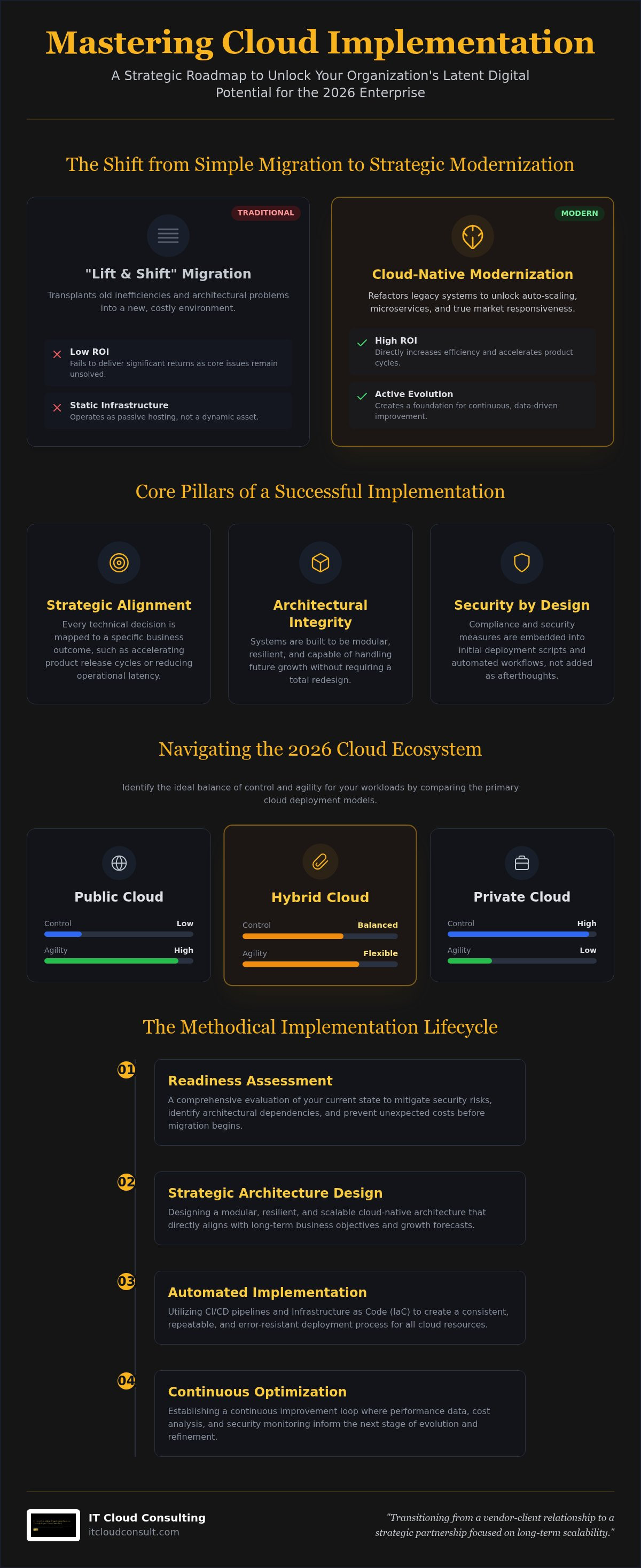
Enterprise evolution requires much more than just changing where your data lives. It's fundamentally about how your business functions and scales in a digital-first economy. Cloud implementation services are the orchestrated deployment of cloud resources to drive organizational agility. By 2026, the standard for success has moved beyond simple connectivity; it's now about deep architectural alignment that unlocks your organization's latent potential.
Effective implementation bridges the gap between high-level business objectives and the underlying technical infrastructure. This requires a nuanced understanding of various cloud computing models to ensure that every resource serves a specific strategic purpose. It isn't enough to simply move servers to a remote data center. You must redesign the way your organization creates value, ensuring that technical processes are directly linked to broader organizational benefits.
The Shift from Migration to Modernization
Core Pillars of Successful Implementation
A "readiness-first" mindset is the foundation of a successful transition. You can't build a future-proof architecture on a shaky understanding of your current state. Successful cloud implementation services prioritize these three pillars to ensure long-term stability:
- Strategic Alignment: Every technical decision must map back to a specific business outcome, such as reducing latency or accelerating product release cycles.
- Architectural Integrity: Building for the long term means ensuring your systems are modular, resilient, and capable of handling future growth without total redesigns.
- Security by Design: Compliance and security aren't afterthoughts; they're baked into the initial deployment scripts and automated workflows.
Implementation doesn't end when the lights go on. It functions as a continuous improvement loop, where performance data informs the next stage of optimization. This approach ensures that your cloud environment evolves alongside your business, maintaining efficiency as your requirements grow more complex.
The Strategic Framework: Beyond Infrastructure Deployment
Success in the digital age requires more than a simple shift of workloads. It demands a deliberate cause-and-effect approach where every architectural choice serves a specific business outcome. When you invest in comprehensive cloud implementation services, you aren't just buying space; you're building a foundation for continuous evolution. Integrating automation and CI/CD pipelines during the initial setup ensures that your operational environment remains consistent, repeatable, and resilient against human error. This systematic orchestration allows your enterprise to realize its full potential, transforming static infrastructure into a dynamic engine for growth.
Architecting for Scalability and Resilience
We utilize a philosophy of "Architecting for Success" to transform legacy constraints into fluid, scalable resources. By leveraging microservices and containerization, your organization can decouple complex systems, allowing individual components to scale independently based on demand. This modularity is the hallmark of cloud infrastructure consulting that prioritizes long-term durability over short-term fixes. As a result, your technical team spends less time on manual maintenance and more time on high-value innovation. This shift doesn't just improve performance; it fundamentally changes your organization's capacity for rapid change.
Data Governance and Compliance Guardrails
Security anxiety is often the primary barrier to modernization. We address this by establishing rigorous data governance and compliance guardrails before the first byte of data is moved. This proactive stance ensures that your environment is secure by design, rather than secured as an afterthought. Utilizing a cloud security assessment checklist during the planning phase allows us to identify potential vulnerabilities early. When professional cloud implementation services are executed correctly, security becomes an enabler rather than a bottleneck. This steady assurance empowers your leadership to move forward without the fear of regulatory friction or data breaches.
Realizing your organization's latent potential requires a partner who acts as both a visionary architect and a dependable guide. Our comprehensive approach to Strategic Cloud Adoption provides the roadmap you need to navigate these complexities with confidence and precision.
Navigating the 2026 Cloud Ecosystem: Models and ROI
Selecting the right deployment model is a pivotal decision that dictates your organization's future agility and fiscal health. Professional cloud implementation services provide the clarity needed to choose between public, private, and hybrid environments based on specific workload requirements. In 2026, hybrid strategies effectively balance cost and control by allowing enterprises to retain sensitive data within private environments while offloading non-critical, high-compute tasks to public providers. This balanced approach ensures you don't overpay for security you don't need or sacrifice the control required for regulatory compliance.
Effective implementation now incorporates FinOps principles from the very first day. We treat financial accountability as a technical requirement rather than a post-migration audit. By embedding cost-visibility tools and governance policies into the initial deployment, your organization can realize the promise of cloud economics without the traditional friction of unpredictable billing. This proactive financial management transforms the cloud from a variable expense into a predictable driver of enterprise value.
Public vs. Private vs. Hybrid: A Strategic Comparison
Choosing a model requires a rigorous framework that evaluates workload sensitivity, performance needs, and latency requirements. Public clouds offer unmatched agility for rapid scaling, while private clouds provide the dedicated resources necessary for highly regulated industries. Many complex enterprises now opt for multi-cloud management to avoid vendor lock-in and maximize resiliency. Utilizing an enterprise cloud transformation roadmap helps align these technical choices with your long-term business trajectory, ensuring your architecture supports growth rather than restricting it.
Maximizing ROI through Cloud Optimization
Successful deployment is merely the first step in a broader journey toward cloud optimization consulting. To avoid the common pitfall of "Cloud Bill Shock," we prioritize right-sizing and resource tagging during the implementation phase. This ensures that every virtual machine and storage bucket is accounted for and optimized for its specific task. Proactive cost management distinguishes a strategic evolution from a simple migration. When cloud implementation services are executed with an optimization-first mindset, the resulting infrastructure delivers immediate operational efficiency and sustainable long-term ROI. We focus on creating a lean, high-performance environment that adapts to your needs without inflating your budget.
The Implementation Lifecycle: A Step-by-Step Execution Guide
Moving from strategic vision to technical reality requires a methodical, purposeful rhythm. Comprehensive cloud implementation services follow a structured lifecycle that eliminates guesswork and ensures every technical action produces a measurable business result. This process isn't a linear march; it's a series of deliberate stages designed to build technical integrity and organizational confidence at every turn. By following a proven roadmap, you transform the complexity of deployment into a controlled evolution.
The lifecycle consists of five essential stages:
- Step 1: Comprehensive Cloud Readiness Assessment and Gap Analysis.
- Step 2: Strategic Roadmap Development and Architectural Design.
- Step 3: Phased Migration and Modernization (Pilot to Production).
- Step 4: Validation, Security Auditing, and Performance Tuning.
- Step 5: Handover to Managed Support and Continuous Optimization.
Phase 1: Readiness and Assessment
Before a single workload moves, you must understand the current state of your technical debt. Legacy system dependencies often hide beneath the surface, waiting to disrupt migration timelines. Identifying these bottlenecks early allows for a more accurate gap analysis and prevents unexpected delays. Setting clear KPIs for the project, such as latency reduction or cost-per-transaction targets, ensures the implementation remains focused on value. This phase is the bedrock of strategic cloud adoption, providing the data needed to design an architecture that truly evolves with your business.
Phase 2: Execution and Validation
Risk mitigation is central to a successful execution strategy. We begin with a "Pilot" phase, moving low-risk workloads first to test the architectural design in a live environment. This controlled deployment allows for real-time performance tuning before full-scale production begins. Continuous monitoring during the transition is essential to maintain visibility and address anomalies before they impact your users. Immediately following the move, we conduct a rigorous validation of the security posture to ensure all guardrails are functioning as intended. Professional cloud implementation services ensure that this transition is seamless and that the final environment meets the highest standards of enterprise excellence.
Transitioning to a modernized infrastructure is a journey that requires both foresight and precision. To begin your readiness assessment, explore our Strategic Cloud Adoption services and secure your organization's digital future.
Partnering for Evolution: Why IT Cloud Consulting
Enterprise evolution is a journey that demands more than a technical vendor; it requires a strategic ally. IT Cloud Consulting serves as a visionary architect and a dependable guide, ensuring your transition to the cloud isn't just a change in location, but a fundamental upgrade in operational capacity. Our approach to cloud implementation services is rooted in the belief that technical processes must directly serve organizational benefits. By focusing on long-term development rather than one-off transactions, we help you realize the latent potential within your digital infrastructure.
Authoritative Guidance for Complex Transitions
We begin every partnership with a professional assessment of legacy systems and a deep dive into your business objectives. This isn't a generic template. It's a bespoke roadmap designed to manage implementation risks effectively while prioritizing operational efficiency. Our consultants provide the "big picture" perspective required to navigate complex architectures during cloud implementation services, ensuring that your cloud adoption is both purposeful and methodical. By connecting specific technical actions to broader business results, we transform the implementation phase into a cause-and-effect journey toward success.
Sustainable Success through Managed Support
The conclusion of a deployment is simply the start of a new phase of growth. Transitioning from initial implementation to managed cloud services ensures the ongoing health and performance of your environment. Understanding managed cloud support fees allows your leadership to plan for sustainable, long-term organizational evolution without the friction of hidden costs. We provide continuous monitoring and proactive maintenance, acting as a steady hand that empowers your internal teams to focus on high-value innovation. This ongoing support is the key to maintaining the architectural integrity established during the first steps of your journey.
Your organization's digital future depends on the strength of its foundation. By choosing a partner dedicated to your long-term trajectory, you ensure that your cloud environment remains a durable source of competitive advantage. It's time to unlock your true potential and accelerate growth through a framework designed for the modern enterprise. We invite you to explore how our expertise in Strategic Cloud Adoption can turn your vision of modernization into a permanent reality.
Realizing Your Organization's Digital Potential
The transition to a cloud-native architecture represents a defining moment in an enterprise's trajectory. We've explored how professional cloud implementation services serve as the foundation for this evolution, bridging the gap between legacy constraints and the fluid efficiency of modern systems. By prioritizing a readiness-first mindset and aligning technical deployment with high-level business objectives, you ensure that your infrastructure becomes a driver of innovation rather than a source of operational friction. This strategic alignment is what transforms a simple migration into a lasting competitive advantage.
Success requires a partner who provides both the strategic vision of an architect and the technical proficiency of a dependable guide. Whether you're initiating a Cloud Readiness Assessment or seeking the long-term stability of 24/7 Managed Cloud Support, the path forward is built on clarity and precision. It's time to move beyond the technical migration event and embrace a future defined by scalability, resilience, and sustainable growth. We're here to help you navigate every stage of this transformation with confidence.
Begin Your Cloud Evolution with a Strategic Roadmap to secure your organization's digital future and accelerate your path to modernization. We look forward to supporting your long-term journey toward excellence.
Frequently Asked Questions
What is the difference between cloud migration and cloud implementation services?
Migration is the technical act of moving data and applications from one environment to another. In contrast, professional cloud implementation services focus on the strategic orchestration of resources to drive organizational agility. It involves architecting for scalability, integrating automation, and ensuring that your technical infrastructure aligns with long-term business goals. While migration is a single event, implementation is the foundational step in a continuous journey of enterprise evolution.
How long does a typical enterprise cloud implementation take?
The duration of an enterprise implementation varies significantly based on the complexity of your legacy environment and the scope of modernization required. A phased approach typically spans several months, beginning with a comprehensive readiness assessment and moving through pilot programs before full-scale production. Smaller, focused transitions might take twelve to sixteen weeks; however, complex global architectures often require six to twelve months of deliberate execution to ensure architectural integrity and minimal operational disruption.
How do implementation services help in reducing cloud costs?
Strategic implementation reduces costs by embedding financial accountability into the initial architectural design. We utilize FinOps principles to ensure that resources are right-sized from day one, preventing the common issue of "cloud bill shock." By automating resource allocation and establishing clear governance guardrails, organizations can avoid paying for idle capacity. This proactive approach transforms your cloud budget from a variable, unpredictable expense into a controlled driver of measurable business value.
What are the biggest risks during the cloud implementation process?
The primary risks include security vulnerabilities, legacy system friction, and a lack of internal expertise to manage complex architectures. Without a "readiness-first" mindset, organizations often face integration failures or compliance gaps that disrupt operations. We mitigate these risks by conducting rigorous gap analyses and establishing security guardrails before any data moves. This methodical approach ensures that your transition is secure, predictable, and fully aligned with your existing regulatory requirements.
Is multi-cloud implementation right for my organization?
Multi-cloud implementation is an excellent choice for organizations seeking to avoid vendor lock-in and maximize operational resiliency. It allows you to distribute workloads across different providers based on specific performance or cost benefits. However, this model introduces additional management complexity and requires a sophisticated architectural framework. We help you evaluate whether the benefits of increased agility and risk distribution outweigh the operational overhead of managing multiple cloud environments simultaneously.
What role does security play in the cloud implementation lifecycle?
Security is the bedrock of the entire implementation lifecycle, functioning as an enabler rather than a bottleneck. We employ a "security by design" philosophy, where compliance guardrails and identity management are baked into the initial deployment scripts. This ensures that your environment is protected from the moment it goes live. Continuous monitoring and automated auditing then maintain this posture, providing steady assurance that your data remains secure as your organization evolves.
Can cloud implementation services help with legacy system modernization?
Yes, professional cloud implementation services are essential for transforming legacy constraints into modern, scalable resources. Rather than a simple "lift and shift," we focus on refactoring legacy applications to be cloud-native. This process involves decoupling monolithic systems into microservices, which increases market responsiveness and reduces technical debt. By modernizing your core systems during implementation, you unlock the latent potential of your data and create a foundation for long-term innovation.
How do we measure the success of a cloud implementation project?
Success is measured through specific, predefined KPIs that reflect both technical performance and business outcomes. Key metrics include system uptime, reduced latency, and accelerated deployment cycles for new features. We also track financial indicators, such as cost-per-transaction, to ensure the infrastructure remains efficient. Ultimately, a successful implementation is defined by your organization's increased capacity to scale and adapt to market changes without experiencing technical or operational friction.


