
By the end of 2026, AI workloads have surged to account for 22% of total enterprise cloud spend, yet many organizations still find themselves blindsided by unpredictable monthly invoices. You've likely experienced the frustration of "bill shock" or the persistent difficulty of proving a clear ROI to executive leadership when costs fluctuate without visibility. Relying on reactive measures is no longer a viable path for growth; instead, sophisticated cloud financial management services are required to transform these volatile expenses into a controlled, strategic advantage. It's time to move beyond simple cost-cutting and treat your infrastructure as a performance-tuned asset.
We'll provide a professional roadmap to mastering the complexities of cloud economics, offering your organization the steady assurance needed to achieve automated governance and sustainable development. This framework aligns finance and engineering teams. It ensures that every dollar spent contributes directly to your long-term modernization goals. You'll discover how to eliminate waste from underutilized reserved instances and establish a predictable spending model that empowers your business to evolve. From strategic optimization to visionary architecture, we'll guide you through the essential components of a robust financial framework that secures your competitive edge for the years ahead.
Key Takeaways
- Shift your perspective from reactive cost-cutting to proactive cloud unit economics to better navigate the complexities of AI-driven resource consumption.
- Establish a professional FinOps framework that ensures 100% visibility into spending through comprehensive tagging and rigorous infrastructure rightsizing.
- Understand why specialized cloud financial management services provide deeper architectural savings than native automated tools by aligning technical decisions with business strategy.
- Follow a structured implementation roadmap that begins with immediate waste elimination and scales into a long-term strategy for sustainable modernization.
- Learn how to position your organization for growth by integrating financial governance into a broader, managed cloud optimization strategy.
The Evolution of Cloud Financial Management in 2026
The paradigm for managing digital infrastructure has undergone a fundamental transformation. In 2026, the era of reactive cost-cutting has ended, replaced by a sophisticated focus on proactive cloud unit economics. Organizations no longer view cloud bills as fixed overhead but as a variable lever for performance. This shift is driven by the realization that traditional IT budgeting, built on rigid annual cycles, fails to account for the fluid nature of modern Cloud computing environments. Professional cloud financial management services have become the primary mechanism for aligning technical agility with fiscal discipline. By treating cloud spend as a strategic investment rather than a utility cost, businesses can unlock latent potential in their digital architecture.
The High Cost of Cloud Sprawl and Shadow IT
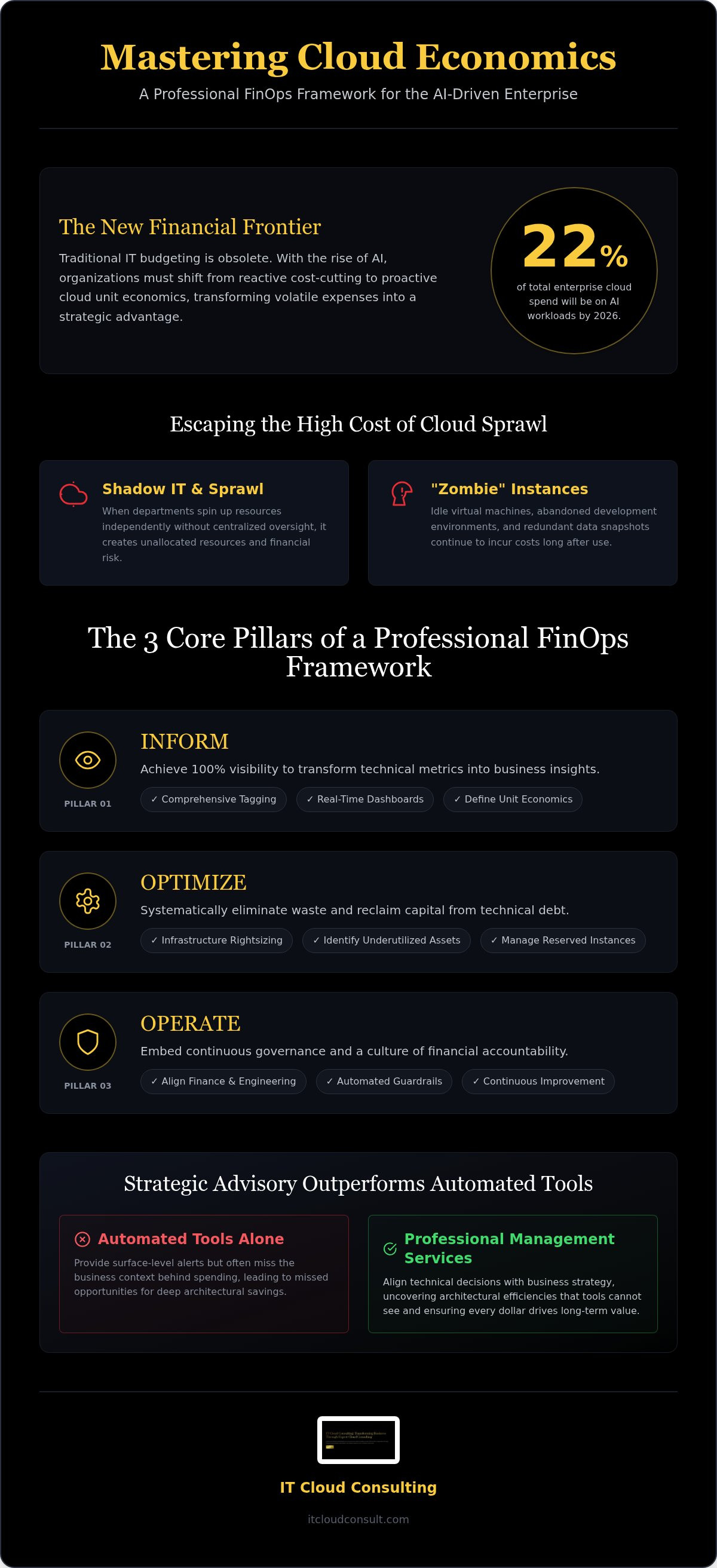
Technical sprawl remains a silent predator of enterprise margins. When departments spin up resources independently, they create "shadow IT" pockets that lack centralized oversight. This leads to unallocated resources and "zombie" instances; these are idle virtual machines or storage volumes that continue to incur costs long after their original project has concluded. The financial risk is substantial. Abandoned development environments and redundant data snapshots erode the bottom line, turning potential profit into technical debt. Identifying these unallocated resources across enterprise departments is the first step in reclaiming control. A strategic assessment of existing infrastructure identifies these invisible drains on capital, linking technical sprawl directly to organizational bottom-line erosion.
AI-Driven Infrastructure: A New Financial Frontier
The rapid integration of artificial intelligence has introduced a volatile new variable into the financial equation. AI workloads now account for 22% of total cloud spend in 2026, largely due to the high cost of GPU-intensive infrastructure and specialized data platforms. Managing these expenses requires a transition from manual oversight to sophisticated, automated governance. Agentic AI and automated scaling can lead to rapid cost escalation if left unmonitored. Balancing the speed of innovation with fiscal responsibility means implementing guardrails that allow for autonomous workloads while maintaining strict budget adherence. Utilizing expert cloud financial management services provides the necessary roadmap to ensure these advanced technologies drive growth rather than uncontrolled waste. For organizations looking to expand their digital footprint across the continent, Torch Services provides leading technology managed services that ensure infrastructure remains a strategic asset.
Establishing a clear financial baseline through Strategic Cloud Adoption allows enterprises to predict monthly spend with precision. This proactive stance enables leadership to treat cloud optimization as a continuous evolution. It transforms a complex technical challenge into a predictable engine for sustainable enterprise growth, ensuring that every technological advancement is backed by a sound financial strategy.
Core Pillars of a Professional FinOps Framework
Establishing a professional FinOps framework requires more than just installing software; it demands a cultural shift toward accountability and precision. A successful strategy rests on three core pillars: Inform, Optimize, and Operate. The Inform phase focuses on 100% visibility, ensuring every resource is mapped to a business owner. The Optimize phase identifies underutilized infrastructure to eliminate waste. Finally, the Operate phase aligns finance, technology, and business leadership to ensure continuous improvement. By mastering these pillars through expert cloud financial management services, enterprises can move from reactive spending to strategic value creation.
Visibility and Allocation: The Foundation of Control
Visibility is the foundation of control. Without a comprehensive cloud tagging strategy, cost attribution remains a guessing game. In 2026, relying on end-of-month bill reviews is insufficient. Real-time dashboards provide the immediate feedback loops required to catch anomalies before they escalate. Defining Unit Economics for your specific business, such as the cost per transaction or cost per active user, allows leadership to evaluate cloud spend in the context of revenue generation. This clarity transforms technical metrics into business insights, allowing you to see exactly which departments drive your cloud consumption.
Cloud Governance and Automated Guardrails
Governance acts as the structural integrity of your cloud environment. Automated guardrails, including alerts and kill switches for runaway costs, prevent accidental overspending. Policy-based provisioning ensures that developers have the resources they need without the risk of over-provisioning. This level of control is rarely achieved through tools alone. Instead, professional cloud infrastructure consulting builds the necessary foundation for governance by designing environments that are optimized for both performance and fiscal responsibility. These automated policies ensure that your scaling remains sustainable as your enterprise grows.
The Operate pillar is where strategy meets execution. It involves creating a feedback loop where engineering teams understand the financial impact of their architectural choices. When finance and technology teams speak the same language, the organization can scale without friction. This alignment is the ultimate goal of any professional framework, turning cloud spend into a transparent and manageable asset.
To measure success, organizations must establish clear KPIs for cloud ROI. Beyond simple budget adherence, look at unit cost efficiency and the percentage of tagged resources. These metrics prove the effectiveness of your cloud financial management services to executive stakeholders. If you're ready to move toward a more optimized future, our team can help you design a strategic cloud optimization roadmap.
Strategic Advisory vs. Automated Tools: Why Strategy Wins
Automated tools are essential components of a modern stack, yet they represent only a portion of a complete solution. Native cost explorers in AWS or Azure excel at identifying immediate anomalies, but they often lack the vendor-neutral perspective required for complex multi-cloud environments. Relying solely on automation creates a "set it and forget it" mentality that misses deep-seated architectural waste. True efficiency originates from a high-level vision that links financial strategy to strategic cloud adoption. This ensures that every technical decision is weighed against its long-term business impact rather than just this month's invoice.
The Human Element in Cloud Economics
Software can generate reports, but it can't bridge the communication gap between the CFO and the DevOps team. In 2026, the cultural shift toward financial accountability is far more valuable than any single software implementation. Professional cloud financial management services act as a dependable guide, facilitating the dialogue needed for organizational evolution. This advisory approach transforms cost management from a technical chore into a shared business priority. It empowers engineering teams to understand the "why" behind their resource consumption, fostering a culture of empowerment rather than restriction. When teams own their spend, they innovate with greater precision.
Architectural Optimization vs. Surface-Level Savings
Most automated tools focus on "quick wins," such as identifying idle instances or unattached storage. While these actions provide immediate relief, they don't address the underlying architectural inefficiencies that drive long-term costs. Moving beyond surface-level savings requires deep refactoring and a sophisticated understanding of modern resource models. For instance, the choice between serverless and containerized architectures in 2026 involves complex trade-offs in performance and unit cost. Engaging in cloud optimization consulting allows enterprises to uncover these hidden efficiencies through architectural precision. This level of insight ensures that your infrastructure doesn't just cost less; it performs better.
Implementing a Cloud Financial Management Roadmap
The first phase involves a comprehensive cross-provider audit to identify redundant services and hidden inter-service dependencies. Analyzing historical spend allows leadership to predict future growth trajectories with greater accuracy, moving away from guesswork toward data-driven forecasting. A Cloud Cost Audit serves as the foundational diagnostic prerequisite for any enterprise cloud transformation, ensuring that architectural decisions are rooted in financial reality. This process exposes "shadow" resources and abandoned environments, providing the clarity needed to reclaim wasted capital before moving into active optimization.
Step 2: Performance-First Right-Sizing
Optimization must never come at the expense of system reliability or user experience. Performance-first right-sizing involves matching specific instance types to actual workload requirements rather than over-provisioning for "worst-case" scenarios. Utilizing spot instances for non-critical workloads and migrating to Graviton-based compute can yield substantial savings while maintaining or even improving system latency. This phase focuses on "quick wins" that provide immediate relief to the monthly bill, creating the fiscal room needed for more complex architectural refactoring. It's about finding the precise balance where resource consumption meets performance demand without a single dollar of waste.
Step 3: Long-Term Commitment Strategies
Navigating the complexity of 2026 AWS Savings Plans and Azure Reservations requires a sophisticated understanding of commitment-based pricing. As cloud markets fluctuate, these instruments allow organizations to hedge against price increases while securing significant discounts. Strategic allocation of committed spend across multi-cloud environments ensures that you aren't locked into a single provider's pricing model. This phase transforms your cloud spend from a variable expense into a predictable, manageable asset. If you're ready to secure your infrastructure's financial future, schedule your strategic cloud assessment with our team today.
The final phase of the roadmap focuses on continuous monitoring and managed governance. By establishing automated guardrails, enterprises can prevent the recurrence of waste and ensure that new deployments adhere to established financial policies. This ongoing support turns cloud optimization into a permanent organizational capability, allowing your team to focus on innovation while our experts handle the complexities of fiscal oversight. Through this steady progression, your organization realizes its latent potential for sustainable, cost-effective growth.
Optimizing Your Cloud Evolution with IT Cloud Consulting
Transitioning from cloud chaos to a state of strategic empowerment requires a partner who understands the intricate balance between technical performance and financial governance. IT Cloud Consulting acts as your visionary architect, designing the structural foundation needed for fiscal discipline, while serving as a dependable guide through the execution phase. We integrate professional cloud financial management services into our comprehensive managed cloud services, ensuring that financial health is an inherent feature of your infrastructure rather than an afterthought. This holistic approach allows your organization to move past the limitations of reactive spending and toward a future of purposeful, scalable growth.
Our Methodology: Strategic Assessment to Managed Support
Our engagement begins with a strategic assessment of your existing infrastructure, where we identify latent inefficiencies and untapped opportunities for optimization. This diagnostic phase isn't a generic checklist; it's a customized deep dive into your specific organizational needs across AWS and Azure environments. Once the roadmap is established, we provide continuous monitoring to maintain long-term fiscal health. Our ongoing technical assistance ensures that as your environment scales, security and performance remain uncompromised. This methodical rhythm of assessment and support builds the trust necessary for a long-term development partnership, allowing you to focus on your core business while we manage the complexities of your cloud evolution.
Realizing Your Organization’s Latent Potential
The ultimate goal of our optimization strategy is to realize your organization's latent potential. By eliminating cloud waste and architectural redundancy, we free up critical capital that can be reinvested into innovation and market expansion. We empower your leadership team with actionable, data-driven financial insights that transform technical metrics into strategic business intelligence. This transparency ensures that every technological advancement is backed by a sound financial rationale. If you're ready to evolve your infrastructure into a high-performance asset, reach out to IT Cloud Consulting today for a strategic consultation. Our experts are prepared to lead your enterprise toward a more optimized and advanced future state.
Securing Your Enterprise Trajectory through Fiscal Precision
The transition from unpredictable cloud spending to a state of strategic empowerment requires more than simple automation. By adopting a professional FinOps framework, your organization moves beyond basic cost containment to achieve true architectural optimization. We've explored how shifting toward unit economics and implementing a structured roadmap ensures that every technological investment aligns with your long-term modernization goals. Expert cloud financial management services provide the clarity needed to transform volatile expenses into a predictable engine for growth.
IT Cloud Consulting is ready to serve as your visionary architect and dependable guide in this evolution. We offer authoritative strategic guidance and a professional assessment of cloud infrastructure to identify your organization's latent potential. With our continuous managed cloud support, you can maintain fiscal health while focusing on innovation. Schedule a Strategic Cloud Optimization Consultation today to begin your journey toward a more optimized and advanced future. Your path to sustainable enterprise growth starts with a single, purposeful step.
Frequently Asked Questions
What are cloud financial management services?
These services represent a professional framework of advisory and technical practices designed to align your cloud spending with business value. They encompass strategic planning, resource optimization, and ongoing governance to ensure infrastructure costs remain predictable. By utilizing cloud financial management services, enterprises move from reactive billing reviews to a proactive model of unit economics. This ensures that every dollar spent on AWS or Azure directly contributes to long-term organizational growth and modernization.
How much can a business save with professional cloud optimization?
While specific outcomes vary based on infrastructure maturity, many enterprises identify immediate waste ranging from 20% to 30% of their annual spend. Professional cloud optimization goes beyond simple cost-cutting by refactoring architectures for efficiency. Savings are often realized through right-sizing underutilized instances, eliminating "zombie" resources, and strategically leveraging commitment-based pricing models. These structural changes provide a sustainable reduction in overhead without compromising system performance or reliability.
Does FinOps slow down the development cycle?
No, a well-implemented FinOps framework actually accelerates innovation by removing financial uncertainty. It empowers engineering teams with real-time visibility into the cost impact of their architectural choices. Instead of facing budget-related work stoppages, developers operate within automated guardrails that allow for rapid scaling and experimentation. This alignment between finance and technology ensures that projects move forward with steady assurance and clear executive support, fostering a culture of technical empowerment.
Is cloud financial management only for large enterprises?
What is the difference between cloud cost management and FinOps?
Cloud cost management is often a reactive, reporting-focused exercise, whereas FinOps is a proactive, cultural discipline. FinOps integrates financial accountability into the entire cloud lifecycle, involving stakeholders from finance, engineering, and leadership. It focuses on "unit economics" rather than just the total bill. This distinction is critical because it shifts the conversation from "how do we spend less" to "how do we maximize the value of every resource" to drive performance.
Can I use native cloud tools instead of a consulting service?
Native tools like AWS Cost Explorer provide foundational data, but they lack the strategic context required for complex architectural decisions. A consulting service acts as a visionary architect, interpreting that data to build a long-term roadmap. Professional advisors provide vendor-neutral expertise that native tools cannot offer, especially in multi-cloud or hybrid environments. This partnership ensures that you aren't just following a generic checklist but executing a tailored optimization strategy for ROI.
How does IT Cloud Consulting handle multi-cloud environments?
We utilize a centralized governance model that provides a unified view of your entire digital estate across AWS and Azure. Our approach focuses on standardizing tagging policies and metadata across different providers to ensure consistent cost attribution. This cross-platform visibility allows us to identify redundant services and optimize resource allocation based on performance requirements. We serve as a dependable guide, simplifying the inherent complexity of managing multiple proprietary billing structures and technical stacks.
What are the most common hidden costs in a cloud bill?
Data egress fees, unattached storage volumes, and over-provisioned snapshots are frequent contributors to "bill shock." Many organizations also overlook the costs associated with inter-region data transfers and idle load balancers that remain active after projects conclude. AI workloads, which accounted for 22% of spend in 2026, often introduce unexpected expenses through high-performance GPU instances. Identifying these hidden drains is a core component of a professional strategic assessment to reclaim wasted capital.


