
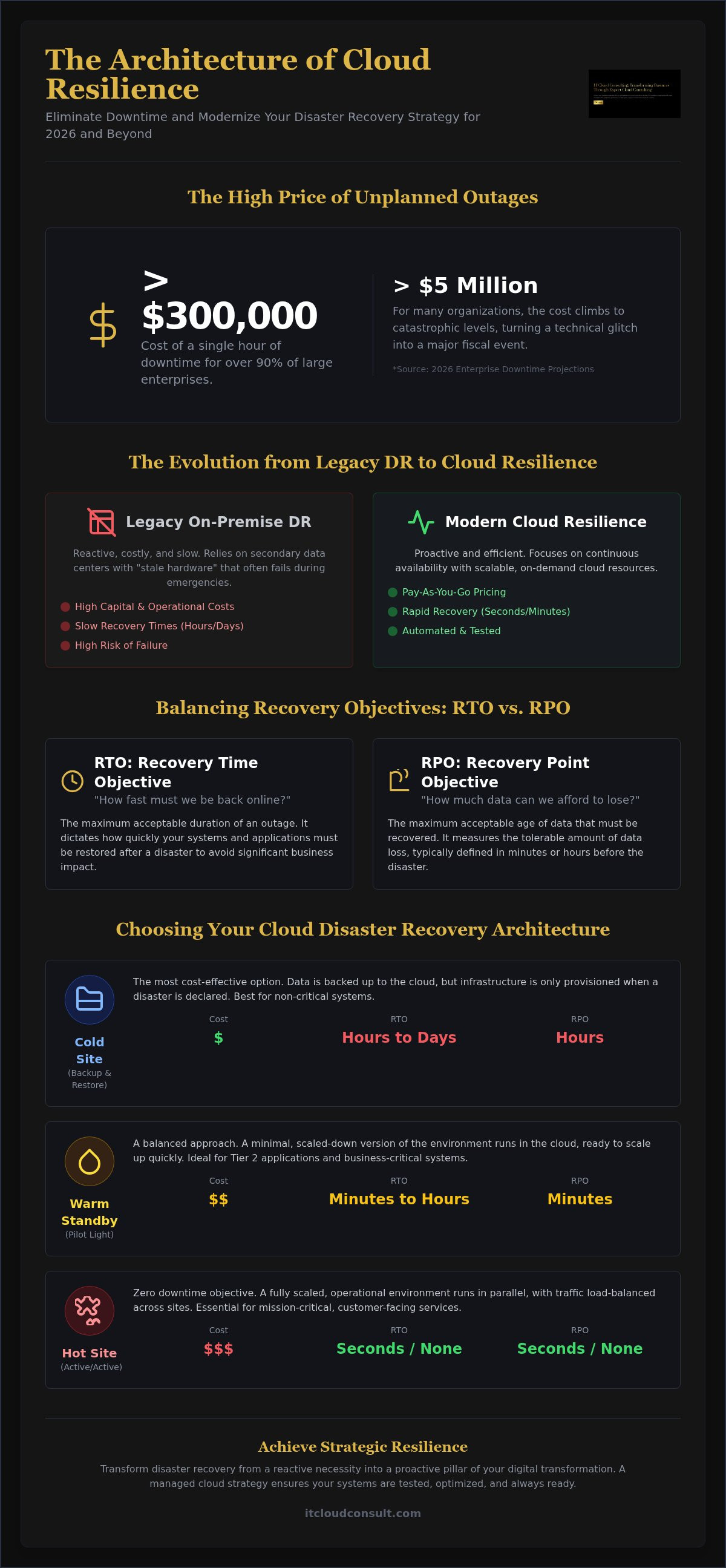
Did you know that in 2026, a single hour of system downtime costs over 90% of mid-to-large enterprises more than $300,000? For many organizations, that figure climbs past $5 million, turning a technical glitch into a catastrophic fiscal event. You likely feel the pressure of maintaining expensive secondary data centers while seeking more efficient cloud disaster recovery services to manage the persistent threat of ransomware. It's a significant burden to balance high-level security with the mandate for lean, optimized operations.
Modernizing your architecture isn't just about survival; it's a strategic move toward organizational evolution. This guide will help you master the strategic architecture of cloud resilience to eliminate downtime and ensure business continuity in an era of complex cyber threats. You'll gain a clear RTO/RPO framework and learn how to reduce infrastructure overhead through a scalable, managed strategy. We'll explore how shifting from legacy systems to cloud-native solutions transforms disaster recovery from a reactive necessity into a proactive pillar of your digital transformation.
Key Takeaways
- Understand how modern cloud disaster recovery services shift the focus from simple data restoration to continuous business availability across multi-cloud environments.
- Learn to balance recovery speed with infrastructure costs by implementing a tiered application framework based on specific RTO and RPO requirements.
- Discover the five-step roadmap for transitioning from legacy backup plans to a resilient, cloud-native framework powered by Infrastructure as Code.
- Realize the strategic value of proactive managed cloud support in ensuring your recovery systems are tested, optimized, and ready for immediate deployment.
- Eliminate the overhead of maintaining secondary data centers by leveraging cloud optimization to achieve superior resilience at a lower cost.
Redefining Resilience: The Strategic Shift to Cloud Disaster Recovery
In 2026, disaster recovery has moved beyond its origins as a back-office insurance policy to become a cornerstone of enterprise strategy. The traditional view of recovery as a simple data backup is no longer sufficient for organizations operating in a hyper-connected environment. Instead, leading firms now treat cloud disaster recovery services as a comprehensive framework for strategic resilience. This approach ensures that business operations remain uninterrupted regardless of external shocks, shifting the focus from reactive restoration to proactive continuity.
Modern organizations are moving away from the "break-fix" mentality of legacy systems toward a model of Continuous Availability. This new enterprise gold standard prioritizes systems that don't just recover, but actually stay online through the duration of a crisis. By architecting for this level of persistence, you transform your technical infrastructure into a reliable engine for long-term development. It's a fundamental shift that requires viewing your cloud environment as a living, adaptable ecosystem rather than a static repository of data.
The Evolution of Disaster Recovery in 2026
The threat landscape has changed dramatically this year. AI-driven cyberattacks now launch with such speed and complexity that the required window for a Recovery Time Objective (RTO) has shrunk from hours to mere seconds. Legacy "cold storage" solutions, where data sits idle until needed, are often too slow to combat modern ransomware. Many enterprises are adopting Recovery as a Service (RaaS) models to implement active-active cloud architectures that distribute workloads across multiple regions. This evolution allows for a seamless transition during a failure, effectively masking the disruption from the end-user. Strategic resilience is the ability to evolve through disruption, ensuring that every challenge serves as a catalyst for further modernization.
Why On-Premise DR is Obsolete
The era of the idle data center is over. Maintaining secondary physical hardware involves massive hidden costs, including power, cooling, and the constant cycle of firmware updates. These "stale hardware" environments often fail during actual emergencies because they haven't been scaled to match the primary production site's growth. Cloud infrastructure consulting provides a solution to this stagnation by leveraging elastic resources that scale on demand. Unlike on-premise setups that struggle during regional outages, cloud disaster recovery services offer the flexibility to move workloads across the nation instantly. This optimization eliminates the financial drain of underutilized assets while providing a level of security that physical sites simply cannot match in 2026.
Evaluating Modern Cloud DR Architectures: Cold, Warm, and Hot Sites
Selecting the right recovery architecture requires a precise balance between operational necessity and fiscal responsibility. In 2026, organizations must categorize their workloads to apply the most efficient model, as a "one size fits all" approach often leads to bloated budgets or dangerous gaps in resilience. Hot sites offer immediate failover through active-active configurations, while cold sites rely on restoring data from backups when an incident occurs. Modern cloud disaster recovery services leverage sophisticated automation to handle these transitions, reducing the risk of human error during high-stress outages. This strategic alignment often draws from established standards, such as the Disaster Recovery Framework Guide, to ensure comprehensive coverage across all business units.
Cold Site vs. Warm Standby: Choosing Your Recovery Speed
For many cost-conscious enterprises, the "Pilot Light" approach offers a sophisticated middle ground. This method keeps essential core elements, like databases, running and up to date while leaving other resource-heavy components dormant until they're needed. It's an ideal choice for Tier 2 applications that can tolerate a few hours of downtime. However, for mission-critical databases where every second of data loss impacts the bottom line, investing in a Warm Standby is essential. This architecture maintains a scaled-down version of your environment that's always running, allowing for a much faster transition to full capacity. Aligning these choices with your broader goals for cloud optimization ensures you aren't paying for idle performance that doesn't serve a clear strategic purpose.
Multi-Cloud and Hybrid DR Strategies
The most resilient organizations in 2026 avoid the trap of vendor lock-in by architecting for cloud-to-cloud recovery. By utilizing cloud disaster recovery services that span multiple providers, you protect your business against a total outage of a single cloud platform. Hybrid models remain equally vital for organizations handling sensitive on-premise data that must comply with strict physical locality requirements. Integrating strategic cloud adoption into your disaster recovery plan allows you to leverage the best of both worlds: the security of local control and the infinite scalability of the cloud. This dual-layered defense creates a robust foundation that evolves alongside your technical requirements, ensuring your business remains steady even when the underlying infrastructure shifts.
Optimizing DR Costs: Balancing RTO/RPO with Enterprise ROI
A robust Business Impact Analysis (BIA) is the first step in this evolution. In 2026, workloads are more fragmented than ever, necessitating a granular look at what truly keeps the lights on. You must categorize applications into tiers. Tier 1 includes revenue-generating or regulatory-critical systems that require near-zero data loss. Tier 3 might include internal archival tools that can stay offline for days. RTO is the maximum tolerable duration of an outage. By setting these recovery targets based on actual impact, you ensure that high-cost hot architectures are reserved only for the most vital functions.
Cost-Reduction Strategies for Disaster Recovery
Modernizing your stack with serverless and containerized environments offers a breakthrough in cost efficiency. These technologies allow for low-cost failover because they don't require pre-provisioned virtual machines to sit idle. Instead, you can automate the spin-up of resources only when a disaster event is triggered. This just-in-time resilience is a core pillar of cloud optimization consulting, focusing on eliminating the financial drain of redundant infrastructure. Managed cloud services play a vital role here by continuously monitoring your environment to identify and prune redundant DR spend that no longer serves your current architecture. This proactive oversight ensures your cloud disaster recovery services remain lean, effective, and fully aligned with your enterprise ROI goals.
The Implementation Roadmap: Building a Resilient DR Framework
Transitioning from a legacy backup plan to a modern resilience framework requires more than just technical migration; it demands a structured, five-step evolution. In 2026, effective cloud disaster recovery services are built on a foundation of repeatable processes that eliminate guesswork during a crisis. This roadmap ensures your organization moves from a state of vulnerability to one of empowered readiness.
- Inventory and Tiering: Map every digital asset to the business-impact tiers established in your initial analysis.
- Environment Provisioning: Use automated scripts to build out the recovery infrastructure, ensuring it mirrors your production standards.
- Data Stream Configuration: Establish secure, continuous replication pipes that maintain synchronization between primary and secondary regions.
- Runbook Orchestration: Script the failover sequence to ensure that services, networking, and security protocols activate in the correct order.
- Operational Validation: Conduct regular, non-disruptive drills to verify that the system performs as expected under simulated stress.
While the technical steps are vital, the human element often determines the success of a recovery. Staff training must go beyond a simple review of the manual. Your teams need clear communication protocols that define who has the authority to trigger a failover and how stakeholders are notified. Without these clear lines of responsibility, even the most advanced cloud disaster recovery services can stall during the critical first minutes of an outage.
Architecting with Infrastructure as Code (IaC)
Consistency is the enemy of downtime. By utilizing Infrastructure as Code (IaC), you ensure absolute parity between your production and disaster recovery environments. This approach treats your infrastructure with the same rigor as software, allowing you to version, test, and deploy environments with a single command. It's a transformative method that significantly reduces human error during high-stress failover events. Integrating these practices into your broader enterprise cloud transformation roadmap allows resilience to become a native feature of your architecture rather than a bolt-on after-thought.
The Failback Lifecycle: Returning to Normal Operations
A recovery plan isn't complete until you've successfully returned to normal operations. The failback lifecycle is often the most complex phase, as it requires synchronizing data accumulated in the DR site back to the primary region without causing a second outage. You must manage the risks of data collision and ensure that the primary environment is fully patched and secure before the transition begins. Once the failback is finalized, a comprehensive post-mortem analysis is essential. This review allows you to evolve your DR plan based on actual performance data, turning every disruption into an opportunity for further system optimization. If you're ready to move beyond basic backups, you can partner with a strategic cloud consultant to architect a framework that guarantees continuity.
Strategic Resilience: The IT Cloud Consulting Advantage
Transitioning from legacy infrastructure to a resilient, cloud-native posture requires more than just software; it requires a seasoned partner who understands the intersection of technical execution and business strategy. IT Cloud Consulting serves as the visionary architect of your resilience, guiding your organization through the complexities of modernization. We position cloud disaster recovery services not as a standalone expense, but as a critical component of your overall strategic growth. By bridging the gap between high-level vision and granular execution, we empower your business to realize its full potential even in an era of unpredictable cyber threats. This steady assurance allows leaders to focus on evolution rather than mere survival.
Our methodology focuses on the realization of latent potential within your existing cloud investments. We don't believe in a vendor-client relationship that ends at the point of sale. Instead, we foster a long-term partnership model that prioritizes continuous cloud modernization. This commitment ensures that as your business scales and the threat landscape shifts, your recovery framework remains optimized and effective. It's a transformative approach that turns technical necessity into a competitive advantage.
Managed Cloud Services for Ongoing Resilience
Maintaining readiness is a continuous process that demands proactive oversight rather than reactive fixes. Our approach utilizes sophisticated monitoring to detect potential failure points before they trigger a full-scale disaster. This focus on continuous system health ensures that your recovery environment isn't just a static backup, but a dynamic, production-ready asset. Regular compliance and security audits further strengthen this posture, ensuring your data remains protected according to 2026 standards. Understanding how managed cloud services integrate with your resilience strategy provides the peace of mind necessary to focus on innovation rather than troubleshooting.
Partnering for Your Cloud Evolution
Every enterprise follows a unique trajectory, and your disaster recovery strategy should reflect that specific path. We provide customized solutions that go beyond generic templates, architecting frameworks that specifically address your unique RTO and RPO requirements. Our professional advisory services offer expert guidance for complex multi-cloud migrations, helping you avoid the pitfalls of vendor lock-in and fragmented security. This partnership ensures that your cloud disaster recovery services evolve as your business grows. The next step in your journey toward total resilience is simple. Scheduling a comprehensive cloud resilience assessment allows us to identify existing gaps and design a roadmap that secures your digital future.
Securing Your Enterprise Evolution
Resilience in 2026 isn't just a technical requirement; it's a strategic imperative that defines your organization's longevity. By moving beyond legacy backups and embracing sophisticated cloud disaster recovery services, you transform potential vulnerabilities into a foundation for continuous growth. We've explored how a tiered approach to RTO and RPO, combined with the precision of Infrastructure as Code, allows you to eliminate expensive idle resources while maintaining total availability.
Since 2015, IT Cloud Consulting has provided authoritative guidance to enterprises seeking to modernize their infrastructure. Our specialized focus on 2026-ready multi-cloud architectures ensures your business remains agile in the face of complex cyber threats. With proactive managed support and 24/7 monitoring, we serve as your dependable guide through every stage of technical transformation.
It's time to realize the latent potential of your cloud environment. Schedule a Strategic Cloud Resilience Assessment with IT Cloud Consulting to architect a future without downtime. The path to a more optimized and resilient future starts with a single strategic choice.
Frequently Asked Questions
What is the difference between cloud backup and cloud disaster recovery?
Cloud backup focuses on long-term data retention and recovery, while cloud disaster recovery services replicate entire system architectures to ensure business continuity. Backup is often sufficient for archival needs, but it lacks the speed required for mission-critical operations. In 2026, DRaaS (Disaster Recovery as a Service) is projected to reach a $23.08 billion market size because it allows organizations to failover to a functional environment in minutes rather than days.
How much do cloud disaster recovery services typically cost?
Industry estimates for disaster recovery costs vary significantly based on your chosen strategy and recovery objectives. A simple backup and restore approach typically adds 5% to 10% to your primary workload costs, while a warm standby strategy can add 40% to 60%. For mission-critical resilience, an active-active multi-region architecture may cost up to 200% of a single-region deployment. These figures reflect the infrastructure investment required to maintain redundant systems.
Can cloud disaster recovery protect my business from ransomware?
Yes, a modern disaster recovery framework is one of the most effective defenses against ransomware-induced data loss. By utilizing immutable snapshots and isolated recovery environments, you can roll back your systems to a point in time before the infection occurred. This capability is essential in 2026, as AI-driven threats have made traditional recovery windows obsolete. To further fortify these defenses, many enterprises integrate specialized security layers from OAD Technologies to provide real-time managed detection and response. Strategic resilience ensures your data remains accessible even when your primary production environment is compromised.
What is the ideal RTO for a mid-sized enterprise in 2026?
The ideal Recovery Time Objective depends on your application tiers, though 2026 regulatory updates have established new minimum standards. For instance, the 2026 HIPAA Security Rule updates now mandate a 72-hour restoration requirement for critical systems. However, most mid-sized enterprises target an RTO of less than four hours for Tier 1 applications to avoid the high costs of downtime, which often exceed $300,000 per hour for larger organizations.
How often should we test our cloud disaster recovery plan?
You should test your recovery plan at least annually, though quarterly drills are recommended for high-growth enterprises. The 2026 HIPAA updates have made annual backup restoration tests with documented results a mandatory requirement for healthcare entities. Regular testing ensures that your configuration remains synchronized with your primary environment. It's a proactive measure that identifies potential failure points before they manifest during a real disaster, providing a clear path for continuous system optimization.
Is multi-cloud disaster recovery necessary for small businesses?
While not strictly mandatory for every small business, multi-cloud disaster recovery is a powerful strategy for avoiding vendor lock-in and platform-specific outages. It provides an additional layer of security by distributing your recovery footprint across different provider infrastructures. For businesses with high-availability requirements, this approach ensures that a regional failure or a provider-wide disruption doesn't result in total system loss. It's a forward-looking choice that supports long-term technical evolution.
How does Infrastructure as Code (IaC) improve disaster recovery?
Infrastructure as Code (IaC) improves disaster recovery by automating the provisioning of your recovery environment, which eliminates the risk of human error during a crisis. By defining your infrastructure through scripts, you ensure that your secondary site is an exact replica of your production environment. This consistency is vital for successful failover and failback operations. It allows your teams to deploy complex multi-cloud architectures rapidly, turning a manual, error-prone process into a repeatable technical standard.
What role does managed cloud support play in disaster recovery?
Managed cloud support provides the proactive monitoring and technical expertise required to maintain a state of constant readiness. Instead of waiting for a failure to occur, managed services identify and resolve infrastructure health issues before they impact your operations. This ongoing support includes regular security audits and compliance checks, which are essential for meeting 2026 regulatory standards. It's a strategic partnership—often managed by specialists like M.I.S. Support, Inc.—that ensures your cloud disaster recovery services evolve alongside your business, providing the steady assurance leaders need.


