
Did you know that 84% of organizations now cite managing cloud spend as their primary operational hurdle? While 94% of enterprises have successfully moved workloads to the cloud, many find themselves trapped in a cycle of "unpacked boxes" characterized by idle resources and architectural debt. Effective post-migration cloud optimization is no longer a luxury; it's the bridge between a simple cloud presence and a high-performance digital ecosystem that actually honors your budget.
You've likely experienced the frustration of monthly invoices that exceed original projections or application latency that suggests your migration hasn't yet delivered on its technical promises. It's common for internal teams to feel the weight of migration burnout as they struggle to align complex infrastructure with shifting business goals. This guide provides a strategic roadmap to transition from reactive firefighting to a state of architectural resilience and predictable spend. We'll explore the financial and technical frameworks required to master your cloud environment, ensuring every dollar spent translates directly into organizational value and long-term growth.
Key Takeaways
- Identify the hidden inefficiencies of "lift and shift" migrations to bridge the gap between initial cloud presence and actual business value.
- Deploy AI-enhanced FinOps and right-platforming strategies as part of a comprehensive post-migration cloud optimization plan to secure predictable ROI.
- Evolve your infrastructure from monolithic legacy models to cloud-native microservices, optimizing your network topology for superior user experiences.
- Build a sustainable Cloud Center of Excellence (CCoE) that utilizes automated observability to maintain resilience and performance in real time.
- Discover how strategic managed support provides the expert advisory needed to overcome internal optimization fatigue and drive continuous modernization.
The Post-Migration Reality Check: Closing the Value Gap
Post-migration cloud optimization represents the critical second phase of digital transformation; it's the methodical process of refining infrastructure to align with specific business KPIs after the initial move. Most enterprises treat the migration finish line as a victory, yet the "Lift and Shift" hangover often follows quickly. This phenomenon occurs when legacy architectures are moved to the cloud without modification, leading to immediate performance lags and cost discrepancies that weren't visible on-premise. The Optimization Gap is the distance between unrefined cloud deployment and the realization of true cloud-native value.
In 2026, achieving operational stability is merely the baseline for survival. Strategic optimization requires a deeper commitment to architectural evolution. While stability ensures your applications stay online, optimization ensures they do so with maximum efficiency and financial precision. It transforms the cloud from a mere hosting destination into a dynamic engine for growth.
Symptoms of an Unoptimized Cloud Environment
Many leaders encounter "Cloud Bill Shock" as their first warning sign. With 84% of organizations citing cloud spend as a top challenge, these runaway expenses often stem from over-provisioned instances or forgotten storage volumes. Beyond the balance sheet, technical friction manifests as application latency. This "chatty app" problem occurs when legacy components make frequent, small data requests over high-latency links, degrading the user experience. Additionally, as governance matures, security and compliance drift can expose vulnerabilities, especially as teams adapt to the new FedRAMP Consolidated Rules for 2026. Addressing these cloud computing cost challenges requires moving beyond reactive fixes toward systemic refinement.
The 2026 Shift: Beyond Basic Cleanup
The baseline for an optimized environment has shifted because of advanced AI and machine learning integrations. These tools now set the standard for resource allocation, making manual adjustments obsolete. Multi-cloud environments, now used by 55% of organizations, further complicate the landscape by obscuring the total cost of ownership across disparate providers. To succeed, enterprises must integrate strategic cloud adoption principles directly into their refinement phase. This approach ensures that post-migration cloud optimization isn't just a cleanup exercise but a forward-looking strategy that transforms technical debt into a competitive advantage.
Strategic Cost Optimization: Advanced FinOps Levers
Traditional cost management relied on static spreadsheets and monthly post-mortems, but the 2026 environment demands real-time, AI-automated visibility. Adopting a structured FinOps Framework allows organizations to move from reactive budgeting to proactive value creation. This shift is essential because 33% of organizations now spend over $12 million annually on public cloud services. Effective post-migration cloud optimization requires a granular understanding of where every dollar flows, particularly as multi-cloud complexity obscures total ownership costs. Predictive AI modeling now sets the baseline for forecasting, replacing the guesswork of previous years with data-driven certainty.
Efficiency starts with the distinction between right-sizing and right-platforming. While right-sizing adjusts the capacity of an existing instance, right-platforming involves migrating workloads to more efficient service tiers, such as moving from a general-purpose virtual machine to a serverless architecture. Organizations must also account for egress fees and data transfer costs, which often act as hidden drivers of budget overruns. By leveraging commitment-based models, enterprises can secure significant discounts. For instance, a one-year commitment in 2026 typically offers discounts ranging from 30% to 37% compared to on-demand rates. Even minor adjustments to a general-purpose virtual machine, which costs approximately $0.19 per hour on-demand, can lead to substantial aggregate savings across a global footprint.
Identifying and Eliminating Cloud Waste
The first step in any cost-recovery effort is the automated detection of "zombie assets" and unattached storage volumes that continue to accrue charges without providing value. Since SaaS platforms often account for a large portion of cloud budgets, tools like licenseiq.app are essential for identifying and recovering wasted spend on Microsoft 365 licenses. Optimizing storage tiers based on data access frequency is equally vital; moving infrequently accessed data to lower-cost archival tiers can drastically reduce monthly bills. Engaging in specialized cloud optimization consulting provides the deep-dive spend analysis necessary to uncover these inefficiencies. For a more comprehensive evaluation, our team at IT Cloud Consulting can help align your infrastructure with your financial targets.
Advanced FinOps focuses on unit economics, specifically calculating the "cost per transaction" or "cost per user" to justify infrastructure spend. This methodology shifts the conversation from total spend to the value that spend generates for the business, a core tenet of effective post-migration cloud optimization. Implementing rigorous tag-based cost allocation ensures departmental accountability, preventing individual teams from exceeding their allocated resources. Modern predictive modeling utilizes machine learning to forecast future spending patterns, allowing leaders to adjust their strategies before a budget overrun occurs. This level of financial precision is the hallmark of a mature, optimized cloud ecosystem.
Architectural Refinement and Performance Tuning
Network topology is another critical area where refinement yields immediate results. Suboptimal routing and "chatty" application behaviors can create significant latency. This degrades the user experience across your national footprint. By implementing edge computing strategies, you bring processing power closer to the user base, reducing the distance data must travel. This approach, combined with sophisticated auto-scaling, ensures your environment maintains peak performance during demand surges without the financial drain of permanent over-provisioning. In 2026, where AI-driven workloads demand low-latency networking, these architectural adjustments are no longer optional.
Choosing between refactoring and replatforming depends on your specific technical debt and long-term goals. While replatforming might involve moving virtual machines to containers with minimal code changes, refactoring involves rewriting components for serverless architectures to maximize efficiency. This process effectively pays down the technical debt inherited during the initial migration sprint. Organizations looking for a professional evaluation should consider a cloud infrastructure consulting engagement to conduct comprehensive architectural health checks and ensure their roadmap is sound.
Continuous Security and Compliance Monitoring
Security perimeters must evolve once the initial cutover is complete. Adopting Zero Trust principles ensures that identity is the new perimeter, which is vital for modern distributed environments. Automating compliance guardrails for SOC2, HIPAA, or GDPR within your cloud environment reduces manual overhead and prevents configuration drift. Utilizing a cloud security assessment checklist helps identify post-migration vulnerabilities that may have been overlooked during the rush to go live. This proactive stance ensures that your optimized architecture remains both resilient and compliant in an increasingly complex regulatory landscape.
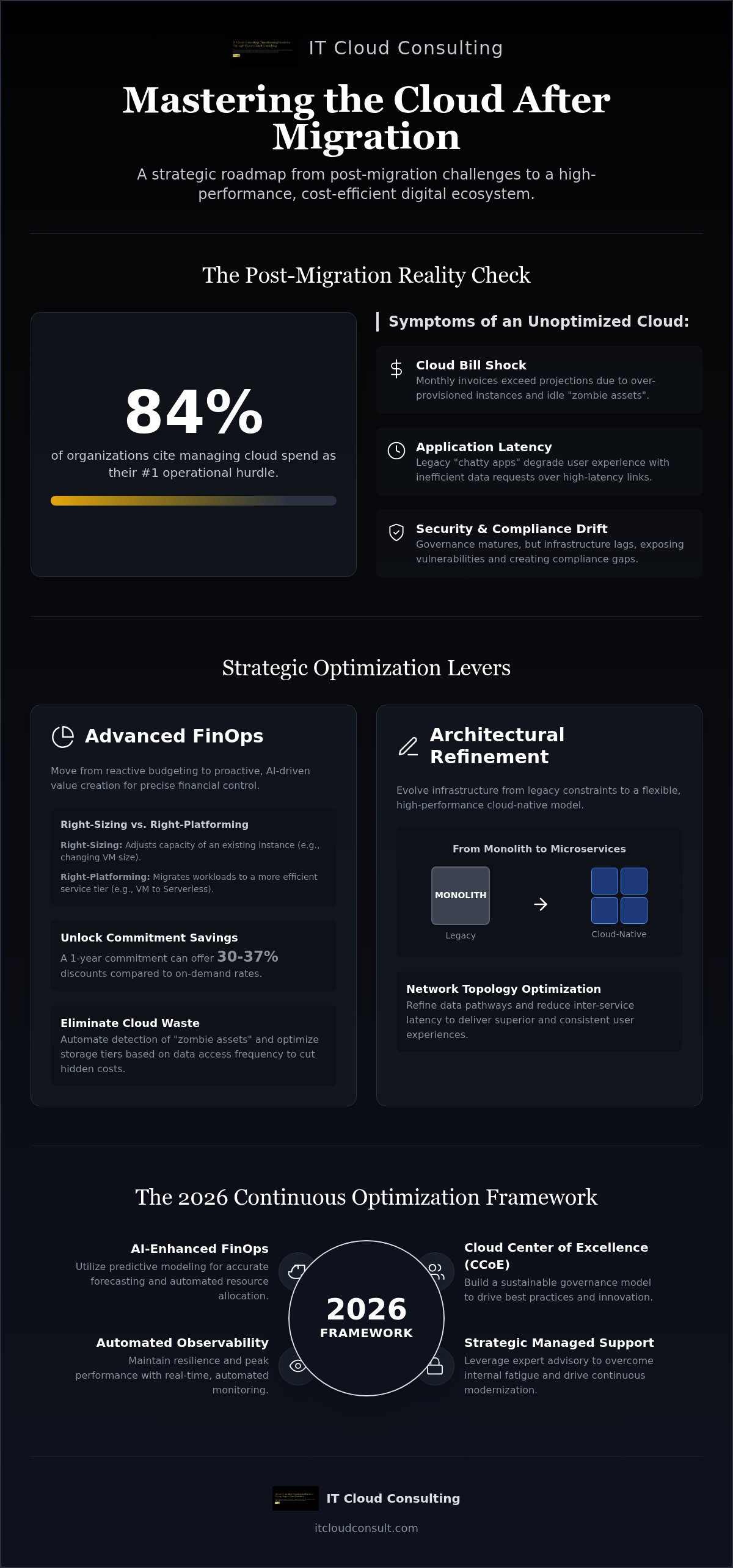
The 2026 Continuous Optimization Framework
The 2026 Continuous Optimization Framework moves beyond periodic reviews to establish a perpetual cycle of refinement. Effective post-migration cloud optimization requires a structured approach that integrates governance with execution. It's the transition from a one-time project to a standard operational rhythm. This framework ensures that your digital ecosystem remains lean, high-performing, and fully aligned with your evolving business objectives.
Step 1 involves establishing a Cloud Center of Excellence (CCoE). This cross-functional team acts as the visionary architect for your environment, ensuring that cloud decisions align with broader business goals while maintaining technical standards. Step 2 focuses on implementing automated observability and synthetic monitoring. By simulating user interactions and tracking metrics in real time, teams can identify performance bottlenecks before they impact your national user base. Step 3 requires the phased modernization of high-cost, low-performance workloads. This methodical refinement ensures that resources are prioritized where they can deliver the highest ROI. Finally, Step 4 creates continuous feedback loops between finance, engineering, and business units. This alignment prevents the departmental silos that often lead to inefficient spending and ensures every technical decision is rooted in business value.
Bridging the Cloud Skills Gap
Your technical infrastructure isn't effective without the people to manage it. Organizations must invest in training internal teams on cloud-native operational frameworks to prevent optimization fatigue. Site Reliability Engineering (SRE) plays a pivotal role here, shifting the focus from manual maintenance to automated system health. Cultivating a culture of cost-consciousness across the development lifecycle ensures that every engineer understands the financial impact of their architectural choices. This cultural shift transforms optimization from a chore into a shared organizational value.
Leveraging AI for Autonomous Optimization
The evolution of self-healing infrastructure in 2026 allows systems to remediate issues without human intervention. AI-driven agents now handle predictive resource allocation, adjusting capacity based on historical patterns and real-time demand. Automated incident response further mitigates downtime risks by identifying and isolating faults instantly. These autonomous systems ensure that your environment remains optimized even as workloads fluctuate or complexity increases. If your organization is ready to move beyond basic cleanup and implement a proactive strategy, our experts provide comprehensive Cloud Optimization services to guide your evolution.
Partnering for Evolution: Strategic Managed Support
Internal teams often face "optimization fatigue" once the initial migration cutover is complete. The intense focus required for the migration sprint often leaves little bandwidth for the granular refinement phase that follows. While your staff understands your specific applications, external advisory provides the objective, "big picture" perspective required to identify systemic inefficiencies that internal teams might overlook. This partnership facilitates the transition from reactive troubleshooting to proactive managed cloud services. IT Cloud Consulting serves as your visionary architect, helping you navigate the complexities of a post-migration cloud optimization strategy to build a resilient and profitable digital future.
Customized Optimization Roadmaps
Developing an enterprise cloud transformation roadmap allows you to tailor your technical journey to specific ROI targets. We focus on a dual-track approach that balances immediate needs with future growth. This involves:
- Identifying immediate "quick wins" to reduce monthly cloud bills and improve performance.
- Planning long-term architectural modernizations that drive sustainable enterprise value.
- Aligning technical execution with your national business growth objectives.
This structured alignment ensures that every technical adjustment supports your broader corporate vision, transforming the cloud from a mere hosting destination into a strategic engine for innovation.
Managed Cloud Evolution as a Competitive Advantage
Managed evolution provides the expert oversight needed to scale your operations without the burden of increasing technical complexity. By delegating the continuous tuning of performance and cost to a dedicated partner, you ensure your environment remains at peak efficiency as workloads evolve. This level of professional management empowers your internal leadership to focus on product innovation and market expansion rather than infrastructure maintenance. We handle the complexities of infrastructure management, from monitoring regulatory compliance to predictive resource allocation. This supportive orientation allows your business to realize its latent potential and maintain a competitive edge in an increasingly digital marketplace.
Architecting Your Future Cloud State
The transition from a basic cloud presence to a high-performance digital ecosystem requires a shift from reactive firefighting to a proactive, forward-looking strategy. By bridging the value gap through sophisticated FinOps levers and cloud-native architectural refinement, your organization can transform initial technical debt into a sustainable competitive advantage. Success in the 2026 landscape is defined by continuous evolution; it's the methodical alignment of infrastructure costs with tangible business value.
A commitment to post-migration cloud optimization ensures that your environment remains resilient, compliant, and fiscally disciplined as workloads scale. Our team provides the visionary architectural advisory and national managed cloud support required to navigate these complexities with steady assurance. Maximize your cloud ROI with a strategic optimization assessment from IT Cloud Consulting. We're ready to serve as your dependable guide, empowering your leadership to focus on innovation while we secure your technical foundation. The potential for modernization is limitless when you have the right framework and partner to realize it.
Frequently Asked Questions
What is post-migration cloud optimization?
Post-migration cloud optimization is the strategic process of refining your cloud infrastructure to meet specific business performance and financial goals. While migration focuses on moving workloads, optimization focuses on making them thrive. This phase involves rightsizing resources, upgrading to modern service tiers, and implementing governance to ensure your digital ecosystem operates with maximum efficiency. It's the transition from a simple cloud presence to an architected, high-performance environment.
How much can a company typically save through cloud optimization?
Savings vary based on your starting point, but organizations often achieve significant reductions through structured refinement. For example, moving from on-demand pricing to committed use discounts can reduce costs by approximately 30% to 37% depending on the provider. Utilizing spot instances for non-critical workloads can offer even deeper reductions of up to 79%. These strategic adjustments ensure that your infrastructure spend directly supports your long-term ROI and business growth.
Why is my cloud bill higher after moving from an on-premise data center?
Higher costs often stem from the "lift and shift" hangover, where legacy applications are moved to the cloud without architectural adjustments. On-premise systems are built for peak capacity, but cloud pricing rewards elasticity. If your applications aren't designed to scale down during low demand, you pay for idle resources. Additionally, hidden drivers like egress fees and unattached storage volumes can quickly inflate your monthly invoice without professional oversight.
How often should we perform a cloud architecture review?
You should treat architectural reviews as a continuous process rather than a one-time event. While a comprehensive, formal review is recommended at least quarterly, any significant change in workload or business strategy should trigger an assessment. In the fast-moving 2026 landscape, new service tiers and AI-driven features emerge frequently. Regular reviews ensure your environment remains resilient and continues to leverage the latest efficiencies to maintain a competitive advantage.
What is the role of FinOps in post-migration success?
FinOps provides the financial management framework required to bring accountability and visibility to your cloud spend. It bridges the gap between engineering, finance, and business units, ensuring that every technical decision is rooted in economic value. By implementing real-time cost tracking and tag-based allocation, FinOps allows your organization to move from reactive budgeting to proactive value creation. This alignment is essential for achieving long-term post-migration cloud optimization goals.
Can we optimize our cloud environment without refactoring applications?
Yes, you can achieve immediate gains through "right-sizing" instances and optimizing storage tiers without changing code. Adjusting your purchasing strategy to include savings plans or reserved instances also provides significant cost relief. However, the most transformative performance and cost benefits usually require some degree of refactoring. Moving to serverless or containerized architectures allows your infrastructure to fully exploit the native elasticity and efficiency of modern cloud environments.
What are the most common hidden costs in a cloud environment?
Data egress fees and inter-region transfer costs are among the most frequent hidden drivers of cloud bill shock. "Zombie assets," such as unattached storage volumes or forgotten snapshots, also continue to accrue charges long after their associated instances are terminated. Additionally, using high-performance SSD tiers for workloads that don't require low latency can lead to unnecessary expenses. Continuous monitoring is required to identify and eliminate these inefficiencies before they impact your budget.
Is it better to optimize cloud resources manually or through automation?
Automation is the superior choice for managing the complexity of modern, multi-cloud environments. While manual reviews provide strategic context, automated tools and AI-driven agents can handle real-time resource allocation and incident response with a speed and precision that humans can't match. Implementing "self-healing" infrastructure ensures that your environment remains optimized 24/7. This proactive approach reduces the risk of downtime and prevents the "optimization fatigue" that often plagues internal engineering teams.


