
By 2026, the traditional cloud migration checklist has become obsolete, replaced by a mandate to architect for an autonomous, agentic future. If your organization still treats the cloud as a mere storage extension rather than a strategic operating system, you aren't just falling behind; you're building on a foundation of technical debt. We understand the frustration of watching monthly billing spikes outpace your operational gains while fragmented environments create persistent security anxiety. This guide empowers you to master the essential architectural and organizational pillars within a modern cloud adoption framework to ensure your enterprise transition is both high-impact and low-risk.
You deserve a strategy that transforms these technical hurdles into a competitive advantage. We'll provide a clear, actionable roadmap that standardizes governance across your departments and secures measurable cost control. From optimizing your data for AI-readiness to closing internal skill gaps, this article outlines the methodical steps required to evolve your legacy infrastructure into a high-performance engine for innovation. By aligning your business vision with technical execution, you can finally realize the latent potential of your digital assets.
Key Takeaways
- Learn why a modern cloud adoption framework must shift focus from simple migration to a "cloud-smart" strategy that anticipates the autonomous and agentic needs of 2026.
- Identify the critical roles of standardized governance and workforce evolution in preventing fragmented environments and unexpected monthly billing spikes.
- Evaluate the unique architectural strengths of AWS, Azure, and Google Cloud frameworks to determine which blueprint best aligns with your specific organizational objectives.
- Follow a phased implementation roadmap that prioritizes thorough readiness assessments and secure landing zones to minimize risk during enterprise-wide optimization.
- Discover how a strategic partnership bridges the gap between high-level framework theory and the measurable operational efficiency required for national enterprise success.
Understanding the Cloud Adoption Framework: The Blueprint for Digital Evolution
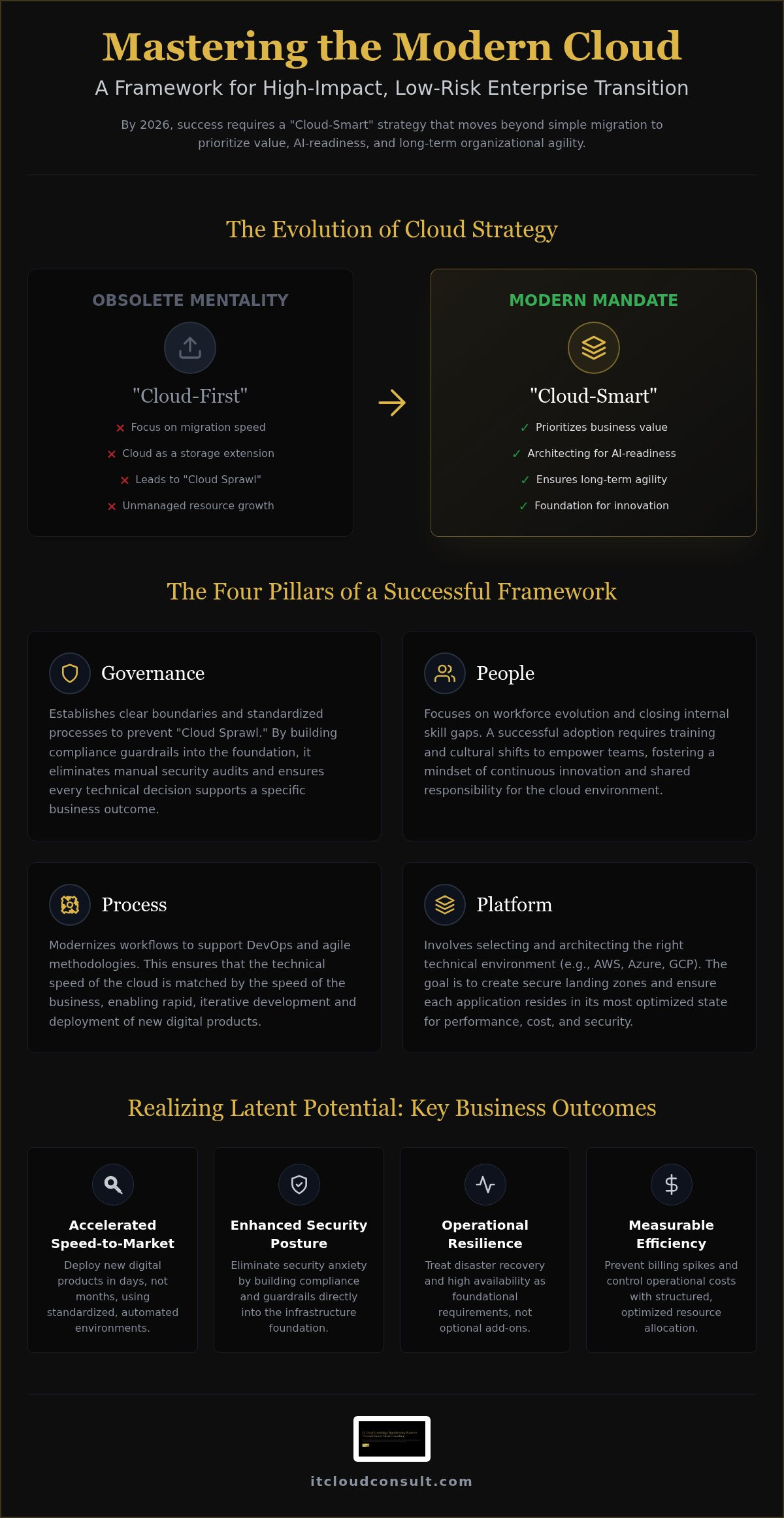
A cloud adoption framework is a structured approach to aligning business goals with cloud technology implementation. It serves as a comprehensive guide that translates high-level executive vision into a series of technical milestones. While early cloud journeys often focused on the sheer speed of migration, the landscape in 2026 demands a more sophisticated methodology. We've moved beyond the "cloud-first" era, where organizations rushed to the cloud to avoid being left behind. Success now requires a "cloud-smart" strategy that prioritizes value, AI-readiness, and long-term organizational agility.
Adopting this structured mentality is vital because enterprise spending on cloud services reached USD 99 billion worldwide in the second quarter of 2025, according to Synergy Research Group. Without a rigorous framework, this level of investment often leads to waste rather than innovation. A well-executed strategy focuses on four core objectives: reducing migration risk, accelerating time-to-value, establishing governance, and controlling operational costs. It's the difference between a fragmented digital estate and a unified, high-performance architecture.
The Strategic Necessity of a Framework
Many enterprises fall into the "Cloud Sprawl" trap, where unmanaged resource growth leads to security vulnerabilities and budget overruns. A cloud adoption framework prevents this by establishing clear boundaries and standardized processes before the first workload moves. It bridges the gap between what the boardroom expects and what the IT department can realistically deliver. A Cloud Adoption Framework is the bridge between business potential and technical reality. By defining these parameters early, you ensure that every technical decision supports a specific business outcome, preventing the technical debt that plagues unguided migrations.
Key Business Outcomes of a Structured Transition
When you approach modernization through a structured lens, the benefits extend far beyond the IT department. We focus on realizing the latent potential of your infrastructure to drive these specific results:
- Accelerated Speed-to-Market: Standardized environments allow developers to deploy new digital products in days rather than months.
- Enhanced Security Posture: By building compliance guardrails directly into the foundation, you eliminate the anxiety of manual security audits.
- Operational Resilience: Modern frameworks treat disaster recovery and high availability as foundational requirements, not optional add-ons.
- Measurable Efficiency: Structured governance ensures that resource allocation is always optimized, preventing the billing spikes that often derail cloud projects.
This methodical approach builds trust across the organization. It transforms the cloud from a source of complexity into a reliable engine for continuous evolution.
The Four Pillars of a Successful Cloud Adoption Strategy
The "Process" pillar focuses on modernizing workflows to support DevOps and agile methodologies, ensuring that the speed of the cloud is matched by the speed of the business. Meanwhile, the "Platform" pillar involves selecting and architecting the right technical environment for your specific workloads. Whether you are deploying a landing zone in Azure or an agentic data cloud in Google, the goal is to ensure each application resides in its most optimized state. This holistic approach ensures that modernization isn't just a change in location, but a fundamental improvement in how the business operates.
By 2026, governance has evolved from a static set of rules into dynamic, automated policy enforcement. This prevents "security drift," where configurations slowly deviate from compliant states over time. We also see the rise of FinOps as a critical governance function. With enterprise cloud spending reaching nearly $100 billion, managing monthly billing spikes is no longer just an accounting task; it's a strategic priority. Implementing standardized cloud blueprints allows national organizations to meet strict regulatory standards without sacrificing the agility that makes the cloud attractive. These guardrails provide the steady assurance that your environment remains secure and cost-effective as it scales.
Organizational Change Management
The transition to the cloud is fundamentally a human challenge. IT teams must evolve from managing physical hardware to mastering cloud orchestration. This shift requires a dedicated focus on upskilling and breaking down traditional silos. By integrating developers, security, and operations into a unified DevSecOps culture, you ensure that security is a foundational component of every deployment. A Cloud Center of Excellence (CCoE) acts as the visionary guide for this journey, driving the adoption of the Cloud Adoption Framework for AI and other emerging technologies. This centralized team ensures that best practices are shared across the enterprise, fostering a culture of continuous improvement. If your team is struggling to align these internal resources, exploring Strategic Cloud Adoption services can provide the roadmap needed to bridge the gap between legacy mindsets and modern execution.
Comparing Major Frameworks: AWS vs. Azure vs. Google Cloud
Choosing the right cloud adoption framework depends heavily on your existing technical ecosystem and long-term business objectives. The AWS CAF is renowned for its focus on business perspectives, helping leaders identify how cloud initiatives drive specific financial and operational outcomes. In contrast, the Microsoft Cloud Adoption Framework for Azure places a heavy emphasis on governance and management. Recent updates in September 2026 have refined its guidance on Azure landing zones, providing clearer implementation paths for complex enterprise structures. Google Cloud takes a different route, prioritizing data-heavy enterprises. With the release of the Google Cloud Cortex Framework Version 7 in September 2026, the focus has shifted toward modernizing data architectures for AI agent readiness.
When to Use a Vendor-Specific Framework
If your organization is deeply committed to a single provider, leveraging their specific framework offers immediate advantages. Tools like AWS Control Tower or Azure Blueprints provide rapid deployment capabilities by automating the creation of secure, compliant environments. However, following a single provider’s framework too closely introduces the risk of vendor lock-in. You might find your architectural choices dictated more by the provider's roadmap than by your own strategic needs. We recommend identifying your dominant provider first, then using their framework as a baseline while maintaining enough flexibility to pivot if market conditions change.
The Hybrid and Multi-Cloud Framework Approach
Many national enterprises now require a custom, vendor-neutral approach to manage hybrid-cloud environments effectively. This strategy prioritizes portability by using containers and Kubernetes as standardized components. By architecting for the "lowest common denominator" across clouds, you ensure that workloads can move seamlessly between providers without significant refactoring. A unified management layer becomes essential here, allowing your teams to oversee multiple clouds through a single cloud adoption framework tailored to your unique needs. For those seeking architectural deep-dives into these complex setups, our guide on Cloud Infrastructure Consulting: A Strategic Guide to Enterprise Modernization offers further technical clarity. This vendor-neutral stance ensures your modernization journey remains driven by business logic rather than technical constraints.
Implementation Roadmap: Scaling from Pilot to Full Optimization
Transitioning from a legacy environment to a modernized infrastructure requires a methodical roadmap that balances immediate wins with long-term stability. This journey ensures that your cloud adoption framework moves beyond theoretical planning into measurable operational success. We structure this evolution into four distinct phases, allowing your organization to scale with precision while maintaining tight control over security and costs. By following a logical progression, you avoid the common pitfalls of fragmented migrations and unmanaged resource growth.
Phase 1 begins with a Readiness Assessment, where we evaluate technical debt and organizational maturity to determine the best path forward. Phase 2 focuses on building the Foundation and Landing Zone, creating the secure starting point for all future workloads. Phase 3 involves the actual Migration and Modernization, where legacy systems are refactored to take full advantage of cloud-native capabilities. Finally, Phase 4 centers on Optimization and Innovation. Here, we tune for peak performance and integrate the agentic AI and autonomous workflows that define the 2026 digital landscape.
The Cloud Readiness Assessment
Before moving a single workload, you must conduct a comprehensive inventory of your digital assets. We categorize each application for Rehost, Replatform, or Refactor based on its business value and technical complexity. Identifying "low-hanging fruit," such as non-critical development environments or standalone databases, allows for initial pilot migrations. These early successes build internal momentum and provide valuable data for the larger rollout. A readiness assessment is the most critical step to prevent project stalls and ensure your technical foundation supports your long-term goals. It provides the clarity needed to align your IT capabilities with executive expectations from day one.
Post-Migration: Continuous Cloud Optimization
The journey doesn't end once your workloads are in the cloud. Continuous cloud optimization is an iterative process of rightsizing, where we adjust resources based on actual usage patterns rather than initial estimates. By 2026, this process has become increasingly automated, leveraging AI-driven insights for proactive performance tuning. This ensures your infrastructure remains as efficient as possible, preventing the monthly billing spikes that often plague unguided environments. You can learn more about maximizing your returns in our guide on Cloud Optimization Consulting. This ongoing support ensures that your modernization effort remains a source of value rather than a growing cost center. If you're ready to move from planning to execution, our team provides the Strategic Cloud Adoption expertise needed to navigate this complex roadmap with confidence.
Modernizing with IT Cloud Consulting: Your Strategic Partner
Theory often meets resistance when it encounters the complexities of a live enterprise environment. While a cloud adoption framework provides the architectural blueprint, the actual realization of that vision requires a partner capable of navigating both technical and cultural hurdles. We don't just provide a checklist; we act as your visionary architect and dependable guide, ensuring that your modernization journey translates into measurable business results. By bridging the gap between high-level theory and operational reality, we help national US enterprises unlock the latent potential within their infrastructure through a methodical, cause-and-effect approach to digital evolution.
Our commitment to your success extends beyond the initial deployment. We focus on the transition from legacy systems to optimized, future-state architectures that are designed to handle the "agentic era" of 2026. This requires a sophisticated understanding of how technical processes connect to broader organizational benefits. By positioning ourselves as a strategic consultant rather than a mere vendor, we ensure that every building block of your cloud journey leads toward a more optimized and advanced future state.
Customized Roadmap Development
Our approach to Strategic Cloud Adoption focuses on developing customized roadmaps that align with your specific business drivers. We move beyond generic vendor templates to build a strategy rooted in your unique industry requirements and organizational maturity. This process involves defining clear Key Performance Indicators (KPIs) from the outset, allowing you to measure the success of your transformation in real-time. We view our engagement as a long-term partnership for growth rather than a simple, one-time migration event. This ensures that your technical evolution remains synchronized with your organizational objectives as you scale across national markets.
Ongoing Managed Support and Evolution
The transition to the cloud is a continuous process of refinement and adaptation. Once the initial migration is complete, the focus must shift toward maintaining the integrity of your cloud adoption framework through ongoing support. Our managed services provide the steady assurance needed to navigate the evolving 2026 threat landscape. We conduct continuous security audits and proactive monitoring to ensure 24/7 operational health, preventing the performance degradation that often follows unmanaged deployments.
This commitment to evolution allows your organization to stay ahead of the curve, integrating new innovations like autonomous AI agents as they emerge. You can discover our full suite of Managed Cloud Services to see how we support your long-term stability. By prioritizing continuous optimization, we transform your cloud environment into a high-performance engine for sustained innovation and measurable efficiency.
Architecting Your Future in the Cloud
Modernization is no longer a destination but a continuous state of evolution. By implementing a structured cloud adoption framework, your enterprise moves beyond fragmented environments toward a unified, high-performance architecture. You've seen how the four pillars of governance, people, process, and platform provide the stability required to scale securely. This methodical approach ensures that technical decisions always serve your broader business drivers, preventing the technical debt that often stalls digital transformation.
Realizing the latent potential of your infrastructure requires more than just a migration plan; it demands a visionary architect to guide the way. Our team specializes in expert guidance for national cloud transformations, maintaining a relentless focus on operational efficiency and ROI. We provide comprehensive managed support to ensure your long-term stability in an increasingly complex digital landscape. Partner with IT Cloud Consulting for your Strategic Cloud Adoption roadmap and begin the transition to a more optimized, future-state architecture today. Your path to sustainable innovation is ready to be built.
Frequently Asked Questions
What is the primary goal of a Cloud Adoption Framework?
The primary goal of a cloud adoption framework is to align an organization's business objectives with its technical cloud implementation. It provides a structured roadmap that ensures technical decisions drive specific financial and operational outcomes. By establishing clear governance and architectural standards, the framework reduces migration risks while accelerating the realization of business value. It transforms the cloud from a simple storage solution into a high-performance engine for continuous innovation and strategic growth.
How long does it take to implement a cloud adoption strategy?
Implementation timelines vary significantly based on organizational maturity and the complexity of existing legacy systems. A pilot phase might take three to six months, while a full enterprise-wide modernization can span one to two years. It's important to view this as a continuous evolution rather than a one-time project. Ongoing optimization ensures the environment adapts to new technologies, such as agentic AI, which became a central theme for cloud providers in early 2026.
Can we implement a framework if we have already moved to the cloud?
You can absolutely implement a cloud adoption framework even if your workloads are already in the cloud. In fact, many organizations adopt a structured framework post-migration to resolve fragmented environments or unexpected billing spikes. This retrospective application focuses on establishing standardized governance and optimizing existing resources. It allows you to retroactively build a secure foundation, ensuring that your current cloud footprint aligns with the high-level strategic confidence required for long-term development.
What is the difference between cloud migration and cloud transformation?
Cloud migration focuses on the technical act of moving workloads from on-premise hardware to a cloud environment. Cloud transformation represents a broader shift that modernizes business processes and organizational culture to leverage cloud-native capabilities fully. While migration is often a lift and shift exercise, transformation involves refactoring systems for maximum efficiency. This deeper evolution allows enterprises to realize the latent potential of their digital assets through improved agility and faster speed-to-market.
How does a Cloud Adoption Framework help with cost control?
A structured framework improves cost control by implementing automated policy enforcement and rightsizing protocols. It establishes a FinOps culture where resource allocation is based on actual usage patterns rather than initial estimates. By using standardized cloud blueprints, organizations can prevent unmanaged resource growth and the monthly billing spikes that often derail IT budgets. This methodical approach ensures that every dollar spent on cloud services directly contributes to measurable operational efficiency and business growth.
Is a Cloud Adoption Framework necessary for small businesses?
While small businesses may not require the complex multi-clause frameworks used by national enterprises, a simplified cloud adoption framework is still essential. It prevents the cloud sprawl and security drift that can occur when resources are deployed without a clear strategy. Even on a smaller scale, having a structured approach ensures that technical investments are purposeful and secure. This foundation allows smaller organizations to scale with precision, avoiding the technical debt that often hinders future growth. For those seeking expert guidance on managing these environments, check out Networking2000.
Choosing between the AWS CAF and the Microsoft Azure CAF depends on your dominant cloud provider and specific organizational needs. The AWS framework is highly regarded for its six perspectives that focus on business and financial outcomes. Microsoft’s framework is often preferred for its deep emphasis on governance and the implementation of secure landing zones. If your organization operates in a hybrid or multi-cloud environment, we often recommend a custom, vendor-neutral strategy that incorporates the strengths of both.
What are the biggest risks of not using a formal framework?
The biggest risks of bypassing a formal framework include fragmented cloud environments, significant security vulnerabilities, and unmanageable operational costs. Without a visionary architect to guide the journey, organizations often face persistent skill gaps and architectural inconsistencies. These issues lead to cloud sprawl, where unmanaged resources create technical debt and operational friction. A lack of standardized governance also increases compliance anxiety, making it difficult to maintain a secure and resilient future-state architecture.


