
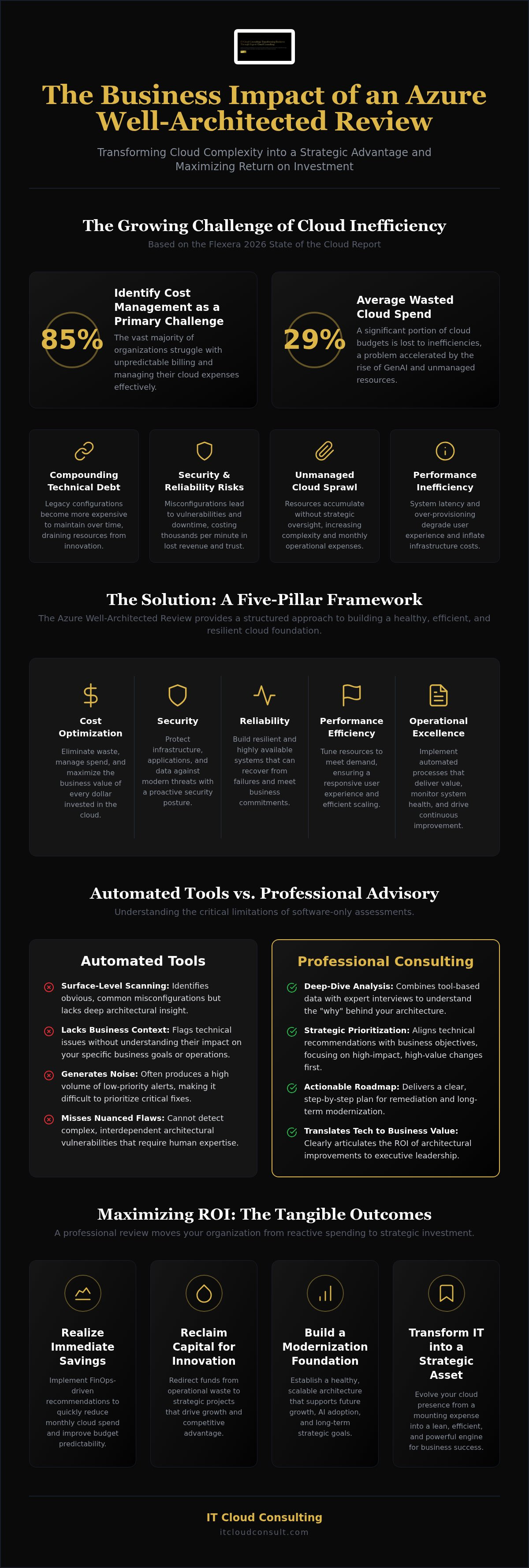
According to the Flexera 2026 State of the Cloud Report, 85% of organizations now identify cloud cost management as their primary challenge, while wasted cloud spend has climbed to 29% due to the surge in generative AI. You likely recognize the friction of unpredictable billing and the cloud sprawl that accumulates when legacy configurations outpace your strategic goals. Evaluating the azure well-architected review cost is a critical step for leaders who need to justify professional advisory fees to executive leadership. You deserve a partner that views your infrastructure as a foundation for innovation rather than a mounting expense.
This guide provides a comprehensive framework for calculating ROI and a clear understanding of professional consulting fee ranges. We'll explore how these assessments move your organization from reactive troubleshooting to a state of operational excellence as part of your broader journey toward strategic cloud adoption. You'll gain a methodical roadmap for implementing optimization findings that secure your environment while maximizing every dollar of your cloud investment. By shifting focus toward value realization, you can transform your digital footprint into a lean, strategic asset.
Key Takeaways
- Understand how architectural technical debt and unmanaged cloud sprawl compound over time to drive up your monthly operational expenses.
- Evaluate how workload complexity and resource interdependencies define the professional azure well-architected review cost for your specific infrastructure.
- Examine the critical limitations of automated tools and why professional advisory is essential to capture the nuanced architectural vulnerabilities that software often misses.
- Learn to prioritize remediation efforts through a FinOps lens to realize immediate savings while building a foundation for long-term modernization.
- Gain a clear roadmap for evolving from a basic technical checklist to a comprehensive strategy for ongoing cloud optimization and strategic adoption.
The Financial Impact of Architectural Inefficiency in Azure
Organizations today face a landscape where technical choices dictate financial outcomes. The shift from capital expenditure to operational models has fundamentally altered cloud computing economics, making architectural health a direct driver of the bottom line. When your infrastructure isn't aligned with best practices, you aren't just facing technical hurdles; you're experiencing a silent erosion of your operational budget. According to the Flexera 2026 State of the Cloud Report, wasted cloud spend has increased to 29 percent, a rise driven by the complexity of rapid AI adoption and unmanaged hybrid environments.
Architectural technical debt compounds much like high-interest financial debt. Legacy configurations that seemed sufficient during initial deployment often require more manual intervention and higher resource consumption as they age. This inefficiency creates a cycle where you pay a premium for systems that no longer serve your strategic goals. When evaluating the azure well-architected review cost, leaders must look beyond the immediate invoice to the long-term savings generated by technical health. The review acts as a circuit breaker for this compounding debt, allowing you to reclaim capital for innovation.
While automated alerts provide a baseline of visibility, they lack the strategic context required for long-term fiscal health. A tool might flag an underutilized virtual machine, but it won't explain why your current architecture prevents that resource from being decommissioned. True optimization requires a deep understanding of the five pillars: Cost Optimization, Operational Excellence, Performance Efficiency, Reliability, and Security. Neglecting any one of these pillars creates a "cloud sprawl" that automated tools simply can't resolve on their own. The azure well-architected review cost is an investment in professional clarity that transforms these technical pillars into business results.
The Cost of Misconfigured Cloud Security and Reliability
Misconfigured security isn't just a risk; it's a liability with a quantifiable price tag. Downtime resulting from poor reliability architecture can cost enterprises thousands of dollars per minute in lost productivity and customer trust. In 2026, the escalating costs of compliance failures and security breaches mean that "just enough" security is often the most expensive strategy an organization can employ. Investing in professional assessment ensures your reliability architecture is resilient enough to withstand modern disruptions without draining your reserves.
Performance Efficiency as a Revenue Driver
Operational waste often hides in system latency, where every millisecond of delay can degrade the user experience and lower conversion rates. Performance efficiency ensures that your resource allocation scales precisely with demand, preventing the over-provisioning that inflates monthly billing. When systems are optimized, they process workloads faster and more reliably, directly impacting your ability to serve customers and generate revenue. Performance efficiency serves as the essential architecture for enterprise scalability by ensuring that technical resources expand in direct proportion to organizational growth.
Breaking Down the Azure Well-Architected Review Cost Components
A professional Azure Well-Architected Review functions as a high-level strategic diagnostic for your digital estate. It moves beyond basic automated checklists to examine the structural integrity of your cloud environment against industry benchmarks. The azure well-architected review cost is primarily dictated by the scope of your workloads and the complexity of their interdependencies. A single, isolated application requires significantly less scrutiny than a global hybrid environment where hundreds of services communicate across multiple regions. As interdependencies increase, the time required to map data flows and security perimeters scales accordingly.
Assessment depth also plays a pivotal role in determining your total investment. While high-level automated scans identify obvious misconfigurations, they often overlook the nuanced architectural flaws that only deep-dive interviews can uncover. Specialized expertise in security, FinOps, and performance tuning ensures that the audit addresses specific business risks rather than generic technical standards. You're paying for the ability to translate technical telemetry into a strategic roadmap that supports your long-term modernization goals.
Direct Consulting Fees and Resource Allocation
Advisory firms typically utilize either hourly rates or project-based pricing models for these assessments. Project-based fees offer more budget predictability for executive leadership, while hourly models might better suit highly fluid or poorly documented environments. Organization size naturally impacts the duration of the process. A multinational enterprise requires more stakeholder engagement and data validation than a mid-market firm, which extends the engagement timeline. Senior cloud architects command a premium because their experience allows them to connect technical remediation directly to business outcomes, ensuring your Cloud Optimization efforts yield a tangible return on investment.
Hidden Factors Influencing Your Review Investment
Beyond the consultant's invoice, you must account for the internal staff time required for data gathering and architectural interviews. Your lead engineers and stakeholders will need to dedicate several hours to provide the context that makes the review actionable. It's also vital to distinguish between the audit fee and the subsequent remediation costs. Identifying a vulnerability or a performance bottleneck is the first step; implementing the fix requires a separate allocation of resources. Finally, consider the frequency of these assessments. While a one-time audit provides a valuable snapshot, many organizations find that a continuous optimization cycle is more effective at preventing the "cloud sprawl" that often accompanies rapid AI adoption. This proactive approach ensures that your azure well-architected review cost remains a controlled, strategic investment rather than an emergency expense.
Strategic Analysis: DIY Assessment vs. Professional Consulting
Deciding between a self-guided assessment and a partner-led engagement is a pivotal choice for IT leadership. While the free Azure Advisor and Self-Assessment tools provide immediate visibility into common misconfigurations, they often fail to address the underlying business logic of your architecture. These automated systems excel at identifying "what" is occurring within your environment; however, they rarely explain "how" those technical patterns impact your long-term organizational goals. Some industry professionals report an "Expertise Gap" where automated tools miss approximately 40 percent of architectural nuances that only a human specialist can identify through contextual analysis.
The true azure well-architected review cost must include the hidden expense of internal engineering time. Diverting your lead developers from product innovation to conduct a deep-dive audit often results in a higher opportunity cost than hiring external specialists. Strategic consultants provide an essential, unbiased third-party perspective that internal teams simply cannot replicate. Internal teams naturally possess blind spots regarding the systems they built and maintain. A strategic partner identifies these gaps without the baggage of institutional bias, ensuring your cloud governance remains objective and forward-looking.
When the Free Tool is Sufficient
Free tools serve as an excellent starting point for small, non-critical workloads or isolated development environments. In these scenarios, the risk profile is low enough that automated baseline checks provide sufficient coverage. You can also use the free self-assessment as a preliminary discovery phase to prepare your team for a professional engagement. However, these tools quickly reach their limits in complex hybrid or multi-cloud configurations where interdependencies create ripples that simple telemetry can't capture.
The ROI of Professional Cloud Optimization Consulting
Professional advisory services offer more than just a list of technical fixes. Engaging a specialist gives your organization access to proprietary frameworks and remediation playbooks that have been refined across hundreds of enterprise deployments. This approach ensures that every technical adjustment aligns with your broader business strategy, transforming your cloud from a cost center into a growth engine. Investing in cloud optimization consulting allows you to bridge the gap between technical telemetry and executive-level value realization.
Maximizing ROI: Turning Review Findings into Cloud Savings
Justifying the azure well-architected review cost to executive leadership requires a clear transition from technical discovery to quantifiable fiscal recovery. The true value of the assessment lies in its ability to categorize findings into immediate "Quick Wins" and foundational "Strategic Shifts". By prioritizing remediation based on impact and effort, organizations often see the review pay for itself through reclaimed waste within the first two quarters. This methodical approach transforms a one-time audit into a catalyst for ongoing financial discipline.
Integrating FinOps principles ensures that the efficiencies gained during the review don't erode over time. A professional assessment provides the data necessary for advanced "Right-Sizing" and the strategic planning of Reserved Instances or Savings Plans. Measuring success involves establishing specific KPIs, such as the ratio of wasted spend to total cloud investment or the percentage of workloads meeting reliability benchmarks. These metrics allow you to demonstrate a direct correlation between architectural health and corporate profitability.
The First 30 Days: Executing High-Impact Recommendations
Immediate savings typically come from identifying and eliminating orphaned resources, such as unattached storage disks or "zombie" virtual machines that consume budget without providing value. Implementing automated scaling ensures your environment contracts during low-demand periods, preventing the common trap of paying for peak capacity 24/7. Proactive security hardening significantly improves your risk-adjusted ROI by preventing the catastrophic financial fallout associated with data breaches and compliance penalties. These initial steps provide the momentum needed to tackle more complex architectural evolutions.
Long-Term Modernization and Strategic Growth
Sustainable cost reduction often requires moving from Infrastructure-as-a-Service (IaaS) to Platform-as-a-Service (PaaS) models. This transition reduces management overhead, eliminates OS-level patching requirements, and often lowers licensing costs. Developing a comprehensive enterprise cloud transformation roadmap allows your organization to build a culture of continuous architectural excellence. By embedding these standards into your delivery lifecycle, you ensure that future growth remains lean and efficient. To begin this journey, consider how professional Ongoing Cloud Support can maintain your optimized state as your business scales.
Partnering for Success: Professional Azure Advisory
At IT Cloud Consulting, we recognize that a technical audit is only as valuable as the business results it enables. While many vendors treat the Azure Well-Architected Framework as a simple checklist, we view it as a diagnostic foundation for long-term evolution. Our advisory services bridge the gap between technical telemetry and executive strategy, ensuring that your infrastructure evolves alongside your organizational goals. By integrating managed support into our delivery model, we ensure that the optimization gains identified during the review become permanent fixtures of your operational environment. Enterprise leaders trust our roadmap because it provides a clear path from current complexity to a future state of lean, high-performance operations.
The azure well-architected review cost should be viewed as the first step in a broader journey of transformation. We don't just identify what is broken; we provide the architectural proficiency required to execute a more advanced vision. This partnership model moves your organization beyond reactive troubleshooting and into a state of strategic confidence. By aligning your cloud investment with proven best practices, you empower your team to innovate without the friction of technical debt or unpredictable billing cycles.
Our Strategic Cloud Adoption Framework
Every industry faces unique regulatory and performance requirements that a generic automated scan cannot satisfy. We utilize customized assessment models tailored to your specific sector, whether you're managing sensitive financial data or high-velocity retail workloads. This specialized approach is a core component of our strategic cloud adoption framework, which guides enterprises through the complexities of modernization. Beyond the initial audit, we provide ongoing monitoring and support to prevent architectural drift, ensuring that the azure well-architected review cost delivers compounding value over time. This proactive stance allows your internal team to focus on core product development while we maintain the structural integrity and efficiency of your cloud estate.
Next Steps: Securing Your Cloud Future
Initiating a professional review begins with a comprehensive discovery and scoping phase. During this stage, we work closely with your stakeholders to define the boundaries of the assessment and identify the mission-critical workloads that require the deepest scrutiny. This transparency ensures there are no surprises regarding the project timeline or the expected outcomes. You'll receive a prioritized roadmap that addresses immediate vulnerabilities while laying the groundwork for future scalability. Transitioning from a state of "cloud sprawl" to a lean, optimized architecture requires a partner who understands both the big picture and the technical execution. Optimize your cloud infrastructure with a professional review from IT Cloud Consulting to realize the full potential of your Azure investment and secure your digital future.
Realizing the Strategic Value of Your Cloud Investment
Modernizing your infrastructure requires a fundamental shift from viewing cloud resources as a utility to treating them as a strategic engine for growth. We have explored how the azure well-architected review cost functions as a catalyst for technical debt reduction; it provides the clarity needed to transform unpredictable billing into a predictable roadmap for innovation. By bridging the gap between automated telemetry and professional advisory, your organization can move beyond surface-level fixes to achieve permanent operational excellence.
IT Cloud Consulting provides the expertise in professional assessment and optimization required to secure your digital estate across our national US coverage area. Our team is dedicated to developing the strategic roadmap that supports your enterprise's long-term modernization goals. Schedule your professional Azure Well-Architected Review with IT Cloud Consulting today to unlock the latent potential of your cloud environment. You have a vision for your organization's future; we possess the architectural proficiency to help you reach it.
Frequently Asked Questions
How much does a professional Azure Well-Architected Review cost on average?
Professional fees for an architectural assessment typically depend on the complexity and volume of the workloads being evaluated. While some partners offer high-level scans at no cost to attract new business, a comprehensive five-pillar review usually involves a flat project fee or an hourly advisory rate. These costs reflect the depth of analysis and the seniority of the cloud architects involved. Organizations should expect pricing to scale with the number of resource groups and interdependencies within their environment.
Is the Azure Well-Architected Review worth the investment for mid-sized businesses?
A review is highly valuable for mid-sized organizations that lack the dedicated FinOps teams found in larger enterprises. Mid-market firms often experience rapid growth that leads to unmanaged "cloud sprawl" and significant resource waste. By identifying these inefficiencies early, a professional review helps stabilize monthly expenditures and ensures that technical infrastructure supports business agility. The return on investment often manifests as reclaimed budget that can be redirected toward product innovation and strategic expansion.
How long does a professional Azure architectural review typically take?
A professional engagement typically spans two to four weeks depending on the scope of the workloads. This timeline includes the initial discovery phase, data gathering through architectural interviews, and the final delivery of a prioritized remediation roadmap. Larger enterprises with complex hybrid configurations may require additional time to ensure all interdependencies are thoroughly analyzed. This methodical pace ensures that final recommendations are accurate and aligned with your specific operational requirements and long-term business strategy.
Does Microsoft provide funding or subsidies for Well-Architected Reviews?
Microsoft frequently offers funding programs and incentives through certified partners to help organizations offset the azure well-architected review cost. These subsidies are often available for mission-critical workloads or projects that lead to significant modernization and cloud adoption. Eligibility typically depends on your current Azure consumption levels and the strategic nature of the proposed optimization. Consulting with a qualified partner allows you to navigate these programs and maximize the financial support available for your architectural assessment.
What is the difference between Azure Advisor and a Well-Architected Review?
Azure Advisor is an automated tool that provides baseline recommendations based on telemetry data. In contrast, a Well-Architected Review is a strategic, human-led diagnostic that examines the business context behind your technical choices. While Advisor identifies "what" is happening, a professional review explains "why" it matters and "how" to fix it within your unique governance framework. This deeper analysis captures nuanced vulnerabilities and performance bottlenecks that automated software frequently misses during high-level scans.
How often should an enterprise conduct a cloud architectural review?
Enterprises should ideally conduct a comprehensive review annually or following any significant change in their technical landscape, such as a major migration or the adoption of generative AI workloads. Regular assessments prevent the accumulation of technical debt and ensure that your infrastructure remains aligned with evolving security standards. Smaller, pillar-specific reviews may be conducted more frequently to maintain cost efficiency. This proactive cycle of continuous optimization prevents the gradual erosion of architectural health and keeps operational expenses under control.
Can a Well-Architected Review help reduce my monthly Azure bill immediately?
Yes, the review process identifies "Quick Wins" that can lead to immediate reductions in your monthly billing. These typically include the elimination of orphaned resources, such as unattached disks, and the decommissioning of "zombie" virtual machines that consume budget without providing value. While long-term modernization provides sustainable savings, these initial adjustments often allow the azure well-architected review cost to pay for itself within the first few months. Strategic right-sizing and reserved instance planning further accelerate these financial benefits.
What deliverables should I expect from a professional Azure consulting engagement?
You should expect a comprehensive written scorecard that evaluates your environment across all five pillars of the framework. This is accompanied by a prioritized remediation backlog that distinguishes between immediate technical fixes and long-term strategic shifts. A professional engagement also provides a clear roadmap for modernization and documented findings from architectural interviews. These deliverables serve as a tactical guide for your engineering team and a strategic justification for executive leadership to support ongoing cloud optimization efforts.


