
Global public cloud spending is projected to reach $850 billion in 2026, yet many organizations still struggle to move past the initial pilot phase. You likely recognize that legacy CapEx models and fears of hidden management costs create significant internal friction during the planning stages. It's difficult to quantify agility or the realization of latent potential when stakeholders are focused solely on the immediate bottom line. Building a business case for cloud migration isn't just about comparing server costs; it's about architecting a strategic blueprint for long-term evolution.
We'll help you master the art of quantifying cloud value to secure stakeholder buy-in and accelerate your enterprise transformation. This guide details how to construct a financial model that accounts for the cost of doing nothing while positioning your infrastructure as a primary driver of efficiency. We will explore the specific components of a multi-year roadmap that transforms technical processes into measurable business results. By the end of this guide, you'll have the framework necessary to lead your organization toward a more optimized and advanced future state.
Key Takeaways
- Understand why the shift from "Cloud First" to "Cloud Only" makes strategic cloud adoption a necessity for maintaining a competitive edge in 2026.
- Learn how to quantify the "cost of doing nothing" by contrasting legacy maintenance expenses with the innovation potential of modernized infrastructure.
- Master the financial transition from CapEx to OpEx while building a business case for cloud migration that emphasizes long-term ROI through strategic FinOps principles.
- Follow a structured, five-step framework to conduct a comprehensive infrastructure audit and map workloads to high-value cloud-native services.
- Discover how a clear roadmap bridges the internal skills gap, ensuring your enterprise moves from a theoretical model to a functional, high-performance transformation.
The Strategic Mandate: Why Cloud Migration is Non-Negotiable in 2026
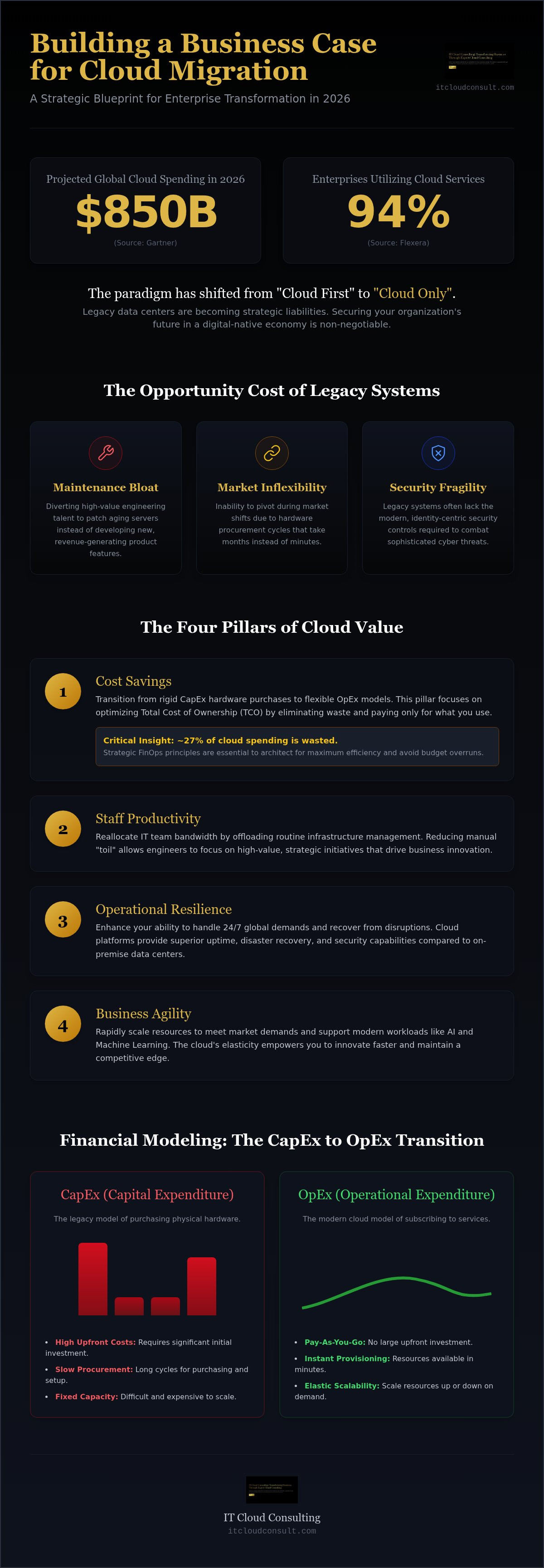
By 2026, the enterprise paradigm has shifted decisively from "Cloud First" to "Cloud Only." Gartner projections suggest public cloud spending will hit $850 billion this year, reflecting a reality where physical data centers are increasingly viewed as strategic liabilities. Flexera data indicates that 94% of enterprises now utilize at least one cloud service, marking the end of the hybrid-hesitation era. Building a business case for cloud migration is no longer about justifying an experimental move; it's about securing the organization's ability to function in a digital-native economy.
Strategic cloud infrastructure consulting helps transform IT departments from reactive cost centers into proactive value drivers that align with global macroeconomic trends. Understanding the core cloud computing principles is the first step toward realizing how these systems provide the agility that legacy hardware simply cannot match. By adopting a forward-looking perspective, leaders can bridge the gap between technical migration and actual business value realization.
The Opportunity Cost of Legacy Systems
In the context of IT infrastructure, opportunity cost is the measurable loss of potential gain from innovation that occurs when resources are diverted to maintaining obsolete systems. Technical debt acts as a silent anchor, preventing rapid market entry and draining budgets through the hidden costs of end-of-life hardware. Consider the following drains on organizational potential:
- Maintenance Bloat: Diverting high-value engineering talent to patch aging servers instead of developing new product features.
- Inflexibility: The inability to pivot during market shifts because procurement cycles for physical hardware take months rather than minutes.
- Security Fragility: Legacy systems often lack the identity-centric security controls required to combat modern cyber threats, making the specialized expertise of SecureB4 a valuable asset for maintaining a strong security posture.
Meeting 2026 Market Demands
Modern workloads, particularly those involving generative AI and large-scale machine learning, require a level of compute elasticity that on-premise solutions cannot provide. Synergy Research Group notes that AI adoption is the primary engine behind the trillion-dollar cloud market in 2026. Strategic Cloud Adoption ensures your enterprise is resilient enough to handle 24/7 global demands while staying prepared for the next wave of technological disruption. Establishing a clear roadmap today is the only way to ensure your organization remains relevant in a landscape defined by speed and scale.
The Four Pillars of Cloud Value Framework
Building a business case for cloud migration requires a multidimensional approach that extends far beyond a simple server-to-server cost comparison. While Total Cost of Ownership (TCO) remains a fundamental metric, it often fails to capture the transformative impact of cloud adoption on an organization's DNA. A comprehensive framework must evaluate cost savings, staff productivity, operational resilience, and business agility to provide a complete picture of potential ROI. By 2026, the focus has shifted from mere cost-cutting to the realization of latent potential across the entire enterprise.
Cost savings in the cloud era are driven by the transition from rigid CapEx models to flexible OpEx structures. However, with Flexera reporting that approximately 27% of cloud spending is wasted due to poor management, optimization must be a core component of your initial business case. It's not just about moving workloads; it's about architecting them for maximum efficiency from the start. If you're unsure where your current infrastructure stands, a Strategic Cloud Architecture Review can provide the baseline data needed for an accurate projection.
Beyond TCO: Measuring Staff Productivity
Managed cloud services significantly reallocate IT team bandwidth by offloading routine infrastructure management to the provider. This reduction in "toil"—the repetitive, manual tasks associated with legacy maintenance—allows engineers to focus on strategic initiatives that drive revenue. Organizations can measure this shift through KPIs like developer velocity and deployment frequency. By automating mundane tasks through cloud-native tools, teams accelerate the release of new features, turning technical proficiency into a competitive advantage. This evolution of the workforce is a primary, though often soft, benefit that must be quantified in your strategic roadmap.
Quantifying Operational Resilience
In 2026, the financial and reputational impact of downtime is more severe than ever in our 24/7 global economy. Legacy on-premise redundancy is often prohibitively expensive and difficult to test effectively, leading to significant risk. In contrast, cloud environments offer built-in disaster recovery and high-availability configurations that ensure continuity. Resilience is deeply interconnected with security; a robust infrastructure is inherently more resistant to both technical failures and cyber threats. Aligning your migration strategy with the results of a Cloud Security Assessment ensures that resilience is baked into the architecture from day one, reducing the long-term risk of catastrophic service interruptions.
Finally, business agility represents the most significant value pillar for modern enterprises. This metric tracks the time-to-market for new features and the ability to pivot in response to macroeconomic shifts. When infrastructure is treated as code, the organization gains the flexibility to experiment without the risk of heavy upfront capital investment. This agility is what ultimately transforms a cloud migration from a technical project into a strategic evolution, allowing your business to scale at the speed of market demand.
To leverage this newfound agility for mobile innovation, you can visit Octal IT Solution and explore how modern cloud architectures support high-performance application development.
Financial Modeling: Navigating the CapEx to OpEx Transition
Building a business case for cloud migration requires more than just a technical roadmap; it demands a fundamental restructuring of how the organization accounts for technology. The transition from Capital Expenditure (CapEx) to Operational Expenditure (OpEx) is a strategic pivot that aligns IT costs directly with business consumption. This shift allows leadership to move away from the heavy, upfront investments required for physical hardware, replacing them with a consumption-based model that mirrors the actual pace of business. By treating infrastructure as a service, companies can realize latent potential within their budgets, redirecting capital toward innovation rather than static assets.
It's vital to account for the "migration bubble" during this transition. This period involves double-running costs where the organization pays for existing on-premise maintenance while simultaneously funding the new cloud environment. These transition fees must be transparently included in the financial model to avoid mid-project budget surprises. Long-term ROI is maintained through FinOps, a practice that ensures every dollar spent in the cloud is maximized. Engaging with Cloud Optimization Consulting helps project these long-term savings by identifying and eliminating waste before it impacts the bottom line.
The CFO’s Perspective: OpEx Predictability
For the CFO, the primary advantage of cloud adoption is the transition from unpredictable hardware failures to predictable monthly fees. In a legacy model, an unexpected server failure results in unplanned capital outlays and emergency procurement cycles. Cloud services replace this volatility with a steady operational cost. There are also significant tax implications; cloud services are typically deducted as business expenses in the year they occur, whereas physical assets must be depreciated over several years. Presenting "elasticity" as a financial advantage means demonstrating how the business can scale down costs during low-demand periods, a level of fiscal control that on-premise assets cannot provide.
Avoiding 'Bill Shock' Through Optimization
Rightsizing workloads before the migration is a critical step in maintaining budget integrity. Without proper governance guardrails, organizations often fall victim to "shadow IT" spend, where unmonitored departments spin up resources that go unused. Optimization is a prerequisite for a valid business case because it ensures the financial model is based on lean, efficient workloads rather than simply migrating existing waste to a more expensive environment. By establishing these controls early, you ensure the transition remains a source of value rather than a source of unexpected debt.
5 Steps to Building a Data-Driven Business Case
Constructing a bulletproof argument for modernization requires a methodical approach that prioritizes empirical evidence over anecdotal assumptions. While many organizations attempt to secure stakeholder buy-in through high-level visions, a data-first methodology ensures your proposal is rooted in technical reality. Building a business case for cloud migration is a structured process that transforms raw infrastructure data into a compelling narrative of organizational evolution. This approach minimizes risk and maximizes executive confidence from the outset.
Step 1: The Infrastructure Discovery Phase
The foundation of any successful case is a comprehensive audit of your current environment. This discovery phase is essential. It focuses on identifying "zombie" servers, which are underutilized assets that consume power and licensing fees without providing measurable value. Mapping complex interdependencies between applications is equally critical because missing a single connection can lead to significant migration-day surprises. Utilizing a Cloud Infrastructure Consulting partner ensures this discovery is exhaustive and provides the granular detail needed for precise financial modeling.
Once the audit is complete, Step 2 involves mapping those workloads to specific cloud-native services. This transition moves beyond "lift-and-shift" to identify where PaaS or serverless options can drive higher efficiency. Step 3 requires an honest estimation of migration and modernization costs, including the "migration bubble" of double-running expenses. By accounting for transition fees and labor costs upfront, you maintain fiscal credibility with the finance team and avoid mid-project budget requests.
Step 4: Quantifying the Intangibles
Assigning dollar values to "soft" benefits like agility and innovation is often the most challenging part of the process. You must be precise. To achieve this, benchmark your organization against industry peers in cloud adoption to identify the competitive risk of stagnation. A risk-adjusted ROI model should account for the speed at which new features reach the market, which directly impacts revenue growth. By quantifying time-to-market improvements, you transform agility from a vague concept into a tangible financial asset that resonates with the C-suite.
Step 5 concludes the process by presenting a clear roadmap and governance plan. This final document outlines the multi-year trajectory of the transformation and the guardrails that will prevent future cost overruns. It's the bridge between a theoretical model and a functional reality. To ensure your data is accurate from the start, request a Cloud Architecture Review to establish your baseline metrics and identify immediate optimization opportunities.
Partnering for Success: How IT Cloud Consulting Executes Your Vision
Building a business case for cloud migration provides the necessary justification for change, but the actual realization of value depends on the precision of your execution. Once you've secured executive buy-in, the challenge moves from financial modeling to the practicalities of a functional Enterprise Cloud Transformation. IT Cloud Consulting acts as a strategic partner in this transition, ensuring that the agility and resilience promised in your proposal are fully realized through expert implementation and long-term support.
The value of a third-party perspective during the initial presentation phase cannot be overstated. External consultants provide an objective validation of your ROI projections, which often helps neutralize resistance from stakeholders tied to legacy CapEx models. This collaborative approach turns your business case into a dependable guide for the entire organization, aligning technical milestones with broader corporate objectives and macroeconomic trends.
Strategic Advisory and Roadmap Development
A visionary architect does more than just draw plans; they ensure those plans are viable within the specific constraints of your industry. Our strategic advisory services focus on tailoring migration strategies to your unique business goals, whether you're managing a sophisticated multi-cloud architecture or a streamlined hybrid environment. By navigating these complexities with seasoned expertise, we accelerate your time-to-value and ensure that your infrastructure is optimized for 2026 market demands from day one. This proactive planning reduces the likelihood of technical debt and ensures your transition is both methodical and purposeful.
Managed Services: Ensuring Long-Term Value
To protect your migration ROI, you must address the internal skills gap through Ongoing Managed Cloud Support. Transitioning to a cloud-only model requires new competencies in FinOps, identity-centric security, and automated resource management. Our managed services provide continuous Cloud Optimization to prevent the "bill shock" that often follows unoptimized migrations. We offer proactive monitoring and security compliance that evolve alongside your business, ensuring your cloud environment remains a high-performance asset rather than a growing cost center. This steady assurance allows your internal teams to focus on innovation while we maintain the stability of the platform.
Contact IT Cloud Consulting for a Strategic Assessment to begin building your data-driven roadmap today.
Leading the Next Phase of Modernization
The transition toward a cloud-only environment is a fundamental evolution that requires a shift in both technical and financial thinking. By building a business case for cloud migration that emphasizes agility and operational resilience, you position your organization to thrive in a landscape defined by rapid innovation. Mastering the move from CapEx models to predictable OpEx structures ensures that IT remains a primary value driver rather than a static cost center. This strategic alignment is the key to unlocking the realization of latent potential across your entire enterprise.
Realizing the full potential of your infrastructure requires bridging the gap between theoretical ROI and functional execution. Our expert consultants provide national enterprise experience and industry-leading Cloud Optimization frameworks to help you navigate this complexity with steady assurance. Through comprehensive Managed Cloud Support, we ensure your systems remain optimized and secure as your enterprise matures. We don't just act as a vendor; we serve as a strategic consultant deeply invested in your long-term trajectory.
The path forward is clear: turn technical potential into measurable business outcomes. Schedule a Strategic Cloud Roadmap Consultation to align your 2026 vision with a data-driven strategy. Your organization's modernization journey starts with a single, purposeful step toward long-term stability and innovation.
Frequently Asked Questions
What is the biggest mistake companies make when building a cloud business case?
The most significant error when building a business case for cloud migration is treating the project as a simple data center relocation. Many organizations fail to account for the "migration bubble" or ignore the realization of latent potential through cloud-native automation. When you overlook the opportunity to rightsize workloads before moving, you essentially migrate existing waste. This oversight often results in "bill shock" that can undermine stakeholder confidence during the critical first year of the transformation.
How do I calculate the Total Cost of Ownership (TCO) for cloud migration?
Calculating TCO requires a comprehensive comparison between current on-premise expenditures and projected cloud consumption fees. You must include direct costs like hardware depreciation, power, and cooling, alongside indirect costs such as IT labor and the financial impact of downtime. A thorough Cloud Architecture Review serves as a foundational step to ensure your data is accurate. By mapping these variables over a multi-year roadmap, you create a realistic financial model that accounts for both technical and operational shifts.
Can cloud migration actually save money in the first year?
Realizing net savings within the first twelve months is rare due to the "migration bubble" of double-running costs. During this transition, your organization typically pays for existing legacy maintenance while simultaneously funding new cloud infrastructure. Savings generally materialize in years two and three as you decommission physical assets and optimize resource consumption. It's essential to present this timeline transparently to ensure executive expectations remain aligned with the methodical pace of a successful enterprise transformation.
What are the 'hidden costs' of cloud migration I should include in my case?
Hidden costs often include data egress fees, employee retraining, and the expenses associated with refactoring legacy applications. Many businesses also underestimate the cost of "double-running" systems during the cutover phase. Building a business case for cloud migration that ignores these transition fees leads to budget overruns. By identifying these variables early, you can incorporate them into a risk-adjusted ROI model that maintains fiscal credibility with your finance department throughout the entire project lifecycle.
How do I convince a skeptical CFO to move from CapEx to OpEx?
You should emphasize predictability and fiscal flexibility to win over a skeptical CFO. Legacy CapEx models require large, upfront investments for hardware that begins depreciating immediately. In contrast, the OpEx model allows the organization to deduct cloud service fees as current business expenses, improving cash flow. Highlight how elasticity acts as a financial advantage, allowing the business to scale costs down during low-demand periods. This transition turns unpredictable hardware failures into a manageable and transparent monthly operational expense.
Should I include security improvements in the financial business case?
Security improvements are a critical component of the financial model because they represent significant risk mitigation. Quantifying the potential cost of a data breach provides a clear financial justification for adopting identity-centric security controls. Cloud-native resilience reduces the likelihood of catastrophic financial loss from downtime or cyber threats. Linking these security results to your broader ROI calculation demonstrates that modernization isn't just about efficiency; it's about protecting the organization's long-term stability and reputational capital.
How does the 'cost of doing nothing' impact the final ROI calculation?
The "cost of doing nothing" is an opportunity cost calculation that measures the loss of potential gain from innovation. Legacy systems act as an anchor, draining budgets through maintenance bloat and preventing rapid market entry. When you fail to modernize, you continue to pay for technical debt that grows more expensive over time. Including this metric in your ROI calculation highlights the competitive risk of stagnation and proves that maintaining the status quo is often the costliest option.
What role does FinOps play in a cloud migration business case?
FinOps provides the governance framework necessary to protect your migration ROI over the long term. It's a practice that ensures every dollar spent in the cloud is maximized through continuous monitoring and resource optimization. By including FinOps principles in your initial case, you demonstrate a commitment to fiscal accountability and "bill shock" prevention. This proactive approach ensures that the organization doesn't just move to the cloud but remains lean and efficient as it continues to evolve.


