
What if your disaster recovery strategy is actually the biggest bottleneck in your digital evolution? Most executive teams recognize that maintaining expensive, idle standby infrastructure is an inefficient use of capital, yet the technical complexity of multi-cloud synchronization often creates a persistent fear of failure. You're likely concerned about regional outages and the risk of permanent data loss, which makes the transition to a modern framework feel like an insurmountable challenge. This hesitation often leaves critical applications vulnerable at the very moment they are needed most.
This guide empowers you to master business continuity planning cloud strategies that move beyond reactive recovery models into a state of proactive, cloud-native resilience. You'll discover how to build an operating model that ensures your enterprise remains functional through any disruption while simultaneously optimizing your cloud spend and infrastructure efficiency. We will provide a strategic 2026 roadmap for defining precise RTO/RPO targets, deploying automated failover mechanisms, and ensuring your resilience architecture aligns perfectly with your long-term business objectives. By the end of this article, you will have a clear path to transforming your continuity plan from a cost center into a distinct competitive advantage.
Key Takeaways
- Transition from reactive disaster recovery to a proactive, cloud-native resilience model to ensure your enterprise maintains continuous operations.
- Build a foundation of geo-redundancy and automated replication to eliminate the risks associated with catastrophic regional provider outages.
- Align your RTO and RPO targets with specific business goals to prevent the wasted expenditure often associated with over-provisioned standby systems.
- Follow a structured 2026 roadmap for business continuity planning cloud success that starts with a deep impact analysis and utilizes automated environment replication.
- Integrate ongoing managed support into your strategy to ensure your resilience architecture remains optimized and ready for immediate execution.
Beyond Backups: Why Cloud-Native Business Continuity is the New Standard
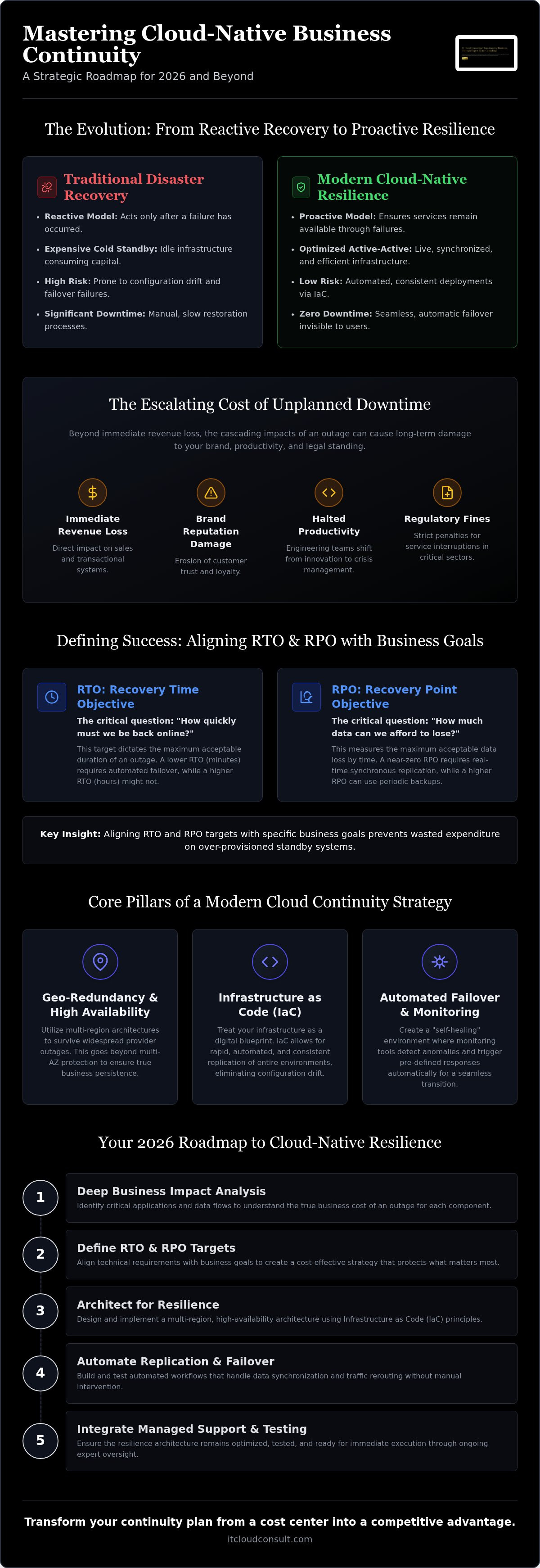
In the high-stakes environment of 2026, the definition of resilience has undergone a fundamental transformation. Modern business continuity planning cloud strategies are no longer relegated to a "break glass in case of emergency" document kept by the IT department. Instead, resilience is now a core operating model that ensures services remain available even when underlying infrastructure fails. While traditional disaster recovery focused on the reactive process of restoring data from a secondary location, true business continuity focuses on the proactive maintenance of operations through architectural design.
The reliance on off-site tape backups or periodic snapshots is insufficient for the demands of the modern enterprise. In a digital-first economy, even a few minutes of unavailability can erode years of built-up customer trust. If your systems are offline, your brand reputation suffers immediate and often permanent damage. Transitioning to a cloud-native approach allows your organization to treat resilience as a constant state rather than a recovery goal, ensuring that your enterprise remains a reliable partner for its clients regardless of technical disruptions.
The Evolution from Traditional DR to Resilient Operations
Legacy disaster recovery often relied on "cold standby" sites. These sites were expensive to maintain yet frequently failed during actual transitions due to configuration drift. Modern business continuity planning cloud frameworks utilize "active-active" deployments instead. These architectures synchronize state across multiple regions in real-time, allowing for a seamless transition that is invisible to the end user. By leveraging microservices, enterprises can isolate specific failures. If a single component fails, the broader system remains functional, preventing a localized glitch from escalating into a total system collapse.
Mitigating the Costs of Unplanned Downtime
The financial impact of downtime has escalated significantly. Beyond the immediate loss of revenue, organizations face "hidden" costs that can be even more damaging. When systems fail, developer productivity halts as engineering teams pivot from innovation to crisis management. Additionally, 2026 regulatory environments often impose strict fines for service interruptions in critical sectors. Establishing a robust business case for resilience is essential. By prioritizing strategic cloud adoption, leadership can transform continuity from an insurance expense into a driver of operational efficiency and long-term stability.
The Core Pillars of a Modern Cloud-Based Continuity Strategy
A robust business continuity planning cloud framework rests on three technological pillars that transform infrastructure from a static asset into a dynamic, self-correcting ecosystem. These components ensure that when a regional outage occurs, the enterprise doesn't just recover; it persists without interruption. By moving beyond manual intervention, organizations can achieve a level of resilience that was previously reserved for only the largest global entities. The focus in 2026 is on creating a "self-healing" environment where monitoring tools detect anomalies and trigger pre-defined responses before the user experience is impacted.
Geo-Redundancy and High Availability Architectures
High availability starts with the distinction between multi-availability zone (multi-AZ) and multi-region deployments. While multi-AZ protects against localized data center failures, a true 2026 strategy requires multi-region geo-redundancy to survive widespread provider outages. Synchronizing data across vast geographic distances introduces latency challenges, requiring asynchronous replication for non-critical data and synchronous commits for high-value transactions. Utilizing managed cloud services simplifies this complexity by providing built-in tools for cross-region traffic routing and data consistency management.
Infrastructure as Code (IaC) for Rapid Replication
Infrastructure as Code (IaC) serves as the digital blueprint for your entire environment. By codifying infrastructure through tools like Terraform or CloudFormation, organizations eliminate the manual configuration errors that often plague recovery efforts during a crisis. This approach enables "Immutable Infrastructure," where servers are never patched or modified in place. If a node fails or a configuration drifts, the system simply destroys the old instance and redeploys a fresh one from the code. This ensures that the recovery environment is always an exact, functional replica of the production state, maintaining total architectural integrity.
Automated Failover and Intelligent Traffic Management
Intelligent traffic management acts as the nervous system of your continuity strategy. Global Server Load Balancing (GSLB) continuously monitors the health of your nodes across different regions. When a health check fails, the system automatically reroutes user traffic to the nearest healthy instance. Automated failover is the process of switching to a redundant system without human intervention. This self-healing capability minimizes the window of vulnerability and protects the bottom line. For leaders seeking to realize this level of resilience, ongoing cloud support ensures these automated systems are regularly audited and refined to meet evolving threats.
Defining Success: RTO, RPO, and the Economics of Resilience
Success in business continuity planning cloud strategies is defined by the precise alignment of technical recovery capabilities with the economic realities of the business. Two metrics remain fundamental: the Recovery Time Objective (RTO), which dictates the acceptable duration of downtime, and the Recovery Point Objective (RPO), which determines the maximum tolerable data loss. In 2026, the expectation for mission-critical systems has shifted toward near-zero targets. However, applying these stringent requirements across the entire enterprise often leads to unnecessary cloud expenditures. True resilience requires a nuanced understanding of application value rather than a blanket approach to redundancy.
The financial impact of over-provisioning for resilience can be just as damaging as the downtime it seeks to prevent. Every second of reduced RTO carries a corresponding increase in infrastructure costs. Leaders must evaluate the diminishing returns of ultra-low latency replication for non-essential systems. Utilizing cloud optimization consulting allows organizations to balance these technical requirements with budgetary constraints, ensuring that every dollar spent on redundancy contributes directly to organizational stability without inflating the bottom line.
Setting Realistic Recovery Objectives
Effective tiering is the cornerstone of a sustainable continuity model. You should categorize applications into three distinct tiers: Mission Critical, Business Critical, and Support. Mission Critical systems require "Zero RPO" through synchronous replication, ensuring that no data is lost during a failover. This technical requirement ensures total data integrity but introduces latency trade-offs that must be managed through architectural design. Business Critical apps might tolerate a few minutes of loss, while Support apps can often wait hours or even a full day. This tiered approach prevents the wasted spend associated with treating every internal tool like a primary revenue engine.
The ROI of Proactive Risk Mitigation
A sophisticated resilience strategy considers the "Resilience Premium" against the "Downtime Penalty." The premium is the incremental cost of maintaining redundant, active-active systems, while the penalty encompasses the total cost of a service failure, including lost sales and reputational damage. Beyond immediate financial protection, a cloud-based BCP improves your overall compliance posture and can significantly reduce cyber insurance premiums. Any successful enterprise cloud transformation must integrate this financial perspective to ensure that resilience remains a sustainable component of the long-term growth strategy.
A Step-by-Step Framework for Business Continuity Planning in the Cloud
Building a resilient enterprise requires transitioning from static documentation to a dynamic, executable framework. A modern business continuity planning cloud strategy operates as a continuous lifecycle rather than a periodic audit. This evolution ensures that your response mechanisms are as agile as the cloud environments they protect. By following a structured roadmap, leadership can identify hidden vulnerabilities and validate recovery assumptions before a real-world crisis occurs. This proactive stance transforms continuity from a defensive necessity into a core component of operational excellence.
Conducting a Cloud-First Business Impact Analysis
The process begins with a comprehensive mapping of data flows across your SaaS, PaaS, and IaaS providers. In 2026, many organizations suffer from "dependency debt," where a failure in a third-party API can paralyze core operations even if your primary servers remain online. You must identify these single points of failure and determine the minimum viable infrastructure required to maintain essential services. This analysis allows you to prioritize resources effectively during a restoration event, focusing on the components that drive the most significant business value. Understanding these dependencies is the only way to prevent a localized provider issue from becoming an enterprise-wide catastrophe.
Implementation also requires sophisticated monitoring tools that detect early warning signs of system stress before they escalate into outages. These signals might include latent database connections or anomalous traffic patterns that suggest an impending failure. Integrating a "Chaos Engineering" practice further strengthens your posture. By intentionally injecting controlled failures into production environments, your engineering teams can observe how the system reacts and refine automated responses under pressure. This "trial by fire" ensures that your automation logic is sound and that your team remains calm during actual disruptions.
Designing and Testing Your Recovery Roadmap
Your technical roadmap should culminate in a "Runbook" that is stored as code and version-controlled alongside your primary applications. This ensures that recovery procedures are never outdated or lost due to configuration drift. Schedule regular game-day exercises to validate your RTO/RPO assumptions in real-time. During these sessions, use cloud security assessment checklists to verify that your recovery environments meet the same rigorous standards as your production site. For organizations looking to bridge the gap between planning and execution, our ongoing cloud support provides the continuous monitoring and strategic advisory needed to maintain a state of perpetual readiness.
Partnering for Resilience: How IT Cloud Consulting Secures Your Future
IT Cloud Consulting serves as the strategic architect for organizations navigating the complexities of 2026 infrastructure. While the technical components of business continuity planning cloud strategies are now well-defined, the successful integration of these tools into a cohesive operating model requires a level of expertise that goes beyond basic implementation. We don't just provide tools; we deliver a comprehensive vision for resilience that aligns your technical capabilities with your broader business trajectory. This partnership ensures that your investment in cloud-native architecture drives measurable growth while protecting your enterprise from the unpredictable nature of digital operations.
The realization of your organization's latent potential depends on its ability to withstand disruption without losing momentum. Our approach focuses on the concept of evolution, moving your team away from reactive "break-fix" cycles and toward a state of empowered readiness. By positioning resilience as a natural extension of your digital strategy, we help you build a foundation that is both stable and highly adaptable to future market shifts.
Strategic Advisory for Continuity Architecture
Bespoke roadmaps are essential because generic templates often fail to account for the unique interdependencies of your specific application stack. Our advisory services focus on identifying hidden optimization opportunities during the initial design phase, ensuring that your continuity plan is both robust and cost-efficient. By providing vendor-neutral guidance, we help you navigate the multi-cloud ecosystem without becoming locked into a single provider's limitations. We invite you to evolve your current posture through professional cloud infrastructure consulting, transforming your recovery site from a dormant expense into a high-performance extension of your production environment.
Continuous Monitoring and Managed Support
Resilience is a state of perpetual readiness, not a static achievement. To maintain this posture, our ongoing cloud support provides continuous monitoring and system health checks that act as an early warning system for your enterprise. This proactive oversight ensures that your automated failover mechanisms and synchronization scripts are always functional and aligned with the latest security standards. Our team offers the steady assurance required to manage complex systems, providing 24/7 technical assistance so your internal engineers can focus on innovation rather than crisis management. Contact us today for a strategic resilience assessment to secure your operational future.
Architecting Your Resilient Future
Transitioning to a cloud-native resilience model is no longer an optional upgrade; it's a fundamental requirement for success in the 2026 digital economy. We've explored how moving beyond legacy backups toward automated, geo-redundant architectures ensures that your enterprise remains operational through any regional disruption. By aligning your technical RTO and RPO targets with specific business goals, you transform resilience from a high-cost insurance policy into a streamlined driver of operational efficiency. This shift allows your organization to treat continuity as a constant state of readiness rather than a reactive recovery goal.
Effective business continuity planning cloud success requires a partner who understands both the architectural nuances and the strategic objectives of your organization. IT Cloud Consulting provides expert roadmap development for strategic cloud adoption and customized resilience frameworks tailored for enterprise evolution. Our proactive 24/7 managed cloud monitoring ensures your infrastructure is always optimized and ready for the unexpected. Secure your enterprise future with a strategic cloud continuity assessment from IT Cloud Consulting. We look forward to guiding you through this transformative journey toward a more stable and optimized future.
Frequently Asked Questions
What is the difference between Disaster Recovery and Business Continuity in the cloud?
Disaster recovery focuses on the technical restoration of systems and data after a failure occurs. Modern business continuity planning cloud strategies encompass the broader operational framework required to maintain essential services during a disruption. While recovery is reactive, continuity is proactive. It ensures that your enterprise remains functional through architectural resilience rather than just relying on backups. This distinction is critical for leaders who prioritize uninterrupted service over simple data restoration.
How does Infrastructure as Code (IaC) improve business continuity planning?
Infrastructure as Code (IaC) provides a version-controlled blueprint for your entire environment. It allows for the instantaneous and error-free replication of infrastructure in a secondary region. By codifying your environment, you eliminate the manual configuration errors that often plague recovery efforts during high-pressure scenarios. This ensures that your standby environment is an exact replica of production, maintaining architectural integrity and significantly reducing the time required to achieve full operational status.
Can we achieve a zero-downtime objective with a cloud-based BCP?
Achieving a zero-downtime objective is entirely feasible through sophisticated active-active architectures. This model utilizes synchronous data replication across multiple geographic regions and intelligent traffic management to reroute users instantly if one node fails. While this level of resilience requires a higher initial investment, it protects high-value revenue streams from any perceptible interruption. A robust business continuity planning cloud framework transforms your infrastructure into a self-healing ecosystem that maintains availability regardless of localized outages.
How often should an enterprise test its cloud business continuity plan?
Enterprises should conduct full-scale resilience testing at least quarterly for mission-critical applications. In addition to these scheduled exercises, modern frameworks utilize continuous chaos engineering to inject controlled failures into production environments. This ongoing validation ensures that automated failover logic remains sound as your application evolves. Regular testing identifies configuration drift and validates your recovery assumptions, ensuring that your team is prepared to execute the plan with absolute confidence during an actual event.
What are the main risks of relying on a single cloud provider for BCP?
Relying on a single cloud provider introduces concentrated risk, particularly during widespread regional outages that affect an entire provider's backbone. If that provider experiences a systemic failure, your secondary regions might be impacted simultaneously. A multi-cloud strategy mitigates this by distributing workloads across different infrastructure platforms. This approach prevents vendor lock-in and ensures that your business continuity remains intact even if a major provider suffers a catastrophic and prolonged service interruption. For organizations requiring high-performance physical infrastructure as part of this strategy, 3EX Hosting provides the necessary colocation and carrier-neutral connectivity to secure a resilient multi-cloud environment.
Legacy on-premise systems are integrated into a cloud-native BCP through a hybrid architecture. You can use the cloud as a highly scalable recovery target for your on-premise data and applications. This involves establishing secure, high-speed connectivity to synchronize state between your local data center and the cloud environment. For home offices or small businesses managing these hybrid setups, Aspire Computing provides the necessary IT support and computer repair services to keep legacy hardware running smoothly. By leveraging the cloud for resilience, you extend the life of your legacy assets while gaining the agility and geo-redundancy inherent in modern infrastructure models.
Cloud-based continuity is often more cost-effective than traditional methods because it eliminates the need for expensive, idle hardware in a secondary data center. You only pay for the storage and minimal compute required to maintain a standby state. During a failover, you scale resources on-demand. This shift from capital expenditure to an operational model allows for greater financial flexibility while providing a level of resilience that was previously unaffordable for most organizations.
What role does automation play in modern cloud resilience?
Automation is the engine that drives modern cloud resilience. It removes the risk of human error and ensures that failover processes occur at machine speed. Automated monitoring tools detect anomalies and trigger pre-defined recovery scripts without manual intervention. This capability is essential for meeting aggressive recovery targets in 2026. By automating the detection and remediation of infrastructure failures, your organization achieves a state of proactive continuity that protects both your data and your brand reputation.


