
In 2026, cloud automation is no longer a technical convenience; it's a strategic orchestration layer that dictates business velocity. You've likely seen how manual management leads to runaway costs and configuration errors that compromise your security posture. It's frustrating to watch slow deployment cycles stall innovation while operational overhead continues to climb. We agree that the traditional hands-on approach to scaling has become the primary bottleneck for the modern enterprise. Achieving true cloud infrastructure automation requires moving beyond basic scripts to a holistic, self-healing architecture that empowers your team rather than draining their resources.
This guide provides the frameworks you need to master this transition and realize the full potential of your digital environment. You'll learn how to implement sophisticated automation strategies that ensure predictable, compliant, and secure cloud environments across multi-cloud footprints. We'll explore the shift toward compliance-as-code and evaluate the latest 2026 tooling, including OpenTofu 1.12 and Argo CD 10.9, to help you accelerate time-to-market. By the end of this article, you'll have a clear roadmap for evolving your infrastructure into a high-performance engine of growth.
Key Takeaways
- Understand why transitioning from manual scripts to intent-based orchestration is essential for removing strategic bottlenecks in 2026.
- Master the core pillars of Infrastructure as Code (IaC) and CI/CD to build resilient, repeatable cloud environments.
- Evaluate the 2026 tooling landscape to effectively orchestrate complex multi-cloud deployments across various providers.
- Follow a structured, phased roadmap to identify quick wins that demonstrate immediate value and operational efficiency to stakeholders.
- Discover how strategic cloud infrastructure automation serves as the primary engine for long-term optimization and enhanced enterprise ROI.
The Evolution of Cloud Infrastructure Automation in 2026
The landscape of cloud management has undergone a fundamental transformation as we move deeper into 2026. Cloud infrastructure automation is a self-regulating system that aligns IT resources with real-time business demands. This evolution marks the end of the era where IT functioned as a reactive cost center. Instead, automation serves as the primary foundation for Strategic Cloud Adoption, allowing leaders to treat infrastructure as a dynamic asset rather than a static expense. By embedding logic directly into the provisioning process, organizations ensure that every new resource adheres to corporate standards from the moment of creation. This precision allows enterprises to scale with confidence, knowing their underlying systems are inherently optimized for performance and cost.
Beyond Scripting: The Shift to Intent-Based Orchestration
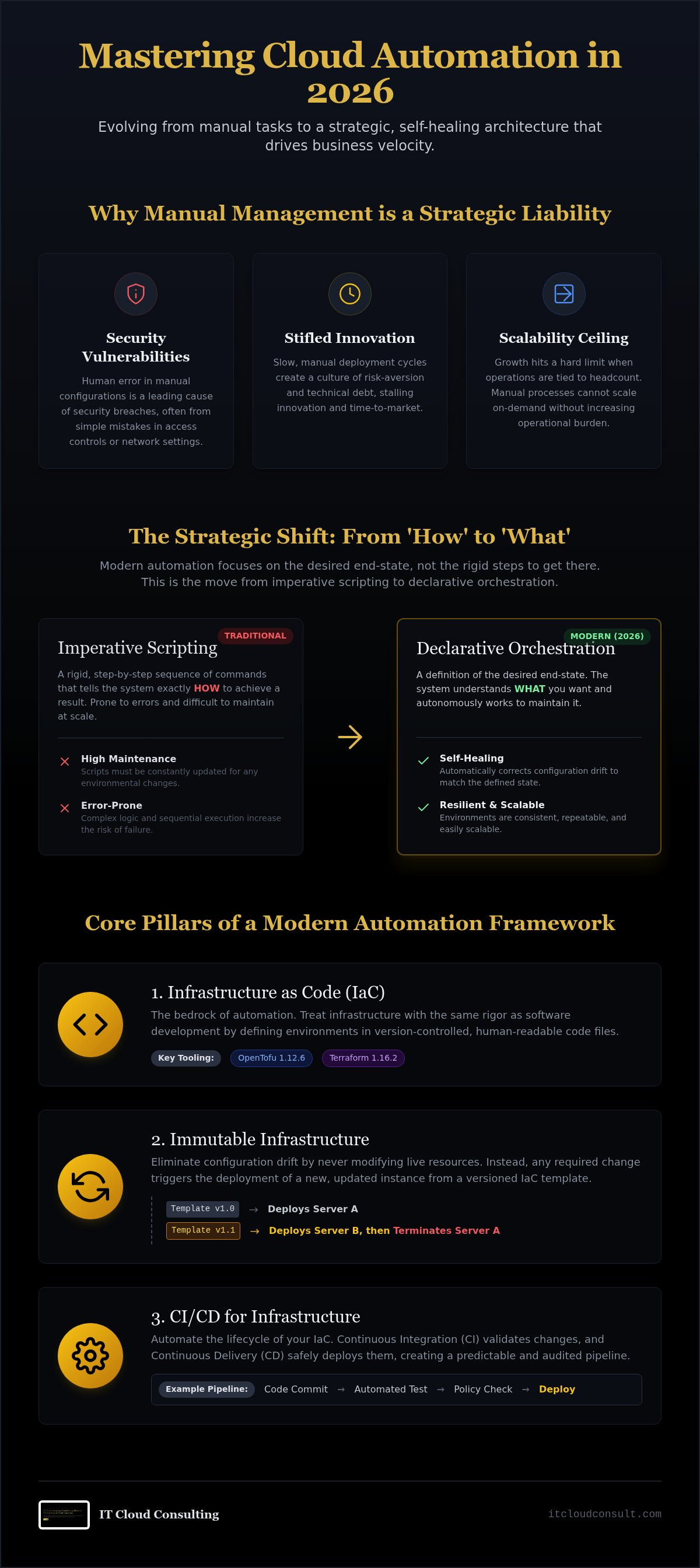
Traditional scripts are imperative; they tell the system exactly how to do something in a rigid, step-by-step sequence. In 2026, the industry has moved toward intent-based orchestration. These systems focus on the "what," which is the desired end state of the environment. By utilizing Infrastructure as Code (IaC), teams define a declarative configuration that the system then maintains autonomously. This approach effectively eliminates configuration drift, where small, manual tweaks cause environments to deviate from their secure, intended state. Automated enforcement ensures that if a resource changes outside of the approved code, the system immediately reverts it to the compliant baseline, maintaining total environmental integrity without human intervention.
Why Manual Management is a Strategic Liability
Relying on manual intervention is no longer just a slow process; it's a strategic liability. Human error remains the leading cause of cloud security vulnerabilities, often stemming from simple misconfigurations in access controls or network settings that go unnoticed for months. These friction points directly stifle enterprise cloud transformation by creating a culture of risk-aversion and technical debt. When every change requires a manual ticket and a human review, the speed of innovation drops to the pace of administrative approval. Scalability also hits a hard ceiling when IT operations are tied to headcount. In contrast, an automated framework allows your environment to expand or contract based on demand without adding any operational burden. This shift moves the IT team from a state of constant maintenance into a role of strategic value creation.
Core Pillars of a Modern Automation Framework
A successful 2026 enterprise strategy isn't built on a single tool but on a foundation of integrated disciplines. These pillars transform cloud infrastructure automation from a series of isolated tasks into a cohesive, self-regulating ecosystem. By standardizing how resources are defined and managed, organizations can eliminate the variability that leads to security gaps and operational waste. This framework ensures that every deployment is a predictable, repeatable event rather than a manual effort prone to human error.
Infrastructure as Code (IaC) and Immutable Infrastructure
IaC serves as the bedrock of modern environments, allowing teams to treat operations with the same rigor as software development. In the 2026 landscape, the industry has shifted toward "immutable infrastructure," where resources are never patched or modified in place. Instead, any required change triggers the deployment of a new, updated instance based on a version-controlled template. This approach is a cornerstone of cloud infrastructure consulting because it guarantees that production environments exactly match their documented state. While Terraform 1.16.2 remains a standard for cross-platform stability, open-source alternatives like OpenTofu 1.12.6 have gained significant traction. Citing the Forrester Wave report on infrastructure automation reveals that the most resilient enterprises are those that integrate these tools into unified version control systems, ensuring total visibility into every environmental change.
Building upon this foundation, CI/CD for infrastructure automates the testing and deployment of these code-based templates. This is often paired with Policy as Code, which embeds security guardrails directly into the delivery pipeline. Instead of waiting for a post-deployment audit, the system automatically rejects any configuration that violates corporate compliance or security standards before it ever reaches production.
AI-Driven Self-Healing and Proactive Remediation
The most advanced stage of automation involves moving from reactive alerting to proactive, machine-led remediation. AIOps platforms now utilize predictive analytics to identify performance anomalies or resource constraints before they impact the end user. This capability is vital for cloud optimization, as it allows the system to rightsize instances or adjust scaling parameters in real-time based on actual traffic patterns. The transition from "Alerting" to "Automatic Resolution" means that common issues, such as configuration drift or localized service failures, are corrected by the orchestration layer without human intervention. This self-healing capacity reduces the burden on IT staff and ensures that the infrastructure remains performant and secure around the clock.
Developing a framework that balances these complex pillars requires a blend of technical precision and high-level vision. Many organizations find that engaging in strategic cloud advisory is the most effective way to align these automation goals with their specific business objectives.
Navigating the Automation Tooling Landscape: Open Source vs. Native
Selecting the right technology stack is a pivotal decision for the modern architect. In 2026, cloud infrastructure automation requires a nuanced balance between the immediate agility of native tools and the strategic flexibility of open-source frameworks. This choice dictates how effectively your organization can scale without incurring crippling technical debt. While cloud-native services offer rapid integration, they often tether your operations to a single provider's specific roadmap. Integrating these selections within a broader managed cloud services ecosystem ensures that interoperability remains a functional reality rather than a theoretical goal.
The Role of Open Source in Multi-Cloud Orchestration
Enterprise leaders increasingly turn to open-source solutions to standardize operations across heterogeneous environments. Frameworks like OpenTofu 1.12.6 provide a vendor-neutral layer that allows for consistent provisioning across AWS, Azure, and GCP. This consistency is essential. It prevents the fragmentation of skills that occurs when teams must manage different proprietary systems for each cloud provider. Community-driven innovation often delivers support for new features faster than a single vendor's development cycle. However, using open-source cloud automation requires a commitment to ongoing maintenance. You must actively manage the security of your automation stack by vetting third-party providers and keeping up with frequent community patches.
Leveraging Cloud-Native Automation Services
Native tools like AWS Systems Manager, Azure Automation, and Google Cloud Deployment Manager provide the deepest possible integration within their respective platforms. They're designed to work natively with the provider's security and monitoring services, which simplifies the initial setup. For organizations committed to a single cloud, these tools offer the fastest path to cloud infrastructure automation. The cost-benefit analysis often favors native tools when the overhead of managing a third-party framework outweighs the benefits of portability. Successful enterprises often adopt a best-of-breed approach. They use native tools for specific, deep-cloud tasks while maintaining a cross-cloud orchestration layer for high-level governance. This hybrid strategy allows for rapid innovation while preserving the ability to pivot if business requirements change.
Implementing Automation: A Strategic Roadmap for Leaders
Successful cloud infrastructure automation isn't achieved through a single deployment or the purchase of a specific tool. It's an evolutionary process that transforms how the business interacts with technology. Leaders must move beyond tool acquisition to focus on a structured roadmap that ensures alignment between technical capabilities and strategic goals. This journey requires a phased approach that prioritizes stability while building the momentum necessary for full-scale modernization. By following a clear path, you can transition from reactive maintenance to a proactive, automated environment that scales with your ambition.
Conducting an Automation Readiness Assessment
Before writing a single line of code, you must evaluate your current environment. This begins with a deep look at technical debt and legacy system compatibility. Many older systems weren't designed for intent-based orchestration, and identifying these friction points early prevents future bottlenecks. A skills gap analysis is equally critical. You need to prepare your workforce for a shift from manual operations to code-based management. Defining success metrics early ensures that "good" automation is measured by business outcomes like deployment velocity and error reduction rather than just the number of scripts written. This phase sets the foundation for everything that follows.
Once you've assessed your readiness, the next step is identifying and automating "low-hanging fruit." Starting with non-production environments or repetitive tasks like environment teardowns provides immediate proof of value without risking production stability. These quick wins build organizational confidence. From there, you can scale automation to mission-critical workloads, ensuring that the same rigorous standards apply to your most vital applications. Establishing an Automation Center of Excellence (CoE) helps centralize these best practices, providing a governing body that guides the entire enterprise toward a unified standard of excellence.
Governance and Policy as Code
Security shouldn't be an afterthought in the automation pipeline. By automating the cloud security assessment checklist, you embed protection directly into the infrastructure lifecycle. This approach creates automated guardrails that prevent common issues like unauthorized resource provisioning or cost overruns. Continuous automated audits ensure that regulatory compliance is a constant state rather than a once-a-quarter event. This level of oversight provides the steady assurance required for long-term development. When compliance is code, it becomes an enabler of speed rather than a barrier to it.
Navigating this complex transition requires both a high-level vision and technical proficiency. If you're ready to define your path forward, our team offers strategic cloud adoption services to help you navigate each phase of this roadmap with precision.
Optimizing ROI Through Strategic Automation Consulting
The true value of cloud infrastructure automation extends far beyond the simple reduction of manual hours. While "time saved" is a common metric, it fails to capture the strategic impact of an environment that corrects its own inefficiencies and scales without friction. In the 2026 landscape, automation serves as the primary engine for cloud optimization consulting success, allowing organizations to maintain peak performance while keeping a tight grip on resource expenditure. By treating automation as a continuous business strategy rather than a one-time technical project, enterprises can transform their cloud presence from a complex cost center into a lean, responsive asset.
Measuring the Business Value of Automation
To quantify the success of your automation initiatives, you must look at metrics that reflect organizational health and market agility. Mean Time to Resolution (MTTR) and Deployment Frequency are two of the most critical indicators of a mature system. A significant reduction in MTTR suggests that your self-healing protocols are effectively neutralizing issues before they impact the user experience. Similarly, a higher deployment frequency proves that your infrastructure is no longer a bottleneck for product innovation. These technical gains directly influence your operational expenditure (OpEx), as automated resource allocation prevents the over-provisioning that often leads to wasted budget. When your infrastructure is agile, your business can pivot to meet market demands faster than competitors who are still bogged down by manual configuration cycles.
How IT Cloud Consulting Partners with Your Organization
Bridging the gap between a high-level vision for automation and its technical execution requires a partner that understands both the "big picture" and the underlying systems. IT Cloud Consulting specializes in accelerating this maturity through tailored strategic planning and roadmap development. We don't just implement tools; we help you build a foundation for Strategic Cloud Adoption that aligns with your long-term growth objectives. Our approach includes providing the managed cloud support necessary to ensure your automated systems remain stable and compliant as they evolve. This ongoing partnership acts as a safety net, allowing your internal teams to focus on innovation while we manage the complexities of the orchestration layer.
As we look toward the future, the "Agentic Era" of AI promises even deeper levels of autonomous management. Future-proofing your infrastructure today means building a modular, code-based foundation that can easily integrate with the next generation of AI-driven agents. To maintain visibility and control over these models, you can learn more about enterprise AI governance platforms. By investing in professional consulting now, you ensure that your organization possesses the technical proficiency and strategic framework required to lead in an increasingly automated world.
Charting the Path Toward Autonomous Infrastructure Excellence
Transitioning to a fully realized state of cloud infrastructure automation is a strategic evolution that transforms your IT operations into a high-velocity engine. We've explored how intent-based orchestration and immutable infrastructure serve as the foundations for this shift, moving your team away from manual maintenance and toward visionary growth. By integrating policy-as-code and self-healing frameworks, your organization secures a predictable environment that scales with business demand while maintaining strict compliance.
Realizing this potential requires a partner that balances high-level strategic confidence with deep technical proficiency. IT Cloud Consulting provides the strategic advisory needed to maximize your long-term ROI across complex multi-cloud and hybrid landscapes. Our managed services ensure 24/7 operational resilience, providing the safety net your enterprise needs to innovate at speed. Schedule your Strategic Cloud Automation Assessment with IT Cloud Consulting to begin your transition today. Your journey toward a modernized, self-regulating infrastructure starts with a single, purposeful step toward optimization.
Frequently Asked Questions
What is the difference between cloud automation and cloud orchestration?
Cloud automation focuses on completing a single, repeatable task, such as provisioning a specific virtual machine or storage volume. In contrast, cloud orchestration coordinates multiple automated tasks into a cohesive, end-to-end workflow. Think of automation as an individual instrument and orchestration as the conductor directing the entire symphony. This higher-level management ensures that complex, multi-step processes across various environments remain synchronized and efficient throughout the entire infrastructure lifecycle.
How does infrastructure automation improve cloud security in 2026?
Infrastructure automation significantly improves security by eliminating manual configuration errors, which remain the leading cause of cloud data breaches. In 2026, automated systems utilize Policy as Code to enforce security guardrails at the moment of deployment. If a resource deviates from its intended secure state, the system detects this configuration drift and triggers an immediate, automated remediation. This proactive approach, often bolstered by AI-native compliance monitoring from Sentience, ensures your cloud infrastructure automation remains resilient against evolving threats without requiring constant manual oversight.
You can automate legacy systems by utilizing modern orchestration wrappers or refactoring specific components as part of a Strategic Cloud Adoption roadmap. While legacy software wasn't designed for the cloud, automation tools can interface with these systems through APIs or specialized middleware. This allows enterprises to bring older, mission-critical applications into a modern management framework. It effectively bridges the gap between traditional reliability and the agility required for contemporary digital operations.
What are the most common risks associated with cloud infrastructure automation?
The most common risk is the potential for cascading errors, often referred to as automating mistakes at scale. If an automated script contains a flaw, it can propagate that error across your entire environment in seconds. Other risks include tool sprawl and the complexity of managing multiple automation frameworks. To mitigate these issues, organizations should implement rigorous testing in non-production environments and establish a clear governance model before deploying automation to mission-critical workloads.
How does automation help in reducing monthly cloud bills?
Automation drives Cloud Optimization by ensuring that resources are only consumed when they're actually needed. Automated systems can rightsize instances based on real-time demand and schedule idle resources to shut down during off-peak hours. By eliminating human oversight in resource management, organizations can prevent the cloud sprawl that leads to inflated monthly bills. This results in a leaner, more cost-effective infrastructure that aligns perfectly with your actual business requirements.
Do we need a dedicated DevOps team to implement infrastructure automation?
You don't strictly need an internal, dedicated DevOps team if you leverage professional advisory and Ongoing Cloud Support services. While a DevOps culture is beneficial, many organizations find success by partnering with strategic consultants who handle the technical execution. This allows your existing IT staff to focus on higher-level innovation while experts manage the complexities of the automation layer. It's a scalable way to achieve maturity without the immediate need for extensive internal hiring.
What is Policy as Code and why is it important for compliance?
AI and machine learning integrate through AIOps platforms that provide predictive analytics for resource management. These systems analyze historical data to anticipate traffic spikes and scale resources before performance is impacted. Machine learning models also identify subtle anomalies that might indicate a security threat or a pending hardware failure. This integration moves your automation from a reactive state to a proactive, self-healing framework that can resolve complex issues without human intervention.


