
Did you know that in 2026, cloud bills are exceeding initial forecasts by as much as 40 percent due to data access charges rather than storage growth? It's a sobering reality for many enterprise leaders who expected the cloud to be a cost-saving miracle, only to find themselves untangling complex interdependencies and mounting egress fees. You likely recognize that migrating legacy infrastructure isn't just a technical shift. It's a high-stakes architectural evolution that requires precision from the very first day to avoid system failures or expertise gaps.
This guide provides the authoritative framework you need to implement cloud migration best practices that transform your legacy systems into a high-performance, cost-optimized environment built for future scale. We're moving beyond simple relocation to focus on strategic modernization that delivers demonstrable ROI. We'll explore a predictable, phased roadmap that eliminates operational complexity, integrates FinOps principles to control costs, and ensures your new infrastructure is secure by design. By the end of this guide, you'll have the clarity to lead your organization through a seamless transition that unlocks latent potential and stabilizes long-term development.
Key Takeaways
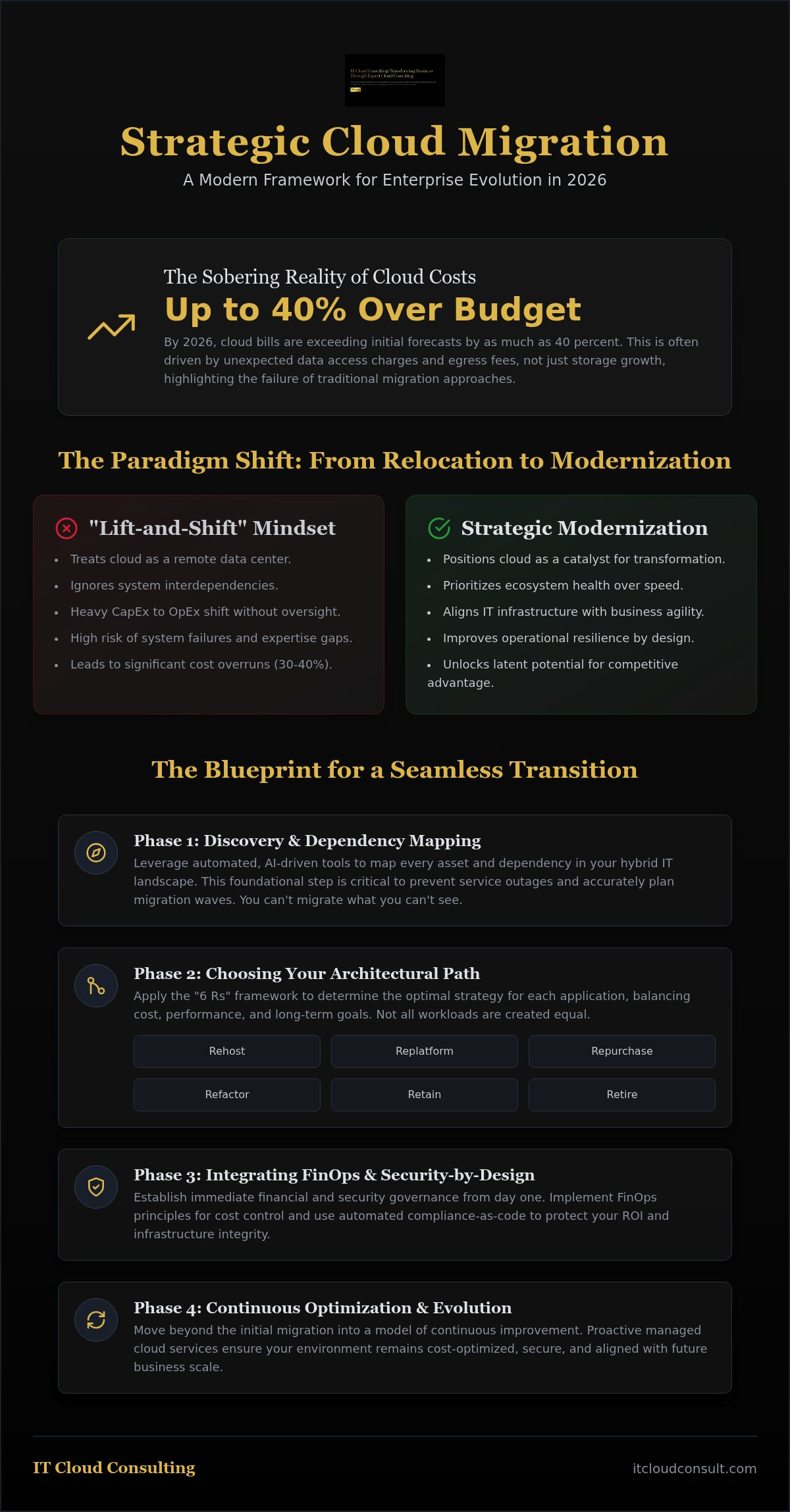
- Transition from a basic "lift-and-shift" mindset to a strategic modernization approach that positions cloud adoption as a catalyst for long-term enterprise evolution.
- Prevent service outages and system failures by implementing automated discovery and comprehensive dependency mapping across your entire hybrid IT landscape.
- Apply the "6 Rs" framework alongside established cloud migration best practices to determine whether to rehost, replatform, or refactor specific legacy applications for maximum efficiency.
- Establish immediate financial and security governance through FinOps principles and automated compliance-as-code to protect your ROI and infrastructure integrity from day one.
- Secure the future of your environment by moving beyond the initial migration phase into a model of continuous optimization supported by proactive managed cloud services.
Beyond the Lift-and-Shift: Defining Strategic Cloud Migration in 2026
By 2026, the definition of success in cloud computing has shifted from simple accessibility to profound architectural evolution. While early migrations focused on technical relocation, modern enterprises now view the transition as a catalyst for total digital transformation. It's no longer sufficient to treat the cloud as a remote data center; instead, it's the foundation for high-performance operations and future scale. Adopting cloud migration best practices in this era requires a departure from the reactive "Lift-and-Shift" model in favor of "Strategic Modernization."
This evolution fundamentally alters how organizations manage their resources. Moving away from heavy capital expenditure (CapEx) toward a flexible operational expenditure (OpEx) model allows for greater fiscal agility, though it demands stricter oversight. To manage this transition, leading organizations are establishing a Cloud Center of Excellence (CCoE). This cross-functional team ensures that every technical decision aligns with broader business goals, preventing the expertise gaps that often lead to project stagnation or unexpected cost overruns.
The Evolution of Cloud Adoption Strategies
Traditional migration methods often fail in complex legacy environments because they ignore the intricate interdependencies of aging systems. With 94 percent of enterprises utilizing at least one cloud service in 2026, the challenge isn't just getting to the cloud; it's staying there efficiently. Strategic cloud adoption is the alignment of IT infrastructure with long-term business agility. By connecting technical milestones to growth outcomes, you ensure that your infrastructure supports innovation rather than hindering it. Success depends on recognizing that cloud migration best practices must prioritize the health of the entire ecosystem over the speed of an individual application move.
The Business Value of a Modernization-First Approach
Adopting a modernization-first mindset accelerates your time-to-market by leveraging cloud-native architectures from the start. This approach improves operational resilience, ensuring that disaster recovery isn't an afterthought but a built-in feature of the environment. Integrating these principles early helps avoid the 30 to 40 percent cost overruns often seen in poorly planned migrations. For a deeper look at creating a phased roadmap that balances performance with cost, explore our guide on strategic cloud adoption. This strategic foundation allows you to realize the latent potential of your systems, turning a technical necessity into a competitive advantage.
Discovery and Dependency Mapping: The Blueprint for Success
A successful migration is built on a foundation of absolute visibility. In 2026, the hybrid IT landscape is more complex than ever, requiring automated discovery to capture every asset across distributed environments. Relying on outdated spreadsheets or manual inventories is no longer viable. Instead, organizations must leverage tools like the latest Azure Migrate features or Google Cloud’s discovery client to map complex application interdependencies accurately. This process is essential to prevent service outages caused by severed connections between legacy databases and modern front-end services. Integrating these insights into your cloud migration best practices ensures that technical execution remains aligned with operational stability. You can't migrate what you can't see.
Agentless Discovery and AI-Driven Mapping
Modern discovery tools now utilize AI to identify hidden dependencies within legacy mainframes and modern containerized environments. This real-time visibility is crucial for reducing migration risks, as it reveals the "silent" traffic that manual tracking often misses. When these connections are overlooked, the result is often a catastrophic cloud adoption failure that derails transformation timelines. By automating this phase, you gain the clarity needed to decide which workloads are ready for the cloud and which require a hybrid coexistence strategy. Our team specializes in strategic cloud adoption advisory to help you navigate these complex technical landscapes.
Risk Mitigation Through Comprehensive Readiness Assessments
Effective discovery must include a rigorous evaluation of data sovereignty and compliance. With the updated CCPA regulations and new state laws in Indiana, Kentucky, and Rhode Island taking effect in 2026, risk assessments are a legal mandate for many enterprises. Conducting a cloud security assessment checklist during the discovery phase allows you to identify sensitive personal information, such as data for individuals under 16, which now requires heightened protection. Establishing a performance and cost baseline before moving the first workload ensures that your transition is not just secure, but also financially predictable. This proactive approach identifies "un-migratable" workloads early, allowing for a phased roadmap that maintains business continuity and long-term stability.
The 6 Rs of Migration: Choosing Your Architectural Path
Selecting the right architectural path is a pivotal decision that dictates the long-term viability of your digital environment. While the "6 Rs" framework remains the foundational standard, applying these paths in 2026 requires a nuanced understanding of cloud-native potential versus the accumulation of technical debt. Adhering to cloud migration best practices means looking beyond the initial transfer to ensure each application resides in its most efficient state. Each workload demands a tailored approach to unlock its latent potential.
- Rehost (Lift-and-Shift): This path prioritizes speed, making it ideal for workloads with tight deadlines. However, rehosting often preserves existing inefficiencies, which can lead to the 40 percent cost overruns common in unoptimized environments.
- Replatform (Lift-and-Reshape): This middle ground introduces cloud-native features, such as managed database services, without a total code rewrite. It offers a balance between effort and immediate performance gains.
- Refactor (Rearchitect): For applications critical to competitive advantage, refactoring involves modernizing code for maximum scalability. This is the most transformative path, enabling full utilization of serverless and microservices architectures.
Matching Workloads to the Optimal Migration Strategy
Determining the correct path requires a rigorous framework that balances immediate ROI against long-term technical debt. While rehosting offers the fastest exit from a physical data center, it may delay the realization of cloud-native benefits and increase egress fees. Conversely, refactoring demands higher upfront investment but yields superior performance and lower long-term costs. For a structured approach to these multi-year decisions, refer to our enterprise cloud transformation roadmap. This planning ensures that your selection aligns with your organization's broader evolution rather than just technical convenience.
Modernizing Legacy Systems for Cloud Efficiency
True modernization involves transitioning monolithic applications into agile microservices. Utilizing containerization technologies like Docker and Kubernetes allows for consistent deployment across hybrid environments, simplifying the migration lifecycle. Additionally, ensuring legacy databases are optimized is critical. With AWS Database Migration Service version 3.6.0 reaching its end-of-life on July 27, 2026, organizations must proactively plan their engine upgrades to maintain support. By optimizing the data layer and decoupling services, you transform rigid legacy systems into flexible, high-performance assets ready for future scale.
Integrating FinOps and Security-by-Design
Integrating financial governance and security protocols into the earliest stages of a transition is a non-negotiable pillar of cloud migration best practices. In 2026, the complexity of distributed environments means that treating cost and security as post-migration checklist items is a recipe for operational failure. Organizations must adopt a "secure-by-default" mandate while simultaneously implementing FinOps principles to maintain visibility over every dollar spent. This dual-focus ensures that your high-performance environment remains both resilient and fiscally sustainable as you scale.
Right-sizing resources is a critical first step that should occur before the first workload moves. By analyzing actual consumption patterns rather than relying on legacy hardware allocations, you eliminate waste from day one. This proactive approach, combined with a Zero Trust architectural model, ensures that every connection is verified and every resource is optimized. To ensure your transition remains both secure and fiscally sound, you can leverage our expertise in Strategic Cloud Adoption to build a foundation for long-term stability.
Cloud Cost Optimization During Migration
Preventing "bill shock" requires more than just a monthly review; it demands real-time monitoring and automated alerts. In 2026, cloud bills frequently exceed forecasts by 30 to 40 percent because of data access charges and egress fees, which start at $0.09 per GB for the first 10 TB on major providers like AWS. By utilizing reserved instances and savings plans for predictable workloads, you can lock in lower rates and stabilize your OpEx. For organizations seeking to master these complex financial structures, engaging in cloud optimization consulting provides the advanced FinOps strategies necessary to maximize enterprise ROI.
Maintaining Continuous Compliance and Security
As of January 1, 2026, new data privacy laws in states like Indiana, Kentucky, and Rhode Island have raised the stakes for compliance. Automating security audits through compliance-as-code allows your team to meet industry-specific regulations, such as HIPAA or PCI-DSS, without manual intervention. Managing identity and access (IAM) across hybrid environments becomes the new perimeter, ensuring that only authorized users can interact with sensitive data. Establishing security-by-design prevents costly post-migration remediation by embedding protection into the infrastructure's very DNA. This methodical approach transforms security from a bottleneck into a business enabler, allowing for rapid innovation within safe, pre-defined guardrails.
Post-Migration Evolution: The Role of Managed Cloud Support
The project concludes. The evolution begins. Successful organizations recognize that reaching the cloud is merely the baseline for enterprise transformation. To sustain a high-performance environment, you must transition from a project-centric mindset to one of continuous operational excellence. Adhering to cloud migration best practices in 2026 means acknowledging that the work doesn't stop at the cutover. Instead, it shifts toward iterative performance tuning and the realization of long-term efficiency. While the initial move addresses immediate technical needs, the post-migration phase is where you truly refine your systems for peak performance and future scale.
Leveraging managed cloud services is essential for proactive maintenance in this new landscape. These services allow your internal teams to focus on high-level innovation rather than the minutiae of infrastructure troubleshooting. By analyzing real-world usage data, you can implement automated scaling and serverless architectures that respond dynamically to business demands. This shift reduces operational complexity and ensures your infrastructure remains a driver of growth rather than a stagnant cost center. Post-migration optimization isn't just about stability; it's about fostering a culture of constant modernization.
Continuous Monitoring and Optimization
Moving beyond the migration requires a shift from reactive troubleshooting to proactive system health monitoring. Many enterprises face an internal skills gap that can hinder the management of complex, distributed environments. Utilizing managed support bridges this gap, providing the expertise needed to maintain 24/7 reliability. Ongoing cloud infrastructure consulting enables regular architectural reviews that catch inefficiencies before they impact your bottom line. Research indicates that post-migration optimization can deliver an additional 20 to 35 percent in cost savings by fine-tuning resource allocation and performance parameters based on actual workloads.
Partnering for Long-Term Enterprise Growth
As your business matures, your cloud environment must evolve in tandem. In 2026, 87 percent of organizations have adopted multi-cloud strategies, while 73 percent utilize hybrid-cloud models to avoid vendor lock-in. Navigating this maturity requires an ongoing advisory partner that understands both the "big picture" strategy and the technical proficiency required for execution. This steady assurance allows you to explore new possibilities, such as AI-driven automation and cross-cloud data orchestration, with total confidence. The right partnership ensures your infrastructure is not a static destination but a flexible foundation for your organization's trajectory. To begin your journey toward a resilient and optimized future, Partner with IT Cloud Consulting for a strategic, secure migration today.
Architecting the Future of Your Enterprise
The transition to a cloud-native environment is a defining moment for any national enterprise. It's the point where legacy constraints dissolve and the potential for rapid innovation becomes a reality. By adhering to cloud migration best practices, you ensure that your organization doesn't just reach a new platform, but evolves into a more resilient, cost-optimized, and agile version of itself. Success in 2026 demands a meticulous approach that balances technical precision with high-level financial governance and security-by-design.
IT Cloud Consulting provides the authoritative guidance required to navigate this complex modernization journey. We focus on maximizing your ROI and operational efficiency through a strategic, phased roadmap tailored to your specific architectural needs. Our national reach and professional managed support ensure that your transition is stable, secure, and built for future scale. The path toward transformation is clear, and the tools for success are within your reach. We invite you to Schedule a Strategic Cloud Migration Consultation to begin architecting your organization's next chapter today. Your evolution starts with a single, strategic step.
Frequently Asked Questions
What are the most common reasons cloud migrations fail in 2026?
Failures in 2026 often stem from unforeseen data access charges and a lack of comprehensive dependency mapping. When organizations overlook silent traffic between legacy mainframes and modern containers, service outages become inevitable. Additionally, failing to integrate FinOps early results in cloud bills exceeding initial forecasts by 30 to 40 percent. Professional advisory helps mitigate these risks by establishing a clear architectural roadmap before the technical transition begins.
How do I calculate the total cost of ownership (TCO) for a cloud migration?
Calculating TCO requires shifting from a capital expenditure mindset to an operational expenditure model. You must account for direct costs like compute and storage, alongside indirect factors such as data egress fees and internal labor for migration. Effective TCO models also factor in the long-term ROI of cloud migration best practices, such as the 20 to 35 percent savings typically realized through post-migration performance tuning and resource right-sizing.
Is a hybrid cloud or multi-cloud strategy better for large enterprises?
The optimal choice depends on your specific regulatory and operational needs. In 2026, 87 percent of organizations utilize multi-cloud strategies to avoid vendor lock-in, while 73 percent adopt hybrid models to maintain sensitive data on-site for compliance. Large enterprises often find a hybrid approach provides a stable bridge for legacy systems while leveraging the public cloud for innovation, eventually maturing into a comprehensive, resilient multi-cloud environment.
How long does a typical enterprise cloud migration take to complete?
A typical enterprise migration follows a phased roadmap rather than a single event, often spanning six to eighteen months. Simple rehosting projects move faster, while complex refactoring of monolithic applications into microservices requires more time. The timeline is heavily influenced by the depth of your initial discovery phase and the availability of internal expertise to manage the transition without disrupting ongoing business operations or critical customer services.
What is the difference between rehosting and refactoring in cloud migration?
Rehosting, or "lift-and-shift," involves moving applications to the cloud with minimal changes to the underlying code. It's the fastest path but offers fewer optimization benefits. Refactoring is a transformative process where you rearchitect applications to be cloud-native, utilizing microservices and serverless functions. While refactoring requires more upfront investment, it ultimately delivers superior scalability and lower long-term costs compared to simple rehosting or replatforming strategies that preserve existing technical debt.
How can I ensure data security and compliance during the migration process?
Ensure security by adopting a Zero Trust architectural model and automating compliance-as-code. With new 2026 data privacy laws in states like Indiana and Rhode Island, risk assessments for sensitive personal information are mandatory. Implementing automated security audits during the migration allows you to meet regulations like HIPAA or PCI-DSS continuously. This "secure-by-design" approach prevents costly remediation and protects your infrastructure's integrity throughout the entire transition lifecycle and beyond.
What role does FinOps play in a successful cloud migration strategy?
FinOps provides the financial governance necessary to track and control migration costs in real-time. By integrating FinOps into your cloud migration best practices, you can identify and eliminate resource waste before it impacts your budget. This discipline ensures that every technical decision is linked to a specific business outcome, allowing you to maximize ROI through reserved instances, savings plans, and proactive spend monitoring across your distributed hybrid environment.


