
The era of the "all-in" public cloud migration is over, replaced by a calculated return to workload sovereignty. You likely recognize that a fragmented environment isn't just a technical hurdle; it's a financial drain where unpredictable egress fees and legacy bottlenecks stifle your momentum. Specialized hybrid cloud consulting has evolved from simple migration assistance into a high-level architectural discipline. It's no longer about just moving data. Instead, it focuses on placing every workload exactly where it delivers the highest performance at the lowest cost.
We understand the pressure to modernize while maintaining absolute operational control, especially as 2026 introduces stricter compliance mandates and shifting AI infrastructure costs. This guide provides a strategic roadmap to unify your management framework and realize a clear ROI on your hybrid investments. We'll explore how to navigate current licensing shifts and implement the FinOps FOCUS 1.1 standard to ensure your data remains portable and your scaling remains sustainable. By aligning your technical architecture with long-term business goals, you can transform your infrastructure into a responsive engine for growth.
Key Takeaways
- Understand why a hybrid environment is now the permanent strategic destination for 87% of enterprises seeking to balance scale with sovereign control.
- Learn to design a resilient architecture that unifies public, private, and edge resources under a single, high-visibility control plane.
- Discover how to leverage Hybrid FinOps strategies to manage unpredictable costs and optimize the balance between CapEx and OpEx.
- Master a phased roadmap for transformation through professional hybrid cloud consulting that prioritizes data portability and architectural sovereignty.
- Identify the core components of a modern assessment that untangles legacy system complexity and prepares your organization for 2026 compliance standards.
The Strategic Role of Hybrid Cloud Consulting in 2026
Hybrid cloud consulting has transitioned from a niche technical service into a vital architectural discipline. It represents the strategic alignment of private infrastructure and public cloud resources to ensure that every workload sits in its optimal environment. This isn't just about maintaining two separate stacks; it's about creating a unified ecosystem where data and applications flow seamlessly between environments based on cost, performance, and security requirements. By 2026, the complexity of these hybrid cloud computing models requires a visionary approach that balances legacy stability with modern scalability.
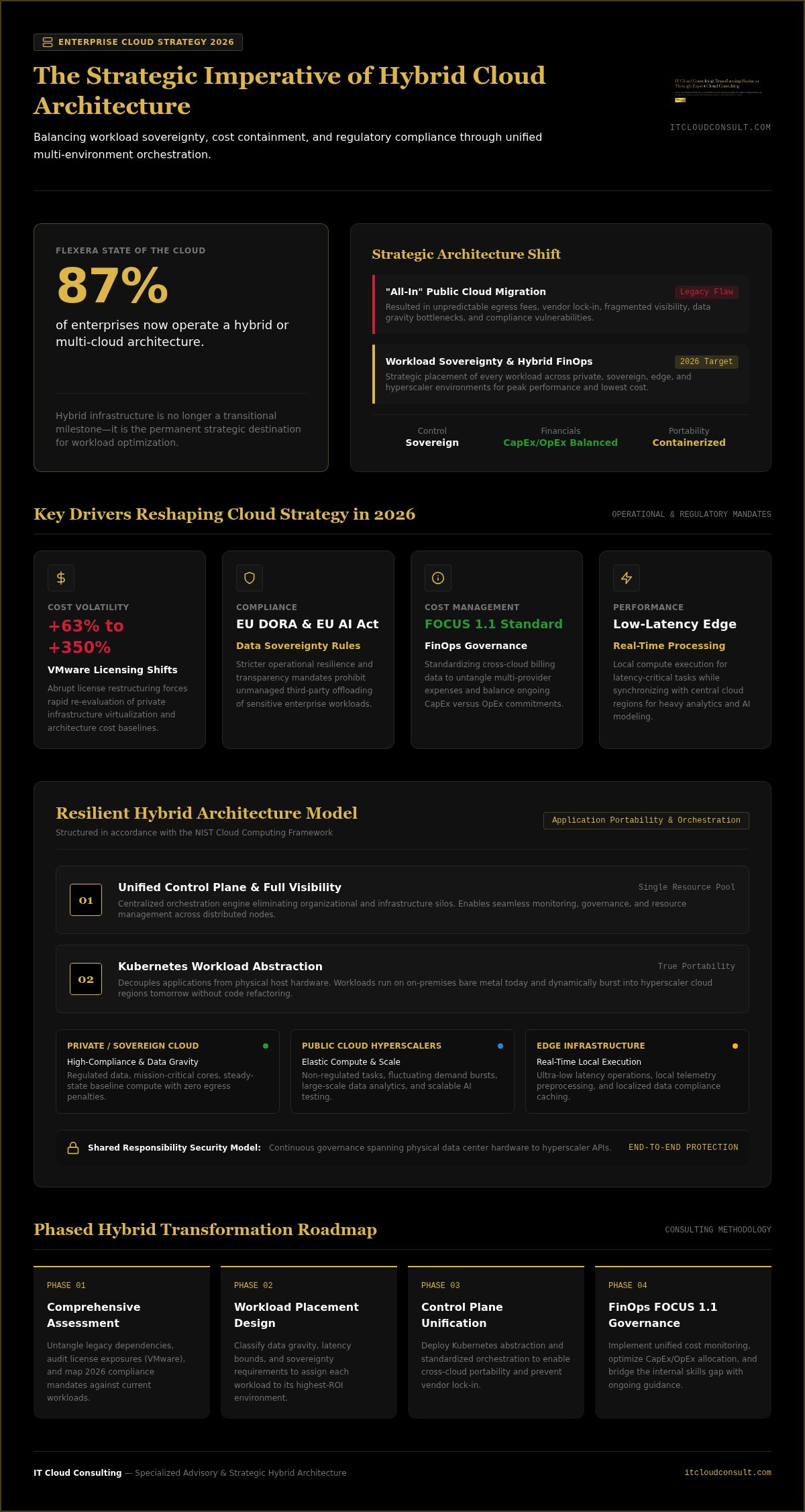
Industry data confirms that hybrid architecture is no longer a temporary transition phase. According to Flexera's State of the Cloud Report, 87% of enterprises now operate a hybrid or multi-cloud architecture. This shift persists because organizations have realized that the "all-in" public cloud approach often leads to unmanaged costs and fragmented visibility. Professional consulting helps you move beyond simple connectivity toward unified orchestration, ensuring your infrastructure evolves alongside your business objectives.
Why Enterprises are Moving Beyond Pure Public Cloud
The initial rush to the public cloud frequently ignored the reality of data gravity and regulatory constraints. In 2026, the enforcement of the EU Digital Operational Resilience Act (DORA) and the transparency mandates of the EU AI Act have made data sovereignty a top-tier priority. Organizations can't simply offload sensitive workloads to a third party without maintaining granular control. Hybrid environments allow you to keep sensitive data on-premises or in sovereign clouds while leveraging the public cloud's elastic power for non-regulated tasks.
Performance requirements also drive this shift. Centralized cloud regions often introduce unacceptable latency for edge computing applications. By maintaining local processing power for real-time needs and syncing with the cloud for deep analytics, you achieve a balance that pure public cloud strategies can't match. It's about efficiency. It's about control. To ensure your on-premises infrastructure is optimized for these needs, you can learn more about Data Center Specialists (M) Sdn Bhd (DCS) and their professional solutions for mission-critical IT environments.
Transitioning to a sophisticated hybrid model requires more than just technical troubleshooting. It demands a commitment to strategic cloud adoption that identifies architectural flaws before they become expensive failures. Many organizations currently struggle with a significant IT skills gap, finding it difficult to manage the intricacies of cross-platform governance and security. A consultant acts as a visionary architect, bridging this gap with expert guidance that empowers your internal teams.
Professional advisory services provide the steady assurance needed to navigate 2026's volatile market. Whether you're dealing with the 63% to 350% cost increases associated with recent VMware licensing shifts or trying to implement the FinOps FOCUS 1.1 standard, external expertise ensures your roadmap remains viable. You don't just need a vendor; you need a partner who understands the long-term trajectory of your digital evolution.
Designing a Resilient Hybrid Architecture
A resilient hybrid architecture isn't a compromise; it's a deliberate design choice that prioritizes operational sovereignty. Modern environments integrate private infrastructure, public cloud resources, and edge computing into a single, cohesive logical entity. According to the NIST cloud computing framework, a successful hybrid model must ensure application portability and orchestration across these distinct boundaries. Achieving this requires more than just high-speed connectivity. It demands a unified control plane that provides total cross-cloud visibility, allowing your teams to manage distributed nodes as a single resource pool. Professional hybrid cloud consulting focuses on building this architectural foundation to prevent the silos that often plague unplanned expansions.
Containerization, specifically through Kubernetes, serves as the critical glue in this ecosystem. By abstracting the application from the underlying infrastructure, you enable true workload portability. This means a service can run on an on-premises rack today and burst into a public cloud region tomorrow without a complete rewrite. However, this flexibility introduces new security challenges. Security must be viewed as a shared responsibility across every layer, from the physical hardware in your data center to the managed services provided by hyperscalers. It's about visibility. It's about resilience.
Workload Placement Strategy
Determining where a workload lives is a multi-dimensional decision. The "Cloud-First, Not Cloud-Only" philosophy recognizes that while the public cloud offers unmatched agility, mission-critical systems often require the predictable latency and data gravity of private infrastructure. You must evaluate performance requirements against the reality of cloud egress fees. For example, large datasets with constant I/O are often more cost-effective when held on-premises, while elastic, burstable applications belong in the public cloud. If you're unsure where your workloads fit best, exploring strategic cloud optimization can help clarify your placement roadmap.
Unified Governance and Security
Consistency is the primary defense against modern threats. Implementing a zero-trust architecture ensures that every user and device is verified, regardless of whether they're accessing resources in a private data center or a public cloud bucket. You can streamline this process by automating compliance checks against a cloud security assessment checklist. Centralizing Identity and Access Management (IAM) is equally vital. It eliminates the risk of "shadow IT" and ensures that security policies remain uniform across your entire hybrid footprint, providing the steady assurance your stakeholders demand.
Financial Optimization: Balancing CapEx and OpEx
The financial landscape of 2026 demands a sophisticated approach to infrastructure spending. While the public cloud offers flexibility, its operational expenditure (OpEx) model can become volatile without strict oversight. Conversely, private infrastructure requires capital expenditure (CapEx) but provides long-term cost predictability for steady workloads. Professional hybrid cloud consulting helps you strike this balance, ensuring you don't overpay for "shelfware" while maintaining the ability to scale. This strategic alignment is the foundation of Hybrid FinOps, a discipline focused on unifying spend management across every environment.
Managing a hybrid budget requires a shift from simple accounting to strategic value realization. You must ensure that every dollar spent on infrastructure directly contributes to operational agility or risk mitigation. By integrating financial data into your architectural decisions, you transform IT from a cost center into a driver of enterprise evolution.
The Economics of Hybrid Infrastructure
Calculating the Total Cost of Ownership (TCO) over a five-year period is essential for accurate forecasting. In 2026, the baseline cost for on-premises private clouds has increased significantly, with Broadcom's VMware licensing changes driving costs up by 63% to 350% for many deployments. Despite these shifts, capitalized hardware remains the more economical choice for constant, 24/7 baseline loads. You can then leverage the public cloud's OpEx model for "bursting" during peak demand, using reserved instances or spot pricing to minimize costs. This tiered approach ensures your financial resources are allocated to their highest and best use.
Eliminating Cloud Bill "Surprises"
Unmanaged spending often stems from a lack of visibility into resource consumption. To combat this, organizations are adopting the FinOps Open Cost and Usage Specification (FOCUS) Version 1.1, which standardizes billing datasets across major hyperscalers. Implementing automated resource tagging and billing alerts provides the steady assurance that your budget remains intact. A critical part of this process involves cloud optimization consulting, which identifies wasted spend and optimizes your instance sizing.
One of the most frequent causes of budget overruns is the cost associated with moving data out of the cloud. Cloud egress fees are the charges hyperscalers levy for data leaving their network, and they can significantly erode the ROI of hybrid environments if data gravity isn't properly managed. By partnering with a hybrid cloud consulting expert, you can design data paths that minimize these charges, ensuring your hybrid evolution remains both technically sound and financially sustainable.
A Phased Roadmap for Hybrid Transformation
Execution requires more than intent; it demands a structured enterprise cloud transformation roadmap that respects the complexity of your existing environment. Successful hybrid cloud consulting focuses on minimizing operational friction through a "pilot and pivot" strategy. This approach allows you to validate architectural assumptions in a controlled environment before committing to full-scale deployment. By prioritizing workloads based on their business impact and technical complexity, you ensure that early wins build momentum for the broader organizational evolution. It's about moving with steady assurance rather than rushing into unmanaged complexity.
Step 1: The Infrastructure Audit
Every successful transformation begins with a deep cloud infrastructure consulting assessment. You must map every dependency between on-premises systems and cloud nodes to uncover hidden technical debt that might prevent seamless integration. This audit benchmarks your current performance against 2026 industry standards, identifying bottlenecks that could throttle your hybrid performance. Understanding these foundational constraints is the only way to untangle a messy hybrid environment effectively. It provides the clarity needed to decide which legacy systems are candidates for modernization and which should remain in their current state for stability.
Step 2: Integration and Orchestration
Reliable integration depends on robust connectivity. You'll need to establish Direct Connect or dedicated VPN links to ensure low-latency communication across your entire footprint. Partnering with a specialist like UTD Technology Corp ensures that your professional technology systems are integrated correctly from the ground up. Once the pipes are in place, deploying cross-platform orchestration tools becomes the priority. These tools allow your teams to manage distributed deployments without caring whether the underlying node is in a private rack or a public region. By creating a "single pane of glass" for monitoring, you gain the visibility required to maintain system health and security across disparate environments. Consistency in management drives reliability in performance.
Optimization is a continuous cycle, not a one-time event. You should iteratively refine resource allocation using real-world usage data to eliminate waste and improve unit economics. Transitioning to managed cloud services provides the 24/7 support necessary to close internal skills gaps and maintain operational stability. Regular audits ensure your architecture adapts to new security mandates, such as DORA compliance, while identifying fresh cost-saving opportunities. This proactive stance transforms your infrastructure into a responsive engine for long-term growth. If you're ready to secure your infrastructure's future, partner with us for strategic roadmap development.
Partnering with IT Cloud Consulting for Hybrid Success
Successful transformation isn't an accident; it is the result of deliberate planning and expert execution. IT Cloud Consulting positions itself as the visionary architect of your digital evolution, providing the technical proficiency and strategic foresight required to navigate 2026's infrastructure challenges. We specialize in untangling the inherent complexities of distributed environments through professional hybrid cloud consulting that focuses on your organization's specific trajectory. By rejecting generic templates in favor of customized roadmaps, we help you realize the latent potential within your current systems while building a foundation for future growth. This commitment to long-term development ensures that your infrastructure remains a responsive engine for innovation rather than a bottleneck.
Our advisory model emphasizes the realization of value through precision. We work closely with your stakeholders to connect technical processes directly to organizational benefits, creating a sense of momentum and progress throughout the modernization journey. With our guidance, you can move away from reactive troubleshooting and toward a state of steady assurance. We don't just offer a service; we offer a reliable partnership that grows alongside your enterprise.
Our Strategic Advisory Framework
Our framework aligns your technical architecture with business growth goals, ensuring that every cloud investment serves a clear strategic purpose. We provide vendor-neutral advice, which is essential for maintaining a high-performance multi-cloud environment that avoids vendor lock-in. This objectivity allows us to recommend the most efficient placement for every workload based on cost, latency, and compliance requirements. Our continuous monitoring and managed cloud support provide the real-time oversight necessary to detect and resolve anomalies before they result in system downtime. By integrating these technical processes with your broader business results, we transform your infrastructure into a competitive advantage.
Take the Next Step in Your Cloud Journey
A common objection to modernization is the perceived difficulty of managing a fragmented hybrid system. We address this directly: complex environments are entirely manageable when you have a partner who possesses both the big-picture perspective and the technical expertise to execute it. The evolution of your enterprise begins with a professional readiness assessment. This assessment clarifies your current state and provides the building blocks for a comprehensive roadmap toward modernization.
Ongoing managed support acts as a dependable guide, closing the IT skills gap and maintaining peak operational efficiency as your organization scales. We invite you to evolve your infrastructure with professional guidance that prioritizes your sovereign control and long-term success. It's time to secure your trajectory and realize the full possibilities of a unified hybrid cloud. Contact IT Cloud Consulting to begin your assessment and take the next step in your digital journey.
Securing Your Infrastructure's Strategic Future
The transition to a sophisticated hybrid environment is no longer a matter of technical convenience; it's a prerequisite for organizational resilience. You've seen how balancing CapEx predictability with OpEx scalability creates a foundation for sustainable growth, while a unified control plane ensures your data remains both portable and secure. Mastering these complexities requires a shift from reactive management to a proactive strategy that prioritizes sovereign control and architectural integrity. Professional hybrid cloud consulting provides the steady assurance needed to navigate these shifts without sacrificing performance or overextending your budget.
IT Cloud Consulting serves as your visionary architect, offering authoritative guidance on strategic cloud adoption and comprehensive infrastructure reviews. Our national managed support ensures your enterprise operations remain stable as you evolve. By untangling legacy bottlenecks and implementing a phased roadmap, we help you realize the latent potential of your digital ecosystem. Schedule your strategic hybrid cloud assessment with IT Cloud Consulting today to begin your transformation. Your path to a modernized, high-performance future is within reach.
Frequently Asked Questions
What is hybrid cloud consulting and how does it differ from standard migration?
Hybrid cloud consulting focuses on the strategic alignment of private and public resources rather than the simple relocation of data. Standard migration often involves a lift and shift approach that ignores long-term architectural health. In contrast, it's our advisory services that develop a comprehensive roadmap prioritizing workload sovereignty and operational control. This ensures your infrastructure evolves to meet specific business goals while you don't fall into common pitfalls of unplanned expansion.
How does a hybrid cloud strategy improve data security and compliance?
A hybrid strategy enhances security by allowing sensitive workloads to remain on private infrastructure while utilizing the public cloud for less critical tasks. This architecture supports compliance with 2026 mandates like the EU Digital Operational Resilience Act (DORA) and regional data residency requirements. By maintaining granular control over your most sensitive datasets, you reduce the risk of unauthorized access. Unified governance frameworks also ensure that security policies remain consistent across every environment in your footprint.
What are the most common challenges in managing a hybrid cloud environment?
The primary obstacles include fragmented visibility across disparate environments and the significant IT skills gap required to manage multi-cloud orchestration. Organizations often struggle with unpredictable egress fees and the complexity of shifting licensing models, such as recent changes in core-based subscription pricing. Professional guidance helps untangle these complexities by implementing a unified control plane. This approach provides the steady assurance that your hybrid ecosystem remains manageable, secure, and aligned with your modernization objectives.
Can hybrid cloud consulting help reduce our monthly AWS or Azure bills?
Specialized consulting identifies wasted spend through a rigorous cloud optimization assessment that aligns resource consumption with actual usage. We leverage the FinOps FOCUS 1.1 standard to provide a standardized view of multi-cloud billing, helping you eliminate shelfware and optimize instance sizing. By identifying where baseline workloads are more cost-effective on private infrastructure, we reduce the heavy OpEx burden of pure public cloud models. This strategic oversight ensures your cloud investments deliver a clear ROI.
How long does a typical hybrid cloud transformation roadmap take to implement?
Implementation timelines vary based on the complexity of your existing technical debt, but a phased roadmap typically spans several months to a year. The process begins with a comprehensive infrastructure audit to map dependencies followed by the integration of robust orchestration tools. We utilize a pilot and pivot approach to minimize operational downtime during the transition. This methodical pace allows your organization to build internal proficiency while ensuring each phase of the evolution is technically sound.
Is hybrid cloud more expensive than moving entirely to the public cloud?
While the initial capital expenditure for private infrastructure is higher, a hybrid model often provides a lower Total Cost of Ownership (TCO) for 24/7 baseline workloads. Pure public cloud strategies can become prohibitively expensive due to variable OpEx costs and aggressive egress fees. By capitalizing baseline hardware and using the public cloud for elastic bursting, you achieve a more predictable financial profile. This balance ensures you don't overpay for the scalability you only need occasionally.
What should I look for when choosing a hybrid cloud consulting company?
You should prioritize a firm that acts as a visionary architect with a deep understanding of both legacy systems and cloud-native technologies. Look for a partner that offers vendor-neutral advice and prioritizes ongoing managed support to close your internal skills gaps. A dependable consultant should focus on customized roadmaps rather than one-size-fits-all solutions. Ensure they have a proven track record in strategic hybrid cloud consulting and a clear methodology for maintaining operational stability throughout your transformation.
How do egress fees affect the ROI of a hybrid cloud architecture?
Egress fees are the charges hyperscalers levy for data leaving their network, and they can significantly erode the ROI of a hybrid architecture if they aren't managed. When large datasets are frequently moved between public and private environments, these costs often lead to budget overruns. Consulting helps you design data paths that prioritize data gravity, keeping heavy I/O workloads on-premises or in colocation facilities. This strategic placement ensures that your hybrid environment remains financially sustainable.


