
With the global average cost of a data breach climbing to $4.88 million, the margin for error in implementing cloud data security best practices has effectively vanished. You likely recognize the mounting pressure to secure assets across AWS, Azure, and GCP while maintaining the velocity your business demands. It's difficult to shake the fear that a single hidden misconfiguration might compromise your entire infrastructure, especially when you are trying to align technical security with ambitious growth goals.
Mastering these protocols is no longer just a defensive necessity; it's a strategic driver for organizational evolution. This guide provides the comprehensive framework and technical controls required to protect your most valuable assets in an increasingly complex landscape. You'll gain a clear, actionable checklist for 2026 that reduces the risk of data exfiltration and improves your compliance posture without sacrificing system performance. We will explore how to leverage NIST CSF 2.0 and CSA CCM v4.1 standards to transform your security from a bottleneck into a dependable foundation for innovation and long term development.
Key Takeaways
- Modern cloud security has evolved into a dynamic, identity-centric discipline where static perimeters no longer protect against AI-enhanced reconnaissance.
- Transitioning to a Zero Trust Architecture (ZTA) ensures that every access request is verified, regardless of its origin within your multi-cloud environment.
- Understanding the nuances of the 2026 Shared Responsibility Model allows your organization to clearly distinguish between security of the cloud and your internal obligations.
- Implementing these cloud data security best practices through a structured, phased approach creates a resilient foundation for business growth while reducing the risk of data exfiltration.
- Aligning technical controls with strategic roadmaps through expert assessments helps bridge the gap between complex security requirements and long-term innovation goals.
The 2026 Cloud Threat Landscape: Why Static Security No Longer Suffices
The definition of cloud security has fundamentally changed. In 2026, it's no longer about building a digital wall around a server; it's a dynamic, identity-centric discipline that prioritizes the movement of data across borders. Automated threat actors now utilize AI-enhanced reconnaissance to identify vulnerabilities in milliseconds, scanning for open ports or unpatched vulnerabilities before your team can even register the attempt. This evolution forces a shift from "protecting the network" to a rigorous focus on "protecting the data and the identity." While the goals of confidentiality and integrity remain constant, the primary risks have sharpened. Misconfigurations, credential theft, and insecure APIs represent the most significant points of failure. Adhering to established cloud computing security principles is the first step in mitigating these sophisticated vectors.
The Reality of Multi-Cloud Complexity
Managing a footprint across AWS, Azure, and GCP introduces layers of friction that traditional security models can't handle. Fragmented security policies often lead to "shadow gaps," where data resides in unmanaged, uncataloged repositories. Recent industry benchmarks indicate that over 35% of breaches now involve this "shadow data," which significantly escalates forensic and recovery costs. Inconsistent Identity and Access Management (IAM) implementations further complicate this; a permission set in one provider might not translate securely to another. For 2026, cloud data security best practices dictate the use of a unified visibility layer. Without this single pane of glass, your team cannot detect the subtle drifts in configuration that lead to catastrophic exposure. Centralized monitoring ensures that your security posture remains consistent regardless of which provider hosts the workload.
The Cost of Reactive Security Postures
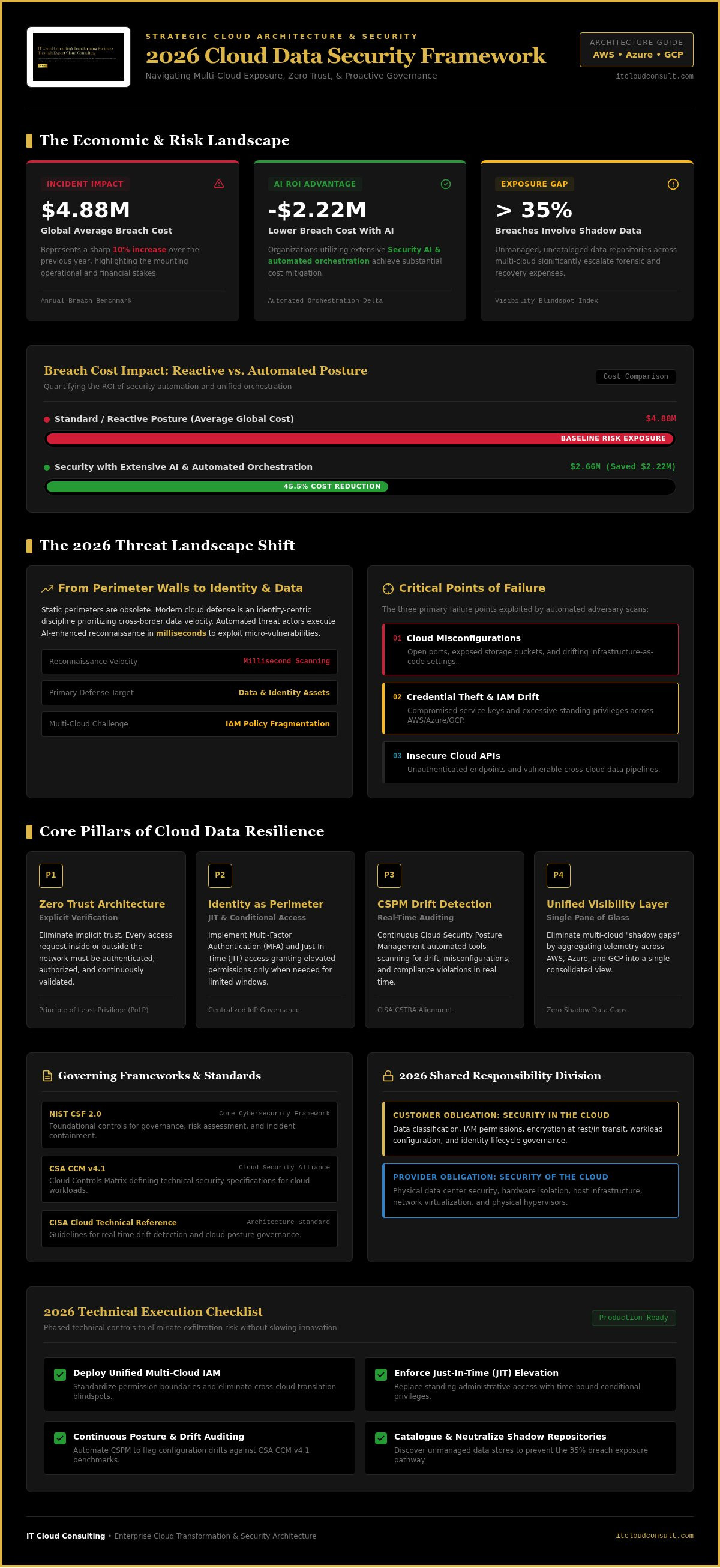
Global data breach analysis shows that the average cost of an incident has climbed to $4.88 million, representing a 10% increase over the previous year. However, the true impact of exfiltration extends far beyond the ledger. It erodes brand equity and stalls critical enterprise cloud transformation initiatives by introducing unnecessary friction. Organizations that view security as a reactive "fix" find their innovation cycles slowed by late-stage audits and emergency patches. Conversely, high security maturity correlates directly with long term cloud ROI. Organizations leveraging extensive security AI and automated orchestration saw breach costs that were $2.22 million lower than those without these advanced capabilities. Positioning cloud data security best practices as a strategic partner allows your organization to realize its full potential. By aligning technical controls with business growth, you transform security from a bottleneck into a dependable foundation for future innovation.
Core Pillars of a Resilient Cloud Data Security Strategy
A resilient strategy begins with the abandonment of implicit trust. Establishing a Zero Trust Architecture (ZTA) serves as the foundational philosophy for 2026, ensuring that every access request is verified regardless of its origin. This transition requires the rigorous implementation of the Principle of Least Privilege (PoLP) across all service accounts. By restricting permissions to the absolute minimum required for a task, you effectively neutralize the potential impact of compromised credentials. To maintain this posture, organizations must leverage Cloud Security Posture Management (CSPM) for real-time drift detection, a practice that aligns with CISA's Cloud Security Technical Reference Architecture. These automated tools act as a continuous audit layer, identifying misconfigurations before they can be exploited by automated threat actors.
Identity as the New Security Perimeter
Traditional firewalls have become secondary to robust Multi-Factor Authentication (MFA) and conditional access policies. In a landscape where credential compromise remains a leading attack vector, your security is only as strong as your identity validation. Implementing just-in-time (JIT) access further minimizes the attack surface by granting elevated permissions only when necessary and for a limited duration. Centralized identity providers are essential in a managed cloud services model, providing the unified visibility needed to enforce consistent policies across disparate providers. If you're unsure where your current identity gaps lie, a professional cloud security assessment can provide the clarity needed to fortify your perimeter.
Data-Centric Protection Mechanisms
Encryption at-rest and in-transit is a baseline requirement, but true resilience requires a data-centric approach. Automating data classification allows your team to identify and shield sensitive Personally Identifiable Information (PII) without manual intervention. For high-stakes environments, utilizing hardware security modules (HSM) for key management ensures that your cryptographic keys remain under your exclusive control. Data tokenization is a method for reducing compliance scope by replacing sensitive data elements with non-sensitive equivalents. By embedding these cloud data security best practices into the fabric of your architecture, you protect the data itself rather than just the infrastructure around it. This methodology ensures that even if a breach occurs, the exfiltrated information remains indecipherable and valueless to the adversary.
Deciphering the Shared Responsibility Model in 2026
The Shared Responsibility Model remains the most misunderstood aspect of modern cloud architecture. While providers secure the physical facilities, hardware, and hypervisors (Security OF the cloud), enterprises are 100% accountable for the configurations, identities, and data residing within those environments (Security IN the cloud). This "Governance Gap" is where most breaches occur. Misconfigurations remain the leading cause of cloud failures, often because teams assume the provider is managing more than they actually are. Adhering to cloud data security best practices requires a precise understanding of where your provider's duty ends and yours begins. This boundary shifts significantly as you move from Infrastructure-as-a-Service (IaaS), where you control the OS and network, to Software-as-a-Service (SaaS), where your responsibility focuses almost entirely on identity governance and data loss prevention.
Provider-Specific Security Nuances
Each major cloud service provider offers a unique set of native guardrails. AWS focuses on granular IAM policies; Azure integrates deeply with Entra ID; Google Cloud emphasizes container security and global VPCs. These differences can create significant friction and "security debt" in a multi-cloud environment. Engaging in cloud infrastructure consulting allows your organization to normalize these disparate controls into a single, cohesive strategy. It's also vital to scrutinize Service Level Agreements (SLAs) regarding data recovery. Most providers guarantee the availability of the infrastructure, but they don't guarantee the integrity or recovery of your specific data if a tenant-side error leads to loss. For a comprehensive overview of these architectural domains, consult the Cloud Security Alliance's Security Guidance.
The Role of Managed Support in Bridging the Gap
Bridging the resource gap is a common challenge for growing enterprises. Managed support provides the continuous monitoring necessary to detect configuration drift in real-time, offsetting the burden on internal teams. This shared oversight ensures that rigorous compliance standards like SOC2, HIPAA, and GDPR are consistently met across all environments. Beyond immediate protection, cloud optimization consulting plays a critical role in reducing security-related waste. By identifying and decommissioning orphaned resources or over-provisioned accounts, you simultaneously lower your monthly spend and shrink your attack surface. This holistic approach ensures that your cloud data security best practices are both effective and efficient, supporting long-term business evolution without unnecessary overhead.
The 2026 Enterprise Cloud Data Security Checklist
Implementing cloud data security best practices requires a methodical transition from reactive patching to a proactive, layered defense. This checklist serves as a strategic roadmap, organizing technical controls into logical phases of maturity that align with your long term development goals. Each phase builds upon the previous one, transforming your cloud environment into a resilient asset that supports business velocity without compromising integrity. To facilitate this transformation, you may want to explore Managed IT and Cybersecurity Service Contracts that provide professional oversight for these critical phases.
Phase 1: Foundation. Conduct a rigorous Identity and Access Management (IAM) audit to eliminate dormant accounts and over-provisioned roles. Enforce phishing-resistant Multi-Factor Authentication (MFA) across all administrative and user roles. Complete a comprehensive asset discovery to identify every data repository, ensuring no "shadow data" remains uncataloged.
Phase 2: Protection. Move beyond access control to active shielding. Roll out encryption for all data-at-rest and data-in-transit using customer-managed keys. Segment your network to isolate critical workloads and harden your APIs to prevent unauthorized data scraping or injection attacks.
Phase 3: Visibility. Centralize your logs into a unified platform to ensure security anomalies aren't missed. Integrate Cloud Security Posture Management (CSPM) to catch configuration drift immediately. Establish real-time alerting for high-risk events, such as the creation of public storage buckets or unauthorized IAM changes.
Phase 4: Resilience. Shift your focus to rapid recovery. Develop and automate incident response playbooks that trigger the moment a breach is detected. Perform quarterly disaster recovery testing to ensure your business can resume operations with minimal downtime regardless of the incident type.
Building a secure environment involves non-negotiable technical guardrails that prevent the most common points of failure. You should enforce 'Block Public Access' on all storage buckets by default; this simple configuration prevents the accidental exposure of sensitive datasets. Rotate your cryptographic keys every 90 days or less to limit the window of opportunity for any compromised credentials. Finally, implement immutable backups. These read-only copies of your data are essential for thwarting ransomware attempts, as they cannot be encrypted or deleted by attackers even if they gain administrative access to your primary environment.
Operational and Governance Readiness
Technical tools are only as effective as the governance structures supporting them. You should conduct a comprehensive cloud security assessment checklist annually to identify emerging gaps in your posture. Establishing a cross-functional Cloud Center of Excellence (CCoE) ensures that security policies remain aligned with your business innovation goals rather than acting as a bottleneck. Additionally, you must train your staff on cloud-native social engineering tactics, such as MFA fatigue attacks and session hijacking. If you're ready to transition from a checklist to a customized strategic roadmap, book a strategic cloud consultation today to secure your digital future.
Navigating Security Maturity with Strategic Cloud Consulting
While automated tools are essential for modern defense, technology alone cannot solve the human element of cloud data security best practices. Sophisticated software can identify a misconfiguration, but it cannot instill the cultural discipline or strategic oversight required to prevent that error from recurring. Many enterprises find themselves trapped in a cycle of reactive firefighting, addressing vulnerabilities only after they appear in a scan. Transitioning to proactive strategic governance requires a shift in perspective, where security is viewed not as a technical hurdle, but as a core component of business integrity. A third party security audit provides the objective clarity needed to uncover hidden vulnerabilities and "shadow data" repositories that internal teams, often burdened by operational demands, might overlook. For growing businesses seeking dedicated assistance to ease this operational burden and reinforce their infrastructure, discover Proactive Networking Ltd for comprehensive IT outsourcing and managed support.
Aligning your security roadmap with broader business modernization goals ensures that your technical controls support, rather than stifle, innovation. When security is integrated into the architectural phase, it becomes a dependable foundation for growth. This alignment allows leadership to quantify risk more accurately and make informed decisions about resource allocation. By moving away from isolated technical fixes and toward a unified strategic framework, your organization can realize its latent potential while maintaining a robust defense against the evolving threat landscape of 2026.
The IT Cloud Consulting Approach
We recognize that every organization follows a unique trajectory. Our methodology integrates security into every stage of the strategic cloud adoption roadmap, ensuring that protection is never an afterthought. We develop customized security frameworks tailored to your specific industry compliance needs, whether you are navigating the complexities of SOC2, HIPAA, or the latest NIS2 requirements. Our commitment to excellence means that performance is never sacrificed for the sake of security. We optimize your multi-cloud environment to ensure that robust encryption and identity controls operate seamlessly, maintaining the high speed and efficiency your enterprise requires to remain competitive.
Next Steps for Your Security Evolution
The path toward security maturity begins with a clear understanding of your current state. Initiating a professional infrastructure review allows you to identify critical gaps and prioritize remediation efforts based on actual business risk. This data-driven approach is essential for building a compelling business case for managed cloud security support and continuous monitoring. Investing in expert guidance transforms your security posture from a source of anxiety into a strategic advantage. When you are ready to fortify your digital assets and align your technical controls with long term development goals, Contact IT Cloud Consulting to secure your cloud environment today.
Securing Your Enterprise Trajectory in 2026 and Beyond
The transition from static network perimeters to a dynamic, identity-centric defense represents a fundamental shift in how we protect digital assets. By adopting the cloud data security best practices outlined in this guide, your organization moves beyond basic compliance to build a resilient foundation for long term development. You've seen how a structured checklist, focused on Zero Trust and continuous visibility, transforms security from a reactive bottleneck into a proactive strategic advantage.
Realizing your enterprise's full potential requires more than just the right tools; it demands a partner who understands the "big picture" of multi-cloud complexity. We provide expert multi-cloud advisory and comprehensive security roadmaps designed to align technical controls with your specific business innovation goals. With proactive managed support, you can ensure your infrastructure remains secure while your team focuses on growth. Take the first step toward a more optimized and secure future by choosing to Schedule a Strategic Cloud Security Consultation with our team today. Your evolution into a cloud-native leader is within reach, and we're here to guide every step of the journey.
Frequently Asked Questions
What is the single most important cloud security best practice for 2026?
The single most important practice is the implementation of a Zero Trust Architecture where no user or device is trusted by default. In 2026, identity has replaced the network as the primary security perimeter. This approach requires continuous verification of every access request regardless of its origin. By combining this with phishing-resistant authentication, you create a robust defense that neutralizes the impact of compromised credentials and prevents lateral movement within your environment.
How does the Shared Responsibility Model affect my data liability?
The Shared Responsibility Model dictates that while cloud service providers manage the security of the underlying infrastructure, you retain 100% liability for the data stored within it. This includes managing access permissions, encryption, and configuration settings. Misunderstanding this boundary is a leading cause of breaches. You are responsible for ensuring that your cloud data security best practices are consistently applied across all platforms to meet legal and regulatory obligations.
Can cloud security measures actually improve system performance?
Yes, well-architected security measures often lead to performance gains by eliminating unnecessary resource exposure and reducing system bloat. Implementing granular access controls and network segmentation reduces noise within your environment, allowing for faster processing and lower latency. Additionally, security-driven automation often identifies underutilized or orphaned resources. This process streamlines your infrastructure, ensuring that your system operates at peak efficiency while maintaining a high level of protection for your digital assets.
What is the difference between CSPM and CWPP in a security strategy?
Cloud Security Posture Management focuses on identifying misconfigurations and compliance risks across your entire cloud environment. It acts as a continuous audit layer. In contrast, Cloud Workload Protection Platforms provide security for the specific workloads themselves, such as virtual machines or containers, during runtime. A comprehensive strategy utilizes both. The posture management ensures the environment is built correctly, while workload protection monitors the activity happening inside to detect active threats.
How often should an enterprise conduct a cloud security audit?
Enterprises should move toward continuous automated monitoring rather than relying solely on periodic checks. However, a formal, comprehensive cloud security audit should be conducted at least once a year. These audits are essential for uncovering hidden configuration drift and ensuring alignment with evolving compliance standards like SOC2 or NIS2. Regular reviews help your leadership team understand the current risk landscape and make informed decisions about future strategic cloud adoption and infrastructure investments.
Is multi-factor authentication (MFA) enough to prevent cloud breaches?
MFA is a critical foundational control, but it's not a silver bullet. Modern attackers use sophisticated tactics like fatigue attacks and session hijacking to bypass traditional authentication. To achieve true resilience, you must combine MFA with conditional access policies, just-in-time permissions, and continuous behavioral monitoring. This layered approach ensures that even if one factor is compromised, other technical controls are in place to detect and block unauthorized activity before data exfiltration occurs.
How do I ensure compliance across multiple cloud providers?
Ensuring compliance in a multi-cloud landscape requires a unified visibility layer that normalizes security policies across AWS, Azure, and GCP. By using centralized management tools, you can enforce consistent cloud data security best practices regardless of the provider's native interface. This approach simplifies reporting and reduces the risk of shadow gaps where data might fall out of compliance. Strategic consulting can help you map these technical controls to specific regulatory requirements for a cohesive posture.
What role does AI play in modern cloud data security?
AI plays a transformative role by enabling automated threat detection and real-time response at a scale humans cannot match. In 2026, security AI is used to analyze vast amounts of telemetry data to identify subtle patterns indicative of a breach. It also assists in risk quantification and automated configuration remediation. By leveraging these intelligent systems, your organization can significantly reduce the time to detect threats and minimize the financial impact of potential security incidents.


