
Most enterprises treat the cloud as a final destination, yet by 2026, organizations that view it merely as a digital storage locker will find themselves structurally obsolete. True modernization requires more than just moving data; it demands a fundamental shift in how your infrastructure supports autonomous innovation. You've likely experienced the friction of migration projects that stalled or cloud costs that spiraled out of control. When internal teams lack the specialized skills to manage intricate multi-cloud environments, professional cloud enablement services become the essential bridge between technical debt and strategic agility.
We understand that the transition to a modern architecture is complex. This guide outlines how to evolve from basic migration to a fully optimized, high-performance ecosystem that drives continuous value. You'll discover a repeatable framework designed to reduce operational complexity and ensure your cloud investments deliver predictable ROI. We will examine the strategic pillars of cloud adoption, providing a clear roadmap to transform your current infrastructure into a catalyst for long-term growth and operational excellence.
Key Takeaways
- Distinguish between simple data migration and comprehensive architectural enablement to build sustainable internal capabilities and avoid structural obsolescence.
- Follow a structured modernization roadmap that begins with auditing technical debt and aligns your infrastructure with specific, measurable performance KPIs.
- Evaluate the differences between strategic advisory and managed cloud enablement services to select the engagement model that best supports your long-term operational agility.
- Identify the essential technical and strategic criteria for selecting a partner capable of navigating complex multi-cloud environments across AWS, Azure, and GCP.
- Transform the cloud from a reactive cost center into a proactive, self-sustaining engine that drives autonomous innovation and predictable business growth.
What are Cloud Enablement Services? Defining the 2026 Standard
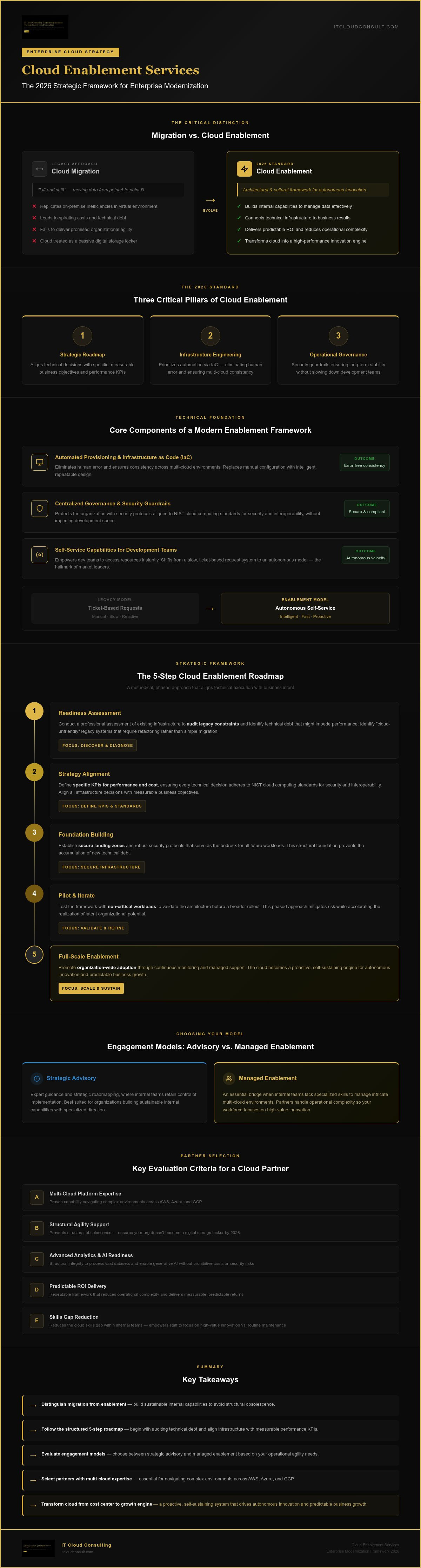
Cloud enablement isn't a single event; it's the architectural and cultural framework that allows a business to innovate autonomously. In the context of modern cloud computing, this process goes far beyond the simple transfer of workloads. While migration focuses on moving data from point A to point B, cloud enablement services focus on building the internal capabilities required to manage that data effectively. By 2026, the standard for success involves three critical pillars: a strategic roadmap that aligns with business objectives, infrastructure engineering that prioritizes automation, and operational governance that ensures long-term stability.
Without this foundation, scaling advanced analytics or generative AI becomes nearly impossible. Enablement provides the structural integrity needed to process vast datasets without incurring prohibitive costs or security risks. It transforms the cloud from a passive utility into a high-performance ecosystem where technical processes are directly linked to organizational benefits.
The Evolution from Cloud Migration to Enablement
The "lift and shift" models of the past decade have largely failed to deliver the agility enterprises were promised. Simply replicating on-premise inefficiencies in a virtual environment leads to spiraling costs and technical debt. Modern cloud enablement services solve this by connecting technical infrastructure directly to broader business results. This evolution effectively reduces the cloud skills gap within internal teams. Instead of struggling with manual configuration, your staff operates within a structured environment where complexity is managed through intelligent design rather than manual labor. For those looking to implement these advanced technical strategies, you can visit Artwounds. It's about empowering your workforce to focus on high-value innovation instead of routine maintenance.
Core Components of a Modern Enablement Framework
A robust framework relies on three technical anchors that drive efficiency and performance. First, automated provisioning and Infrastructure as Code (IaC) eliminate human error and ensure consistency across multi-cloud environments. Second, centralized governance provides security guardrails that protect the organization without slowing down development. Finally, self-service capabilities empower development teams to access the resources they need instantly. This shift from a ticket-based request system to an autonomous model is what separates market leaders from those still caught in legacy workflows. By implementing these components, organizations realize the latent potential of their digital investments and establish a predictable path for future growth, often leveraging specialized partners like Apollonix Tecnologia to refine and automate their cloud-based business ecosystems.
The Cloud Enablement Roadmap: A Strategic Framework for Success
Success in enterprise modernization isn't the result of chance; it's the product of a methodical, phased approach that aligns technical execution with business intent. While many organizations rush into implementation, the most resilient infrastructures are built upon a structured roadmap. This framework ensures that cloud enablement services provide a sustainable foundation for growth rather than a series of disconnected technical fixes. By following a logical progression, leaders can mitigate risk while accelerating the realization of latent organizational potential.
- Step 1: Readiness Assessment – Conduct a professional assessment of existing infrastructure to audit legacy constraints and identify technical debt that might impede performance.
- Step 2: Strategy Alignment – Define specific KPIs for performance and cost, ensuring every technical decision adheres to NIST cloud computing standards for security and interoperability.
- Step 3: Foundation Building – Establish secure landing zones and robust security protocols that serve as the bedrock for all future workloads.
- Step 4: Pilot and Iterate – Test the framework with non-critical workloads to validate the architecture before a broader rollout.
- Step 5: Full-Scale Enablement – Promote organization-wide adoption through continuous monitoring and managed support.
Assessing Organizational Cloud Readiness
Before moving a single workload, you must identify "cloud-unfriendly" legacy systems that require refactoring rather than simple migration. This phase involves evaluating internal team skill sets to pinpoint where training or external expertise is required to bridge the gap. Utilizing a formal Cloud Readiness Assessment allows your team to perform a deeper audit of current constraints, ensuring that the transition to an optimized future state is grounded in reality. It's a critical step for maintaining predictable cloud ROI from day one.
Designing the Strategic Adoption Roadmap
A visionary roadmap balances immediate technical "quick wins" with the long-term health of your infrastructure. This requires setting realistic timelines for enterprise-scale transformation while prioritizing workloads based on their business impact and technical complexity. By mapping out this trajectory, you transform a complex technical project into a manageable strategic evolution. If you're ready to move beyond basic migration, engaging with strategic cloud adoption experts can help you architect a roadmap that turns modernization into a permanent competitive advantage.
Comparing Engagement Models: Advisory vs. Managed Enablement
Selecting the appropriate engagement model is a pivotal decision that dictates the trajectory of your digital transformation. Organizations often find themselves navigating the choice between high-level strategic advisory and hands-on managed enablement. While both are essential components of comprehensive cloud enablement services, they serve distinct purposes within the modernization lifecycle. Strategic advisory focuses on the "why" and "how" of architecture, ensuring that every structural decision aligns with NIST cloud computing standards and definitions. Conversely, managed enablement prioritizes the "always-on" reliability and performance of your digital ecosystem.
When to Choose Strategic Cloud Consulting
Organizations at a crossroads benefit most from an advisory-led engagement. If you're facing complex migration risks or need to overhaul a stagnant infrastructure, strategic cloud consulting provides the visionary architecture required for success. This model emphasizes strategic cloud adoption, connecting technical choices directly to ROI and long-term business goals. It's about making high-stakes architectural decisions with the confidence of a seasoned architect. This ensures your roadmap is both ambitious and achievable.
The Value of Managed Cloud Support
Once the foundation is built, the focus naturally shifts to operational excellence and long-term stability. Managed support ensures your systems remain performant and secure 24/7, effectively eliminating the "cloud bill shock" that often plagues unmonitored environments. This model provides continuous optimization, where technical processes are refined in real-time to match fluctuating demand and performance requirements. For leaders seeking pricing transparency and a clear understanding of recurring fees, our Managed Cloud Services Buying Guide offers a comprehensive breakdown of what to expect from a professional partner.
Many modern enterprises now adopt a hybrid approach to cloud enablement services to maximize efficiency. This allows you to leverage internal talent for domain-specific tasks while utilizing external strategic expertise for complex systems engineering and multi-cloud orchestration. Cost considerations typically follow this functional split. Advisory services often involve project-based fees tied to specific architectural milestones; managed models operate on recurring fees that cover continuous monitoring and optimization. This structure provides the fiscal predictability needed for long-term financial planning, allowing your organization to transition from a current state of operational uncertainty to an optimized future state with steady assurance.
Selecting a Cloud Enablement Partner: Key Evaluation Criteria
Choosing a partner for cloud enablement services is a strategic decision that impacts your organization's trajectory for years. You aren't just looking for a vendor to fulfill technical tickets; you're seeking a visionary architect that understands the comprehensive landscape of enterprise evolution. A capable partner must possess the technical depth to navigate the complex nuances of AWS, Azure, and GCP simultaneously. They should demonstrate a clear strategic vision that connects technical milestones directly to business ROI and long-term growth. This ensures that every dollar spent on infrastructure contributes to a measurable increase in operational agility.
Security remains the non-negotiable foundation of this partnership. A reliable guide will prioritize a comprehensive cloud security assessment to identify vulnerabilities before they become operational liabilities. Finally, look for a cultural fit that emphasizes empowerment. The right partner builds your internal team's capabilities through knowledge transfer and structured training rather than creating a cycle of permanent dependency. This supportive orientation is what transforms a simple vendor relationship into a long-term strategic partnership focused on realizing your organization's latent potential.
Evaluating Multi-Cloud and Hybrid Proficiency
Enterprises in 2026 require a platform-agnostic approach to avoid vendor lock-in and maximize operational resilience. Your partner should provide evidence of successful deployments in complex, multi-vendor environments through verified case studies and high-level certifications. When assessing their proficiency, look for a deep understanding of cloud infrastructure consulting that spans across various cloud providers. This ensures your architecture remains flexible and responsive to shifting market demands without being tethered to a single ecosystem. It's about building a framework that allows you to leverage the best features of each provider while maintaining a unified management layer.
Security, Compliance, and Governance Guardrails
A sophisticated enablement framework must integrate compliance and governance into its very fabric. This involves more than just setting up basic firewalls; it requires a proactive stance on threat detection and continuous monitoring. You should also evaluate a partner's FinOps expertise to ensure your cloud spend is constantly optimized against performance metrics. This prevents the common pitfall of spiraling costs while maintaining high-performance standards. By establishing these guardrails early, you create a secure environment where your developers can innovate without compromising organizational safety.
If you're ready to transition from a fragmented infrastructure to a unified, high-performance ecosystem, our team is here to guide your evolution. Partner with IT Cloud Consulting to begin architecting your modernization roadmap and secure your competitive advantage in a multi-cloud world.
Modernizing Your Future with IT Cloud Consulting
IT Cloud Consulting serves as the visionary architect for your enterprise evolution, bridging the gap between current technical constraints and an optimized future state. Our professional cloud enablement services are built on a foundation of strategic planning and deep technical proficiency. We don't just provide tools; we deliver a comprehensive framework for Strategic Cloud Adoption that accelerates your journey toward operational excellence. By integrating cloud optimization consulting into our core process, we ensure your infrastructure remains a high-performance asset rather than a growing liability. Our approach transforms the cloud from a reactive cost center into a proactive engine for growth.
We recognize that every organization occupies a unique position on the modernization spectrum. Whether you're struggling with legacy technical debt or seeking to orchestrate a complex multi-cloud environment, our team provides the steady assurance required for long-term development. We focus on the realization of your latent potential, connecting technical processes directly to measurable business results. This cause and effect structure ensures that every architectural decision we make together serves a specific strategic purpose.
Customized Strategic Guidance for Long-term Development
Our commitment goes beyond technical execution; we prioritize organizational empowerment. We tailor our enablement roadmaps to your specific business trajectory, ensuring that your internal teams gain the skills necessary to manage the new ecosystem autonomously. This transition from external assistance to internal capability is a hallmark of our supportive, client-centric orientation. We provide continuous monitoring and managed support to ensure your systems remain performant, secure, and aligned with your evolving goals. It's a partnership designed for the long haul, focusing on sustainable progress rather than temporary fixes.
Next Steps: Initiating Your Cloud Enablement
The path to a modernized enterprise begins with a professional assessment of your existing infrastructure. This initial audit identifies the structural bottlenecks and legacy constraints that currently hinder your agility. By starting with a clear recognition of your current state, we can architect a precise path forward that reduces friction and eliminates the risk of stalled migration projects. Our expert implementation team handles the complexities of execution, allowing you to focus on high-level innovation and strategic planning. When you're ready to evolve your digital capabilities, schedule a strategy session with IT Cloud Consulting to begin your transition to a fully enabled, high-performance ecosystem.
Architecting Your Path to Operational Excellence
Modernizing your enterprise requires a shift from viewing the cloud as a destination to treating it as a platform for continuous innovation. By prioritizing architectural integrity and strategic roadmaps, you ensure that your infrastructure remains a high-performance asset rather than a source of technical debt. Professional cloud enablement services provide the essential framework for this evolution, balancing immediate technical needs with long-term business goals through every stage of the adoption lifecycle.
The transition from a fragmented current state to an optimized future state demands more than just migration; it requires a partner who acts as both a visionary architect and a dependable guide. Whether you need high-level advisory or ongoing technical assistance, focusing on structural security and performance optimization will safeguard your organization’s trajectory. We're here to provide the steady assurance you need to navigate these complex systems with confidence.
Are you ready to realize the latent potential of your digital ecosystem? Our team provides national US expert advisory to help you build a sustainable capability for growth. Partner with IT Cloud Consulting for Strategic Cloud Enablement to leverage our expertise in strategic roadmap development and continuous performance optimization. We're excited to support your long-term success as you lead your industry into a more efficient, modernized future.
Frequently Asked Questions
What is the difference between cloud migration and cloud enablement?
Cloud migration involves the technical relocation of data and workloads from one environment to another. Cloud enablement services go much further by architecting the tools, governance, and internal processes required for sustainable success. While migration is a finite project, enablement is a transformative strategy that builds the capability for autonomous innovation. It ensures your infrastructure is performant and secure rather than just being in the cloud without a clear management framework.
How long does a typical cloud enablement engagement take?
The timeline for a cloud enablement engagement varies based on infrastructure complexity and organizational goals. A professional assessment typically takes several weeks; full-scale implementation of a strategic roadmap often spans three to six months. This phased approach allows for testing with non-critical workloads before promoting organization-wide adoption. we focus on building a sustainable foundation that delivers long-term results rather than rushing technical execution at the expense of stability.
Do cloud enablement services include cost optimization?
Yes, cost optimization is a fundamental component of the enablement process. Professional cloud enablement services integrate FinOps principles to ensure every technical choice aligns with your financial KPIs. This includes continuous monitoring and optimization of existing resources to prevent unexpected bill spikes. By establishing governance guardrails early, we help you maintain predictable ROI and ensure that your cloud spend directly contributes to measurable business results and operational efficiency.
Can cloud enablement help with multi-cloud management?
Cloud enablement is specifically designed to handle the complexities of multi-cloud and hybrid environments. We build platform-agnostic frameworks that allow your teams to manage resources across AWS, Azure, and GCP through a unified management layer. This approach reduces operational complexity and prevents vendor lock-in; it empowers your organization to leverage the unique strengths of different providers. It's about creating a cohesive ecosystem that supports strategic cloud adoption across the entire enterprise.
What internal roles are needed to support cloud enablement?
Successful cloud enablement requires a collaborative effort across several key internal functions. You'll typically need cloud architects to oversee technical design, security leads to manage compliance, and FinOps analysts to track cloud spend. It's also essential to involve development teams who will utilize the self-service capabilities. Our role is to empower these internal stakeholders through knowledge transfer and structured roadmaps, ensuring they have the specialized skills needed to manage the new environment.
How do cloud enablement services handle legacy system security?
Security for legacy systems is addressed through a professional assessment of existing infrastructure to identify vulnerabilities. We implement secure landing zones and automated governance guardrails that protect older workloads as they transition to modern environments. This process often involves refactoring legacy components to meet current security standards rather than simply moving them. By integrating proactive threat detection, we ensure your modernized infrastructure remains resilient against evolving risks while maintaining strict compliance standards.
Is cloud enablement only for large enterprises?
Cloud enablement is not exclusive to large enterprises; it's a strategic requirement for organizations of all sizes. Small and mid-market companies often face tighter budget constraints and smaller internal teams, making professional guidance even more critical. Strategic cloud adoption helps these businesses scale efficiently without incurring prohibitive technical debt. Whether you're a growing startup or a national corporation, building a high-performance cloud ecosystem is the key to maintaining a competitive edge in 2026.
What are the most common cloud adoption failures to avoid?
The most common failures include treating the cloud as a mere technical destination and neglecting a strategic roadmap. Many organizations attempt a lift and shift of legacy inefficiencies, which leads to spiraling costs and poor performance. Other pitfalls include ignoring the cloud skills gap or failing to implement centralized governance early in the process. Avoiding these mistakes requires a methodical approach that prioritizes long-term infrastructure health and aligns every technical decision with broader business objectives.


