
Professional finops consulting services transform this cycle of reactive spending into a proactive model of strategic value. We understand that true optimization requires more than just deleting idle instances; it demands a fundamental evolution of how your business views cloud utility. By aligning your technical architecture with financial goals, you'll achieve a predictable budget and foster a culture where engineering and finance speak the same language. This guide provides a clear roadmap for 2026, detailing how expert intervention turns cloud waste into a catalyst for higher ROI and long term growth.
Key Takeaways
- Learn why the 2026 cloud landscape demands a shift from "growth at all costs" to a model of efficient innovation rooted in architectural alignment.
- Discover how professional finops consulting services provide the strategic advisory necessary to turn complex billing data into actionable engineering tasks.
- Understand the importance of establishing governance through tagging and account hierarchies to ensure accountability across every engineering team.
- Recognize why tools alone fail without a framework that prioritizes strategic insights over mere dashboard visibility to avoid the trap of tool fatigue.
- Identify the critical criteria for selecting a strategic partner capable of navigating multi-cloud environments and delivering a roadmap for continuous optimization.
The Evolution of Cloud Economics: Why FinOps Consulting is Mandatory in 2026
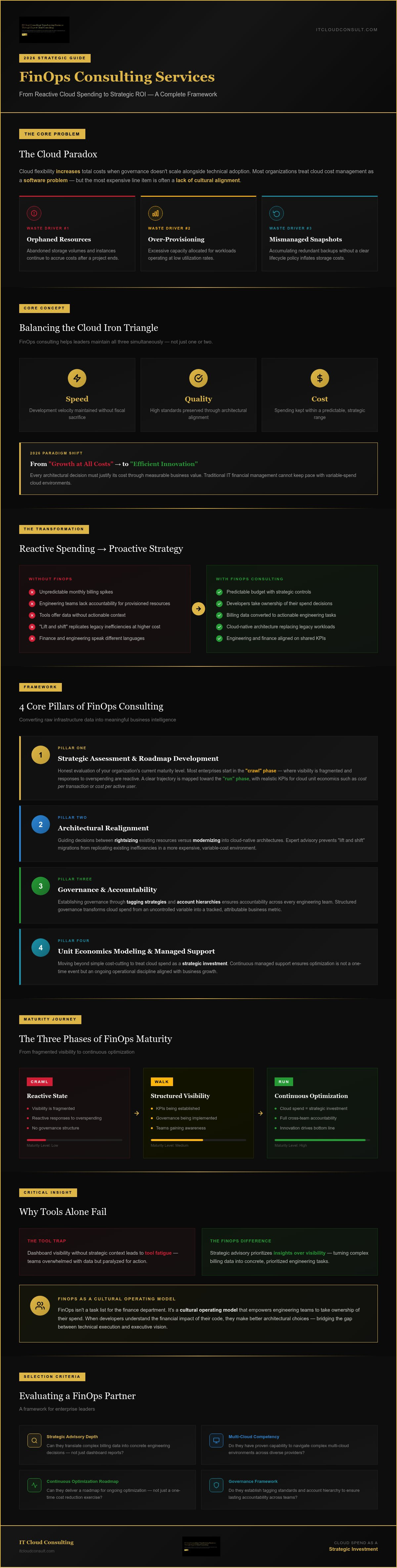
By 2026, the era of unchecked digital expansion has ended. Organizations no longer prioritize rapid deployment without considering the fiscal impact. This shift toward "efficient innovation" means that every architectural decision must justify its cost through measurable business value. Traditional IT financial management, built for the predictable cycles of on-premise hardware, cannot keep pace with the variable-spend nature of cloud computing. In this environment, finops consulting services become a mandatory strategic asset. They help leaders balance the "Iron Triangle" of cloud economics: maintaining development speed and high quality while keeping costs within a predictable range.
The High Cost of Cloud Waste
Cloud waste isn't just a budget leak; it's a symptom of architectural misalignment. This leads to the "Cloud Paradox," where the flexibility of the cloud actually increases total costs because governance didn't scale alongside technical adoption. Common drivers of this inefficiency include:
- Orphaned resources: Abandoned storage volumes or instances that continue to accrue costs after a project ends.
- Over-provisioning: Allocating excessive capacity for workloads that operate at low utilization rates.
- Mismanaged snapshots: Accumulating redundant backups without a clear lifecycle policy.
To prevent these leaks, organizations must move toward strategic cloud adoption that integrates cost controls from the outset. Without a professional roadmap, companies often pay for capacity they never use, diluting the ROI of their modernization efforts.
FinOps as a Cultural Operating Model
Success in cloud financial management requires more than just installing a dashboard. It demands a fundamental shift in how teams interact. FinOps isn't a list of tasks for the finance department; it's a cultural operating model that empowers engineering teams to take ownership of their spend. When developers understand the financial impact of their code, they make better architectural choices. FinOps is a strategic alignment of business, technology, and finance goals. By fostering this collaborative environment, finops consulting services bridge the gap between technical execution and executive vision. A visionary architect acts as the guide in this journey, ensuring that innovation remains sustainable and every dollar spent on infrastructure drives the bottom line forward.
Core Pillars of Professional FinOps Consulting Services
Professional finops consulting services deliver the structural framework required to convert raw infrastructure data into meaningful business intelligence. It isn't enough to observe spending patterns; you must understand the "why" behind every fluctuation. This transformation relies on four foundational pillars: comprehensive assessment, governance, unit economics modeling, and managed support. By focusing on these areas, organizations move beyond simple cost-cutting and begin to treat cloud spend as a strategic investment.
Strategic Assessment and Roadmap Development
Success begins with an honest evaluation of your organization's current maturity level. Most enterprises start in the "crawl" phase, where visibility is fragmented and responses to overspending are reactive. We help define a clear trajectory toward the "run" phase by establishing realistic KPIs for cloud unit economics, such as cost per transaction or per active user. This assessment phase connects directly to cloud optimization consulting, ensuring your financial targets remain grounded in technical reality.
Architectural Realignment
A major obstacle to sustainable spend is the "lift and shift" migration strategy. Simply moving legacy workloads to the cloud often replicates existing inefficiencies in a more expensive, variable-cost environment. Expert finops consulting services guide you in deciding between rightsizing existing resources or modernizing them into cloud-native architectures. This level of cloud infrastructure consulting is vital for long-term control. It's about evolving your system from a static cost center into a dynamic, value-generating asset.
Beyond architecture, establishing tagging and account hierarchy governance ensures that every resource has a defined owner. We build sophisticated cost allocation models that reflect your specific business structure, making it possible to attribute spend to individual products or departments. This level of clarity enables continuous optimization rather than one-time fixes. If you're ready to transition to a more mature financial model, our strategic cloud advisory can provide the roadmap your organization needs to thrive.
Beyond Software: Why Tools Alone Fail Without Strategic FinOps Advisory
Many enterprises fall into the "Tool Fatigue" trap, amassing a collection of dashboards that provide visibility without driving actual change. Having ten different views of your cloud spend doesn't inherently reduce the bill. It often creates a paralysis where teams are overwhelmed by data but lack the authority or direction to act on it. While software is excellent at identifying anomalies, it cannot navigate the organizational nuances that lead to waste. This is where finops consulting services provide the necessary bridge, transforming raw billing data into a prioritized list of actionable engineering tasks.
Data isn't the solution; context is everything. A tool might flag an underutilized instance, but it doesn't know if that resource is part of a critical disaster recovery test or a legacy system scheduled for decommissioning next month. Professional advisors close the "Optimization Gap," ensuring that technical findings align with broader business cycles. They also provide the high-level financial expertise required to manage complex Reserved Instance (RI) and Savings Plan strategies. These commitments often involve significant capital and multi-year horizons, requiring a human expert to validate the long-term roadmap before pulling the trigger on a purchase.
Software vs. Strategy: A Critical Comparison
There is a fundamental distinction between technical monitoring and strategic governance. Tools provide the "What" by highlighting spending spikes, but consultants provide the "How" and "Why" through deep architectural analysis. Relying solely on automated features like auto-scaling can be risky without strategic guardrails; an unmonitored script can easily scale costs just as quickly as it scales performance. It's helpful to remember that tools are tactical instruments while consulting is the strategic score. Without the score, the instruments lack harmony and purpose.
Managing the Human Element
The greatest challenge in cloud financial management isn't the technology; it's the culture. Engineers often view cost-cutting as a hindrance to speed or a threat to their creative freedom. We address this resistance by establishing "Guardrails, not Gates." This approach provides teams with the autonomy to innovate within pre-defined financial boundaries rather than requiring approval for every decision. By integrating these principles into your enterprise cloud transformation roadmap, you empower your staff to treat efficiency as a first-class citizen in the development process. Finops consulting services guide this cultural evolution, ensuring that financial accountability becomes a source of pride for engineering teams rather than a burden.
Evaluating a FinOps Partner: A Framework for Enterprise Leaders
Selecting the right provider for finops consulting services requires a shift from standard vendor management to a more integrated strategic partnership. You shouldn't settle for generalist IT firms that treat cloud spend as a secondary administrative concern. True practitioners possess deep, multi-cloud proficiency across AWS, Azure, and GCP, which allows them to navigate the specific billing nuances and service models of each provider. They offer tool-agnostic advice, ensuring that your financial strategy isn't dictated by the limitations or biases of a specific software platform. This independence is what allows a consultant to act as a fiduciary for your cloud budget.
Key Selection Criteria
A partner's value is measured by their architectural depth rather than their ability to generate colorful reports. They must demonstrate a clear cause and effect understanding of how technical adjustments, like moving to serverless or reconfiguring containers, impact the bottom line. It's also vital to evaluate how their recommendations integrate with your existing managed cloud services to ensure that optimization doesn't come at the cost of operational stability. Beyond the technical, look for change management expertise. FinOps is a cultural shift, and technical fixes only stick if the partner can effectively guide your engineering culture through the transition.
The Consultation Process
During an initial discovery session for finops consulting services, a qualified consultant will focus on your specific business objectives and current maturity level rather than pushing a pre-packaged product. You should use this time to evaluate their methodology. Is it a one-time audit that leaves you with a static PDF, or a framework for continuous evolution? Be wary of "red flags" in consulting proposals, such as guaranteed savings percentages offered before they've performed a deep data dive. Such claims often ignore the complexity of enterprise environments. Transparency is equally critical; ensure your partner provides a structured breakdown of ongoing cloud support fees to maintain a predictable budget.
A successful engagement isn't a one-time event but a continuous journey toward financial maturity. If you're ready to move from a state of financial uncertainty to one of strategic control, our team is here to provide the architectural roadmap you need. Schedule a strategic consultation to optimize your cloud investment.
Driving Sustainable ROI with IT Cloud Consulting’s FinOps Framework
IT Cloud Consulting approaches cloud financial management as a continuous lifecycle rather than a one-time correction. Our framework bridges the gap between high-level strategic adoption and daily operational excellence, ensuring that your infrastructure remains aligned with your fiscal goals. Unlike vendors who focus solely on surface-level billing data, our architecture-first approach targets the root causes of waste. This methodology transforms your cloud environment from a source of unpredictable expense into a finely tuned engine for growth.
A Roadmap to Cloud Maturity
Achieving financial maturity in the cloud requires a methodical progression from recognition to mastery. Our process follows three distinct stages designed to build trust and deliver measurable results:
- Step 1: Deep-dive assessment. We analyze every layer of your current infrastructure to identify latent potential and immediate inefficiencies.
- Step 2: Custom roadmap development. We create a tailored strategy that prioritizes high-impact architectural changes alongside long-term governance goals.
- Step 3: Continuous management and proactive health monitoring. Our Managed Cloud Support provides the ongoing technical assistance needed to prevent cost drift and ensure your environment stays optimized indefinitely.
Empowering Your Teams for the Future
The ultimate goal of professional finops consulting services is to foster an environment of self-sufficiency. We view training and enablement as core components of our engagement, providing your engineering and finance departments with the skills they need to collaborate effectively. By establishing clear governance and accountability structures, we ensure that your teams can innovate at speed without compromising the bottom line. This focus on cultural evolution means that the benefits of our partnership persist long after the initial implementation is complete.
Schedule a strategic FinOps assessment with IT Cloud Consulting today.
Realizing the Potential of Your Cloud Investment
Navigating the complexities of cloud financial management requires a transition from reactive cost-cutting to a model of intentional, efficient innovation. We've explored how the 2026 landscape demands more than just automated tools; it requires a fundamental cultural evolution and architectural alignment. By prioritizing unit economics and establishing robust governance, your organization can turn unpredictable billing spikes into a strategic advantage. This journey isn't just about reducing spend; it's about empowering your engineering teams to deliver maximum value with every resource they provision.
Partnering with professional finops consulting services provides the expert advisory needed to navigate complex enterprise transformations. IT Cloud Consulting offers a strategic focus on long-term cloud optimization, ensuring your infrastructure remains lean and performant as your business scales. Our comprehensive managed support delivers the sustained efficiency required to thrive in a variable-spend world. We're committed to helping you bridge the gap between your current state and an optimized future state. Maximize your cloud ROI with IT Cloud Consulting’s FinOps experts. You possess the vision for your organization's growth, and we're here to provide the architectural roadmap to reach it.
Frequently Asked Questions
What exactly do FinOps consulting services include?
Professional finops consulting services encompass a holistic approach to cloud financial management. This includes performing a deep-dive infrastructure assessment, establishing tagging governance, and creating a custom roadmap for cloud optimization. Advisors also facilitate cultural change by training engineering teams on financial accountability. The focus is on aligning technical architecture with business goals to ensure every dollar spent contributes to measurable growth and long-term scalability.
How is FinOps consulting different from a standard cloud audit?
A standard cloud audit provides a static snapshot of current inefficiencies and security gaps. In contrast, FinOps consulting establishes a continuous operating model focused on efficient innovation. It moves beyond one-time cost reductions to create sustainable processes for ongoing cloud support. Advisors help you build a culture where financial decisions are integrated into the engineering lifecycle; ensuring that optimization becomes a permanent part of your organizational DNA.
Can FinOps consulting help with multi-cloud environments like AWS and Azure?
Specialized consultants possess the architectural depth to manage complex multi-cloud environments, including AWS and Azure. Each provider has unique billing structures and service models that require specific optimization strategies. A strategic partner provides tool-agnostic advice to normalize data across these platforms. This allows leaders to maintain a single source of truth for their global cloud spend while leveraging the specific strengths of each individual provider.
How long does it typically take to see results from FinOps consulting?
Most organizations identify immediate "quick win" savings, such as orphaned resources or over-provisioned instances, within the first 30 to 90 days. However, the full realization of ROI occurs as the cultural shift takes root over several months. You'll see a gradual transition from reactive billing responses to proactive, predictable budgeting. Long-term success is measured by the stabilization of unit economics and the consistent alignment of cloud costs with business value.
Will FinOps consulting interfere with our engineering teams’ speed?
Effective FinOps strategies are designed to accelerate innovation rather than hinder it. By establishing "Guardrails, not Gates," consultants empower engineers to make autonomous decisions within pre-defined financial boundaries. This reduces the need for manual approvals and prevents costly architectural mistakes before they occur. When teams understand the cost impact of their code, they build more efficient systems that perform better and scale more reliably without administrative friction.
What is the typical ROI for an enterprise FinOps engagement?
While specific percentages vary based on your current maturity level, the ROI of finops consulting services is realized through significant waste reduction and improved gross margins. Organizations often report that the savings generated from architectural realignment far exceed the initial advisory fees. Beyond direct cost savings, the primary value lies in the predictability of your cloud budget and the ability to reinvest recovered capital into strategic growth initiatives.
Do we need FinOps consulting if we already use cloud-native cost tools?
Cloud-native tools provide essential visibility, but they lack the strategic context required to drive meaningful change. Software can identify an underutilized resource, but it cannot navigate the organizational complexities or technical dependencies involved in fixing it. Consultants bridge this "Optimization Gap" by turning raw data into prioritized engineering tasks. They provide the human expertise necessary to manage long-term savings plans and complex architectural modernizations that automated tools often overlook.
How do managed cloud services support a long-term FinOps strategy?
Managed cloud services provide the continuous monitoring and technical assistance required to prevent cost drift over time. As your infrastructure evolves, ongoing support ensures that new deployments adhere to established governance and optimization standards. This proactive health monitoring allows your internal teams to focus on core innovation while experts handle the complexities of infrastructure maintenance. It's a foundational component of a sustainable strategy that maintains cloud efficiency indefinitely.


