
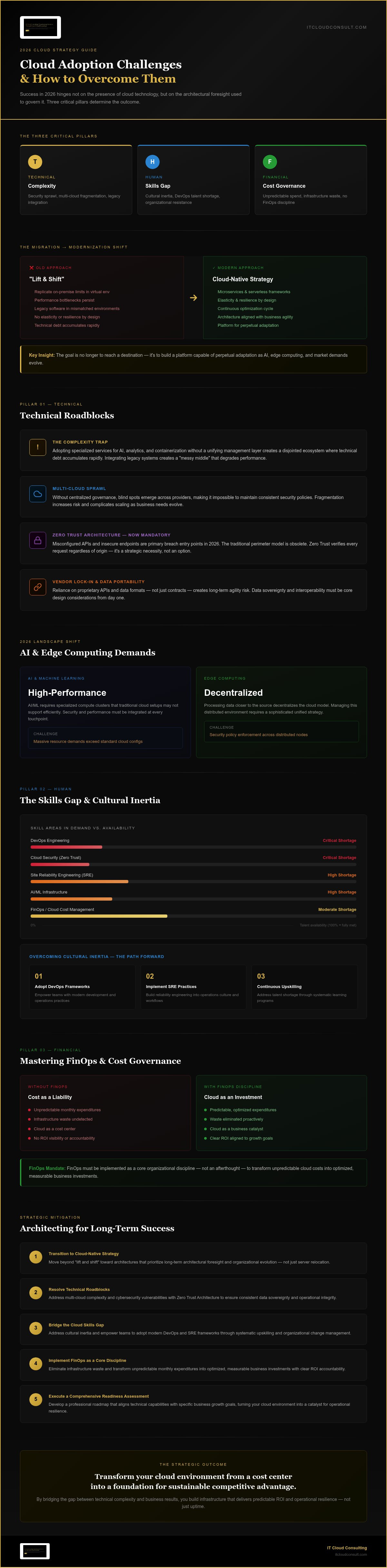
By 2026, the success of your organization no longer hinges on the mere presence of cloud technology, but on the architectural foresight used to govern it. Many leaders find themselves trapped in a cycle of reactive fixes, struggling with persistent cloud adoption challenges that drain resources and stall innovation. You're likely all too familiar with the sting of unpredictable monthly expenditures and the difficulty of securing a complex multi-cloud environment while facing a shortage of specialized talent.
It's time to move beyond survival and toward strategic mastery. This guide provides a comprehensive roadmap to identify and mitigate the technical, financial, and organizational hurdles that threaten your modernization efforts. We'll explore how to synchronize your IT capabilities with long-term business growth goals, ensuring your infrastructure isn't just a cost center but a catalyst for predictable ROI and operational resilience. By bridging the gap between technical complexity and business results, you can transform your cloud environment into a foundation for sustainable evolution.
Key Takeaways
- Transition from outdated "lift and shift" migrations toward a cloud-native strategy that prioritizes long-term architectural foresight and organizational evolution.
- Identify and resolve common cloud adoption challenges such as multi-cloud complexity and cybersecurity vulnerabilities to ensure consistent data sovereignty.
- Bridge the critical cloud skills gap by addressing cultural inertia and empowering your teams to adopt modern DevOps and SRE frameworks.
- Implement FinOps as a core discipline to eliminate infrastructure waste and transform unpredictable monthly expenditures into optimized business investments.
- Execute a comprehensive readiness assessment to develop a professional roadmap that aligns your technical capabilities with specific business growth goals.
Navigating the 2026 Cloud Landscape: Beyond Simple Migration
The era of "lift and shift" has largely concluded. Organizations have realized that simply replicating on-premise limitations in a virtual environment fails to capture the cloud's inherent potential. Modern strategies now prioritize cloud-native architectures that are designed for elasticity and resilience from the outset. This is a continuous cycle of optimization; the goal is no longer to reach a destination, but to build a platform capable of perpetual adaptation. To succeed, leaders must address hurdles across three critical pillars: technical complexity, human talent, and financial governance.
The Shift from Migration to Modernization
Many enterprises that rushed into basic migrations now face significant performance bottlenecks. These issues often stem from legacy software attempting to run in environments it was never intended for. By transitioning to microservices and serverless frameworks, businesses can decouple services to improve reliability and scaling. Modernization is the alignment of architecture with business agility. This approach ensures every technical decision directly supports the organization's ability to pivot and grow.
Why 2026 is Different: AI and Edge Computing
The current landscape is defined by the massive resource demands of AI and machine learning. These technologies require specialized, high-performance compute clusters that traditional cloud setups may not support efficiently. Simultaneously, edge computing is decentralizing the cloud model by processing data closer to the source. This convergence requires a sophisticated strategy where security and performance are integrated at every touchpoint. Managing this distributed environment is complex, but it's essential for maintaining a competitive edge in a data-driven market. Overcoming these cloud adoption challenges requires a partner who understands both the big picture and the technical execution.
Technical Roadblocks: Security, Complexity, and Multi-Cloud Sprawl
Technical hurdles often represent the most immediate friction in any modernization journey. While the vision of a seamless, automated infrastructure is compelling, the reality frequently involves navigating deep-seated cloud adoption challenges like fragmented security and service sprawl. Leaders must look beyond the initial deployment to ensure their systems remain resilient against sophisticated threats and operational decay.
The "Complexity Trap" is a common pitfall. Organizations often adopt specialized services for AI, analytics, and containerization without a unifying management layer. This results in a disjointed ecosystem where technical debt accumulates quickly. Integrating legacy systems with these modern, cloud-native applications creates a "messy middle" that can degrade performance if not handled by a visionary architect who understands the interaction between old and new systems.
Multi-cloud sprawl introduces further risks when there's no centralized governance. Without a single pane of glass for monitoring, blind spots emerge, making it difficult to maintain consistent security policies across different providers. This fragmentation doesn't just increase risk; it also complicates the ability to scale efficiently as business needs evolve.
The Evolving Threat Landscape in the Cloud
In 2026, cybersecurity is inseparable from data sovereignty. Misconfigured APIs and insecure endpoints have become primary entry points for breaches, making the traditional perimeter model obsolete. Adopting a Zero Trust Architecture is no longer optional; it's a strategic necessity to verify every request regardless of its origin. For a granular breakdown of these risks, review our Cloud Security Assessment Checklist for enterprise environments.
Interoperability and Data Portability Issues
Vendor lock-in remains a significant risk to long-term agility. It's rarely about the contract alone. Instead, it's the reliance on proprietary APIs and data formats that makes switching providers cost-prohibitive. Moving massive datasets between clouds often reveals hidden egress fees and technical bottlenecks that can stall a business's ability to pivot. Architecting for portability from day one is the only way to maintain strategic leverage.
If you're feeling overwhelmed by these technical layers, a strategic cloud optimization review can help align your infrastructure with your broader business goals. Overcoming these cloud adoption challenges requires a methodical approach that prioritizes interoperability and security above all else. When you build with the future in mind, you turn technical complexity into a foundation for innovation.
The Human Element: Addressing the Skills Gap and Cultural Inertia
Bridging the 2026 Cloud Skills Gap
When job roles evolve, anxiety is a natural byproduct. Leadership must bridge this gap by clearly articulating how cloud-native workflows benefit both the company and the individual contributor. Effective communication focuses on how automation removes repetitive tasks, allowing staff to engage in higher-value strategic work. For a structured approach to reorganizing your teams, consult the Enterprise Cloud Transformation Roadmap. This framework provides the organizational structure tips necessary to align your human capital with your long-term technical vision. The transition is most successful when training programs and external advisory work in tandem to support your team's professional evolution.
Successfully managing the human side of digital transformation also requires deep insight into your leadership's capacity for change. Utilizing OKTI Leadership Diagnostics can help organizations identify and develop the right leaders to guide their teams through these complex architectural and cultural shifts.
Financial Friction: Mastering FinOps and Unpredictable Costs
Financial friction remains one of the most significant cloud adoption challenges for modern organizations. While the promise of the cloud is efficiency, many leaders encounter "bill shock" when their monthly expenditures far exceed initial projections. This isn't a failure of the technology itself, but a symptom of poor financial governance. In a 2026 economic context, the transition from Capital Expenditure (CapEx) to Operational Expenditure (OpEx) requires a fundamental shift in how we value and track infrastructure.
On-premise hardware allowed for predictable, one-time costs, but the cloud's consumption-based model can lead to runaway spending if left unmonitored. Proactive monitoring and automated alerting are essential to prevent surprises. Most waste stems from idle resources or over-provisioned instances that serve no active business purpose. By identifying these root causes, you can reclaim your budget and reinvest it into strategic growth that drives actual value.
Hidden Costs of Cloud Adoption
The complexity of modern billing goes far beyond compute fees. Data egress fees, API call volume, and premium support tiers often hide in the fine print. Another common issue is "Shadow IT," where departments spin up resources outside central IT control. These unmanaged environments create security risks and financial leaks. Reviewing Cloud Optimization Consulting strategies can help identify these leaks and reclaim your budget.
Implementing a FinOps Framework
FinOps is the intersection of finance, engineering, and business. This framework operates through three phases: Inform, Optimize, and Operate. By providing visibility into spending and identifying rightsizing opportunities, FinOps embeds financial accountability into the engineering workflow. Real-time cost allocation changes behavior by making the impact of technical decisions immediately visible. When teams see the price tag of their architecture, they lean toward more efficient designs.
If your organization is struggling with unpredictable costs, our strategic cloud optimization services can help you align your spend with your actual business goals. Mastering the financial aspect of the cloud is essential to overcoming broader cloud adoption challenges and ensuring that your modernization efforts remain sustainable. When you treat cost as a functional requirement, you turn your cloud infrastructure into a predictable engine for ROI.
Strategic Mitigation: Architecting for Long-Term Cloud Success
Navigating the complexities described in previous sections requires more than just technical fixes; it demands a structured approach to risk mitigation. A professional roadmap serves as a visionary blueprint, aligning your IT infrastructure with specific growth targets and long-term operational resilience. By conducting a comprehensive readiness assessment, you can pinpoint specific cloud adoption challenges before they escalate into costly operational failures. This proactive stance ensures your organization builds on a foundation of stability rather than reactive adjustments.
To further bolster these efforts, you can discover FaultLine Cyber & Security Ltd to access specialized exposure assessments that identify hidden vulnerabilities within your operational and supply chain frameworks.
Establishing Strategic Cloud Adoption as your primary framework allows you to prioritize high-value workloads while maintaining rigorous security standards. We recommend a pilot-program approach for any significant transition. Starting with a non-critical but representative workload allows your team to validate the architecture and refine processes in a controlled environment. This strategy effectively mitigates high-risk migration errors and builds internal confidence before you scale to mission-critical systems.
The Role of Professional Cloud Advisory
External consultants act as visionary architects who identify blind spots that internal teams might overlook due to cultural inertia or daily operational demands. While cloud providers offer generic templates, these often fail to account for the unique legacy integrations or specific regulatory requirements of your business. A customized roadmap provides a purposeful path forward. To maintain this momentum, integrating Managed Cloud Services ensures that your environment remains optimized as technologies evolve. This ongoing support transforms the cloud from a static asset into a dynamic driver of efficiency.
Next Steps: From Assessment to Execution
Moving from vision to reality requires a methodical sequence of actions. Continuous monitoring and optimization are the hallmarks of a mature cloud strategy. Use this checklist to begin your risk mitigation journey:
- Conduct a deep-dive audit of current infrastructure and identify "Shadow IT" instances.
- Define clear KPIs for cloud ROI and operational performance to track success.
- Establish the FinOps governance model discussed earlier to manage real-time spending.
- Implement a Zero Trust security framework across all distributed endpoints.
- Deploy a pilot project to test architectural assumptions and gather performance data.
If you're ready to evaluate your current infrastructure and overcome persistent cloud adoption challenges, the first step is a professional assessment. We invite you to book a strategic consultation to bridge the gap between your current technical state and your future business goals. Architecting for the future requires a partner who understands both the big picture and the technical proficiency required for execution.
Mastering the Future of Cloud Infrastructure
The transition to a cloud-native environment in 2026 requires more than technical updates. It's about a visionary approach to governance and culture. By prioritizing FinOps to control unpredictable costs and addressing the internal skills gap, your organization can turn infrastructure into a driver of business value. While cloud adoption challenges like multi-cloud sprawl and security vulnerabilities are significant, they aren't insurmountable with the right architectural foresight.
Success depends on bridging the gap between technical complexity and business results. We provide authoritative enterprise roadmap development and specialized FinOps expertise to ensure your infrastructure remains optimized. As a national US advisor for complex cloud environments, IT Cloud Consulting is your partner in building a resilient future. Partner with IT Cloud Consulting to navigate your cloud transformation with a professional roadmap and unlock your organization's latent potential. You have the vision; we have the technical proficiency to help you execute it with confidence.
Frequently Asked Questions
What are the most common cloud adoption challenges for enterprises in 2026?
Common cloud adoption challenges in 2026 include navigating multi-cloud sprawl and managing the intensive compute demands of AI. Enterprises frequently struggle with fragmented security architectures and the difficulty of maintaining data sovereignty across different regions. These hurdles often lead to operational friction if a professional roadmap isn't established early. A visionary approach focuses on architectural foresight to ensure that technical complexity doesn't stall organizational growth or innovation.
How can we reduce our monthly cloud spend without hurting performance?
Reducing monthly cloud spend requires a disciplined focus on infrastructure optimization. Organizations should implement automated rightsizing to ensure instances match actual workload requirements and eliminate idle resources that serve no business purpose. By adopting a FinOps framework, teams gain real-time visibility into cost allocation, allowing for more informed technical decisions. This methodical approach ensures that performance remains high while eliminating the waste that typically inflates operational expenditures.
Why do cloud migration projects often exceed their initial budgets?
Cloud migration projects often exceed budgets because organizations underestimate the hidden costs of data egress and API call volumes. A "lift and shift" approach often replicates legacy inefficiencies in a more expensive virtual environment. Without a comprehensive readiness assessment, businesses may overlook the technical debt that requires costly remediation post-migration. A professional roadmap is essential to align technical execution with financial reality and prevent these common budgetary overruns.
What is the "skills gap" and how does it impact cloud security?
Is multi-cloud more difficult to manage than a single cloud provider?
Multi-cloud environments are inherently more complex to manage than single-provider setups because they lack a unified governance layer. Disparate security policies and proprietary management tools create operational blind spots that increase risk. To maintain control, leaders must implement a centralized management platform that provides a single pane of glass for monitoring and compliance. This strategic approach ensures that multi-cloud flexibility doesn't come at the cost of operational efficiency or security consistency.
How does a cloud readiness assessment help prevent adoption failure?
A cloud readiness assessment identifies potential bottlenecks in legacy systems and evaluates organizational maturity before any migration begins. This professional evaluation uncovers technical debt and security vulnerabilities that could lead to project failure if left unaddressed. By understanding these cloud adoption challenges early, leaders can develop a customized roadmap that prioritizes high-value workloads. This methodical preparation ensures that scaling occurs on a stable foundation, significantly reducing the risk of costly errors.
Can managed cloud services help mitigate adoption risks for small teams?
Managed cloud services offer small teams access to high-level expertise that would otherwise be cost-prohibitive to hire internally. These services provide ongoing technical assistance and continuous monitoring, allowing the core team to focus on business-specific innovation rather than infrastructure maintenance. By augmenting internal capabilities with specialized advisory, organizations can navigate complex modernization journeys with the confidence of a larger enterprise. This partnership ensures long-term operational resilience and consistent infrastructure optimization.
What role does FinOps play in successful cloud adoption?
FinOps acts as the strategic intersection of finance, engineering, and business operations to drive financial accountability in the cloud. It involves a continuous cycle of informing, optimizing, and operating to ensure every technical decision is aligned with business growth goals. By embedding cost awareness into the development workflow, FinOps transforms cloud spending from a passive expense into a predictable engine for ROI. This discipline is essential for mastering the financial friction associated with modern cloud environments.


