
In 2026, nearly 40% of enterprise cloud bills exceed initial forecasts, not because of storage volume, but because of hidden data access charges and egress fees. Choosing the right cloud platform has evolved from a simple procurement exercise into a high-stakes architectural decision that dictates your fiscal health for years to come. You likely recognize that the promise of agility often comes with the reality of vendor lock-in and fragmented security across your hybrid environments. It's a complex landscape where a single miscalculation can stifle your organization's future ability to pivot.
This article provides a vendor-neutral, strategic framework to align your technical infrastructure with your business's long-term evolution. We will explore a clear decision matrix for vendor selection, methods for maximizing ROI through optimized resource allocation, and the infrastructure requirements necessary to support the 19% of cloud budgets now dedicated to AI workloads. By the end, you'll have a roadmap to build a future-proof environment ready for the next wave of automation and strategic growth.
Key Takeaways
- Transition from treating the cloud as a storage utility to leveraging it as a strategic engine for AI execution and business modernization.
- Assess potential vendors through the four pillars of performance, scalability, AI readiness, and specialized innovation frameworks.
- Master a methodical 5-step process for choosing the right cloud platform that prioritizes business-critical outcomes over generic technical features.
- Identify why hybrid and multi-cloud models have become the strategic standard for organizations operating in highly regulated environments.
- Discover how neutral, third-party advisory services prevent architectural misalignment and ensure your infrastructure supports long-term growth.
Beyond the Big Three: The Strategic Stakes of Cloud Selection in 2026
By the second quarter of 2026, global enterprise spending on cloud infrastructure services reached $143.4 billion. This 43% year-over-year growth highlights a fundamental transition in the market. Cloud technology has evolved from a simple storage utility into a strategic business engine that drives organizational modernization. Companies no longer seek a place to host data; they require a sophisticated environment that realizes latent potential and supports rapid evolution.
Many executives fall into the trap of making a "default" choice based on existing familiarity or previous vendor relationships. This path is a primary driver of cloud adoption failure. For a foundational cloud computing overview, it's clear that standard service models are now commodities. Choosing the right cloud platform involves looking beyond market share to evaluate how a provider's specific ecosystem supports your unique long-term roadmap. A misaligned choice creates technical debt that limits future agility and complicates cross-platform integration.
The financial consequences of a poor selection are substantial. In 2026, cloud bills often exceed forecasts by 30% to 40% because of data access charges and complex egress fees. Strategic selection focuses on more than just initial compute costs. It requires a deep understanding of scalability, data sovereignty, and the specific requirements of your specialized workloads. When you align platform architecture with business goals, you transform technical processes into direct organizational benefits.
The Shift from Infrastructure to Intelligence
Identifying Organizational Readiness Gaps
You can't transition to an optimized future state without a clear view of your current environment. Assessing legacy system compatibility is a mandatory step before shortlisting any vendor. We recommend linking your platform selection to a cloud readiness assessment to ensure your technical inventory matches your desired outcomes. This process also reveals gaps in internal skill sets. Understanding these human and technical constraints allows you to choose a platform that your team can actually manage and secure effectively.
The Four Critical Pillars for Evaluating Cloud Platforms
Real-time data processing requires minimal latency, which is only achievable through a robust network of edge locations. You need to analyze whether a provider offers regional availability that aligns with your user base without forcing you to sacrifice centralized management. A sovereign cloud is a specialized deployment model designed to ensure that all data remains within US borders and complies with national jurisdictional laws regarding data privacy. High-performance VMs, which cost approximately $0.19 per hour for general-purpose compute, must be backed by a network that handles high-throughput workloads without bottlenecking.
AI-Native Capabilities and Developer Experience
AI-related spending now constitutes 19% of total cloud budgets. This shift means your platform choice directly dictates the speed of your AI agent deployment. You should prioritize providers that offer integrated AI development environments and mature Large Language Model (LLM) support. Isolated sandbox infrastructure is essential for rapid AI prototyping. It allows your developers to experiment with GPU provisioning and orchestration without risking the stability of your production environment. Engaging a partner for ongoing cloud support ensures these innovative tools are integrated correctly into your existing workflows.
Security Frameworks and Compliance Standards
Modern security has moved beyond basic encryption toward zero-trust architectures that assume every request is a potential threat. You must compare shared responsibility models to understand exactly where the provider's duties end and yours begin. Utilizing a cloud security assessment checklist during the selection process helps identify potential vulnerabilities early. This is particularly vital for ensuring compliance with evolving US industry-specific regulations that govern data handling and identity-centric controls.
Financial governance remains the final, critical pillar. With data egress fees ranging from $0.08 to $0.11 per gigabyte, unpredictable costs can quickly erode your ROI. Platform-native FinOps tools are no longer optional; they're necessary for maintaining visibility over resource allocation. Choosing the right cloud platform involves selecting a partner that provides the granular billing data required to prevent your monthly spend from exceeding forecasts.
Deployment Models: Comparing Public, Hybrid, and Multi-Cloud Ecosystems
The enterprise standard has shifted. In 2026, pure public cloud environments are no longer the singular goal for maturing organizations. Instead, 73% of enterprises now utilize hybrid cloud environments to balance operational speed with rigid data requirements. Choosing the right cloud platform requires a nuanced understanding of these deployment models, as the "all-in" public approach often fails to address the complexities of legacy integration or strict regulatory mandates. Organizations now view the cloud as an operating model rather than a destination.
The Rise of the Purpose-Built Hybrid Cloud
Hybrid models offer a strategic bridge for modernization. They allow you to maintain on-site data control for sensitive workloads while leveraging cloud-native scalability for burst capacity. This is particularly vital for regulated industries where data sovereignty is a legal requirement. By utilizing cloud infrastructure consulting, organizations can design architectures that ensure seamless data flow between private and public tiers. This approach doesn't just manage risk; it optimizes performance by placing workloads exactly where they function most efficiently. It prevents the "all-or-nothing" migration trap that frequently leads to operational downtime.
Managing Multi-Cloud Complexity
While 87% of organizations have adopted a multi-cloud strategy, this path introduces significant operational hurdles. Redundancy is the primary driver. However, the complexity of managing disparate environments often erodes the expected benefits. You must account for the hidden costs of data egress. Major providers charge between $0.08 and $0.11 per gigabyte for data transfer out to the internet or competing platforms. These fees can quickly turn a multi-cloud strategy into a financial burden if you don't have unified visibility tools in place.
Choosing the right cloud platform involves a rigorous cost-benefit analysis of these ecosystems. You need to determine if the safety of vendor diversification outweighs the increased training costs and security fragmentation. For many, the goal isn't just having more providers, but rather having the right mix that supports long-term evolution without creating unmanageable technical sprawl. Success requires a methodical approach to resource allocation. Without a clear framework, multi-cloud environments become silos that hinder the very agility they were intended to provide. Strategic alignment ensures that every environment contributes to a unified vision of success.
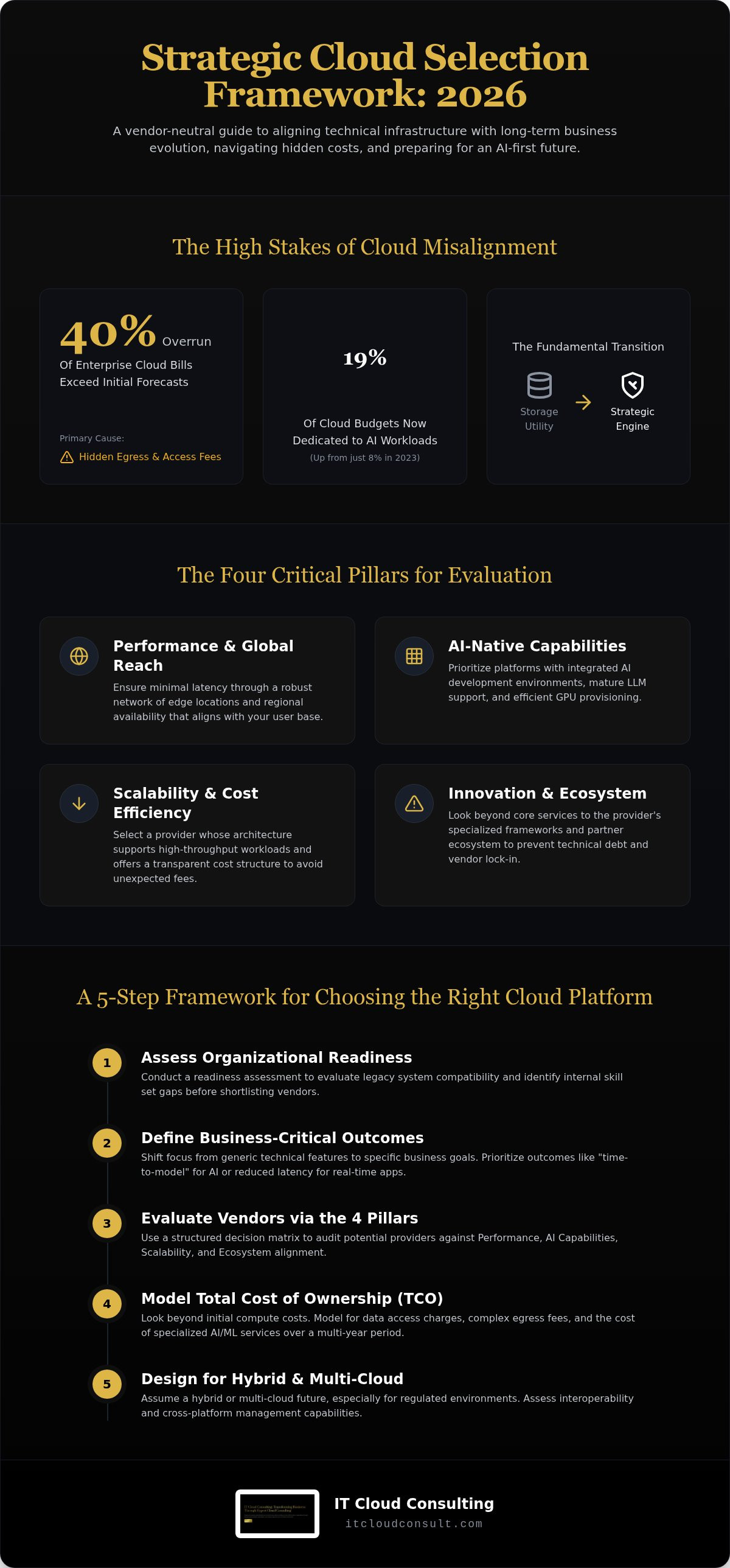
A 5-Step Framework for Choosing the Right Cloud Platform
Selecting a provider isn't a simple procurement task. It's a foundational architectural decision that dictates your organization's trajectory. Choosing the right cloud platform requires a methodical approach that connects technical capabilities to organizational potential. This five-step framework moves beyond feature checklists to focus on strategic alignment and long-term fiscal health.
Step 1: Define Business-Critical Outcomes. You must articulate exactly what success looks like. Success isn't just moving to the cloud; it's reducing operational latency for real-time applications or enabling rapid AI prototyping. Without clear objectives, technical teams often optimize for the wrong metrics.
Step 2: Technical Inventory and Dependency Mapping. Audit your current environment thoroughly. You need to understand how legacy systems will interact with a modern platform before shortlisting any vendor. This prevents the architectural misalignment that often leads to adoption failure.
Projecting the Real Total Cost of Ownership
Sticker prices for compute and storage are often deceptive. While general-purpose compute might cost around $0.19 per hour, the real financial impact lies in training, migration, and ongoing maintenance. Hidden data access charges and egress fees, which range from $0.08 to $0.11 per gigabyte, can cause monthly bills to exceed forecasts by 40%. Utilizing cloud optimization consulting allows for accurate forecasting. It ensures you calculate the ROI of specialized features, such as native LLM support, against the cost of building those capabilities manually.
Step 4: Vendor Ecosystem and Support Model Evaluation. Assess the provider's roadmap. You're looking for a partner that invests in the same future you envision, particularly regarding security and AI orchestration. The maturity of the vendor's support ecosystem is a critical factor in maintaining operational stability.
Executing the Pilot and Benchmarking Success
The final step is the proof-of-concept phase. You must set clear KPIs for performance, such as "time-to-model" for AI workloads. This is also the time to test for vendor lock-in risks. Try moving a small, non-critical workload to see how difficult it is to extract data or switch services. Scaling from this pilot to full production requires a comprehensive business cloud migration plan that accounts for both technical hurdles and internal skill gaps. If you're ready to transition from a state of uncertainty to an optimized future, consider a partner for strategic cloud adoption to ensure your framework is executed with precision.
Accelerating Your Transformation with Strategic Cloud Advisory
IT Cloud Consulting bridges the gap between high-level vision and technical execution. We act as a seasoned guide, helping you transition from a state of fragmented systems to an optimized future state where your cloud environment acts as a catalyst for growth. Securing long-term success requires more than a successful migration; it demands the ongoing governance provided by managed cloud services. This approach ensures that your systems remain secure, operational, and ready for the next wave of innovation.
From Selection to Optimization: The Continuous Journey
Selection is merely the starting point of your cloud journey. Optimization is a continuous cycle that involves monitoring resource allocation and adjusting to shifting workloads. Ongoing cloud support is essential for maintaining system health and security, particularly as AI-related spending continues to rise toward 20% of total cloud budgets. We position ourselves as a partner in your development, providing the technical proficiency required to refine your environment as your business needs evolve. This steady assurance allows your internal teams to focus on core innovation while we maintain the foundation.
Next Steps: Architecting Your Cloud Future
Initiating a professional assessment of your current environment is the most effective way to identify latent potential and hidden risks. A structured enterprise cloud transformation roadmap provides the clarity needed to navigate the complexities of choosing the right cloud platform. This roadmap connects specific technical actions with broader organizational benefits, ensuring every investment drives measurable ROI. Secure your strategic advantage today by engaging with experts who understand both the "big picture" and the execution details required for a successful modernization. Reach out to IT Cloud Consulting to begin your transformation.
Architecting Your Organizational Evolution
Choosing the right cloud platform has transitioned from a routine procurement task into a high-stakes architectural commitment. You now understand that success depends on a methodical alignment of technical pillars with long-term business outcomes. By moving beyond default vendor choices and focusing on a neutral, strategic framework, you protect your organization from the hidden costs of technical debt and fragmented security. It's about building a foundation that doesn't just host data, but actively drives innovation through purposeful resource allocation and fiscal governance.
IT Cloud Consulting serves as a seasoned expert for enterprises across the United States. We provide the expert advisory required for strategic cloud adoption and offer comprehensive managed cloud support to ensure your infrastructure remains optimized as market demands shift. Partner with IT Cloud Consulting for a Strategic Cloud Assessment to begin your transition toward a more advanced and efficient future state. Your path to modernization is clear, and the potential for your organization's growth is limitless.
Frequently Asked Questions
How do I choose between AWS, Azure, and Google Cloud in 2026?
What are the most common mistakes when choosing a cloud platform?
The most frequent error is making a default choice based on existing familiarity rather than a strategic assessment of workload requirements. Many organizations overlook data egress fees, which typically range from $0.08 to $0.11 per gigabyte across major providers. Another mistake is failing to account for the 30% to 40% budget overruns often caused by complex data access charges. These oversights result in technical debt and limited future agility.
Is multi-cloud better than a single cloud provider for security?
Multi-cloud strategies offer redundancy but increase operational complexity and create potential security fragmentation. While 87% of organizations use a multi-cloud model to avoid vendor lock-in, managing security consistently across disparate environments requires sophisticated identity-centric controls. A single-provider model often allows for more deeply embedded, automated threat responses. You must weigh the benefit of risk distribution against the challenge of maintaining unified visibility across multiple platforms and providers.
How much does it cost to switch cloud platforms?
Switching costs are substantial and include more than just the technical migration fees. You must factor in staff retraining, potential downtime, and significant data egress charges for moving large volumes of information. Because cloud bills in 2026 often exceed forecasts by nearly 40% due to access charges, a platform switch requires a rigorous cost-benefit analysis. A successful transition depends on a structured roadmap that accounts for these hidden fiscal hurdles early.
What is the role of AI in choosing a cloud provider today?
AI is now a primary driver of cloud strategy, with AI-related spending reaching 19% of total cloud budgets in 2026. You should evaluate providers based on their time-to-model metrics and native support for Large Language Models. The maturity of a provider's AI-as-a-Service offerings and GPU provisioning capabilities dictates how quickly your organization can deploy automated agents. This shift makes specialized AI infrastructure a critical factor in your long-term platform selection.
Can a hybrid cloud model help reduce my monthly cloud bill?
A hybrid model can reduce costs by keeping predictable, high-gravity workloads on-site while using the public cloud for burst capacity. This approach minimizes the impact of egress fees for data that doesn't need to leave your private environment. By optimizing resource allocation between these environments, organizations can avoid the 30% budget overruns common in pure public cloud deployments. It provides a strategic balance between on-site control and cloud-native scalability.
How do I know if my organization is ready for a full cloud migration?
Readiness is determined by a comprehensive audit of your legacy system compatibility and internal skill sets. You're ready when you have mapped all technical dependencies and established clear business-critical outcomes for the transition. If your current infrastructure hinders innovation or creates unpredictable costs, it's time for a professional assessment. A structured roadmap ensures that choosing the right cloud platform results in a secure environment your team can actually manage and optimize.
What criteria should I use to evaluate cloud consulting services?
Prioritize consultants who offer a neutral, third-party perspective rather than those pushing a specific vendor's agenda. You should look for expertise in strategic cloud adoption and a proven focus on cloud optimization to improve ROI. Evaluate their ability to provide ongoing managed support and comprehensive roadmap development. A seasoned partner should bridge the gap between your vision and technical execution while ensuring your infrastructure remains future-proof and ready for next-generation automation.


