
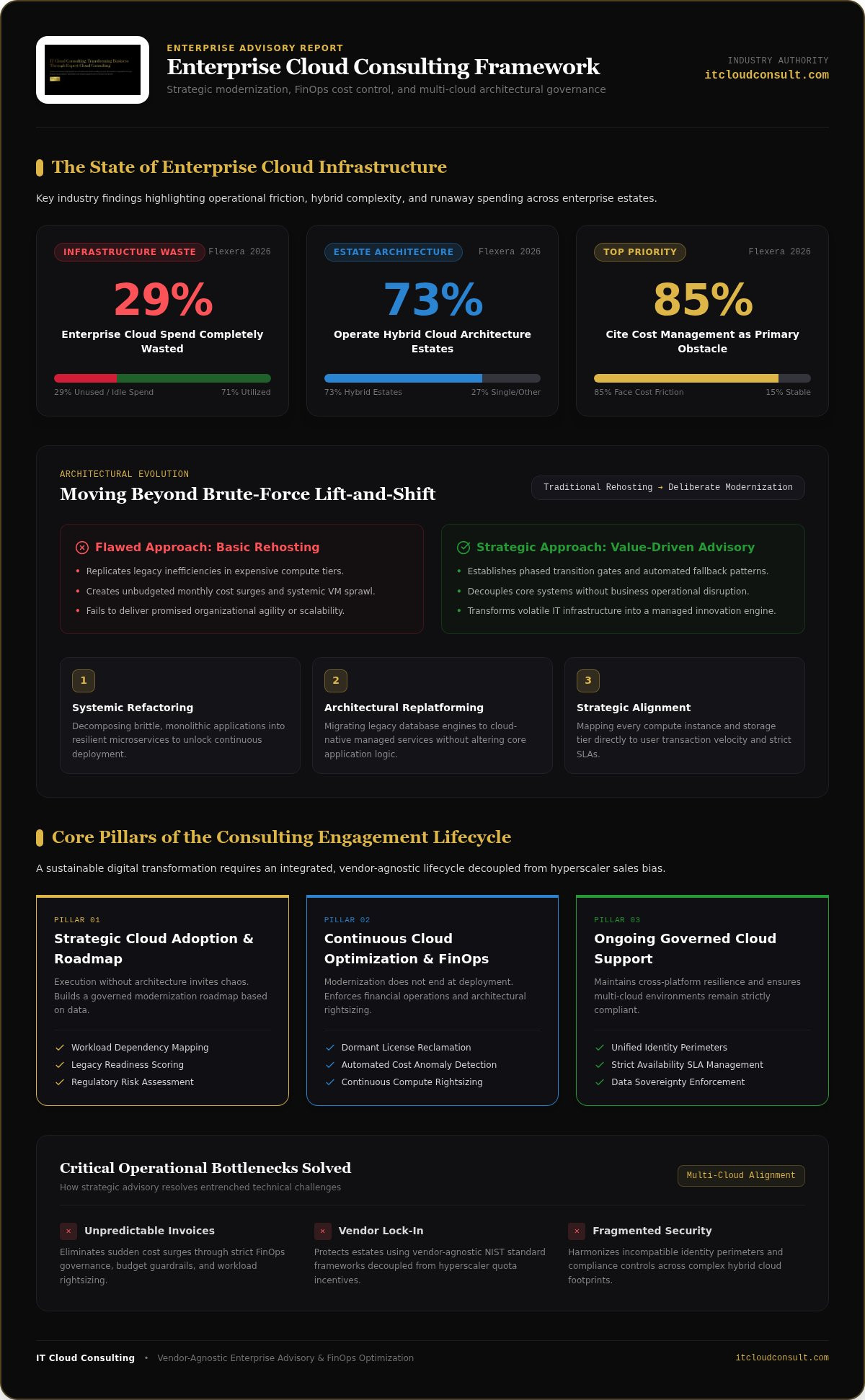
According to Flexera's 2026 State of the Cloud Report, an estimated 29% of enterprise cloud infrastructure spend is completely wasted. When rushed migrations and fragmented hybrid estates produce unpredictable monthly invoices, compliance exposure, and crippling vendor lock-in, partnering with the right enterprise cloud consulting team transitions from a tactical choice into a core business imperative.
You already know that brute-force migrations and surface-level rehosting can't deliver the agility your organization demands. Enterprise technical teams are often stretched thin across disjointed environments, operating without the specialized multi-cloud governance needed to modernize entrenched legacy systems while keeping day-to-day operations secure and reliable.
This guide reveals how strategic enterprise cloud consulting transforms volatile infrastructure from an unmanageable cost center into an agile innovation platform. We'll explore actionable frameworks for aligning strategic cloud adoption with strict FinOps cost optimization, closing architecture vulnerabilities, and maintaining governed ongoing support that directly accelerates your long-term business ROI.
Key Takeaways
- Learn how vendor-agnostic enterprise cloud consulting moves your organization beyond brittle lift-and-shift migrations to achieve sustainable architectural agility.
- Discover the compounding value of integrating Strategic Cloud Adoption, Cloud Optimization, and Ongoing Cloud Support into a cohesive operational lifecycle.
- Master a rigorous decision framework to evaluate consulting partners on architectural independence, execution velocity, and long-term governance capabilities.
- Uncover proactive strategies to eliminate runaway infrastructure spend, resolve legacy technical debt, and establish predictable multi-cloud financial operations.
- Explore the critical prerequisites for transformation engagements, including application catalog readiness and baseline performance metrics that ensure rapid project momentum.
Enterprise Cloud Consulting: Why It Is Critical in 2026
Modern organizations can no longer treat cloud infrastructure as an off-site data center managed by transactional vendors. Enterprise cloud consulting provides the vendor-agnostic advisory framework required to direct architectural modernization, enforce data sovereignty, and secure operational governance. Grounded in established principles of information technology consulting, this strategic engagement model aligns technical deployments directly with organizational growth objectives rather than third-party quota incentives.
Flexera's 2026 State of the Cloud Report notes that 73% of enterprises operate hybrid cloud architecture estates. Simultaneously, 85% cite cloud cost management as their primary operational obstacle. As distributed multi-cloud footprints expand to absorb complex workloads, internal IT departments face severe operational friction. In-house engineering teams often run at peak capacity simply maintaining existing systems. Engaging an enterprise cloud consulting partner injects specialized architectural perspective, empowering organizations to evolve past day-to-day firefighting toward intentional transformation.
Beyond Lift-and-Shift: The Evolution of Cloud Advisory
Basic rehosting failed to deliver the agility that enterprise leaders originally expected. Brute-force "lift-and-shift" migrations replicated legacy inefficiencies in expensive compute environments, causing unbudgeted cost surges and systemic sprawl. Mature cloud advisory pivots entirely from rehosting toward deliberate, value-driven modernization:
- Systemic Refactoring: Decomposing brittle, monolithic applications into resilient microservices to unlock continuous deployment.
- Architectural Replatforming: Migrating legacy database engines to cloud-native managed services without altering core application logic.
- Strategic Alignment: Mapping every compute instance and storage tier directly to clear business metrics, from user transaction velocity to strict availability SLAs.
The Strategic Business Drivers for Enterprise Advisory
Legacy modernization carries substantial operational risk, especially when decoupling core ERP systems or decades-old transactional frameworks. An experienced advisory partner mitigates this risk by establishing phased transition gates and automated fallback patterns before execution begins.
Cross-platform architectural resilience has become an urgent business requirement. When enterprises spread mission-critical workloads across multiple cloud providers, fragmented security controls and incompatible identity perimeters inevitably surface. An authoritative external advisor analyzes these distributed environments objectively. By identifying hidden operational bottlenecks, unmanaged data pipelines, and dormant licensing expenses that internal stakeholders overlook, strategic advisory turns reactive maintenance into structural stability.
Core Pillars of Enterprise Cloud Consulting Services
Sustainable digital transformation demands an integrated service lifecycle rather than disjointed, one-off IT projects. Premier enterprise cloud consulting relies on three interconnected disciplines: Strategic Cloud Adoption, Cloud Optimization, and Ongoing Cloud Support. Aligning these capabilities to the standard NIST cloud computing framework ensures every architectural decision remains decoupled from hyperscaler sales bias, protecting your estate against vendor lock-in while systematically maximizing business value.
Strategic Cloud Adoption and Roadmap Design
Execution without architecture invites chaos. Establishing a predictable journey begins with thorough dependency mapping, readiness scoring, and regulatory risk assessments for complex legacy workloads. Instead of guessing how monolithic platforms will behave off-premises, disciplined teams follow a governed strategic cloud adoption framework that systematically maps technical feasibility to measurable commercial returns.
Continuous Cloud Optimization and FinOps Governance
Modernization doesn't stop at deployment. Flexera's 2026 State of the Cloud Report indicates that 63% of enterprise organizations now operate dedicated FinOps teams to control volatile spend. Continuous optimization applies structured engineering rigor across compute, storage, and egress paths. Aligning multi-cloud telemetry with open standards like FOCUS 1.4 eliminates idle resources and ties consumption to unit economics. Discover specialized efficiency models through our cloud optimization consulting guidance.
Ongoing Managed Support and Resilient Operations
The traditional break-fix operational model cannot protect modern distributed topologies. Resilient architecture requires proactive oversight, automated observability, and 24/7 infrastructure health monitoring. These practices preempt outages, enforce policy-as-code security baselines, and maintain seamless uptime across hybrid estates. For organizations seeking reliable operational stability, exploring vetted managed cloud services ensures systems remain continuously governed.
When these three pillars function synchronously, enterprise cloud consulting builds an operational foundation that scales efficiently. Organizations ready to align infrastructure spend with executive priorities can partner with IT Cloud Consulting to establish nationwide, vendor-agnostic governance.
Evaluating Enterprise Cloud Consulting Partners: A Decision Framework
Selecting an external advisory partner requires objective criteria rather than reliance on brand recognition alone. Too many organizations mistake massive staffing bodies for strategic guides, discovering too late that their hired counsel promotes proprietary tools over business objectives. Authentic enterprise cloud consulting delivers vendor-agnostic architecture aligned with federal benchmarks like NIST Special Publication 800-145, protecting your organizational independence across private, public, and hybrid environments.
Technology executives need an actionable vetting model. Before signing engagement contracts, evaluate prospective firms across four primary dimensions:
- Hyperscaler Independence: Ensure the firm holds multi-cloud competency across AWS, Microsoft Azure, and Google Cloud without financial incentives that push specific proprietary ecosystems.
- Architectural Ownership: Confirm that deliverables include full infrastructure-as-code scripts, architectural blueprints, and detailed runbooks rather than black-box managed solutions.
- Structured Knowledge Transfer: Require active pairing between external architects and your in-house engineers so capabilities remain within your team post-engagement.
- Contractual Governance: Base agreements on measurable technical gates and performance milestones rather than open-ended time-and-materials arrangements.
Essential Selection Criteria for Enterprise Technology Leaders
Examine how prospective partners handle heterogeneous estates. A partner must demonstrate technical depth across distributed networks, identity perimeters, and regulatory constraints, such as EU DORA compliance or FedRAMP standards. Don't settle for staffing agencies masquerading as consultancies; verify that your engagement team consists of seasoned enterprise architects rather than junior resources learning on your production workloads.
Global Systems Integrators vs. Strategic Advisory Consultancies
Choosing between a global systems integrator (GSI) and a focused advisory consultancy represents a critical strategic fork. While GSIs offer massive headcounts, their scale often brings bureaucratic rigidity, high administrative overhead, and multi-layered management tiers that dilute direct architectural guidance. Senior partners typically vanish once the contract closes, handing execution to offshore junior delivery pools.
Focused strategic consultancies operate differently. They deploy dedicated senior enterprise architects directly to your initiatives from day one. This streamlined structure fosters speed, technical precision, and close alignment with your internal leadership. Rather than seeking continuous scope expansion, a specialized advisory partner focuses on solving structural inefficiencies, transferring knowledge quickly, and ensuring your modernization investments yield clear, defensible returns.
Solving Primary Enterprise Cloud Bottlenecks: Cost, Governance, and Legacy Debt
Uncontrolled monthly billing and inherited technical debt represent the dual anchors dragging down corporate modernization. When organizations rush workloads off-premises without establishing rigorous guardrails, configuration drift takes hold. Enterprise cloud consulting provides the targeted diagnostic interventions required to audit these environments, expose invisible operational bottlenecks, and re-establish fiscal control across multi-cloud footprints.
Eliminating Runaway Cloud Spend and Unused Resources
Cloud waste rarely stems from catastrophic failure. It compounds through thousands of unmonitored compute instances, abandoned block storage snapshots, and provisioned databases running at a fraction of their capacity. Independent enterprise cloud consulting targets these specific drains through systematic right-sizing and dynamic elasticity rules, reallocating memory and vCPUs to match actual demand profiles rather than legacy peak tolerances. By instituting granular tagging structures and multi-cloud allocation standards, engineering teams gain transparent visibility into unit economics, connecting infrastructure consumption directly to departmental accountability.
Untangling Legacy Architectural Debt and Dependencies
Tightly coupled applications remain the primary structural barrier to real agility. When legacy architectures rely on hard-coded dependencies, shared backend databases, and proprietary middleware, scaling any single business component requires scaling the entire estate. Solving this bottleneck requires domain-driven decomposition. Consultants isolate discrete business capabilities into independent operational boundaries, establishing event-driven messaging pipelines and API gateways that decouple services without risking operational downtime. To map this process methodically across your application inventory, consult the enterprise cloud transformation roadmap.
Enforcing Enterprise Governance and Security Guardrails
Velocity without governance guarantees compliance breaches. Modern cloud environments demand strict, programmatic enforcement that protects data without creating bureaucratic deployment friction:
- Granular IAM Architecture: Replacing overly permissive administrative profiles with zero-trust, role-based access policies governed by least privilege.
- Policy-as-Code Enforcement: Embedding compliance policies directly into CI/CD deployment pipelines, preventing unencrypted volumes or misconfigured ingress ports from deploying.
- Auditable Security Baselines: Validating infrastructure continuously against established frameworks using our comprehensive cloud security assessment checklist.
Remediating structural debt transforms brittle systems into adaptable operational assets. To audit your infrastructure and systematically resolve cost inefficiencies, schedule an enterprise cloud assessment with our nationwide advisory team.
Architecting Your Transformation: How to Engage an Enterprise Cloud Consultant
Engaging an advisory partner shouldn't feel like an ambiguous, open-ended research project. High-impact enterprise cloud consulting follows an intentional, phased methodology designed to de-risk modernization from initial assessment through steady-state operations. Technology leaders can accelerate progress before project kickoff by preparing core operational assets: comprehensive application catalogs, network topology schematics, software licensing agreements, and current baseline performance metrics.
The Collaborative Onboarding and Assessment Phase
Discovery begins with an exhaustive infrastructure audit. Seasoned advisors examine active configurations, resource utilization, and cross-platform identity perimeters to uncover hidden structural inefficiencies. Structured interviews with technical leads and executive stakeholders connect infrastructure milestones directly to business objectives. Establishing concrete performance baselines, such as cost-per-transaction, deployment cycle times, and mean time to recovery, ensures subsequent optimization remains transparent and quantifiable.
Execution, Operational Handover, and Ongoing Partnership
Modernization succeeds through iterative execution. Consultants implement modular transition sprints designed to eliminate production downtime and maintain operational continuity:
- Risk-Mitigated Sprints: Decoupling workloads in controlled increments backed by automated test suites and tested rollback mechanisms.
- Direct Technical Pairing: Embedding advisory architects alongside internal personnel to transfer operational knowledge and institutionalize infrastructure-as-code standards.
- Operational Transition: Moving modernized workloads into structured ongoing support models to maintain operational health and compliance.
Once deployment stabilizes, advisory engagements transition into continuous Cloud Optimization and Ongoing Cloud Support. This ongoing relationship delivers comprehensive lifecycle governance, combining 24/7 infrastructure monitoring with regular FinOps reviews to prevent configuration drift and control variable compute expenses.
IT Cloud Consulting serves as an authoritative strategic guide with a nationwide advisory footprint. By unifying Strategic Cloud Adoption, proactive Cloud Optimization, and dedicated Ongoing Cloud Support into a cohesive framework, we empower enterprise organizations to unlock their architectural potential and achieve sustained operational resilience.
Transforming Infrastructure into a Long-Term Strategic Advantage
Mastering modern multi-cloud complexity requires shifting from reactive maintenance to purposeful architectural transformation. By uniting disciplined adoption frameworks with continuous optimization and dedicated operational oversight, enterprise leaders can eliminate structural waste, resolve legacy technical debt, and ensure their digital estates scale efficiently alongside changing business demands.
Achieving this operational resilience requires an objective advisory ally. Vendor-agnostic enterprise cloud consulting bridges the gap between executive ambition and technical execution, safeguarding your autonomy across disparate platforms. Backed by a proven national advisory footprint, specialized FinOps practices dedicated to uncovering hidden cloud charges, and end-to-end lifecycle support spanning initial discovery to managed operations, our team helps you realize your architecture's full potential.
Your infrastructure shouldn't restrict your operational agility. Partner with IT Cloud Consulting to modernize your enterprise infrastructure and build a secure, cost-governed foundation that powers your next chapter of innovation.
Frequently Asked Questions
What is the primary difference between a cloud consulting firm and a managed service provider?
A cloud consulting firm focuses on high-level architecture, roadmap strategy, and business transformation, whereas a traditional managed service provider primarily handles day-to-day administration and routine ticketing. Modern enterprise cloud consulting merges both domains. It begins by establishing strategic roadmaps and cloud optimization, then transitions smoothly into ongoing managed support, ensuring executive strategy translates directly into stable operational execution.
How does enterprise cloud consulting help control and reduce unpredictable cloud spend?
Enterprise cloud consulting curtails unpredictable spend through disciplined FinOps governance, identifying idle compute capacity, unattached storage volumes, and misaligned commitment plans. Consultants introduce real-time telemetry and normalized billing schemas, mapping every compute dollar directly to business unit metrics. This visibility eliminates recurring infrastructure waste without sacrificing application performance, providing finance and engineering executives with predictable monthly forecasting and transparent cost accountability across hybrid environments.
Can an enterprise cloud consultant help modernize legacy systems without causing business downtime?
Yes, consultants avoid business downtime by utilizing decoupled migration strategies like the strangler fig pattern and event-driven data streaming. Rather than attempting a risky single-cutover migration, modern legacy modernization isolates monolithic services step by step. Production traffic shifts gradually to new cloud microservices while both environments run in parallel. Automated rollback protocols and continuous verification testing ensure customer-facing availability remains uninterrupted throughout every transformation phase.
What cloud environments and platforms do enterprise consulting firms typically support?
Enterprise consultancies typically support major hyperscale public clouds alongside private virtualized environments and colocation data centers. A vendor-agnostic consulting partner evaluates workloads objectively across Amazon Web Services, Microsoft Azure, and Google Cloud Platform, as well as hybrid deployments. This multi-platform proficiency ensures your infrastructure design reflects your specific performance, latency, and regulatory requirements rather than the proprietary commercial agenda of any single provider.
How long does a typical enterprise cloud consulting assessment and strategy engagement take?
A comprehensive assessment and architectural roadmap engagement typically takes four to eight weeks, depending on the breadth of your application estate. During this discovery window, consultants inventory your active workloads, assess technical dependencies, audit security configurations, and benchmark current resource consumption. The engagement culminates in a prioritized modernization roadmap with clear architectural blueprints, risk mitigation plans, and measurable executive milestones ready for immediate implementation.
What metrics determine the return on investment of an enterprise cloud consulting partnership?
Return on investment is evaluated across financial efficiency, operational velocity, and systemic resilience. Key performance indicators include percentage reductions in wasted infrastructure spend, decreased cloud bill variance, and accelerated software deployment cycles. Additionally, organizations track reduced mean time to recovery during incidents, lowered licensing expenses, and successful mitigation of compliance penalties, demonstrating how strategic guidance delivers substantial value well beyond basic computing cost reductions.
How do enterprise cloud consultants ensure data security and compliance during cloud migrations?
Consultants safeguard environments by implementing zero-trust identity architectures and automated policy-as-code guardrails before moving live data. Every transmission utilizes robust encryption in transit and at rest, alongside strict network isolation controls. Advisory teams also align system configurations with mandatory regulatory frameworks like FedRAMP or DORA, using continuous compliance monitoring to prevent configuration drift and eliminate vulnerabilities during every migration phase.


