
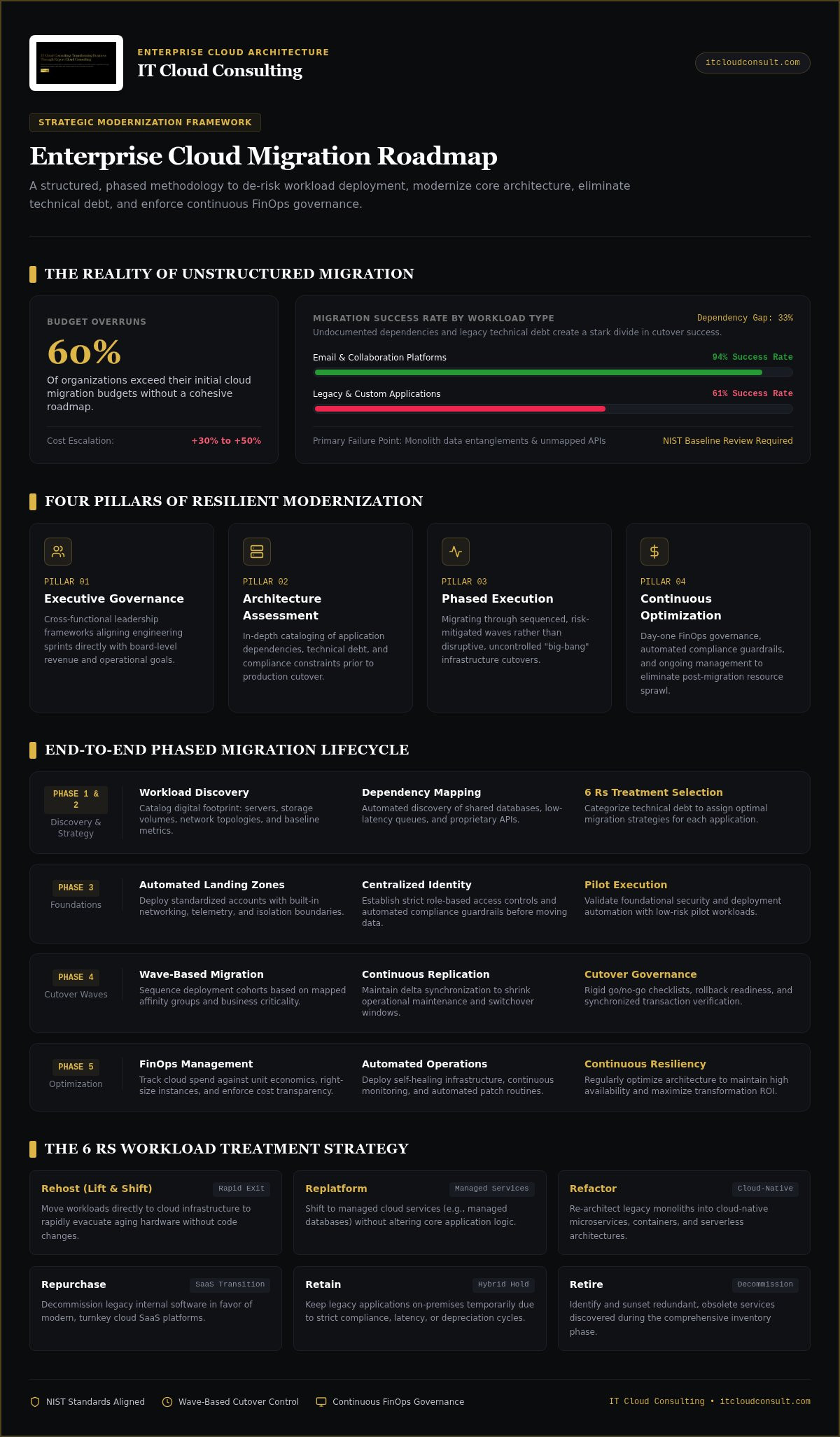
Roughly 60% of organizations exceed their initial cloud migration budgets by 30% to 50%, while unmapped legacy dependencies constantly threaten day-to-day business continuity. Shifting enterprise workloads isn't merely an infrastructure upgrade; without a cohesive cloud migration roadmap, hidden technical entanglements quickly turn into prolonged operational stalls. You likely already feel the friction. Balancing aggressive modernization targets against the real risk of production downtime, runaway cloud operational costs, and persistent silos between development, security, and operations is a daunting challenge.
True transformation succeeds only when strategic business priorities guide technical execution rather than trailing behind it. This blueprint provides the phased methodology you need to de-risk deployment, modernize core architecture, and maximize long-term cloud ROI. We'll examine how to evaluate workloads with precision using the 6 Rs framework, sequence multi-phase migration timelines around executive goals, and establish automated security compliance and FinOps governance from day one.
Key Takeaways
- Structuring a phased cloud migration roadmap transforms infrastructure upgrades into measurable, high-value enterprise modernization.
- Comprehensive asset discovery and the 6 Rs framework allow teams to categorize technical debt and select the ideal treatment for every workload.
- Establishing automated landing zones with centralized identity and compliance guardrails protects critical data prior to migration.
- Executing wave-based cutovers with continuous data replication minimizes business disruption and shrinks operational maintenance windows.
- Instituting early FinOps governance and continuous optimization ensures newly migrated environments remain cost-effective and resilient.
Deconstructing the Modern Cloud Migration Roadmap
Enterprise infrastructure transitions fail when treated merely as routine data center relocations. A truly effective cloud migration roadmap functions as an enterprise-wide blueprint for digital transformation, bridging technical re-architecture with strategic business outcomes. While traditional infrastructure lift-and-shift focuses narrowly on moving virtual machines to external servers, modern transformation leverages the dynamic elasticity of cloud computing to rebuild organizational agility, eliminate technical debt, and accelerate release cycles.
A resilient transition rests on four interconnected operational pillars:
- Executive Governance: Establishing cross-functional leadership frameworks that align engineering sprints with board-level revenue and operational objectives.
- Architecture Assessment: Auditing application dependencies, technical debt, and compliance constraints before touching production infrastructure.
- Phased Execution: Migrating workloads through staged, risk-mitigated waves rather than disruptive "big-bang" cutovers.
- Continuous Optimization: Embedding FinOps principles and automated management to prevent post-migration resource sprawl.
Rigorous architectural planning directly drives operational speed and prevents spiraling run-rate costs. By standardizing operational frameworks early, leadership ensures that modernization strengthens system uptime and unlocks scalable growth.
The Business Imperative for Strategic Planning
Unstructured transitions carry severe operational penalties. Skipping deep architectural discovery frequently triggers unanticipated service outages, security compliance regressions, and uncontrolled operational expenses. Strategic roadmapping prevents these failures by mapping every technical task to a concrete corporate milestone. Securing active executive sponsorship aligns engineering, security, and finance teams around unified objectives, ensuring shared ownership across every deployment wave.
Core Dimensions of Migration Readiness
Determining migration readiness requires evaluating maturity across internal tooling, team capabilities, and existing security postures. An objective discovery phase uncovers organizational friction, skills gaps, and data governance obligations before live workloads move. To assess your team's current readiness posture against cross-industry benchmarks, consult our strategic enterprise cloud transformation roadmap to systematically guide your modernization trajectory.
Phase 1 & 2: Workload Discovery, Assessment, and the 6 Rs Strategy
Every successful transformation begins with exhaustive asset discovery. Before executing any phase of an enterprise cloud migration roadmap, organizations must catalog their complete digital footprint, spanning server configurations, storage volumes, and network topologies. Data from industry research shows email and collaboration platforms achieve a 94% migration success rate, yet legacy and custom applications succeed only 61% of the time. This gap stems directly from undocumented dependencies and unresolved technical debt. Establishing baseline performance metrics and reviewing strict NIST cloud computing standards ensures workloads meet structural baselines before migration begins.
Mapping Complex Dependencies and Data Flows
Modern enterprise applications rarely function in isolation. Monoliths share legacy databases, low-latency messaging queues, and proprietary APIs that break if separated without planning. Automated dependency discovery maps these communication pathways to prevent costly latency penalties during hybrid coexistence. Our comprehensive blueprint for strategic cloud adoption details how cross-system mapping protects transactional continuity during high-volume cutovers.
The 6 Rs Application Treatment Matrix
Determining the right technical trajectory for each workload eliminates waste and operational bottlenecks:
- Rehost: Move workloads via lift-and-shift to rapidly evacuate aging hardware.
- Replatform: Shift to managed cloud services without altering core application logic.
- Refactor: Re-architect legacy systems into cloud-native microservices and containerized environments.
- Repurchase: Replace bespoke software with mature Software-as-a-Service (SaaS) platforms.
- Retain: Keep non-critical or highly specialized workloads on-premises until depreciated.
- Retire: Decommission redundant, obsolete instances to immediately reduce licensing costs.
Prioritizing Workload Waves for Immediate ROI
Workload waves require deliberate sequencing based on business criticality and architectural complexity. Teams should initiate low-risk pilot migrations first, validating provisioning pipelines and testing identity configurations under real conditions. Once pilots hit established performance benchmarks, you can confidently schedule core operational databases and user-facing applications into structured deployment waves. Partnering with seasoned advisors for strategic cloud adoption advisory provides the operational assurance needed to avoid costly migration stalls and maintain continuous business delivery.
Phase 3: Foundations, Secure Landing Zones, and Pilot Execution
Establishing an enterprise-grade cloud environment demands resilient, pre-configured infrastructure before moving any live production systems. Within a mature cloud migration roadmap, this foundational phase centers on standing up multi-account landing zones that enforce governance, centralized identity federation, and secure network routing as code. Rather than configuring resources by hand, teams deploy automated infrastructure templates that establish boundary policies, log collection frameworks, and hybrid interconnects. This structured groundwork eliminates security oversights and provides isolated operational tiers across development, staging, and production environments.
Every scalable foundation relies on specific structural safeguards:
- Centralized Identity: Federated Single Sign-On (SSO) mapped to corporate directories, enforcing least-privilege role-based access control and hardware token multi-factor authentication.
- Automated Guardrails: Immutable policy definitions that block unauthorized internet-facing storage buckets and mandate AES-256 encryption at rest.
- Unified Network Architecture: Centralized hub-and-spoke transit networks with automated inspection firewalls and dedicated hybrid interconnects.
- Continuous Audit Trails: Immutable, non-repudiable log aggregation streamed directly to a dedicated security account for threat analysis.
Architecting Compliant Enterprise Landing Zones
Segmenting enterprise workloads across dedicated cloud accounts creates hard boundaries against lateral threat movement. Development and staging workloads must run in isolated sandboxes separated from mission-critical production data. Enforcing mandatory TLS 1.2 or higher for all traffic in transit ensures data remains safe as it crosses internal boundaries. To evaluate your environment against strict regulatory mandates, review our thorough cloud security assessment checklist before initiating production workloads.
Validating Operations Through Pilot Wave Deployments
Theory meets reality during the pilot execution phase. Teams deploy non-critical, representative applications into the landing zone to pressure-test synchronization pipelines, network bandwidth, and monitoring agents under simulated production stress. Engineers deliberately simulate unexpected outages, testing automated failover routines and data rollback runbooks against hard recovery point objectives. Gathering empirical metrics during these initial runs uncovers configuration bottlenecks early, refining deployment procedures before enterprise-scale migration waves commence.
Phase 4: Enterprise Migration Waves and Cutover Governance
Execution at enterprise scale requires synchronizing automated deployment pipelines with rigid operational governance. While pilot migrations prove technical configurations, scaling across multi-tier applications demands systematic orchestration to protect ongoing revenue generation. Research shows partner-led migrations achieve a 71% on-time completion rate compared to just 49% for do-it-yourself attempts. Executing a disciplined cloud migration roadmap ensures that complex cutovers compress maintenance windows and prevent business disruption through meticulous wave planning.
A resilient cutover model coordinates four operational capabilities:
- Automated CI/CD Delivery: Reusable deployment templates that provision workloads rapidly across validated environments.
- Continuous Synchronization: Block-level disk replication and transactional data pipelines running concurrently with live production.
- Centralized Command Operations: A dedicated war room uniting infrastructure leads, application owners, and executive decision-makers.
- Reversible Cutover Checklists: Time-boxed operational gates supported by automated health validations before DNS updates go live.
Data Migration and Database Synchronization
Maintaining data integrity remains the most delicate part of migration execution. Teams use change data capture (CDC) tools to replicate database changes continuously from on-premises instances to cloud targets. This background replication minimizes delta sync times during final cutovers, reducing planned maintenance windows from days to minutes. Network traffic shaping prevents replication streams from saturating shared enterprise bandwidth. Automated checksum routines audit tables immediately before shifting production traffic, ensuring zero transactional loss.
Cutover Orchestration and Rollback Procedures
Cutover execution requires minute-by-minute coordination. During the cutover window, cross-functional teams assemble in an operational command center to execute predefined runbooks with time-boxed checkpoints. If an unforeseen dependency surfaces or an application fails end-to-end integration tests, the team executes a rehearsed rollback to revert traffic to source systems without data corruption. To safeguard your mission-critical operations against downtime and execution risks, partner with our migration advisory team to build robust cutover runbooks and maintain operational stability.
Phase 5: Post-Migration Optimization, FinOps, and Operational Management
Executing cutover does not conclude digital modernization. A complete cloud migration roadmap treats day-two operations as the true baseline for business value realization. Organizations estimate that 27% of their cloud spending is wasted, primarily through unattached storage volumes, idle test instances, and over-provisioned virtual machine footprints. Transitioning lifted workloads toward cloud-native elasticity requires a disciplined cadence of structural rightsizing, automated lifecycle policies, and proactive architectural refinement.
Sustained cloud value depends on four ongoing operational practices:
- Granular Cost Allocation: Mandatory tagging policies linking individual infrastructure resources to distinct business units and cost centers.
- Architectural Rightsizing: Downsizing over-provisioned compute instances based on empirical runtime metrics rather than initial safety buffers.
- Continuous Compliance Auditing: Automated policy evaluations that immediately detect configuration drift and permission creep.
- Sustained Operational Governance: Centralized patch management, disaster recovery testing, and proactive performance tuning.
Embedding Continuous FinOps and Cost Governance
Modern cost governance transcends monthly invoice reviews. Embedding FinOps establishes cross-functional accountability between engineering, operations, and finance teams. Standardized tagging schemas provide visibility into unit economics, while automated analysis uncovers underutilized compute, orphaned storage snapshots, and inefficient database instances. Discover proven methodologies for eliminating technical overhead in our strategic guide to cloud optimization consulting.
Sustained Operational Excellence and Managed Cloud Support
Reallocating in-house engineering talent from routine maintenance to strategic product innovation accelerates corporate momentum. Partnering with a dedicated managed support provider delivers 24/7 security observability, proactive incident response, and continuous infrastructure health monitoring without overburdening internal staff. Retaining specialized advisory guarantees that your infrastructure evolves smoothly alongside changing enterprise requirements. Ready to secure operational stability and accelerate digital growth? Schedule a strategic cloud consultation to design your enterprise migration roadmap.
Transforming Strategy Into Sustainable Cloud Modernization
Moving legacy enterprise systems to modern cloud infrastructure doesn't have to trigger unexpected operational downtime or unmanaged expense overruns. By pairing exhaustive workload discovery with standardized landing zones and disciplined wave cutovers, technology leaders establish a secure, repeatable framework for growth. Executing a proven cloud migration roadmap bridges high-level executive vision with technical rigor, ensuring every migrated asset delivers measurable business agility.
True transformation extends well past cutover day into continuous governance and proactive performance management. Leveraging nationwide advisory expertise, IT Cloud Consulting delivers comprehensive lifecycle consulting spanning foundational architectural assessments, continuous FinOps optimization, and ongoing managed support. With structured engineering guardrails and experienced guidance, your enterprise can modernize critical applications with total confidence. Partner with IT Cloud Consulting for strategic cloud adoption to de-risk your deployment and build a resilient digital future.
Frequently Asked Questions
What is the difference between a cloud migration strategy and a cloud migration roadmap?
A cloud migration strategy defines high-level business goals, target operating models, and commercial justifications, while a cloud migration roadmap translates that high-level vision into an actionable, phased execution timeline. The strategy determines why an enterprise migrates and what modernization outcomes it expects. The roadmap establishes how teams will execute discovery, deploy secure landing zones, schedule prioritized workload waves, and govern cutovers without disrupting day-to-day business operations.
How long does an enterprise cloud migration typically take to execute?
Enterprise cloud migrations typically take between six months to several years, depending on portfolio complexity and workload volume. Mid-market environments with moderate legacy dependencies often complete migration in six to twelve months. Complex enterprise portfolios spanning hundreds of legacy applications, proprietary monoliths, and regulatory compliance constraints require multi-year wave executions. Structuring a clear phased timeline ensures early wins materialize quickly while mission-critical systems migrate methodically.
What are the 6 Rs of cloud migration and how are they used?
The 6 Rs represent strategic workload treatment pathways: Rehost, Replatform, Refactor, Repurchase, Retain, and Retire. Teams evaluate each application during initial discovery to select its optimal technical path. Rehosting enables rapid evacuation of aging hardware, while replatforming swaps infrastructure layers for managed cloud services. Complex monoliths may require refactoring into cloud-native microservices. Retaining postpones low-priority assets, repurchasing moves workloads to SaaS, and retiring decommissions redundant software entirely.
How do organizations prevent cost overruns during and after cloud migration?
Organizations prevent cost overruns by embedding FinOps practices and automated governance before migration starts. Research shows 60% of migrations exceed initial budgets, primarily due to over-provisioned compute, unmanaged licensing, and idle storage. Enforcing strict resource tagging assigns financial accountability directly to application owners. Continuous post-migration rightsizing based on real runtime metrics ensures enterprises only pay for required capacity, preventing runaway operational expenses and maximizing long-term cloud ROI.
Why do enterprise cloud migrations commonly stall, and how can teams prevent it?
Migrations commonly stall due to unmapped application dependencies, internal skills gaps, and misaligned stakeholder priorities. Discovering hidden database connections late in the cycle creates operational friction that halts deployment waves. Teams prevent stalls by investing in automated dependency discovery and building secure, standardized landing zones before migration. Executing an enterprise cloud migration roadmap with cross-functional executive governance ensures technical, financial, and security teams remain aligned on delivery targets.
What role does a cloud consulting partner play in the migration process?
A strategic cloud consulting partner acts as an experienced guide, providing vendor-agnostic architecture expertise, workload assessment, and risk mitigation. Partners help enterprise teams avoid common operational pitfalls, design automated landing zones, and orchestrate complex database cutovers. Partner-led migrations achieve a 71% on-time completion rate, significantly outperforming unassisted efforts. Specialized advisory ensures strategic cloud adoption, continuous performance optimization, and reliable managed support across private, public, or hybrid environments.
Can legacy monolithic applications be migrated without a complete architectural rewrite?
Yes, legacy monoliths can be migrated successfully without an immediate, complete architectural rewrite. Organizations often rehost monoliths to lift them off end-of-life hardware quickly, or replatform them by shifting underlying databases to managed cloud services without touching core application code. Once operating in the cloud, engineering teams can incrementally refactor functionality into containerized microservices over time. This phased approach minimizes cutover risk and preserves immediate operational continuity.


