
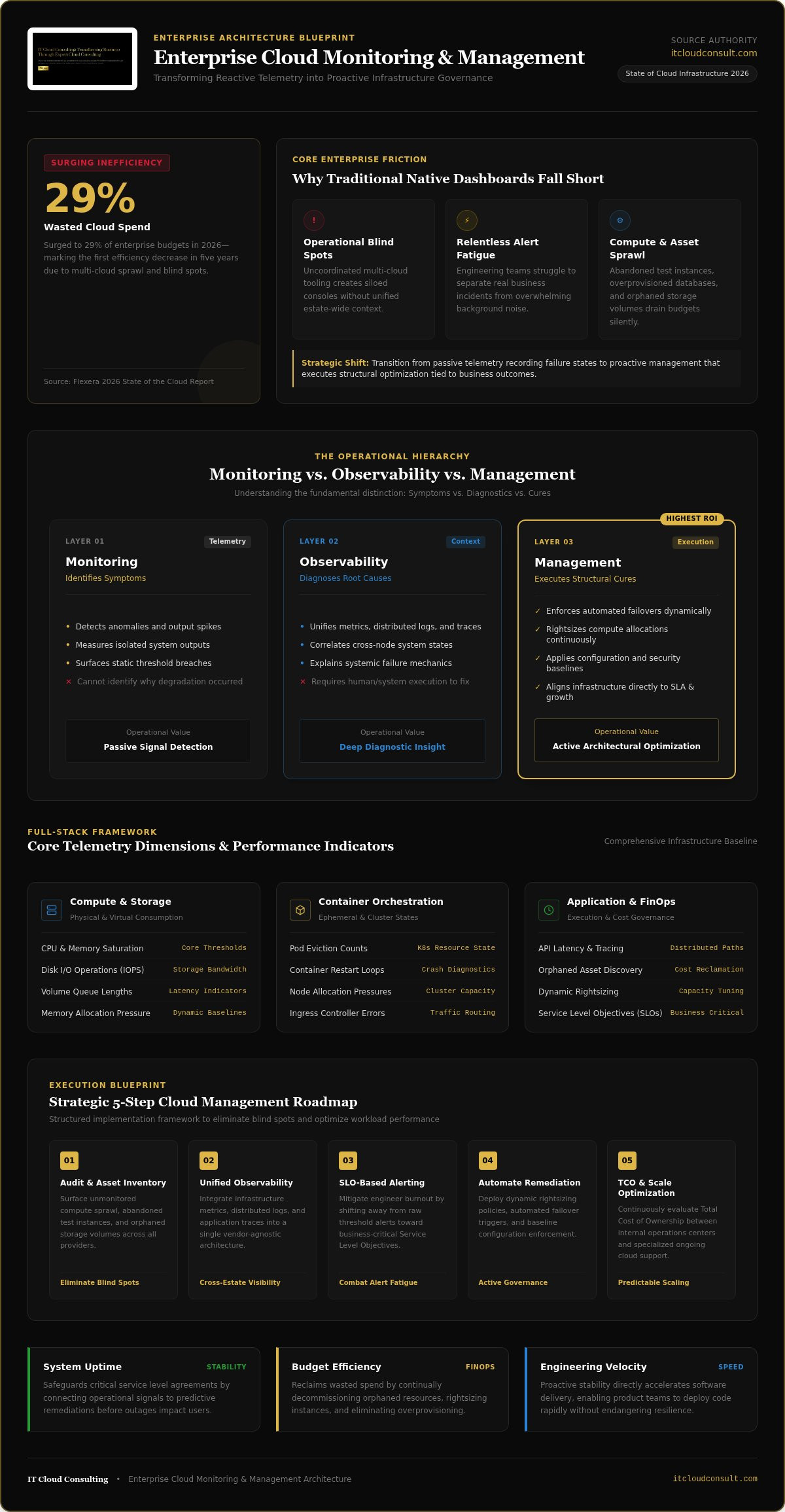
According to the Flexera 2026 State of the Cloud Report, wasted cloud spend surged to 29% of total enterprise budgets this year, marking its first increase in five years. As multi-cloud footprints expand, uncoordinated tooling creates operational blind spots, and relentless alert fatigue leaves engineering teams struggling to separate real incidents from background noise. Resolving this friction requires recognizing a fundamental shift: while basic telemetry identifies isolated symptoms, enterprise cloud monitoring and management executes proactive structural optimization that ties technical performance directly to business outcomes.
If your teams feel overwhelmed by runaway operational costs while still battling intermittent outages, you aren't alone. Engineering leaders shouldn't have to sacrifice system stability to keep infrastructure budgets in check. In this guide, you'll discover how modern cloud monitoring and management transforms reactive infrastructure operations into proactive business value. We examine actionable strategies to establish end-to-end visibility across hybrid estates, automate predictive incident resolution, and align ongoing resource allocation with core enterprise growth.
Key Takeaways
- Distinguish between passive telemetry and active governance to establish modern cloud monitoring and management that prevents costly service disruptions.
- Unify metrics, distributed logs, and application traces into an integrated observability architecture that eliminates multi-cloud blind spots.
- Mitigate alert fatigue and engineer burnout by transitioning from raw threshold alerts to business-critical Service Level Objectives.
- Execute a structured five-step implementation roadmap that surfaces orphaned assets and optimizes workload performance.
- Evaluate the total cost of ownership between internal operations centers and specialized ongoing cloud support to scale infrastructure efficiently.
What Is Cloud Monitoring and Management in Enterprise IT?
Enterprise IT environments have outgrown simple infrastructure health checks. Today, robust cloud management requires an integrated discipline that unites automated data collection with strategic operational control. Modern cloud monitoring and management provides the governance architecture necessary to oversee distributed workloads across hybrid, private, and public platforms, turning sprawling infrastructure components into cohesive business value.
Passive telemetry alone can't protect modern enterprises from costly disruptions. Ingesting raw performance data merely records failure states as they unfold; it does nothing to prevent them. Proactive infrastructure governance closes this critical gap by connecting real-time operational signals directly to systemic remediations, long-term capacity planning, and organizational delivery goals.
While native tools like AWS CloudWatch or Azure Monitor deliver granular metrics within their respective silos, they rarely offer estate-wide context. Vendor-agnostic management strategies bridge these fragmented consoles, ensuring engineering teams maintain consistent security postures, predictable budgets, and reliable application performance across every provider.
The Crucial Difference Between Monitoring and Management
Monitoring identifies symptoms, but management executes cures. Telemetry collection captures operational shifts, such as memory saturation or elevated API latency, through isolated data streams. True management interprets these signals to alter system states dynamically. It couples observability, the contextual synthesis of distributed traces, metrics, and structured logs, with actionable remediation workflows, continuous resource resizing, and ongoing architectural improvements across the application lifecycle.
- Monitoring: Detects anomalies, measures system outputs, and surfaces threshold breaches.
- Observability: Analyzes underlying state correlations across distributed nodes to explain why a degradation occurred.
- Management: Enforces automated failovers, rightsizes compute allocations, applies configuration baselines, and refines infrastructure performance.
The Business Imperative: Uptime, Efficiency, and Velocity
Unmonitored enterprise estates introduce severe operational vulnerabilities. Compute sprawl silently drains technology budgets through abandoned test environments, overprovisioned database instances, and orphaned storage volumes. By implementing disciplined operational oversight, organizations eliminate resource waste while safeguarding critical service level agreements. This proactive stability directly accelerates software delivery, enabling product teams to deploy code rapidly without endangering production resilience.
Core Components of a Modern Cloud Monitoring and Observability Framework
Achieving total operational transparency requires moving beyond siloed, proprietary dashboards toward an integrated observability framework. True full-stack visibility spans three distinct functional tiers: fundamental compute and network telemetry, distributed application execution paths, and real-time financial governance. When combined, these layers elevate routine cloud monitoring and management into an engine for business agility.
Modern architectures encompass a dynamic mix of virtual machines, ephemeral container clusters, and on-demand serverless functions. Because resource lifecycles now measure in seconds rather than months, operations teams must correlate data streams continuously across every abstraction layer to maintain infrastructure health.
Infrastructure Health and Telemetry Metrics
Infrastructure telemetry tracks physical and virtual resource consumption, including core metrics like CPU saturation, memory thresholds, and network I/O. In orchestrated environments like Kubernetes, tracking shifts toward pod eviction counts, container restarts, and node allocation pressures. Establishing dynamic baselines across these data points allows systems to distinguish normal operational spikes from genuine degradation.
- Compute and Storage Telemetry: Evaluates disk I/O operations per second (IOPS), volume queue lengths, and memory allocation pressure.
- Container Orchestration: Tracks Kubernetes node readiness, ingress controller errors, and pending pod states across microservice clusters.
- Network Performance: Monitors packet drops, round-trip connection latency, and egress saturation between private virtual networks.
Application Performance Monitoring (APM) and Tracing
Application performance monitoring provides granular visibility into code-level execution across distributed networks. End-to-end distributed tracing tags incoming requests with unique IDs, tracking transactions as they hop through microservices, managed databases, and external third-party APIs. Simultaneously, synthetic monitoring simulates end-user workflows, surfacing latency anomalies and database query bottlenecks before they degrade customer experiences.
Unified Security and Cost Governance Telemetry
A comprehensive operations strategy links performance indicators directly to regulatory compliance and ongoing expenditure. As defined in the foundational NIST definition of cloud computing, measured service and resource pooling require rigorous accounting. Unified security telemetry validates configuration posture against compliance frameworks like PCI DSS 4.0, while FinOps integration tracks real-time operating costs alongside workload throughput. Applying enterprise cloud optimization consulting ensures architecture choices scale efficiently without triggering budget overruns. Organizations seeking vendor-neutral architecture reviews can partner with IT Cloud Consulting to unify their operational and financial telemetry under a single governance model.
Overcoming Common Cloud Management Challenges: Blind Spots and Sprawl
Enterprise cloud footprints rarely scale in clean, predictable lines. Instead, organic team expansion and multi-cloud adoptions create fragmented architectures where blind spots thrive. When operational boundaries blur, even mature IT departments struggle with uncoordinated monitoring tools, silent configuration drift, and rising operational debt. Overcoming these hurdles requires transforming disparate operational practices into a coherent model for cloud monitoring and management.
Organizational friction between software development, security, and infrastructure operations magnifies these operational vulnerabilities. Developers prioritize deployment velocity, operations teams focus on baseline stability, and security groups mandate rigid compliance policies. Without a single, unified operational model, these competing priorities spark conflicting alerting thresholds, disjointed ticketing workflows, and prolonged triage cycles during critical service disruptions.
Navigating Hybrid and Multi-Cloud Complexity
Managing disparate toolsets across AWS, Azure, and private cloud deployments fractures visibility. Each cloud provider outputs proprietary log schemas and distinctive metric naming conventions, forcing engineers to swivel between consoles to diagnose a single transaction failure. Establishing a standard data ingestion layer, utilizing open schemas like OpenTelemetry, normalizes this telemetry across diverse infrastructure environments. As highlighted in our strategic guide on cloud infrastructure consulting, standardizing these operational baselines early eliminates the tooling fragmentation that routinely undermines multi-cloud investments.
Taming Alert Fatigue with Intelligent Triage
Excessive alerting degrades engineering responsiveness faster than system complexity itself. Poorly calibrated static thresholds flood on-call rotations with non-actionable notifications, desensitizing engineers to genuine production risks. Eliminating this cognitive overload requires structural triage mechanisms that prioritize impact over raw system noise:
- Algorithmic Correlation: Groups co-occurring events into a single, cohesive operational incident rather than generating hundreds of distinct alerts.
- Automated Escalation Matrices: Routes high-severity incidents directly to responsible platform specialists based on affected service boundaries.
- Dynamic Thresholding: Replaces rigid alerts with adaptive baselines that account for cyclical business patterns and planned deployments.
Configuration drift introduces another insidious threat. When individual engineers make unrecorded manual hotfixes across distributed virtual networks or container clusters, environments slowly diverge from their declared infrastructure-as-code baselines. Establishing automated compliance scans and drift detection ensures your cloud operations remain fully aligned with established performance and security guardrails.
How to Implement a Strategic Cloud Management Framework in 5 Steps
Transitioning from fragmented oversight to disciplined governance requires a structured operational roadmap. Rather than layering additional monitoring tools over an unstable architecture, organizations must align their underlying infrastructure with business-critical outcomes. Executing a systematic cloud monitoring and management framework enables IT teams to eliminate operational waste while protecting core service availability.
Successful implementation follows a sequential progression, starting with complete estate visibility and culminating in proactive operational lifecycle management.
Step 1 & 2: Environment Discovery and Objective Definition
Every governance initiative begins with an exhaustive infrastructure audit. Automated discovery scans evaluate all enterprise subscriptions, virtual networks, and storage accounts to catalog active workloads, unattached storage volumes, and underutilized compute nodes. With a verified inventory in place, engineering leaders can define meaningful Service Level Indicators (SLIs) and Service Level Objectives (SLOs).
- Map Technical SLIs: Identify key performance parameters such as end-to-end transaction latency, HTTP error rates, and database queue depths.
- Define Pragmatic SLOs: Set availability and performance targets rooted in real user impact and revenue risk rather than arbitrary uptime metrics.
- Quantify Error Budgets: Determine acceptable thresholds for system downtime to balance rapid feature releases against production stability.
Step 3 & 4: Tooling Consolidation and Automated Remediation
Consolidating disjointed dashboards into a unified operational pane eliminates console fatigue. By streaming normalized telemetry into a central observability plane, engineering teams correlate cross-cloud system behaviors in real time. Next, configure automated remediation runbooks to resolve deterministic failure scenarios without human intervention, such as provisioning additional capacity during traffic surges, restarting stalled microservice containers, or executing automated rollbacks during canary deployment failures.
Step 5: Continuous Operational Optimization
System environments change constantly as applications evolve. The final step embeds regular architectural reviews into engineering sprints to evaluate consumption patterns, rightsize overprovisioned instances, and retire legacy infrastructure. Operational telemetry transforms into a forward-looking capacity planning engine, accurately forecasting future compute demand and operating spend. To design and deploy a customized operational framework across your enterprise estate, schedule a strategic assessment with IT Cloud Consulting today.
Evaluating Internal Operations vs. Professional Managed Cloud Services
Deciding between maintaining an internal operations team and engaging a specialized advisory partner represents a defining architectural crossroads. While technical leaders often consider internal staffing first, the cumulative operational realities of continuous infrastructure management demand rigorous evaluation. Modern cloud monitoring and management requires continuous coverage, advanced tooling stacks, and deep cross-platform proficiency that challenge even well-resourced enterprises.
Attempting to handle every operational requirement internally often forces engineering teams into a perpetual break-fix cycle. Rather than driving strategic product roadmaps, senior engineers spend valuable hours resolving alerts and diagnosing configuration discrepancies across hybrid environments.
The True Cost of Building an Internal 24/7 Operations Center
Staffing a dedicated internal operations center involves far more than baseline engineering compensation. To achieve full 24/7/365 coverage without exhausting your workforce, organizations need a multi-tiered team of cloud architects, systems engineers, and on-call specialists. Factoring in ongoing technical training, recruiting expenses in a competitive talent market, and enterprise monitoring software licenses causes the true total cost of ownership to multiply quickly.
- Key-Person Risk: Relying on a small internal group creates severe operational bottlenecks when critical architects depart or become unavailable during unexpected off-hours disruptions.
- Opportunity Cost: Directing core development teams toward infrastructure triage diverts essential technical capacity away from client-facing application feature delivery.
- Talent Retention Challenges: High-stress on-call rotations and repetitive firefighting accelerate burnout among top engineering talent.
How Strategic Managed Services Elevate Enterprise IT
Partnering with a dedicated cloud advisory firm transforms infrastructure oversight from a tactical expense into a business accelerator. Instead of acting as a simple outsourced helpdesk, specialized advisors deliver proactive architectural governance, continuous workload rightsizing, and comprehensive operational stability. This model, explored thoroughly in our guide to managed cloud services, equips enterprises with decades of advisory experience without the overhead of building an operations center from scratch.
Strategic Ongoing Cloud Support empowers your internal developers to focus entirely on software innovation, secure in the knowledge that your baseline environments remain resilient, compliant, and cost-efficient. Explore how IT Cloud Consulting secures and manages mission-critical cloud infrastructure to advance your enterprise modernization initiatives.
Transforming Operational Complexity into Sustainable Enterprise Value
Mastering modern enterprise infrastructure demands a deliberate shift from reactive firefighting to active architectural governance. By uniting granular telemetry with business-critical service level objectives, organizations eliminate systemic blind spots and prevent costly downtime before it impacts end users. A disciplined approach to cloud monitoring and management ensures that technical performance directly supports operational agility and long-term financial predictability.
Achieving this level of continuous operational excellence doesn't require burdening your engineering teams with unsustainable on-call demands. With vendor-neutral architectural guidance across AWS, Microsoft Azure, and hybrid environments, our dedicated enterprise advisors provide proven methodologies for eliminating cloud cost sprawl while boosting uptime. Through proactive modernization roadmaps, your internal teams gain the freedom to focus entirely on software delivery and revenue-generating innovation. Partner with IT Cloud Consulting for Expert Cloud Optimization and Ongoing Support to unlock the full strategic potential of your enterprise cloud estate today.
Frequently Asked Questions
What is the primary difference between cloud monitoring and cloud observability?
Monitoring tracks predetermined metrics to detect known failure states, alerting teams when predefined thresholds breach. Observability infers the internal health of complex distributed systems by analyzing external outputs, specifically correlated metrics, traces, and structured logs. While monitoring tells you that a specific component has failed, observability provides the deeper contextual visibility required to diagnose why an unforeseen degradation occurred across interconnected microservices.
Why are native tools like AWS CloudWatch or Azure Monitor not always enough?
Native provider tools excel within their isolated environments but struggle in hybrid and multi-cloud architectures. They trap telemetry in distinct operational silos, forcing engineering teams to interpret conflicting metric schemas across disparate consoles. Enterprise-grade cloud monitoring and management relies on unified platforms that ingest, normalize, and correlate cross-provider telemetry, giving technical leaders comprehensive estate visibility and preventing blind spots that cloud-native dashboards miss.
How does comprehensive cloud management help reduce runaway enterprise IT spend?
Comprehensive management unites infrastructure performance metrics with FinOps practices to surface overprovisioned compute nodes, orphaned storage volumes, and idle instances. Rather than reacting to monthly billing surprises, engineering teams evaluate real-time usage data against workload requirements. This ongoing operational discipline enables targeted rightsizing, eliminates dormant resources, and aligns capacity planning directly with actual application demand to eliminate unnecessary operating spend.
What key performance indicators should an enterprise monitor across its cloud infrastructure?
Enterprises should track a balanced blend of operational and business-centric indicators. Critical infrastructure metrics include CPU saturation, memory allocation pressure, disk IOPS, and network error rates. At the application layer, teams must track end-to-end request latency, HTTP error percentages, and database transaction throughput. Aligning these indicators with customer-facing Service Level Objectives ensures operational teams focus directly on service quality rather than raw volume alerts.
How does automated remediation work within a mature cloud management framework?
Automated remediation couples telemetry triggers with predefined operational runbooks to execute corrective actions without manual human intervention. When a monitoring threshold flags a deterministic error, like an unresponsive container, saturated memory buffer, or failed health check, the system instantly executes an automated script. Common remediations include restarting degraded services, auto-scaling compute capacity during traffic spikes, or redirecting network traffic away from unhealthy availability zones.
Can third-party managed cloud services integrate with an organization’s existing internal IT team?
Yes, professional Ongoing Cloud Support is structured to augment internal teams rather than replace them. External advisors integrate directly with your internal communication channels, ticketing systems, and deployment workflows. By delegating continuous operational oversight, architectural tuning, and routine maintenance to specialized advisory partners, your internal engineering talent can step away from repetitive triage and focus entirely on high-impact software development and strategic business initiatives.
How does multi-cloud monitoring maintain data security and compliance standards?
Multi-cloud monitoring enforces continuous compliance by tracking configuration changes and access permissions across all cloud environments in real time. Advanced monitoring systems detect unauthorized configuration drift, identify open security ports, and audit resource access against governance frameworks like PCI DSS. A mature cloud monitoring and management framework centralizes audit logs across providers, ensuring technical teams maintain rigorous compliance verification and immediate visibility into potential security anomalies.


