

Organizations estimate that 27% of their cloud spending is wasted, according to Gartner’s 2026 research. Without clear authority over cloud decisions, waste can grow alongside friction between DevOps and traditional IT. Shadow IT can make spending harder to govern, too. A cloud center of excellence charter gives these groups a shared mandate and a practical way to coordinate action.
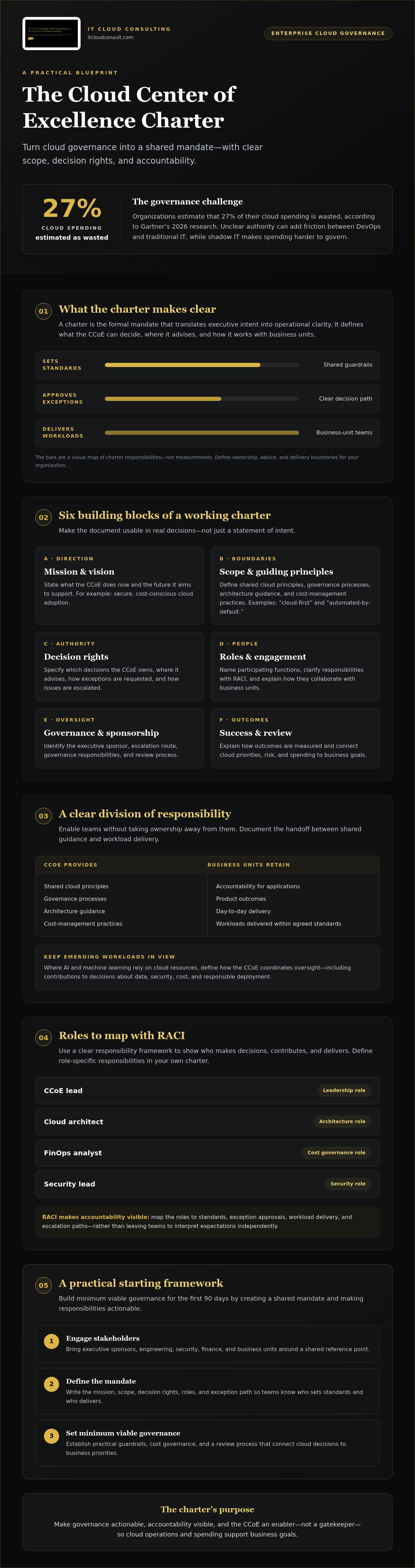
A charter should do more than describe a team. It should define the CCoE’s mission, decision-making authority, scope, roles, and responsibilities so teams know who sets standards, who approves exceptions, and who delivers workloads. A clear RACI and defined cost governance can help connect cloud operations and spending to business goals.
This guide provides a practical charter template for enterprise modernization in 2026. You’ll learn which sections can help secure executive buy-in, clarify accountability, and position the CCoE as an enabler rather than a gatekeeper. As an early step in a strategic cloud adoption roadmap, a well-defined charter can also make financial accountability part of how teams plan and use cloud resources.
Key Takeaways
- Use a cloud center of excellence charter to turn cloud governance into an actionable mandate, with a defined mission, scope, and decision rights.
- Identify the charter components that help leaders connect cloud priorities with business initiatives and modernization goals.
- Map responsibilities across CCoE roles, including the lead, architect, FinOps analyst, and security lead. Use RACI to clarify decision-making.
- Build a practical starting framework by engaging stakeholders and defining minimum viable governance for the first 90 days.
- Consider how professional cloud assessment and guidance can support a stronger CCoE foundation and broader transformation.
Defining the Purpose and Scope of a Cloud Center of Excellence Charter
A Cloud Center of Excellence (CCoE) needs more than a name and a group of cloud specialists. A cloud center of excellence charter is the formal mandate that authorizes the function to guide cloud decisions, establish shared practices, and support organizational change. It translates executive intent into operational clarity by defining what the CCoE can decide, where it advises, and how it works with business units.
A mission statement might express an aspiration, such as enabling secure, efficient cloud adoption. A charter makes that aspiration actionable. It sets out the CCoE’s authority, scope, governance responsibilities, stakeholders, and decision paths. As an instrument of Corporate Governance of IT, it connects cloud oversight to organizational priorities rather than leaving teams to interpret expectations independently. This makes the charter a practical first step in a strategic cloud adoption roadmap.
Why Governance Fails Without Formal Authorization
Cloud environments can span teams, platforms, data, and emerging AI workloads. Without documented authority, business units may make separate technology and purchasing decisions, creating shadow IT and fragmented spending. A charter gives stakeholders a shared reference point. Engineering can see the guardrails, security can understand its review role, and finance can establish how cloud usage and costs are considered.
Formal authorization also helps distinguish who sets standards from who delivers workloads. It gives executives a basis for sponsoring the CCoE, resolving cross-functional conflicts, and checking that its priorities still support business strategy. Specify the executive sponsor, escalation route, and review process so sponsorship remains active as organizational needs evolve.
The Scope of the Modern Cloud Center of Excellence
Define boundaries clearly so the CCoE can enable teams without taking ownership away from them. The charter can assign the CCoE responsibility for shared cloud principles, governance processes, architecture guidance, and cost-management practices. Business units can remain accountable for their applications, product outcomes, and day-to-day delivery within agreed standards.
This distinction helps move cloud from isolated projects toward an enterprise platform for repeatable modernization. It also makes cost governance part of planning, supporting cloud optimization by connecting resource decisions to business priorities.
Include AI and machine learning in scope where they rely on cloud resources. Identify how the CCoE will coordinate oversight of cloud-based AI use, including who contributes to decisions about data, security, cost, and responsible deployment. Clear boundaries let teams explore new capabilities while keeping accountability visible.
Core Components of a High-Impact CCoE Charter
A charter is useful when readers can apply its principles to real decisions. An enterprise document should define the CCoE’s mandate, scope, authority, stakeholders, governance processes, and review cadence. It should also explain how the function supports business priorities, manages risk, and measures outcomes. These sections turn the cloud center of excellence charter from a statement of intent into a working reference for executives and delivery teams.
Include a Mission and Vision section to set direction. The mission states what the CCoE does now, such as enabling secure, cost-conscious cloud adoption. The vision describes the future it aims to support, such as an enterprise that can adapt and scale cloud capabilities as business needs evolve. Examples such as the Cloud Center of Excellence in Higher Ed illustrate the value of shared policies and frameworks. The charter should tailor those priorities to the organization’s own operating context.
Make the document practical with sections such as:
- Guiding principles: State how teams should make decisions. “Cloud-first” can establish a preferred direction when appropriate, while “automated-by-default” can encourage repeatable processes.
- Decision rights and governance: Identify which decisions the CCoE owns, which it advises on, and how teams request or escalate exceptions.
- Roles and engagement: Name participating functions and explain how they collaborate with business units.
- Success metrics: Specify how progress will be assessed, using measures such as cloud spend aligned to business initiatives, adoption of shared standards, or delivery lead times. Set baselines and targets using organizational data rather than arbitrary benchmarks.
- Review and revision: Define who maintains the charter and how it will adapt as cloud strategy and business priorities change.
Strategic Alignment and Business Objectives
Connect cloud initiatives to corporate goals, not just infrastructure milestones. If leadership prioritizes return on investment, the charter can make cost visibility and business-unit accountability CCoE priorities. If agility matters, it can focus on reducing avoidable delays in approved cloud adoption. Cloud optimization consulting can help inform cost-governance goals, while the charter clarifies how the CCoE supports efficient decisions and time to market.
Governance, Security, and Compliance Standards
Set guardrails that help teams move safely without making the CCoE a gatekeeper for every decision. Use a cloud security assessment checklist to identify areas that require review, then document how the CCoE coordinates with the CISO office on security standards, risk escalation, and accountability. For help aligning charter goals with modernization priorities, consider strategic cloud adoption guidance.
Establishing Roles, Responsibilities, and RACI Frameworks
A charter creates operational clarity only when it assigns decisions to people and functions. Define each CCoE role by its authority, expected contributions, and relationship with delivery teams. A practical core group can include:
- CCoE Lead: Coordinates the charter, aligns priorities with business objectives, and escalates decisions that exceed the team’s authority.
- Cloud Architect: Establishes architecture guidance and helps teams apply shared design principles.
- FinOps Analyst: Improves cost visibility, supports financial accountability, and connects cloud usage to business value.
- Security Lead: Coordinates security guidance and works with security stakeholders to address cloud risks.
Use a RACI matrix to clarify who is Responsible for completing work, Accountable for the outcome, Consulted before a decision, and Informed afterward. For example, a business unit might be responsible for deploying a workload, while its product owner is accountable for the outcome. The CCoE architect and security lead could be consulted on shared standards, and finance could be informed about cost implications. Assign one accountable owner to each decision to avoid ambiguous responsibility.
The Executive Sponsor: The Anchor of the Charter
Executive sponsorship gives the charter organizational authority. Name a C-level sponsor, such as the CIO or CTO, who can resolve cross-functional disputes, remove roadblocks, and keep cloud priorities connected to enterprise goals. Specify the sponsor’s responsibilities, escalation path, and reporting cadence. Regular reviews give leaders a way to assess progress and adjust CCoE priorities as business needs change.
The FinOps Pillar: Managing Cloud Spend
Make cost governance an explicit CCoE responsibility, not an informal finance review. A Cloud Business Office can coordinate this work by bringing cloud teams, finance, and business owners together to review spending, clarify ownership, and connect resource use to outcomes. The charter should state what the office advises on and which financial decisions remain with business units.
Define unit economics in terms relevant to the organization: the cloud resources used to deliver a business measure, such as cost per transaction or per customer served. Tracking an appropriate measure alongside service performance can help teams evaluate whether cloud consumption supports business value. The charter can authorize the CCoE to recommend cost-reduction strategies while preserving business accountability for trade-offs.
Include HR, Legal, and Procurement as consulted or informed stakeholders where their expertise affects cloud decisions, workforce readiness, contractual terms, or purchasing processes. The Practical Guide to Cloud Governance can offer a reference as you define these decision paths. A clear RACI and stakeholder map make the charter usable across technical and business functions.
Drafting Your Charter: A Step-by-Step Implementation Framework
A cloud center of excellence charter becomes actionable through a deliberate drafting process. Treat the first version as a decision-making foundation, not an attempt to document every future scenario. Use these steps to build agreement, put initial governance into practice, and set a clear path for refinement.
- Step 1: Identify stakeholders and conduct discovery. Bring together executive sponsors, IT, engineering, security, finance, and representatives from affected business units. Document current cloud decision paths, recurring friction, business priorities, and areas where ownership is unclear.
- Step 2: Define minimum viable governance for the first 90 days. Select a small set of high-impact guardrails teams can apply immediately, such as who approves exceptions, how cloud costs are reviewed, and how teams raise security concerns. Keep the initial scope practical enough to test.
- Step 3: Draft with core leadership. Turn discovery findings into a working document covering the CCoE’s purpose, scope, authority, roles, decision processes, and initial measures of progress. Ask leaders to resolve competing expectations in the document rather than leave ambiguity for delivery teams.
- Step 4: Socialize the charter and secure executive sign-off. Share the draft with affected teams, explain how it clarifies decisions, and incorporate feedback. Obtain formal approval from the designated executive sponsor so the CCoE has a recognized mandate.
- Step 5: Establish a review cycle. Assign an owner to maintain the charter, set a six-month review cadence, and define how teams can propose changes between reviews. Use implementation experience to adjust priorities, responsibilities, and governance.
The Iterative Approach to Charter Maturity
The first charter shouldn’t try to solve every cloud challenge at once. Starting with a manageable scope helps teams learn from real decisions before expanding the mandate. At each six-month review, check whether roles and boundaries still fit. As the organization progresses from cloud adoption toward cloud-native operations, evolve the charter to address broader platform capabilities and business needs.
Common Pitfalls to Avoid During the Drafting Phase
Analysis paralysis can stall progress if leaders debate edge cases before agreeing on basic guardrails. Prioritize decisions that affect security, accountability, and cost governance, then refine the rest as experience grows. Avoid shelfware by assigning an owner, review date, and process for communicating updates. Involve both traditional IT and cloud-native teams in drafting, and explain how shared governance supports delivery rather than adding unnecessary friction.
Use the charter as the first step in a broader strategic cloud adoption roadmap, with cost governance supporting ongoing cloud optimization. For guidance on shaping that roadmap, discuss your cloud adoption strategy.
Maturing Your Governance with Professional Cloud Consulting
A charter sets direction, but its value depends on how well it reflects the organization’s cloud environment and turns priorities into workable decisions. Professional cloud guidance can help leaders assess current capabilities, identify gaps in ownership or cost governance, and shape a CCoE foundation that fits modernization goals. This can be useful during cloud transformation, when teams need to align governance with a broader roadmap.
External expertise can also help address skills gaps while the CCoE takes shape. An adviser can facilitate planning and offer an independent perspective, while internal teams retain ownership of business decisions and day-to-day responsibilities. The result should be a charter grounded in the organization’s needs, not a framework tied to a single provider or cloud platform.
Strategic Guidance for Complex Modernization
Hybrid and multi-cloud environments call for governance that accounts for different platforms, teams, and operating practices. A professional assessment can help identify where policies should be consistent across environments and where the charter should allow platform-specific decisions. That clarity supports a shift from reactive approvals to proactive guidance, so teams understand expectations before designing and deploying workloads.
Connect the CCoE’s mandate to a wider cloud infrastructure consulting strategy by linking governance priorities to architecture, operational efficiency, and business outcomes. This makes the cloud center of excellence charter more than a governance document. It becomes a practical reference for sequencing modernization and assigning accountability.
Ensuring Long-Term ROI Through Governance
As the CCoE matures, a periodic third-party assessment can provide an outside view of whether its responsibilities, decision paths, and measures still support organizational priorities. Use the findings to identify improvements, not simply to score performance. If cost ownership remains unclear, for example, refine the charter’s financial accountability model. If teams receive inconsistent guidance, clarify shared standards and escalation routes.
Continuous optimization is an ongoing outcome, not a one-time charter milestone. Review cloud usage, governance effectiveness, and alignment with business goals, then update the roadmap as needs evolve. Organizations planning the next stage of operations can also consult this managed cloud services guide to understand considerations for ongoing support. IT Cloud Consulting provides strategic guidance in cloud adoption and optimization, along with ongoing cloud support, to help organizations connect governance decisions with modernization objectives.
Turn Your Charter Into a Roadmap for Progress
A well-designed cloud center of excellence charter gives cloud governance a clear mandate and connects decisions to business priorities. Its value depends on more than defining the CCoE’s scope. Clear roles, executive sponsorship, and measurable goals help teams turn the mandate into coordinated action.
Start with practical governance priorities, clarify accountability across technology and business stakeholders, and revisit the charter as organizational needs evolve. Centralized cost governance can also support cloud optimization by making spending more visible and aligning resource use with business outcomes.
IT Cloud Consulting offers professional advisory for strategic cloud adoption, cloud optimization, and ongoing cloud support. Explore strategic cloud adoption guidance to start shaping your CCoE charter and roadmap.
Frequently Asked Questions
What is the primary goal of a Cloud Center of Excellence charter?
The primary goal is to give the CCoE a clear mandate to guide cloud adoption and governance across the organization. A cloud center of excellence charter defines the team’s mission, decision authority, scope, and relationships with business units. It helps leaders align cloud decisions with business priorities and clarify ownership across areas such as security, architecture, and financial accountability.
How long should a CCoE charter be for a mid-sized enterprise?
There’s no standard page count. The charter should be long enough to clarify its mandate, decision rights, roles, governance processes, and measures of success, but concise enough for leaders and teams to use. Keep detailed technical procedures in separate, maintainable documents and link to them where appropriate. Prioritize clarity over length, and add detail when it resolves real ambiguity.
Who should sign the CCoE charter to make it official?
The executive sponsor should approve and sign the charter, often a CIO or CTO with authority to support cross-functional cloud decisions. The CCoE lead and relevant functional leaders can also acknowledge their responsibilities, particularly across technology, security, and finance. The organization should define its approval path. The charter becomes operationally meaningful when appropriate leadership formally endorses it and communicates its authority.
How often should the CCoE charter be updated?
Set a scheduled review every six months, along with a process for updates when business priorities, cloud strategy, or CCoE responsibilities change materially. A review doesn’t require rewriting the document if its mandate remains relevant. Confirm that roles, decision paths, and success measures still fit the organization. Assign an owner to record approved changes and communicate the current version to stakeholders.
Can a CCoE exist without a formal charter?
Yes, a CCoE can operate informally, but without a charter its authority and responsibilities may be unclear. Teams might not know who makes decisions, how to raise exceptions, or who owns cloud cost governance. A concise charter helps establish executive sponsorship, clarify collaboration between the CCoE and business units, and give cloud guidance a consistent organizational basis.
What is the difference between a CCoE and a Cloud Business Office (CBO)?
A CCoE typically coordinates broader cloud strategy, governance, architecture guidance, security collaboration, and enablement. A Cloud Business Office generally focuses on the financial aspects of cloud use, such as cost visibility, spending reviews, and coordination between finance and technology teams. Responsibilities vary by organization, so define whether the CBO sits within the CCoE or works alongside it, and document how the groups share decisions.
How does a charter help with cloud cost management?
A charter makes cost governance an assigned responsibility rather than an informal task. It can define who monitors cloud spending, how financial information reaches business owners, and which group coordinates optimization decisions. Clarifying accountability between the CCoE, finance, and delivery teams helps connect cloud consumption to business priorities. This provides a foundation for more consistent cloud optimization without prescribing one financial process for every team.
Should the CCoE charter include specific technical tool choices?
Usually, the charter should establish principles and decision processes for choosing tools rather than lock the organization into a detailed tool list. Products and technical requirements can change, so document selection criteria, ownership, and approval responsibilities at the governance level. Keep current tool inventories and implementation procedures in supporting documents. If a particular tool is essential to a defined standard, reference it with an owner and review process.


